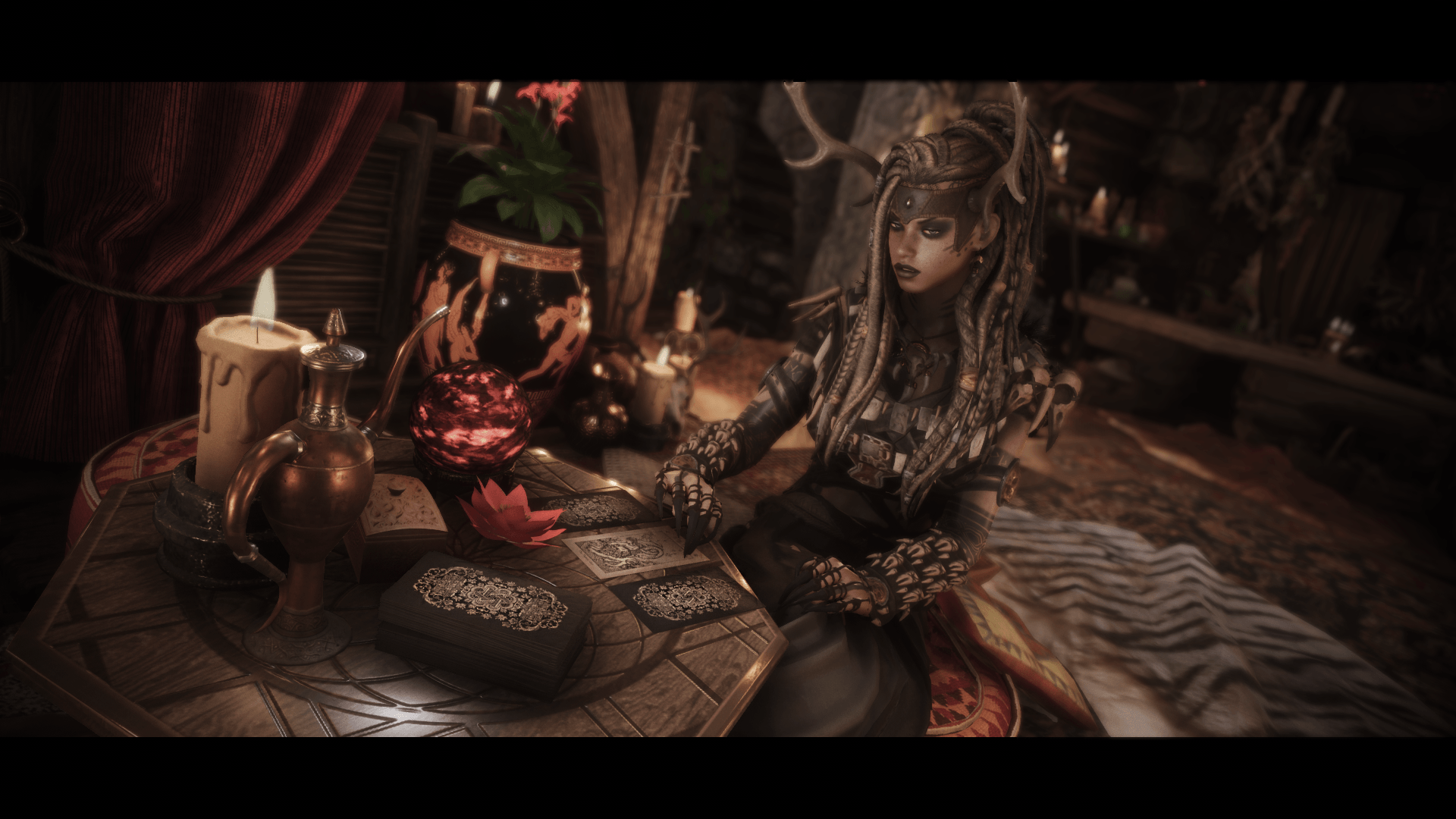
Chapter I — The Shape of Possibility
GRIMOIRE II
Divination
Possibility • Pattern • Uncertainty
CHAPTER I
The Shape of Possibility
The Future Is Not a Road Already Laid

Among those unfamiliar with the discipline, Divination is often described as the art of seeing the future. The description is convenient, memorable and incomplete.
The future is not a distant country waiting to be observed from afar. It possesses no fixed landscape through which every life must inevitably travel. What lies ahead is shaped continuously by choice, circumstance, knowledge, interference and forces too numerous for any single witness to account for fully.
Divination does not remove this uncertainty. It studies it.
A vision may reveal what is likely, what is feared, what is desired or what another intelligence wishes the observer to believe. An omen may warn of a danger already taking shape without proving that the danger cannot be avoided. A dream may preserve the echo of something that has not yet occurred—or arrange memories of the past into a form the dreamer mistakes for prophecy.
The Diviner therefore seeks more than images of what may come. They examine the conditions from which possibility emerges.
✦ What Divination Observes
Divination begins with the belief that events do not always arrive without trace. Possibility may cast shadows before certainty takes form. Patterns may appear in dreams, celestial movements, repeated symbols, disturbed animals, altered flames or coincidences too precise to dismiss without examination.
Such signs do not speak in a universal language. The same symbol may carry different meanings across cultures, traditions and individual witnesses. A black bird may signify death in one account, safe passage in another and nothing beyond its own hunger in a third.
The Diviner does not begin by asking what a sign traditionally means. They begin by asking what occurred, under which conditions and whether the pattern has appeared before.
Interpretation follows observation. Certainty follows neither.
A sign is not an answer.
It is an invitation to look again.
📜 From the Notes of an Unknown Stargazer
“The heavens do not speak. We name their movements language because silence offers us nothing to translate.”
◇ The Future as Possibility
Many surviving traditions describe the future as a branching structure. Each decision closes certain possibilities while strengthening others. Some branches remain broad and likely. Others depend upon a sequence of unlikely events and may disappear before any witness reaches them.
This image should not be mistaken for literal truth. Possibility possesses no visible branches, nor has any Diviner successfully counted every outcome arising from a single choice. The comparison survives because it expresses something repeated throughout the archives: what may happen is not always what must happen.
Certain events appear more resistant to change than others. A war prepared across many years may be difficult to prevent through one warning. A death caused by countless converging circumstances may appear repeatedly in visions despite every attempt to avoid it. Even then, resistance should not be mistaken for inevitability.
The closer an event approaches, the fewer conditions remain capable of altering it. Possibility narrows as consequence gathers momentum.
The distant future spreads widely.
The approaching moment draws its paths together.

◐ Certainty and Likelihood
Divinatory records frequently describe outcomes as certain when the surviving evidence supports only likelihood. This is particularly common in accounts written after the event, when earlier signs appear obvious because the conclusion is already known.
A responsible Diviner distinguishes between what was witnessed and how strongly that observation supports a particular outcome. A recurring dream may justify concern. It does not prove that every detail will occur. An omen shared by several observers may deserve investigation. It does not become certainty merely because fear makes hesitation uncomfortable.
Predictions should therefore preserve their conditions whenever possible. A vision seen after blood loss cannot safely be compared with one received during ordinary sleep without noting the distinction. A celestial alignment observed during corruption may not reveal the same patterns to an unaltered witness.
The statement this will happen conceals more than it explains.
Speak instead of what appears likely,
what remains uncertain
and what may still be changed.
📖 Historical Reflection
The King Who Escaped His Death
A fragmented account from lands beyond the Exiled Lands describes a ruler who was warned that he would die beneath a red moon while surrounded by those who loved him.
Fearing betrayal, he dismissed his household, imprisoned his family and ordered every red banner removed from his city. When the appointed night arrived, he remained alone within a sealed chamber guarded by soldiers forbidden to speak.
The moon rose pale.
Believing the prophecy defeated, the ruler emerged and summoned his family to witness his triumph. During the celebration, fire spread through the upper palace. Smoke turned the moon crimson above the courtyard.
The king did not die.
His youngest son did.
Later copies disagree on whether the original vision named the ruler at all. Some scholars believe fear altered his recollection. Others argue that his actions redirected the event toward another member of his bloodline.
The account survives not as proof that prophecy cannot be escaped, but as warning that knowledge of possibility may itself become one of the forces shaping it.
⟡ The Observer Within the Vision
No Diviner stands entirely outside the future they observe. To witness an outcome is to gain knowledge capable of influencing every decision that follows. Even silence becomes a choice shaped by what was seen.
This creates one of the discipline’s oldest difficulties. A warning may prevent disaster. It may also cause the panic through which disaster becomes unavoidable. A favourable prophecy may encourage confidence, recklessness or rivalry. A vision concealed to protect others may leave them unprepared for what approaches.
The Diviner must therefore consider not only whether a vision is true, but what will occur because it has been revealed.
Some records describe prophecies that appeared to defend themselves by provoking the very actions required for their fulfilment. Others suggest that certain visions represent outcomes dependent upon the observer receiving them.
Whether the future was witnessed or created may remain impossible to determine afterwards.
The moment a possibility becomes known,
it is no longer untouched by the witness.
📜 Warning Preserved Beside a Sealed Prophecy
“Do not ask only whether the vision should be believed. Ask what belief will make of those who hear it.”
☽ Sources of Divinatory Knowledge
Divination draws upon many sources, none of which should be assumed trustworthy merely because it produces information the observer could not otherwise possess.
Celestial Patterns
Stars, moons and wandering lights have been observed across generations because their movements permit comparison over long periods. Their regularity makes deviation noticeable, though scholars disagree on whether celestial bodies influence events, reflect them or merely provide a structure upon which interpretation is imposed.
Dreams and Visions
Dreams may contain symbolic warnings, memories, outside influence or the ordinary workings of a burdened mind. Vividness alone does not establish prophetic value. Repetition, shared imagery and knowledge unavailable to the dreamer may justify closer examination.
Omens
Omens arise through events interpreted as signs: unusual births, animal behaviour, altered weather, broken objects, disturbed flames or coincidences occurring at meaningful moments. Their significance depends heavily upon context and cultural understanding.
Spirits and Other Intelligences
Information may be received from the dead, spirits, demons, gods or beings whose nature remains uncertain. Such knowledge may be accurate and still be given for deceptive purposes. Truth offered by an interested intelligence should never be confused with impartial guidance.
Ritual Instruments
Bones, stones, cards, reflective surfaces, smoke, blood and marked vessels may be used to structure uncertainty into visible patterns. The instrument does not necessarily create the answer. It may direct attention, establish conditions or provide a language through which the practitioner interprets what appears.
A source may reveal truth.
It does not reveal why that truth was offered.
This space awaits an illustration.
Submit a screenshot or artwork from your character’s magical journey, and it may be preserved in a future edition of the Circle’s archives.
◉ Error, Desire and Deception
The greatest threat to Divination is not always a false vision. It is often a true fragment interpreted according to the observer’s desire.
Fear directs attention toward danger. Hope elevates favourable signs above contradictory evidence. Grief transforms ordinary dreams into messages from the dead. Ambition encourages the practitioner to interpret uncertainty as proof of special purpose.
Outside intelligences may exploit these tendencies, but deception does not require an external deceiver. The mind is capable of misleading itself with remarkable patience.
Divinatory records should therefore preserve failed interpretations beside successful ones. A prophecy remembered only after fulfilment offers weaker evidence than one written, sealed and dated before the event. A symbol interpreted differently by several witnesses deserves comparison rather than forced agreement.
The honest Diviner does not conceal uncertainty to appear gifted.
A vision becomes no clearer because its interpreter speaks with confidence.
✧ Pattern and Coincidence
The world contains more repetition than any observer can record. Faces resemble one another. Words recur. Animals cross paths at meaningful moments. Dreams borrow symbols from waking life. Most coincidences carry no message beyond the fact that many events occur.
Yet to dismiss every pattern as meaningless is as careless as declaring every repetition prophetic.
Divination requires sustained observation. Does the pattern recur under similar conditions? Does it appear to several witnesses? Does it provide knowledge unavailable through ordinary means? Does its interpretation predict anything before the outcome is known?
A single unusual event may inspire inquiry. Repetition permits comparison. Prediction allows interpretation to be tested.
Even then, certainty may remain beyond reach.
Coincidence asks to be noticed.
Pattern survives being examined.
✦ To Look Without Demanding Certainty
Divination offers no escape from uncertainty. Its discipline lies in approaching uncertainty without forcing it into the shape of certainty too soon.
The Diviner observes what may be, records what was witnessed and accepts that the meaning of a sign may change as circumstances unfold. They understand that knowledge of the future creates consequence in the present and that silence, warning and intervention each carry their own risks.
To study possibility is to remain aware that every interpretation may be incomplete.
This humility is not weakness. It is the foundation upon which every reliable act of Divination must rest.
Do not ask the future to become certain.
Learn instead to recognize the shapes it may take.
✦
Chapter II — Reading the World
CHAPTER II
Reading the World
Possibility Leaves Traces in Many Forms

Divination has no single source. The world may reveal unusual patterns through the movements of animals, the repetition of dreams, the arrangement of stars or visions that intrude upon ordinary perception without warning.
These phenomena differ greatly in form, yet each presents the same difficulty. The observer must distinguish what occurred from what they believe it means.
A strange event is not automatically an omen. A vivid dream is not automatically prophetic. A celestial arrangement does not declare its own significance, and the clarity of a vision offers no guarantee that its interpretation is true.
Diviners therefore study not only signs, but the conditions through which signs acquire meaning.
✦ Signs and Omens
A sign is an occurrence believed to point beyond itself. Its form may be ordinary: a bird falling silent, a flame bending without wind, an animal entering a place it normally avoids or the same symbol appearing across several unrelated encounters.
Meaning most often arises through repetition, timing and context. A raven crossing a road means little by itself. The same raven appearing at every place named within a recurring dream deserves closer observation.
Yet surprise alone establishes nothing. Rare events occur constantly. If every unusual moment is treated as revelation, Divination becomes indistinguishable from superstition.
The Diviner records what appeared, where it appeared and what circumstances surrounded it. Only later may comparison reveal whether the event belonged to a greater pattern.
An omen begins as an observation.
Time determines whether it becomes more.
◇ The Natural World as Witness
Animals, weather and landscape often respond to changes too subtle for human senses. Birds fall silent before predators approach. Herds avoid unstable ground. Insects gather before rain. Such behaviour may appear prophetic while arising through ordinary perception.
This does not make the observation useless. A sign need not be supernatural to reveal what is approaching.
The difficulty lies in determining whether the observed response arises from ordinary danger, corruption, sorcerous disturbance or an unseen presence. The natural world should therefore be treated first as witness, not immediately as messenger.
The animal may perceive danger.
It does not necessarily know its name.
☽ Dreams
Dreams borrow freely from memory, fear, desire and imagination. They combine familiar faces with impossible places and forgotten events with experiences that never occurred.
Most reveal the dreamer more readily than they reveal anything beyond them. Nevertheless, the archives preserve dreams containing knowledge their witnesses could not reasonably have possessed, dreams shared by unrelated sleepers and recurring images later supported by independent evidence.
Repetition deserves particular attention. A dream returning unchanged across months may indicate memory, outside influence or a possibility that continues to gather strength. Small alterations between repetitions may prove more important than the elements that remain.
Dreams should be recorded immediately upon waking. Memory reshapes them quickly, strengthening details that fit later events and erasing those that do not.
Record the dream before waking thought teaches it what it meant.
This space awaits an illustration.
Submit a screenshot or artwork from your character’s magical journey, and it may be preserved in a future edition of the Circle’s archives.
◐ Visions
Unlike dreams, visions intrude upon waking life. They may occur during ritual, exhaustion, corruption, contact with relics or circumstances no surviving method has reliably reproduced.
A vision is not merely a vivid image. It may overwhelm ordinary perception completely, placing impossible landscapes, forgotten faces, unfamiliar voices and symbolic events beside one another without explanation.
Clarity should never be mistaken for truth. A false vision may be detailed, coherent and emotionally convincing. An accurate one may arrive as fragments whose connection remains hidden for years.
The witness must preserve what appeared before interpretation fills the missing spaces.
A vision forces its way into perception.
Meaning does not always enter with it.
✧ The Heavens
Celestial observation differs from dreams and omens because its evidence endures. Stars may be charted. Their movements can be compared across generations. Eclipses and wandering lights return according to patterns long enough to outlive the scholars who first recorded them.
Their regularity offers measurement, not automatic meaning. Two observers may agree upon the exact position of every visible star while disagreeing entirely about what the arrangement signifies.
Constellations reveal this difficulty clearly. One culture sees a hunter where another sees a serpent. The stars remain unchanged while inherited stories draw different figures between them.
The heavens provide patterns. The observer supplies language, comparison and interpretation.
The stars may be measured.
Their purpose remains beyond measurement.
⟡ Shared Observation
When several witnesses encounter the same phenomenon, their accounts should be recorded separately before discussion begins. Agreement formed through conversation may imitate shared perception.
One witness names a distant shape a tower. Another adopts the description while still uncertain. By the time the event is recorded, each remembers a tower more clearly than either saw one.
Differences should not be erased. One person may hear speech where another hears only wind. One may see three figures while another remembers four. Such contradictions may reveal how the phenomenon affected each observer.
A shared experience should produce several records before it produces one story.
📖 Historical Reflection
The Sign Seen in Three Forms
An old register describes three practitioners who separately encountered the image of a broken gate. One saw it in a dream. Another watched smoke divide into its shape above a brazier. The third found the same form traced repeatedly by birds above a ruined road.
Each interpreted the sign differently. One expected invasion. One believed a sealed place would open. One argued that no shared meaning had yet been established.
Weeks later, an earthquake exposed a passage beneath the road. What emerged from it was never recorded.
The three observations agreed upon the image.
None contained the whole event.
✦ Many Sources, One Discipline
Omens, dreams, visions and celestial patterns are not separate Schools. They are different ways through which uncertainty becomes observable.
Each carries distinct strengths and weaknesses. Dreams preserve intimacy but fade quickly. Omens arise within the world but depend heavily upon context. Visions may reveal what ordinary perception cannot reach while resisting control and verification. The stars permit generations of comparison but remain silent regarding their own meaning.
The Diviner does not demand that every source speak in the same manner. They preserve what each can reveal and remain attentive to what each may conceal.
The world speaks in many forms.
Divination begins by learning not to confuse them.
✦
Chapter III — The Diviner’s Instruments
CHAPTER III
The Diviner’s Instruments
Objects Through Which Uncertainty Is Given Form

Throughout history, Diviners have cast bones, studied smoke, watched ripples upon still water, arranged stones, observed flames and interpreted countless other mediums through which uncertain knowledge might be approached.
To those unfamiliar with the discipline, these objects often appear to possess supernatural power of their own.
The archives offer little support for so simple an explanation.
A ritual instrument is rarely important because of what it is. It becomes valuable because of what it allows the practitioner to observe.
✦ Why Ritual Instruments Exist
The unknown rarely presents itself in clear language. Human perception seeks patterns even where none exist, while overlooking subtler relationships hidden beneath expectation. Ritual instruments provide structure. They slow observation and encourage the Diviner to examine what appears rather than immediately forcing it into familiar conclusions.
Whether the pattern emerges through smoke, polished stone or carved bone matters less than the discipline with which the observation is recorded.
The instrument does not necessarily create the answer.
It creates conditions under which an answer may be sought.
The instrument guides attention.
It should never replace judgment.
📜 From the Southern Archive
“Those who worship the bones rarely notice what the bones are attempting to show them.”
☠ Bones
Bones appear throughout the oldest divinatory traditions because they preserve shape long after flesh has disappeared. Their permanence made them natural tools for recording patterns and casting lots.
Some traditions value particular species. Others prefer bones gathered from ritual sites or inherited through generations. A few insist the material itself is irrelevant provided the pieces remain consistent throughout observation.
The archives preserve convincing readings performed with ordinary stones and meaningless results obtained from revered relics.
Consistency often proves more valuable than rarity.
🌊 Water
Still water has long been regarded as a surface capable of reflecting more than appearance. Some practitioners seek visions within its depths, while others watch disturbances upon the surface for symbolic patterns.
Water possesses advantages rarely acknowledged by those fascinated only by its mystery. It responds immediately to movement, sound, vibration and wind. Distinguishing ordinary disturbance from meaningful change therefore becomes part of the Diviner’s discipline.
The quietest bowl may reveal only the breathing of the observer leaning above it.
This space awaits an illustration.
Submit a screenshot or artwork from your character’s magical journey, and it may be preserved in a future edition of the Circle’s archives.
🌫 Smoke
Smoke is among the least stable of divinatory mediums. It shifts with invisible currents, making certainty impossible and encouraging interpretation to remain flexible.
Some schools study the direction of movement. Others observe how smoke gathers, separates or lingers around particular objects. Certain archives record colours, scents and unusual persistence following ritual activity.
Because smoke changes constantly, it reminds the Diviner that meaning may vanish as quickly as it appears.
🔥 Flame
Flames have been observed for thousands of years. Height, colour, movement and unexpected behaviour have all been interpreted as signs under carefully controlled conditions.
Yet no medium deceives the impatient observer more easily. Air currents, fuel quality, moisture and impurities alter fire continuously.
The Diviner records these conditions before concluding that the flame speaks of anything beyond them.
🪞 Reflective Surfaces
Mirrors, polished metal, obsidian and still pools occupy a curious place within Divination. Reflection invites comparison between what is present and what appears to be present. Many traditions therefore treat reflective surfaces as thresholds between certainty and perception.
Whether the reflection reveals hidden truth or merely encourages careful observation remains debated throughout the archives.
The disagreement itself has endured longer than many kingdoms.
Reflection may alter nothing.
It may alter the observer completely.
📖 Historical Reflection
The Diviner Without Instruments
One account preserved within the western archive describes a Diviner who abandoned every ritual implement after years of study. Visitors assumed this represented mastery.
When questioned, the old scholar reportedly laughed.
“The instruments taught me patience,” they replied.
“Now I carry the patience with me.”
No surviving record states whether later practitioners reached the same conclusion.
◉ Mistaking the Instrument for the Practice
Many beginning practitioners devote greater attention to acquiring impressive tools than to developing disciplined observation.
Beautiful instruments become treasured possessions. Rare materials become symbols of authority. Elaborate rituals replace careful questioning.
The Circle preserves countless examples demonstrating that none of these guarantee reliable interpretation.
An ordinary bowl used honestly has often proved more valuable than a sacred relic approached with arrogance.
The instrument cannot compensate for the absence of discipline.
📜 Archive Warning
“Treat every instrument as though it might be ordinary. Treat every observation as though it might not be.”
✦ Instruments and Understanding
Ritual instruments remain valuable because they preserve methods refined through generations of observation.
They remind the practitioner to slow down, to compare, to question and to record.
They should never become objects of worship.
Divination belongs not to the bowl, the bone or the mirror.
It belongs to the patient mind willing to observe without demanding certainty.
The instrument opens the question.
The Diviner must still seek the answer.
✦
CHAPTER IV — The Limits of Divination
CHAPTER IV
The Limits of Divination
Not Every Question Possesses an Answer
This space awaits an illustration.
Submit a screenshot or artwork from your character’s magical journey, and it may be preserved in a future edition of the Circle’s archives.
Divination is often described by those outside its study as the art of obtaining hidden answers.
This description is incomplete.
Divination may reveal traces, fragments and relationships that ordinary observation cannot easily perceive. It may expose a concealed influence, preserve an image of a distant place or suggest one path among several possible futures.
Yet it does not follow that every question may be answered, nor that every answer can be understood by the person who receives it.
Some things remain hidden because the method is unsuitable. Others resist observation, change before they can be examined or possess no single form for Divination to reveal.
The limits of the discipline are therefore not merely failures of skill. They belong partly to the nature of the unknown itself.
◇ Distance and Separation
Distance does not always prevent Divination, but it weakens the connections upon which many methods depend.
A practitioner searching for a distant person may require an object associated with them, knowledge of their appearance, a place they inhabited or some other trace through which the inquiry may be directed.
Without such a connection, impressions may become broad and unstable. A face may appear without a name. A landscape may be visible without any means of locating it. Several similar individuals may become indistinguishable from one another.
Physical distance is not the only separation that matters. Time, forgotten identity, deliberate concealment and the destruction of personal traces may place a subject farther beyond reach than any ocean.
The farther the inquiry moves from what is known, the less securely its fragments may be identified.

✦ Questions Without One Answer
Some inquiries fail because they assume a single answer where none exists.
The question of what will happen may depend upon choices not yet made, accidents not yet occurred and influences not yet present. Divination may reveal several possible outcomes without identifying which one will become real.
Questions concerning motive are similarly unstable. A person may act from fear, ambition, affection and resentment at the same time. A vision that reveals one motive does not prove the absence of the others.
Even simple questions may conceal uncertainty. The location of a traveller changes as they move. The loyalty of an ally may alter when circumstances change. A danger avoided because it was foreseen may never occur in the form originally observed.
Divination cannot produce one answer where the world itself contains many.
◐ The Hidden Present
The present is often assumed to be easier to observe than the future.
This is not always so.
A distant chamber may be concealed by stone, ritual wards or the intentions of those within it. A person may disguise their identity, suppress an emotion or carry memories fragmented beyond recognition.
Divination may reveal that concealment exists without revealing what lies beneath it. A closed door can be perceived as closed while remaining impossible to see through.
In some records, the absence itself becomes the only reliable observation: a reflection that should contain a figure but does not, a name that vanishes from every reading or a location surrounded by impressions that cease at its boundary.
To discover that something is hidden is not the same as discovering what has been hidden.
⟡ Sorcerous Interference
Divination does not operate apart from other forms of sorcery.
Wards may obscure a subject. Illusions may introduce false images. Mesmeric influence may alter the witness who receives them. Spirits may answer questions with fragments chosen for purposes of their own.
Interference does not always produce an obvious falsehood. More often it introduces small distortions: the wrong face attached to a true event, a correct location shown at the wrong time or an authentic warning directed toward the wrong person.
Several competing influences may also overlap within a single reading. The resulting vision may contain true fragments whose arrangement is entirely misleading.
A revelation may be genuine while the hand arranging it is not impartial.
◈ Resistance and the Unwilling Subject
Living subjects are not passive objects of observation.
Awareness, discipline, sorcerous protection and deliberate resistance may all disturb an inquiry. Some individuals seem naturally difficult to perceive, while others learn to conceal themselves through ritual, false identities or the destruction of personal connections.
Resistance may produce silence, but it may also produce struggle within the reading. Images fracture. Symbols repeat without progression. The practitioner may encounter impressions belonging more strongly to the subject’s defences than to the information being sought.
The archives also preserve cases in which the subject became aware of the observation and looked back through the same connection.
Not every gaze travels in only one direction.
☽ The Limits of the Observer
No act of Divination is separated entirely from the person who performs or receives it.
Familiar symbols are recognised more readily than unfamiliar ones. Fear directs attention toward danger. Desire strengthens interpretations that promise favourable outcomes. Previous knowledge fills gaps before the observer notices that anything was missing.
A vision of a crowned figure may be interpreted as a king by one culture, a priest by another and a dead ancestor by a third. The image may remain the same while its meaning changes with the witness.
Experience reduces some errors but introduces others. A practitioner who has encountered the same symbol many times may recognise its pattern—or may become unable to imagine that it means anything else.
Every revelation passes through a mind already shaped by memory.
✧ Memory and Reconstruction
Divinatory experiences are often brief, overwhelming or difficult to describe.
Once the experience ends, memory begins to reconstruct it. Missing details are supplied. Sequences are rearranged. Later knowledge alters what the witness believes they originally saw.
A dream recorded after several days may resemble the later event more closely than the dream that was actually experienced. This resemblance does not necessarily prove prophecy. It may reveal only that memory has been rewritten by recognition.
For this reason, the earliest record usually carries greater evidentiary value than the most polished account.
Memory preserves meaning by changing detail.
Divination often depends upon the detail it changes.
📖 From the Archive
The Three Accounts of the Flooded Tower
Three Diviners were asked separately to observe a tower whose lower chambers had disappeared beneath a sudden flood.
The first described a chained door below the water. The second recorded a pale figure standing behind a narrow window. The third saw only darkness interrupted by seven points of blue light.
When the waters receded, investigators found a chained door, seven blue stones embedded around its frame and no window anywhere within the surviving structure.
Behind the door lay the remains of a person dressed in pale ceremonial cloth.
Each observation preserved part of what was present. None reproduced the chamber as it was later found.
The accounts were not identical.
Neither were they entirely wrong.
◇ Silence
Sometimes Divination reveals nothing.
The surface remains unchanged. The dream does not return. The stars produce no unusual relationship, and the observed signs lead nowhere.
Silence may indicate that the method failed, that no useful connection exists or that the question has no form the chosen practice can approach.
It may also indicate concealment.
The practitioner cannot safely choose among these explanations without further evidence. To describe silence as confirmation of whatever they already believed is to transform the absence of information into permission for invention.
Nothing seen is not the same as nothing present.
✦ Failure
Failed readings are part of the study of Divination.
A prophecy contradicted by later events may reveal that the future changed, that the original interpretation was mistaken or that the vision never concerned the event to which it was attached.
A false conclusion may arise from a true observation. A successful prediction may arise from coincidence, manipulation or behaviour changed by knowledge of the prediction itself.
Outcome alone cannot determine whether the method was sound.
The archives therefore preserve unsuccessful inquiries beside celebrated revelations. Without them, later scholars would inherit only victories and mistake selective memory for reliability.
A failed answer may preserve more knowledge than a fortunate guess.
✧ The Unknowable
Some questions may lie beyond every surviving form of Divination.
The first cause of the world, the final shape of time, the complete intention of a god or the true nature of forces existing outside mortal perception may produce symbols without ever producing comprehension.
Such inquiries frequently return images shaped by the observer’s own beliefs. Different cultures receive different faces, names and explanations while approaching what may be the same hidden thing.
This does not prove that the subject is imaginary. It establishes only that the mind may lack the structure required to perceive it without translation.
A truth may exist beyond the form in which a mortal mind can receive it.
✦ The Boundary of Sight
The limits of Divination do not render the discipline useless.
A map remains valuable because it describes part of the land, not because it contains the whole world. A distant light may guide a traveller without revealing what waits beyond the horizon.
Divination offers fragments through which hidden circumstances may be approached. Its value depends upon recognising the boundary between what appeared, what was inferred and what remains unknown.
Beyond that boundary, the practitioner may continue to search.
Sight reaches farther than certainty.
It does not reach without end.
✦
CHAPTER V — False Prophets and Deception
CHAPTER V
False Prophets and Deception
Truth May Be Used to Mislead as Easily as Falsehood

Divination grants no protection against deception. A vision may be false, incomplete, altered by expectation or offered by an intelligence whose purpose remains concealed. Even an accurate revelation may direct the witness toward a mistaken conclusion when the conditions surrounding it are misunderstood.
This uncertainty has produced countless false prophets, fraudulent oracles and sincere practitioners whose confidence exceeded their understanding. Some knowingly manufacture signs. Others mistake coincidence for proof, conviction for insight or reputation for evidence.
The distinction is not always visible from the outside.
The false prophet and the mistaken Diviner may speak with equal certainty. The deceiving spirit and the helpful one may reveal the same truth for entirely different reasons. The task is therefore not merely to determine whether a message is accurate, but to examine how it was obtained, what it omits and what purpose may be served by belief.
✦ The Appearance of Authority
Divinatory authority is easily constructed. Elaborate garments, inherited titles, rare instruments, guarded silence and theatrical surroundings may persuade an audience before any evidence has been offered.
Such things do not prove fraud. Ritual form may preserve concentration and tradition. The danger begins when appearance replaces examination and the practitioner becomes protected from question by the reputation surrounding them.
Failed predictions are then explained away. Doubt is treated as blindness. Every contradiction becomes proof that the revelation was too subtle for ordinary understanding.
A claim does not become stronger because its speaker is feared, admired or difficult to approach.
Grandeur may command attention.
It cannot make a vision true.
📜 Marginal Warning from an Oracle’s Catalogue
“The robe was embroidered with stars. The prediction remained wrong.”
◇ The Safety of Vague Prophecy
A prophecy broad enough can survive almost any outcome. Blood will be spilled. Trust will be broken. A journey will bring hardship. Such statements appear accurate because they describe events common wherever people live, struggle and desire.
Ambiguity is not itself evidence of deception. Visions are often symbolic, fragmented and uncertain. The distinction lies in how ambiguity is treated after the event.
An honest record preserves several possible interpretations before fulfilment. A false prophet selects whichever meaning later appears correct and claims it was always intended.
The more flexible a prophecy becomes after its outcome is known, the less value it possesses as evidence.
A prediction that cannot fail can prove nothing.
This space awaits an illustration.
Submit a screenshot or artwork from your character’s magical journey, and it may be preserved in a future edition of the Circle’s archives.
◐ True Fragments and False Conclusions
Falsehood is only one means of misleading. A true fragment stripped of context may direct the witness more effectively than an invented vision.
A person is seen holding a bloodied weapon. The vision does not reveal whether they caused the injury, attempted to prevent it or arrived after the violence had ended. A trusted companion is shown concealing something. Nothing establishes whether the secret is betrayal, fear or an effort to protect the observer.
The mind completes what the vision leaves unfinished. Suspicion supplies motive. Fear supplies guilt. Desire supplies certainty.
The revealed fragment remains true while the conclusion built around it becomes false.
Accuracy of detail does not guarantee accuracy of meaning.
⟁ Interested Intelligences
Spirits, demons, the dead and unfamiliar intelligences should never be assumed impartial. Even those who speak truth may possess desires, loyalties and grievances unknown to the practitioner.
Some seek release. Others desire revenge, worship, influence or simple access to those who have begun listening. A being may warn of danger because it wishes the danger prevented, because it caused the danger or because the warning itself will direct events toward another end.
An intelligence that answers every question freely may be learning as much about the questioner as the questioner learns from it.
Truth establishes that the source possesses knowledge. It does not establish trust.
Ask what changes when the message is believed.
📖 Historical Reflection
The Oracle Beneath the Well
A settlement once sought guidance from a voice heard beneath an ancient well. The voice warned of raids, drought and illness with such accuracy that offerings were lowered into the darkness each month.
When the voice named a family accused of poisoning the water, the settlement killed them and cast their bodies into the well.
The sickness continued.
Years later, travellers discovered tunnels beneath the settlement connecting the well to distant caverns. Within them lived a creature that had observed the roads, weather and inhabitants through openings hidden among the rocks.
It had predicted danger because it could see danger approaching.
It had accused the family because their attempts to seal the tunnels threatened its access to the settlement.
Every warning had been true.
The accusation had served the source.
✧ The Diviner as Deceiver
Not every deceiver acts deliberately. The practitioner may mislead others because desire has altered interpretation before conscious falsehood begins.
A Diviner who fears failure remembers successful readings and forgets the rest. One who believes themselves chosen interprets coincidence as confirmation. Grief transforms ordinary dreams into messages from the dead. Ambition turns uncertain images into proof of destiny.
Reputation intensifies the danger. Once others depend upon the practitioner’s certainty, admitting confusion may appear to threaten every earlier revelation. The role becomes more important than the record.
Written accounts, comparison and correction protect the Diviner not only from fraud committed by others, but from the persuasive force of their own conviction.
The easiest prophet to deceive is the one who cannot imagine being wrong.
◈ Manufactured Signs
Omens may be arranged deliberately. Animals can be released at chosen moments. Marks may be placed upon doors. Ritual lots may be weighted, flames altered through hidden substances and dreams influenced through drugs, suggestion or sorcery.
Manufactured signs are effective because the witness completes the deception. The observer recognizes a familiar symbol and supplies its inherited meaning without asking how the symbol came to be present.
Those who understand omen traditions may influence entire communities through carefully arranged events. A false sign of divine favour may begin a war. A fabricated curse may isolate an inconvenient rival. A staged celestial warning may strengthen a ruler’s claim.
The Diviner therefore examines not only what appeared, but who possessed the opportunity and knowledge required to arrange it.
A sign placed by mortal hands may still produce consequences beyond mortal control.
This space awaits an illustration.
Submit a screenshot or artwork from your character’s magical journey, and it may be preserved in a future edition of the Circle’s archives.
⛓ Dependence Upon the Oracle
Divination may become self-sustaining when every answer creates another question. The seeker stops trusting observation and judgment, consulting signs before every choice and interpreting uncertainty as proof that further guidance is required.
A deceptive oracle may cultivate this dependence deliberately. Danger is presented as ever-present. Interpretation becomes impossible without their assistance. Each warning requires another offering, visit or act of obedience.
Dependence may also arise without deliberate manipulation. A practitioner who answers constantly becomes the source through which another person experiences every uncertainty.
In either case, the oracle’s influence grows while the seeker’s ability to interpret their own life diminishes.
When every road requires the same interpreter,
the oracle has become part of the landscape being read.
📜 From a Seeker’s Journal
“At first I asked whether I should leave. By the end, I asked whether I should breathe before speaking.”
◉ Testing a Divinatory Claim
A claim should be recorded before its outcome is known. Its wording must remain unchanged, and its conditions should be preserved clearly enough that later interpretation cannot create precision that was absent at the beginning.
Successful predictions should be compared with failures. A practitioner who speaks constantly will eventually appear correct through chance. Accuracy gains meaning only when the number of attempts is known.
Independent witnesses may preserve details the original practitioner later forgets. Instruments should be inspected. Ordinary sources of information must be considered. A prophecy containing secret knowledge may indicate supernatural access, espionage or both.
Examination does not weaken a genuine revelation. It protects the record from reputation, memory and fraud.
A claim worthy of preservation should survive being examined.
⟡ Conflicting Revelations
Two Diviners may examine the same question and receive incompatible answers. One sees departure, another death. One interprets a symbol as warning while another understands it as protection.
Contradiction does not prove that both are false. They may have witnessed separate possibilities, different moments or fragments shaped by the methods through which they were obtained.
Nor does contradiction prove that both are true. Agreement should not be forced merely to protect the reputation of either practitioner.
The records should preserve where the visions differ, which conditions surrounded each and whether later events support one interpretation more strongly.
When revelations disagree, preserve the disagreement.
Certainty invented afterwards teaches nothing.
📖 Historical Case Study
The Prophet Who Was Never Wrong
A celebrated oracle once served a city for more than thirty years and was remembered as having predicted every famine, invasion and death of importance during that time.
After the oracle’s death, an apprentice opened a sealed room containing hundreds of failed predictions. None had entered the public record.
Successful prophecies had been copied onto tablets and displayed within the temple. Failed ones had been hidden, revised or attributed to conditions that changed before fulfilment.
The city did not destroy the surviving tablets. They were preserved beside the concealed records so that later scholars could examine how infallibility had been constructed.
The oracle had spoken many truths.
The legend had been created by forgetting everything else.
✦ To Question the Revelation
Divination cannot be protected from deception through suspicion alone. A practitioner who rejects every vision avoids fraud only by abandoning the discipline entirely.
The answer lies in examination. Preserve the wording. Record the conditions. Compare success with failure. Ask what the source knew, what it omitted and what changed because the message was believed.
A revelation may be false. It may be accurate but incomplete. It may be true and still serve a purpose hostile to the witness.
None of these possibilities can be removed through confidence.
Do not ask only whether the vision is true.
Ask what kind of truth it offers,
and whose purpose that truth may serve.
✦
Chapter VI - Divinatory Practises
CHAPTER VI
Divinatory Practices
Five Paths Through the Unseen
This space awaits an illustration.
Submit a screenshot or artwork from your character’s magical journey, and it may be preserved in a future edition of the Circle’s archives.
Divination is not practiced through a single method. Different questions demand different approaches, and each practice observes the unseen through its own discipline.
None guarantees certainty. Each possesses strengths that become weaknesses when relied upon alone.
The wise Diviner therefore chooses a practice according to the nature of the question rather than loyalty to a favourite method.
What follows are the principal practices preserved within the archives.
✦ Divinatory Practice I — Scrying
Looking Beyond the Veil
Scrying seeks impressions through reflective or receptive surfaces. Water, polished metal, crystal, mirrors, smoke, flame and even darkness have served as mediums throughout history.
The object itself is not believed to create knowledge. Rather, it provides a stable point through which perception may be directed toward subtler impressions.
Most attempts reveal nothing beyond the observer's own expectations. Others produce images whose meaning cannot immediately be understood.
Successful Scrying therefore depends less upon seeing extraordinary things than upon recording exactly what appeared before imagination supplies the missing details.
The surface reflects the observer.
Occasionally, something else is reflected with them.
◇ Divinatory Practice II — Augury
Reading the Language of Events
Augury studies unusual occurrences within the natural world.
Animal behaviour, weather, accidents, recurring symbols, unexpected meetings and countless other events may become meaningful only when considered within their wider context.
Unlike Scrying, Augury rarely asks the practitioner to seek hidden knowledge directly. Instead, it trains attention upon a world already speaking in patterns too subtle for ordinary notice.
A single raven means little.
The same raven appearing beside every place named within recurring dreams deserves careful record.
The world rarely repeats itself without reason.
The reason may remain hidden long after the repetition has ended.
This space awaits an illustration.
Submit a screenshot or artwork from your character’s magical journey, and it may be preserved in a future edition of the Circle’s archives.
☽ Divinatory Practice III — Prophetic Dreams
The Mind That Watches While Sleeping
Dreams belong to every living mind, yet only a small number preserve information beyond memory, fear or desire.
Throughout the archives appear dreams describing places never visited, conversations not yet held and symbols later recognised by independent witnesses.
Such dreams cannot be identified by intensity alone. Many ordinary nightmares possess greater emotional force than genuine prophetic experiences.
Repetition, corroboration and careful recording distinguish the remarkable from the merely vivid.
For this reason, dreams should be written immediately after waking. Memory begins altering them almost at once, replacing uncertainty with narrative.
The dream ends upon waking.
The investigation begins there.
✧ Different Roads
Scrying seeks.
Augury observes.
Dreams arrive unbidden.
Though each practice approaches uncertainty differently, none exists apart from disciplined observation and careful record.
The practice shapes the search.
It does not shape the truth.
◐ Divinatory Practice IV — Visions
When Knowledge Arrives Uninvited
Unlike other practices, visions cannot be summoned with consistency.
They intrude unexpectedly, often during ritual, contact with ancient places, prolonged exposure to corruption or circumstances no surviving record has fully explained.
A vision may replace ordinary perception entirely. Familiar surroundings vanish beneath impossible landscapes, forgotten faces appear among strangers and events separated by centuries unfold as though occurring together.
Their greatest danger lies not in their intensity but in their apparent certainty. The clarity of a vision does not prove its accuracy, nor does confusion prove its falsehood.
The Diviner therefore records the experience exactly as it appeared before attempting to discover what, if anything, it revealed.
A vision demands attention.
It does not explain itself.
✧ Divinatory Practice V — Astrology
Reading the Long Memory of the Heavens
Astrology studies patterns too vast for any single lifetime.
The movements of stars, wandering lights, eclipses and recurring celestial alignments are observed across generations, compared against older records and preserved for those yet to come.
Unlike dreams or visions, the heavens do not arrive unexpectedly. Their strength lies in repetition and continuity rather than sudden revelation.
Yet the stars reveal no explanation of themselves. Their positions may be measured precisely while their significance remains uncertain.
The practice therefore depends as much upon patient record-keeping as observation.
The heavens remember every generation.
Each generation understands only a little.

⟡ Practices in Combination
Though described separately, the practices seldom remain isolated.
A recurring dream may direct attention toward an unusual constellation. An omen may encourage a period of Scrying. A vision may contain symbols already encountered through celestial records.
Agreement between several practices does not transform uncertainty into certainty, but it allows different forms of observation to illuminate one another.
Likewise, disagreement should not be dismissed. Conflicting impressions often reveal more about the limits of each practice than perfect agreement ever could.
Different paths may approach the same mystery.
None walks it completely alone.
✦ The Discipline Beyond the Method
No practice grants authority by itself.
Instruments may fail. Omens may deceive. Dreams fade. Visions overwhelm. The stars continue their courses without concern for those who observe them.
The true discipline of Divination lies not in mastering one practice above all others, but in preserving observation faithfully enough that later understanding remains possible.
Every method reveals only part of what may be known.
Together they remind the Diviner that certainty has never been the purpose of the School.
Many practices.
One discipline.
Endless uncertainty.
✦
Epilogue
EPILOGUE
The Sky Remains Silent
Observation Ends. The Unknown Does Not.
This space awaits an illustration.
Submit a screenshot or artwork from your character’s magical journey, and it may be preserved in a future edition of the Circle’s archives.
Every generation believes it stands a little closer to certainty than the one before it.
Every generation leaves behind records proving otherwise.
New stars are charted. Forgotten rituals are recovered. Dreams are compared across centuries, and omens once dismissed acquire meaning only after long observation.
Yet the unknown never becomes smaller.
Each answer uncovers another question. Every pattern reveals another whose purpose remains uncertain.
✦ The Scholar's Duty
The Diviner's purpose is not to command the future, nor to convince others that every mystery has already been solved.
It is to observe carefully, preserve faithfully and distinguish what was truly witnessed from what was merely believed.
Others may one day discover that an old interpretation was mistaken.
If the original observation survives unchanged, the error becomes knowledge rather than loss.
A careful record may outlive a brilliant prophecy.
📖 Final Entry
"The heavens offered no answer tonight. I have recorded them exactly as they were."
✧ Beyond the Last Page
Divination does not end when the final page of a grimoire is turned.
It continues wherever careful observation survives curiosity, wherever uncertainty is preserved instead of erased and wherever a question remains worthy of being asked despite the possibility that no answer will come.
The archives are unfinished because the world itself remains unfinished.
The stars remain silent.
The Diviner continues to watch.
✦
END OF GRIMOIRE II
The unknown has never promised to become known.