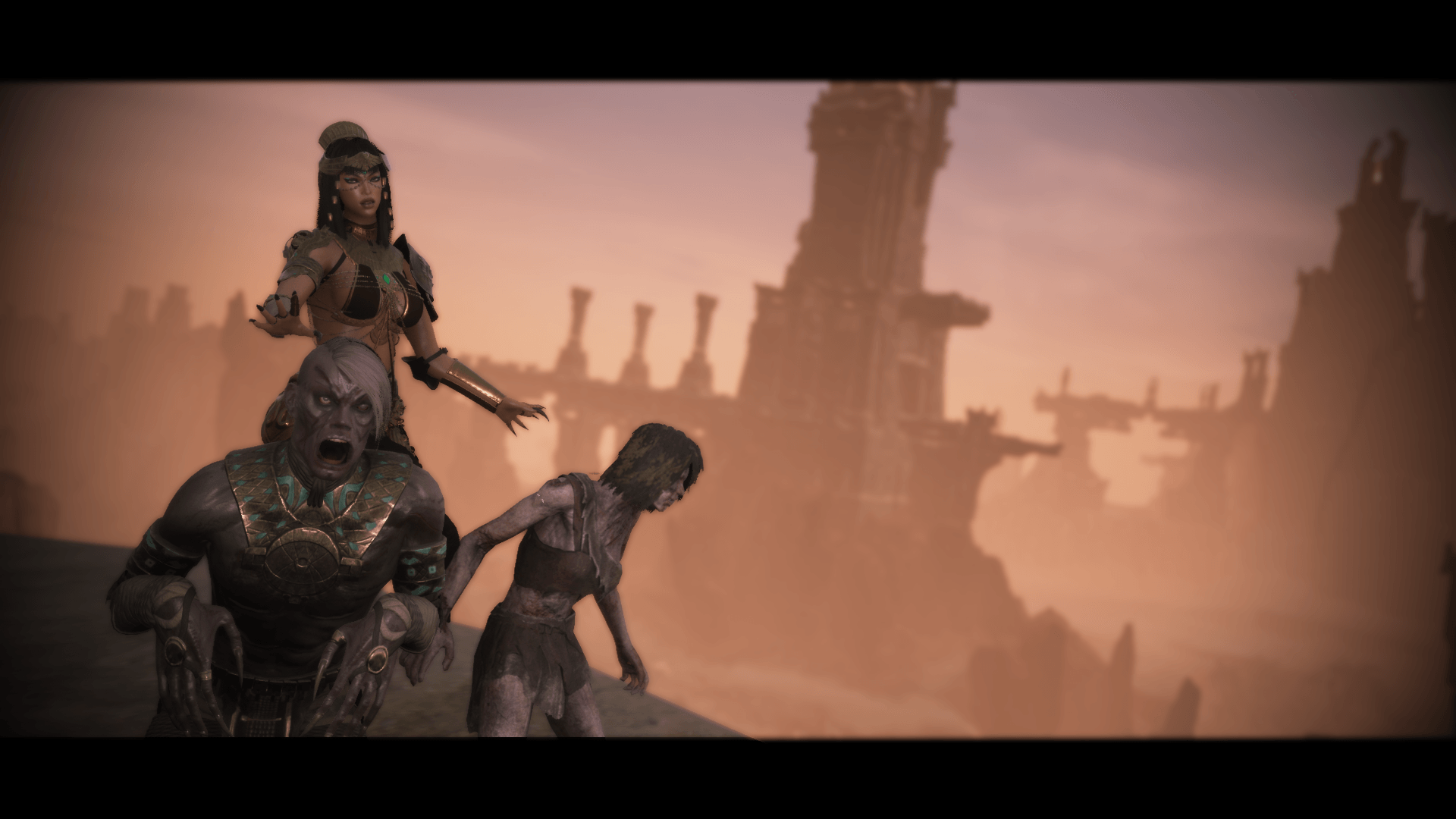
CHAPTER I — The Silence After Death
CHAPTER I
The Silence After Death
Death Is Not the End of Every Story

Few subjects have inspired more certainty than death. Every nation buries its dead according to its own customs, every priesthood offers its own explanation and every generation believes it has understood the boundary separating life from what follows. Yet the oldest records preserved within the Circle rarely speak with such confidence. Instead, they begin with a quieter observation: death changes the living more readily than it explains the dead.
Necromancy does not begin with corpses, nor with the animation of flesh. It begins by asking what, if anything, truly remains when life has departed. Throughout the Hyborian Age, scholars, priests and sorcerers have offered different answers. Some claim the soul journeys onward. Others believe it lingers. Some deny that anything survives at all. The Circle preserves these disagreements without pretending to resolve them, for certainty has always proven rarer than belief.
✦ What Remains
Death separates what was once united, yet the nature of that separation has never been fully understood. Flesh decays according to familiar laws, but memory, identity and spirit have long resisted such simple observation. Across countless traditions, the dead continue to appear in dreams, linger within sacred places or leave impressions that outlast the body itself. Whether these encounters represent surviving souls, echoes of memory or something entirely different remains uncertain.
For this reason, Necromancy concerns itself less with death itself than with what endures after it. Every practice within the School rests upon the belief that something of significance may remain, even when its true nature cannot yet be explained.
The body falls silent.
The question does not.
This space awaits an illustration.
Submit a screenshot or artwork from your character’s magical journey, and it may be preserved in a future edition of the Circle’s archives.
◇ Memory and Echo
Not every trace of the dead need possess awareness. Some places appear marked by powerful events long after those who witnessed them have vanished, while certain objects seem inseparable from the lives once bound to them. The archives therefore distinguish between the dead themselves and the echoes they may leave behind. One may think, remember or choose. The other merely remains.
Confusing these two has led many practitioners toward false conclusions, attributing intention where only lingering memory existed.
An echo answers no questions.
It merely repeats.
◐ Mortality
Necromancy is often mistaken for a rebellion against death itself. The archives preserve no evidence supporting this belief. Every living thing dies. Every kingdom falls. Every monument crumbles. No rite has erased this certainty. Instead, the discipline concerns itself with understanding the relationship between the living and the dead rather than denying that such a boundary exists.
To study death is not necessarily to reject it.
Only the living fear mortality.
The dead have already crossed it.
📖 From the Archive
The Empty Grave
One weathered account describes an ancient burial mound opened by grave robbers who expected treasure within. The chamber contained no body, no offerings and no signs of disturbance. Yet every visitor independently recorded the same impression upon leaving: the overwhelming certainty that someone had watched them throughout their descent.
Later annotations offer many explanations, though none claims certainty. The final archivist wrote only one sentence beneath the account.
"The grave was empty.
Whether death was, no one could say."
✧ Before the Dead Speak
Necromancy begins not by commanding the dead, but by questioning the silence they leave behind. Whether that silence conceals souls, memories, echoes or nothing at all remains uncertain, yet it is within that uncertainty that the School finds its purpose. Before any rite is attempted, before any corpse is disturbed and before any spirit is called, the practitioner must first accept that death remains one of the oldest mysteries known to humankind.
Death ends a life.
It does not end the question.
✦
CHAPTER II - Flesh, Soul and Echo
CHAPTER II
Flesh, Soul and Echo
Not Everything That Remains Is the Same
This space awaits an illustration.
Submit a screenshot or artwork from your character’s magical journey, and it may be preserved in a future edition of the Circle’s archives.
The oldest Necromantic records rarely speak of "the dead" as though death leaves behind a single thing. Instead, they distinguish between several remnants that may persist after life has ended, each governed by different principles and each demanding different methods of study. Confusing these remnants has been the source of countless contradictions throughout the surviving archives, where one manuscript appears to describe a wandering spirit while another clearly records nothing more than the lingering influence of memory.
For this reason, the Circle preserves a careful distinction between flesh, soul and echo. Though they may once have belonged to the same living being, death does not necessarily leave them bound together. Each may endure in its own manner, disappear at a different time or remain entirely absent.
✦ Flesh
The body is the most visible remnant of death and, consequently, the one most often misunderstood. It preserves shape, strength and the marks of a life once lived, yet it does not preserve life itself. Time alters every corpse according to familiar natural laws, and no Necromantic practice has ever halted decay entirely. Preparation may slow corruption, preserve movement or improve the usefulness of mortal remains, but the body itself never becomes alive again.
For this reason, Necromantic traditions devote considerable attention to the preservation of the vessel. The condition of the body often determines the limits of what may later be attempted through sorcery, even when the body itself possesses no will or awareness.
The vessel may endure.
Life does not return with it.
This space awaits an illustration.
Submit a screenshot or artwork from your character’s magical journey, and it may be preserved in a future edition of the Circle’s archives.
◇ Soul
Whether the soul survives death has been debated for as long as mortals have buried their dead. Priesthoods, philosophers and sorcerers have offered countless explanations, few of which agree. The archives preserve reports of spirits that speak, remember and recognise the living, while other accounts insist that whatever once animated the body departs beyond all reach. Rather than favouring one belief over another, the Circle records these observations as they were encountered, acknowledging that certainty has remained elusive.
Necromancy therefore concerns itself not with proving the existence of the soul, but with examining those occasions in which something appears to answer from beyond death. Whether that presence represents the departed themselves or another phenomenon entirely remains a question left deliberately unresolved.
Many have spoken of the soul.
Few have agreed upon its nature.
◐ Echoes
Not every trace left by the dead possesses awareness. Certain places seem forever marked by violence, grief or devotion, while particular objects continue to evoke the presence of those who once carried them. These remnants are frequently described throughout the archives as echoes: impressions left upon the world by lives that have already ended. They may repeat fragments of the past without understanding them, much as a footprint survives long after the traveller has departed.
Because echoes often resemble hauntings, inexperienced observers have occasionally mistaken them for spirits. Later records, however, frequently distinguish between an echo that merely repeats and a presence capable of recognising or responding to the living.
An echo remembers nothing.
It only remains.
✧ Relics and Resting Places
The dead rarely leave behind only bodies. Tombs, weapons, jewellery, funerary offerings and places of burial often become inseparable from those who once possessed them. Whether this connection arises through memory, ritual, lingering spiritual presence or simple association remains uncertain, yet such objects appear repeatedly throughout Necromantic records as points where the boundary between the living and the dead becomes more readily observed.
For this reason, the Circle records not only the remains themselves but also the places and objects surrounding them. In many accounts, these prove as significant as the body to which they once belonged.
The dead leave more behind than flesh.
📖 From the Archive
The King's Crown
Among the oldest entries preserved within the archives is the account of a royal tomb opened centuries after its construction. The king's body had long since decayed beyond recognition, yet those entering the chamber independently remarked upon the same unease whenever they approached the ancient crown resting beside the empty bones. No apparition appeared, no voice was heard and no ritual had been performed, yet later scholars repeatedly returned their attention to the object rather than the corpse itself.
The manuscript ends without explanation, preserving only a brief observation added by a later archivist.
"The crown remembered
long after its king did not."
✧ Distinguishing the Dead
The records preserved within the Circle suggest that death rarely leaves behind a single, simple remnant. Flesh decays according to one law, echoes linger according to another and whatever may become of the soul has inspired debate since the earliest civilizations. Necromancy begins by recognising these distinctions, for no meaningful study of death can proceed while every remnant is mistaken for the same thing.
Whether these remnants remain connected, become separated or cease altogether lies beyond the certainty of the surviving archives. The purpose of the School is not to erase that uncertainty, but to preserve the observations from which later generations may continue their inquiry.
The dead are remembered.
What remains is another question.
✦
CHAPTER III - The Work of the Necromancer
CHAPTER III
The Work of the Necromancer
Working With What Death Has Left Behind

Necromancy differs from many other Schools in that it does not seek to create something entirely new. Every practice preserved within the archives begins with something that already exists: a body, a spirit, an echo, a place marked by death or an object carrying the weight of a departed life. The work of the Necromancer lies not in creation, but in preparation, preservation and manipulation of what death has already claimed.
For this reason, the oldest manuscripts devote surprisingly little attention to spectacular rituals and far more to the careful treatment of mortal remains. A poorly prepared vessel, an overlooked detail within a burial site or the careless handling of funerary objects appears throughout the archives as the cause of failure far more often than any lack of magical knowledge.
✦ Preparation
Nothing within Necromancy begins at the moment a ritual is performed. The condition of a corpse, the preservation of a relic or the circumstances surrounding a death frequently determine what may later become possible. Across many traditions, preparation occupies more time than the rite itself, reflecting the belief that sorcery cannot compensate for neglect of the material upon which it depends.
Bodies may be preserved against decay, burial places carefully documented and objects protected from damage or contamination. These acts possess little spectacle, yet they appear throughout the oldest records as essential foundations for later work.
Death leaves its remnants.
Preparation determines their use.
This space awaits an illustration.
Submit a screenshot or artwork from your character’s magical journey, and it may be preserved in a future edition of the Circle’s archives.
◇ Preservation
Time is among the greatest adversaries of the Necromancer. Flesh decays, structures collapse and memories fade, gradually erasing the traces upon which the discipline depends. Many surviving traditions therefore developed methods intended to slow these processes, preserving bodies, tombs or sacred objects without claiming to halt the passage of time itself.
Preservation should not be mistaken for restoration. A preserved body remains dead, just as a carefully protected relic remains an object rather than the life once connected to it. The archives consistently distinguish between maintaining what survives and recreating what has already been lost.
To preserve is not to restore.
◐ Continuation
Many Necromantic practices concern themselves with extending the usefulness of what remains after death. A body may become a vessel, a spirit may linger briefly beyond its passing and a place marked by ancient burials may continue influencing those who enter it centuries later. Such continuations should not be understood as the return of life, but as new conditions arising from death itself.
For this reason, the archives describe many workings not as acts of creation, but as acts of continuation. Something persists, though often in a form unlike that which existed before.
What continues
is not always what once lived.
✧ Imitation
Among the oldest debates preserved within the Circle is the distinction between life and its imitation. Animated corpses may walk, speak or labour, yet movement alone has never been accepted as proof that life has returned. Likewise, the voice of a departed spirit does not necessarily establish that the entire person endures unchanged beyond death.
The archives therefore encourage careful distinction between appearance and nature. Necromantic workings frequently resemble life, but resemblance alone has never resolved the deeper question of whether life itself has truly returned.
Motion resembles life.
It does not define it.
📖 From the Archive
The Preserved Warrior
One account describes the discovery of a perfectly preserved warrior within a forgotten tomb. Armour, weapons and flesh remained almost untouched despite the passing of centuries. Later investigators recorded no sign of animation, haunting or supernatural disturbance. The preservation itself proved remarkable enough to attract generations of scholars, each proposing different explanations while agreeing upon one conclusion: death had not been undone, only delayed in its visible effects.
A later archivist added a brief observation beneath the account.
"The body endured.
The life did not."
✧ The Necromancer's Craft
The surviving records consistently portray Necromancy as a discipline of careful preparation rather than sudden miracles. Every working begins with what death has already left behind, whether flesh, spirit, relic or memory, and proceeds by shaping those remnants without claiming to restore what has been lost. The distinction is subtle, yet it appears throughout the oldest manuscripts as one of the defining characteristics of the School.
No surviving archive preserves evidence that Necromancy creates new life. Instead, it records the countless ways in which the remains of death may be preserved, examined, guided or employed for purposes that continue long after mortal life has ended.
Necromancy creates nothing.
It works with what remains.
✦
CHAPTER IV - The Limits of Necromancy
CHAPTER IV
The Limits of Necromancy
Death Leaves Boundaries That Cannot Be Ignored
This space awaits an illustration.
Submit a screenshot or artwork from your character’s magical journey, and it may be preserved in a future edition of the Circle’s archives.
Necromancy concerns itself with death, yet it has never escaped the conditions imposed by it. Every surviving tradition preserved within the Circle begins with the same observation: the practitioner does not create the subject of their study, but inherits what death has left behind. Bodies decay, spirits depart, memories fade and the passage of time gradually erodes every trace that remains. Necromantic practice therefore begins not with unlimited possibility, but with limitations already established before the first rite is attempted.
The archives consistently portray these limitations not as failures of the School, but as the conditions under which it operates. Every successful working depends upon the state of the body, spirit, echo or relic involved, and none of these remnants remains entirely within the sorcerer’s control.
✦ Mortality
The dead do not become living merely because sorcery has set them in motion. Bodies may walk once more, spirits may answer questions and echoes may linger where lives have ended, yet none of these observations has erased the distinction between life and death. Throughout the archives, animation and life remain separate conditions, despite their occasional resemblance.
Necromancy therefore appears throughout the surviving records not as the defeat of mortality, but as the study and manipulation of its consequences. The discipline exists because death changes what it claims, not because that change can be perfectly undone.
Death provides the material.
It does not surrender its boundary.
This space awaits an illustration.
Submit a screenshot or artwork from your character’s magical journey, and it may be preserved in a future edition of the Circle’s archives.
◇ Decay
Time remains one of the oldest adversaries recorded within Necromantic study. Flesh weakens, bones fracture, tombs collapse and even carefully prepared remains gradually surrender to age. Embalming, alchemical treatment and ritual preservation may delay these processes, yet no surviving record suggests that decay can be abolished entirely.
Many of the oldest manuscripts consequently devote remarkable attention to the condition of a corpse before describing the rite performed upon it. Preservation appears not as victory over decay, but as the careful management of its progress, extending the usefulness of a vessel without restoring what time and death have already removed.
Time continues its work.
Necromancy merely works beside it.
◐ The Silent Dead
Not every spirit answers when called. Some records describe clear exchanges with the recently departed, while others preserve repeated attempts that produced only silence. Certain traditions interpreted this silence as refusal, others as complete departure, and some as evidence that no spirit remained capable of response.
The Circle preserves these accounts without favouring one explanation over another. Whether the dead cannot answer, choose not to answer or no longer exist in a form capable of being reached remains beyond the certainty of the surviving archives.
Silence is also part of the record.
✧ Imperfect Remains
Everything left behind by death is incomplete. A corpse lacks life, an echo lacks awareness and a memory lacks physical presence. Even where spirits are believed to endure, the archives rarely claim that they remain untouched by death itself. Time, separation and the circumstances of passing all appear capable of altering whatever survives.
Every Necromantic working therefore begins with fragments rather than wholeness. The discipline shapes, preserves, anchors or employs what remains, but it does not begin with a complete life waiting to be restored.
Every working begins
with something missing.
📖 From the Archive
The Unanswered Tomb
A weathered manuscript records the attempts of three different practitioners to communicate with the occupant of an ancient royal tomb. The burial chamber remained undisturbed, the funerary rites appeared intact and every account agreed that the place carried an overwhelming sense of presence. Yet despite employing different rites over many years, none recorded a single reply.
The final annotation contains only a brief observation.
“The tomb remembered its king.
The king remembered no one.”
✧ The Boundaries of the Dead
The surviving archives portray Necromancy as a discipline defined as much by absence as by presence. Every practice depends upon what death has left behind, whether flesh, spirit, memory, echo or relic, and every working proceeds within the limitations imposed by those remnants. A corpse cannot provide what decay has destroyed, a spirit cannot be compelled to contain memories it no longer possesses and a vanished soul leaves no certain path by which it may be reached.
These boundaries have never ended Necromantic study. They have instead defined its methods, its failures and the narrow possibilities preserved within its records.
Death leaves many things behind.
None of them are life.
✦
CHAPTER V - The Illusion of Resurrection
CHAPTER V
The Illusion of Resurrection
What Returns Is Not Always What Was Lost
This space awaits an illustration.
Submit a screenshot or artwork from your character’s magical journey, and it may be preserved in a future edition of the Circle’s archives.
Among the oldest misconceptions surrounding Necromancy is the belief that mastery over death consists in reversing it. The archives preserve countless accounts of animated corpses, lingering spirits and voices answering from beyond the grave, yet remarkably few describe the true restoration of a life once ended. Instead, they repeatedly distinguish between continuation and return, recognising that resemblance alone cannot resolve whether what has been recovered is truly what was lost.
This distinction has shaped Necromantic study for centuries. Flesh may be preserved, memory may endure and spirits may answer when called, yet each represents only part of a mystery that no surviving manuscript claims to have solved. The appearance of familiarity often proves more convincing than certainty itself.
✦ Recognition
The archives contain many accounts in which the dead appear recognisable to those who once knew them. Familiar voices, remembered names and long-forgotten gestures often accompany Necromantic encounters, encouraging observers to conclude that the departed have returned unchanged. Later records, however, frequently question these assumptions, observing that recognition alone reveals little about the true nature of what stands before the living.
A face may endure. A voice may remain. Memory itself may survive in fragments. None of these, by themselves, establish that the living individual has been restored.
Recognition is not proof of return.
This space awaits an illustration.
Submit a screenshot or artwork from your character’s magical journey, and it may be preserved in a future edition of the Circle’s archives.
◇ Memory
Memory occupies an uncertain place within Necromantic records. Some spirits appear capable of recalling names, places and events from their mortal lives, while others retain only fragments or none at all. Animated corpses may occasionally display familiar habits despite possessing no apparent awareness of their former existence. Such observations have led many scholars to conclude that memory survives differently from life itself, persisting unevenly among the remnants left by death.
For this reason, the archives treat remembered knowledge as evidence worthy of preservation, but not as sufficient proof that the individual has returned in full.
Memory survives.
Identity remains uncertain.
◐ Appearance
The outward signs of life have often encouraged false conclusions. Warm flesh, movement, speech or familiar expressions may all accompany Necromantic workings, yet none has consistently demonstrated that life itself has returned. Throughout the archives, appearances repeatedly prove easier to restore than whatever deeper qualities once distinguished the living from the dead.
The Circle therefore preserves descriptions of appearances separately from observations concerning awareness, recognising that the two have rarely proven identical.
Life may be imitated.
It is not therefore restored.
✧ What Cannot Be Recovered
Perhaps the most persistent question preserved within Necromantic study concerns what death removes forever. Different traditions provide different answers, and the archives preserve them without resolution. Some speak of an immortal soul, others of a final departure beyond all mortal reach, while still others describe only silence. Whatever the truth, the surviving records consistently acknowledge that something remains beyond the reach of every known rite.
Whether this absence belongs to the soul, to life itself or to some quality that has never been adequately named remains one of the oldest unanswered questions within the School.
Not every absence can be filled.
📖 From the Archive
The Mother's Voice
One manuscript recounts the testimony of a woman who claimed to have spoken with her deceased mother through Necromantic rites. The voice answered every question correctly, recalled forgotten family stories and recognised each of her children by name. Yet the account concludes with a single observation recorded after the ritual had ended: despite hearing the same voice, she remained convinced that she had spoken to someone she no longer truly knew.
The archivist who copied the account declined to explain the contradiction, preserving only the final remark.
"Everything she remembered was there.
Something else was missing."
✧ Beyond Resemblance
The archives consistently distinguish between resemblance and restoration. Bodies may move, spirits may speak and memories may endure, yet no surviving record demonstrates that these alone are sufficient to erase the boundary established by death. Rather than resolving the mystery, Necromancy has repeatedly revealed how difficult it is to determine what truly makes one life the same as another.
The question has endured far longer than any single ritual, and it continues to accompany every attempt to look beyond the grave.
The dead may answer.
Whether they return remains unknown.
✦
CHAPTER IV - Necromantic Practices
CHAPTER VI
Necromantic Practices
Four Disciplines of the Dead
This space awaits an illustration.
Submit a screenshot or artwork from your character’s magical journey, and it may be preserved in a future edition of the Circle’s archives.
The archives preserve four principal disciplines within Necromancy, each concerned with a different remnant of death. Corpse Reanimation works through the physical vessel, Mediumship seeks communication with departed spirits, Funeral Fire concerns the final treatment of mortal remains, and the Keeper of the Threshold preserves a connection that would otherwise fade or pass beyond reach. These practices are united not by a promise of resurrection, but by their dependence upon what death has already left behind.
They should not be understood as stages of increasing mastery. Each addresses a different condition and employs different materials, rites and forms of preparation. One gives motion to dead flesh, another listens for a voice beyond it, while the remaining disciplines either bring a lingering connection to an end or hold it briefly in place.
✦ Necromantic Practice I — Corpse Reanimation
The Preparation of the Vessel
Corpse Reanimation encompasses the rites through which a prepared body is restored to movement after death. Contrary to the claims of common tales, bodies do not rise through a spoken command or a gesture alone. The vessel must first be procured, examined and prepared through a combination of arcane rite, alchemical treatment and funerary craft. Fresh remains taken from strong and healthy stock appear throughout the archives as the most effective vessels, for the condition of the body continues to determine its usefulness even after life has ended.
Alchemical embalming slows decay, preserves strength and allows dead flesh to endure the strain of later animation. Only after this preparation are profane rites performed to restore motion and bind the resulting construct to an external will. What rises is not a living person returned from death, but a dead vessel given movement, purpose and varying degrees of obedience. The surviving records generally distinguish two broad forms of reanimated servant: the empty husk, animated without a soul, and the soul-bound servant, within which some remnant of the deceased has been preserved or confined.
The corpse rises.
The life does not.
◇ Soulless Husks
Soulless husks are bodies animated without the restoration or anchoring of a soul. They possess no true identity and display little beyond the commands impressed upon them during their creation. Their absence of independent will makes them comparatively easy to direct, yet their usefulness remains limited by the decay of the vessel and by the simplicity of the forces sustaining it.
The archives commonly describe such servants as weak, short-lived and prone to rapid deterioration. They may walk, labour and fight, but no reliable account attributes genuine memory, desire or awareness to them. Any familiar mannerism they display is generally interpreted as a remnant of the body’s former habits, a consequence of the rite or an imitation shaped by the will directing them.
The husk obeys
because nothing within it refuses.
◇ Soul-Bound Servants
Soul-bound servants arise from a more complex form of Corpse Reanimation in which some remnant of the deceased is bound to the prepared vessel. Such constructs may retain fragments of memory, recognition, former skill or personality, though surviving descriptions differ greatly in the degree of awareness displayed. Whether the bound remnant constitutes the whole soul, a damaged portion of it or an unusually coherent echo remains unresolved throughout the archives.
These servants appear more capable than ordinary husks, but also more difficult to sustain and command. The presence of memory or will introduces uncertainty into a practice otherwise founded upon imposed obedience, and many records describe the servant as dependent upon the Necromancer who created or maintained the binding. When that connection failed, the servant seldom continued unchanged, and some accounts suggest that the death of the sorcerer brought the bound dead to an end alongside them.
The stronger the remnant,
the less empty the vessel.
This space awaits an illustration.
Submit a screenshot or artwork from your character’s magical journey, and it may be preserved in a future edition of the Circle’s archives.
✧ Necromantic Practice II — Mediumship
Voices of the Recently Dead
Mediumship is the practice of seeking contact with spirits of the dead without restoring motion to their remains. Through funerary objects, sites of death, personal relics or rites performed shortly after passing, the practitioner attempts to hear, see or otherwise perceive a departed presence. The most detailed accounts concern the recently dead, whose connection to the mortal world appears less diminished by time and whose memories may remain more readily accessible.
The archives describe these encounters as inconsistent. Some spirits speak clearly and appear capable of recognising those who call them, while others answer only through fragmented images, repeated sensations or brief impressions. Many rites produce no response at all, and repeated attempts to reach the same spirit do not necessarily improve the result. Mediumship therefore records what answers without assuming that every silence conceals a voice.
The dead may be called.
They are not always found.

⟡ Necromantic Practice III — Funeral Fire
The Final Treatment of Mortal Remains
Funeral Fire concerns the use of sacred or sorcerously prepared flame in the treatment of the dead. The rites preserved under this discipline purify mortal remains, complete funerary observances and sever lingering influences that might otherwise persist within flesh, bone or burial place. Unlike Corpse Reanimation, which preserves the body for continued use, Funeral Fire brings the usefulness of the vessel to an end.
The archives contain numerous traditions in which flame was employed to prevent corruption, deny possession or render a corpse unsuitable for later Necromantic manipulation. Some accounts describe the fire as consuming more than flesh, burning away stains, attachments or foreign presences that ordinary flame could not reach. Whether such rites free a spirit, destroy an echo or merely remove the material through which either might be reached remains debated.
What the fire takes
cannot easily be claimed again.
✦ Necromantic Practice IV — Keeper of the Threshold
The Anchoring of the Departing Soul
The practice known as Keeper of the Threshold concerns the temporary anchoring of a soul or spirit to the mortal world. Through ritual, the connection may be fastened to a person, place, object or prepared physical vessel for a defined purpose, preserving a presence that might otherwise fade, wander or pass beyond mortal reach. The rite does not recreate life, nor do the surviving records consistently portray it as granting ownership over what has been anchored. It preserves and stabilises a connection.
Surviving accounts differ in both duration and result. Some anchored spirits remained only long enough to speak a final message, while others were preserved as guardians, witnesses or sources of knowledge. The strength of the connection appears to depend upon the condition of the spirit, the chosen anchor and the purpose around which the rite was formed. When any of these failed, the presence either departed or became increasingly difficult to distinguish from an echo.
The threshold is not closed.
It is held.
◇ Practices in Combination
Although the archives preserve these disciplines separately, many Necromantic workings combine them. Mediumship may establish whether a spirit remains capable of answering before the Keeper of the Threshold attempts to anchor it. Corpse Reanimation may prepare a vessel later used to contain a bound remnant, while Funeral Fire may end the same connection by destroying the body, relic or place through which it was sustained.
The relationship between these practices is one of preservation, manipulation and release. One gives motion to what has died, another seeks the voice that may remain, a third holds that presence near the mortal world and the last severs the paths by which flesh or spirit might continue to be disturbed.
✧ The Four Remnants
The four disciplines preserved within Necromancy correspond to four different relationships with death. Corpse Reanimation employs the body and may produce either an empty husk or a vessel containing some bound remnant of the deceased. Mediumship seeks the spirit without restoring it to flesh, Funeral Fire ends the usefulness of mortal remains, and the Keeper of the Threshold preserves a connection between the dead and the living for a defined purpose.
None restores a complete life, for each begins only after death has already divided flesh, memory, identity and soul. Together these practices describe the narrow territory in which Necromancy operates: not the return of the living, but the manipulation of what death has failed to erase.
Four disciplines.
One boundary.
Only remnants return.
✦
Epilogue
EPILOGUE
Beyond the Grave
Death Ends Every Life, But Not Every Question

Few subjects have inspired more certainty than death, yet few have yielded so little agreement. Kingdoms bury their dead according to ancient custom, priesthoods promise different destinies beyond the grave and countless traditions attempt to explain what becomes of those who pass beyond mortal life. The archives preserved within the Circle offer no final answer. Instead, they preserve the observations, contradictions and unanswered questions left behind by generations of Necromancers who stood before the same mystery.
Throughout this grimoire, bodies have been prepared, spirits sought, echoes distinguished and thresholds briefly held open. None of these practices claims dominion over death itself. They merely concern themselves with its remains, examining the traces left behind where life once stood. In this, Necromancy differs from many other Schools. It does not promise victory over mortality. It studies what mortality leaves in its wake.
✧ Final Reflection
The oldest manuscripts preserved by the Circle rarely conclude with certainty. Some describe spirits that spoke with remarkable clarity, while others record only silence. Some preserved bodies endured for centuries, while others surrendered quickly to decay despite every preparation. Such contradictions appear throughout the archives, not as flaws to be corrected, but as faithful records of a mystery that has never yielded entirely to observation.
For this reason, the Circle continues to preserve each account alongside those that disagree with it. Every tomb opened, every spirit questioned and every remnant examined contributes another fragment to a discipline that remains incomplete. The study of death has never belonged to those who believed they possessed every answer, but to those willing to preserve the questions for those who would come after them.
Death keeps its silence.
The archives keep the record.
✦