
Aquilonia is a large, landlocked nation of many cultures stitched together by the conquering Hyborians who invaded after the downfall of the Acheronian Empire.
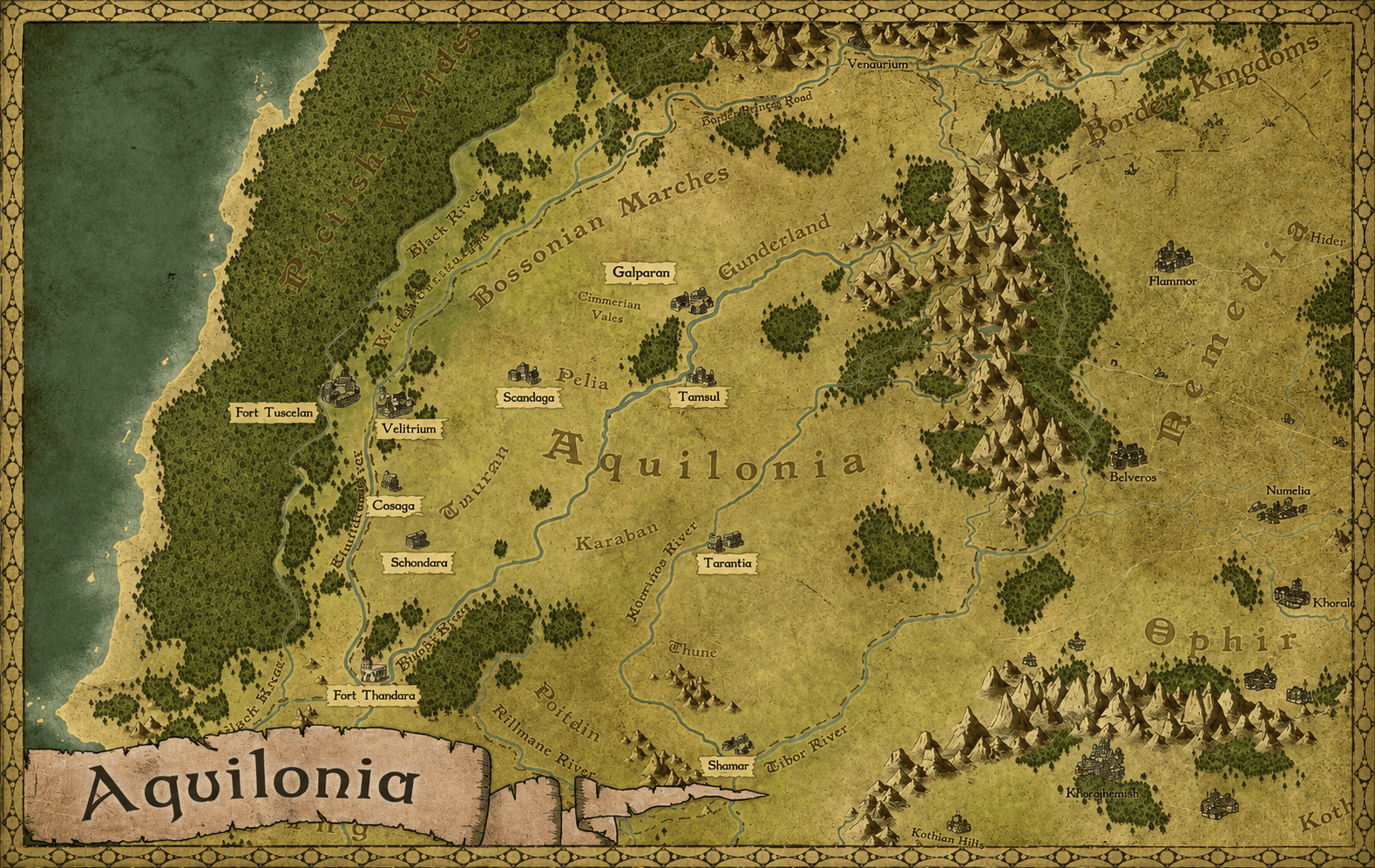
Aquilonia is separated from the Pictish Wilderness in the West by the Bossonian Marches, the cutting edge of which is Westermarck, and is separated from the fearsome Picts by the narrow ribbon of the Thunder River. The people of the region live a frontier lifestyle, variously gaining and losing ground with the Picts. Bossonians are considered among the best longbowmen in the world.
In the North, the Gundermen believe themselves to be a free and self-governing people. They are tied to Aquilonia by treaty, rather than conquest. They hold the line between the rest of Aquilonia and the barbaric Cimmerians, and have the most pure Hyborian bloodlines of the southern Hyborian kingdoms, having very little exposure to or interbreeding with other races.
To the south, Poitain guards the hills and mountains that butt against Zingara. Poitain is a heavily agricultural region and is well known for its warm climate and production of oranges and olives, among other staples like wheat. The nobles of Poitain are the most steadfastly loyal to the crown.
Aquilonia is the most advanced and powerful of the Hyborian kingdoms with a proud, overall wealthy populace when stacked against other nations of the age. Nearly 25 million people live in Aquilonia's various counties, baronies, villages, towns, and cities.
Notable Geographic Features: Rivers
- Alimane River: The Alimane is a river marking the border between Aquilonia and Zingara. It was too shallow in places to allow much, if any, navigable river trade. A caravan trail follows along the banks of the Alimane. The caravan trail crosses the road to the Khorotas at the village of Pedassa. The Ford of Nogara is a common route for trade from the Saxula Pass to cross the Alimane. A road passes from here to Culario, the capital of Poitain.
- Bitaxa River: The Bitaxa is a turbulent tributary of the Alimane, flowing over the Imirian Escarpment into the Brocellian Forest below.
- Black River: This river is the frontier border of Aquilonia and the site of many battles with the savage Picts. The river has a swift current, yet is quite deep and rather wide, carrying a large volume of water. The river's source is somewhere in the mountains of northern Pictland. It flows southward along the border of the Bossonian Marches, then along the frontier border of Westermarck. Eventually it curves to the West as it flows into Zingara on its course to the open sea. The Zingaran capital of Kordava sits at its mouth.
- Khorotas River: This is a major river of Aquilonia. It is navigable in its middle reaches and flows within a mile of Tarantia. Once in Poitain and its mountains, the river falls in a series of picturesque falls, cascades and rapids. The Tybor and the Alimane merge with it and flow to the Western Ocean at Messantia in Argos. The Road of Kings crosses the Khorotas near its confluence with the Tybor. Fishermen and merchant boats are the usual craft seen on the river but occasionally a slender, black craft bearing one of the dead of Asura floats down the river. The road crosses the road to the Alimane at the village of Pedassa.
- Ossar River: This is a swift flowing river that eventually joins with the Fury at the wicked city of Sicas. Its source is somewhere in the hills around Tarantia.
- Shirki River: The Shirki river is an important waterway through Aquilonia, although it is largely not navigable. It is swift and turbulent from its source in the mountains of Cimmeria all the way past Tanasul, although the rocks at Tanasul are high enough to afford a crossing into Gunderland most of the time. Another crossing exists at Galparan, although it is less certain than the Tanasul crossing. The lower reaches of the Shirki can be crossed by ferries. Rapids and cascades typify this river through the Tauran.
- Thunder River: This is another important river for Aquilonia and is a border against Pictland. It was named the Thunder River for its long stretches of white-water rapids in northern Zingara and southern Bossonia.
- Tybor River: The Tybor river is described by Howard in The Scarlet Citadel as a placid river marking the border between Aquilonia and Ophir. There is no bridge at Shamar crossing the river, so it must be both deep and wide, allowing for river traffic.
Notable Geographic Features: Landmarks
- Brocellian Forest: The Brocellian forest lies between the southern Poitain cities and the Imirian Escarpment. The peasants believe that supernatural beings lurk in these woods. The nobles of Poitain encourage these beliefs, as the superstition preserves the woods for their hunting pleasures. A road runs through the forest toward the Imirian Escarpment where the Bitaxa River carves out the Giant's Notch, a large gorge through the escarpment that the road follows. It takes a day to cross the width of the forest from the edge to the escarpment. Satyrs are rumored to live in this dark forest but Trocero and his barons do not encounter them while hunting in the forest.
- Mount Golamira: This is the Mount of Eternal Time, called ‘black-hearted' in Aquilonia. The legendary prophet Epimetreus' body was laid to rest here 1,500 years ago in a magically protected tomb. He sends forth his spirit in dreams when Aquilonia is in dire need.
- Valley of Lions: The Valley of Lions is a fan-shaped valley in the Goralian hills in northwestern Aquilonia.
- Valley of Valkia: This valley, with attendant river, lies in eastern Aquilonia about ten miles from Nemedia's border. Mountains lie to the west of it. This is the site of the great battle lost by Conan's army in the beginning of The Hour of the Dragon.
Important Aquilonian Cities
Tarantia
Tarantia is the capital of Aquilonia, the ‘most princely city of the world's West.' This great walled city stands regally on a plain not far from the Khorotas River in southeastern Aquilonia on the Road of Kings. This city is a formidable center of commerce as well as the home of the King of Aquilonia. The troops based here are called the Black Legion and the king's personal bodyguard are known as the Black Dragons. The gates are guarded by great bronze portals. The wealthy travel about town in chariots. Tarantia's population exceeds 80,000 most of the time.
- The Citadel: The king's palace with its blue and golden towers is surrounded by thick walls and battlements. Gunderland pikemen and Bossonian archers protect the walls. The walls are penetrated via a barbican. Passing through that gatehouse leads one to a drawbridge, then to the inner barbican where an iron portcullis and massive double doors defend the outer ward. This outer ward houses the servant's quarters, stables, wells, forges, groves, fields and other castle support. An interior wall surrounds the keep, where Conan and his family live. A gate allows access to the inner ward where the more direct castle support can be found, such as the kitchens and bakeries, the private gardens and the royal stables. The keep itself is the strongest portion of the entire royal citadel.
- The Iron Tower: ‘The grim Iron Tower stood apart from the citadel, amid a maze of narrow streets and crowding houses where the meaner structures, appropriating a space from which the more fastidious shrank, had invaded a portion of the city ordinarily alien to them. The Tower was in reality a castle, an ancient, formidable pile of heavy stone and black iron, which had itself served as the citadel in an earlier, ruder century.' The infamous Iron Tower is used now to execute Aquilonia's political enemies, although a thousand years or more ago it was the primary castle of the Hyborian king who originally ruled these lands. The interior of the Tower is as forbidding and gloomy as the exterior.
Shamar
Shamar is an ancient city, possibly older than Atlantis itself. It is a walled city built on the Tybor River's banks and the river itself supplies the water for its moat. The southern walls are against the river and have ballistae mounted on them. The city is governed by a duke and its most famous export is its wines. It is a strategic and powerful city which has been attacked many times. Ophir has laid siege to it at least three times. Nemedia has attempted to capture it twice. Even Aquilonia attacked it once during a rebellion. Its duke maintains a large militia force that exceeds 2,500 soldiers, having grown since the time of The Scarlet Citadel. Shamar is one of the largest cities in Aquilonia and has a population exceeding 42,000.
Other Cities & Outposts
- Culario: Culario is the capital of Poitain. It is located in the south. The streets are narrow and the flags of Poitain fly proudly from the battlements. The city holds elections for its mayor. It has a population of 15,223.
- Miran: Miran is a small town a day and a half north of an Aquilonian military outpost. The small town lies southeast of Tamaros on a road toward Nemedia. At the military outpost to the south that road forks, with one fork heading into Nemedia and the other heading into Tarantia. Thus, Miran and the outpost usually have fairly current news of happenings at the capital.
- Samalara: Samalara is a military outpost in central Aquilonia two days ride from Poitain. Prior to the events of The Silent Enemy, Samalara was completely manned by Gundermen.
- Sicas: This small city (population 10,402) between Tarantia and Shamar was once known as the City of Silver before the ore played out. Now it is a rather wicked Aquilonian city lorded over by a King's Reeve. Most of the royal officials stationed there earn their wealthy life-styles by accepting bribes of almost any sort.
- Tamaros: Tamaros is the ‘child of Tamar'. It is described as a good-sized town with taverns, inns and gambling houses. It is located near the borders of the Border Kingdom, Nemedia and Gunderland but is in Aquilonia proper. It is considered a northern gateway to Tarantia from the eastern front, so there is a military outpost at the town. Two roads lead from Tamaros toward Nemedia. One is straight; the other heads southeast through a town called Miran.
- Tanasul: Tanasul is a fortified town in northern Aquilonia. It sits on a reef of rocks, a natural bridge, on the turbulent Shirki River. It guards one of the only fordable places on that powerful river. The other ford lies at Galparan, north of Tanasul. During periods of flooding, this ford is as impassable as the rest of the river. Tanasul has a population of 4,989. This is a strategic place during Conan's war against Tarascus and Xaltotun and events here reveal to Xaltotun's allies that the Acheronian is not invincible.
- Velitrium: Velitrium is the market center of the Westermarck province of Conajohara. It is the site of a great battle between Aquilonia (led by Conan) and the Picts. It is the only settlement left in Conajohara with a population of 985.
Provinces & Baronies
There are approximately 54 baronies, counties and principalities in Aquilonia. Few of these have been named, but below is a list of several of the better known ones. The capitals of most of these places bear the name of the region (e.g., the capital of Albiona county is the city of Albiona).
- Albiona: Albiona is a county in Aquilonia. Its ruling family is kin to the Theringo fief-holders of Ophir. Marala, Countess Albiona, was once Queen of Ophir but now lives in exile in Aquilonia.
- Attalus: Called one of the most important as well as Aquilonia's most culturally and commercially advanced baronies of Aquilonia by Howard, little else is known about this rich province. The barony of Attalus is located in the southeast of Aquilonia.
- Gunderland: Gunderland is a northern province between the Aquilonian heartland and Cimmeria. Gunderland was once a separate kingdom but chose to become a vassal state to Aquilonia to avoid being subsumed as a subject people. Despite their concessions to Aquilonia, the people of Gunderland view themselves as relatively independent. Its people are tawny-haired and grey-eyed and, with no slaves and little interbreeding with other peoples, are the purest of the Hyborian bloodlines.
- Poitain: Poitain, ruled by Count Trocero of Culario, is the southernmost county of Aquilonia, and is Conan's most loyal province. In addition, Poitain is one of Aquilonia's most important provinces. Less than two decades ago, Trocero himself led the Poitainians against Tarantia, and many Aquilonians remember the devastation Poitain is capable of causing if they should rise up again.
- The Tauran: This province in northwest Aquilonia is a land of open groves and sun-dappled meadows dotted with forests. Although not a border province, the people of the Tauran feel they are as important to the defense of Aquilonia as any of the frontier provinces. They consider themselves superior woodsmen, but are viewed by the Bossonians as ‘ox-eyed yokels' who mean well, but are lacking in serious woodcraft. The Tauran is famed for its hunting, and the deer and panther native to this region are favored targets. This is a civilized realm, yet the posturing of its people as some sort of frontiersmen give a rustic flavor that is quite charming. Homes in this province are thatched cottages with glazed windows. The economy is agricultural, based on its extensive fruit groves and the herding of domesticated farm animals in its beautiful pastures.
- Westermarck: The Westermarck is a region east of the Thunder River between the Pictish Wilderness and the Bossonian Marches. The Westermarck was established by the order of King Vilerus. This important frontier supplies troops to provide a buffer between the Picts and Aquilonia's heartlands.
- Bossonia: Bossonia is also called the Bossonian Marches and is a frontier province between the Aquilonian heartland, the Pictish Wilderness and the Cimmerians. Recent expansion westward has placed the Westermarck between the Marches and the Picts, but the Bossonians are still Aquilonia's primary defense against Pictish assault. The rustic Bossonians are matchless warriors, frontiersmen of formidable skill and serve as the premier soldiers of Aquilonia's expansionist armies. People in Bossonia live behind walled forts and villages where they can defend themselves against barbarian assaults, be they Cimmerian or Pictish. The Bossonians are well known as archers and hunters, although the Bossonians also practice subsistence farming.

Aquilonia represents the pinnacle of Hyborian Age societies, a realm of enlightenment and prosperity. Even so, its forms of government and its treatment of the various economic classes of people fall back on ancient Hyborian traditions.
The Feudal Hierarchy
Aquilonia has a feudal government. It is ruled by a king, who divides the land and the responsibilities of the kingdom among various barons and counts, who then subdivide their properties and responsibilities further.
Aquilonia is an impressively large kingdom and is larger than its king can effectively rule. The king cannot prevent local powers from rising except by sending valuable troops to quell them. The king also does not have enough soldiers to enforce his will everywhere. Thus, the nations are left with fragmented governments comprised of local counts and barons who perform civil and military functions in the name of the king for an equally fragmented kingdom subdivided into numerous fiefs and sub-fiefs.
Provincial Fragmentation
The area of each Hyborian kingdom is broken up into smaller territories, or provinces. These in turn are broken up into even smaller pieces. Often the boundaries are not well defined, nor do the various lands ruled by a count or baron need to be contiguous.
This is extremely evident in the frontiers, where the Westermarck, which considers itself to be part of Aquilonia, is separated from the rest of the nation by Gunderland, which does not consider itself to be part of Aquilonia despite an agreement to the contrary. The divisions tend to undermine the sovereignty of the king and lead to inefficient government by the counts, barons, and those subordinate to the upper nobility.
Nobility and Inheritance
The counts and barons hold noble titles and fiefs when the king grants them official power. The granting of these fiefs is done through patents or contracts wherein nobles swear fealty to the king, and the king grants them all rights pertaining to the land proffered as fief. The fief includes both private property and a noble title.
These noble titles are inherited through the male line, although the king may remove a title at his pleasure. The eldest son or the husband of an eldest daughter almost always inherits the noble title. The actual property of the fief, however, can be divided among the lord's heirs however he sees fit. If a dispute over inheritance occurs, especially in a case where a nobleman produces no heir, the king may intercede and name an heir.
The Illusion of Unity
Unfortunately, the political and military structure of Aquilonia tends to maintain only the illusion of unity beneath the king. The counts and barons frequently can and do ignore the edicts and commands of the king.
Although the king rules all of Aquilonia in theory, the true practice of power there shows that the king rules Tarantia and its surrounding manors only. Many times in Aquilonia's history have provinces taken themselves outside of Aquilonia and had to be ‘reacquired' by the king's force of arms. Aquilonia's borders swell and shrink depending on the relative strength of the various kings.
Supplemental Lore: The Instruments of Royal Power
Addendum to "The Illusion of Unity"
To combat this fragmentation, Aquilonian monarchs rely on specific institutions to project power beyond the capital:
- The Royal Exchequer: While barons collect local taxes, the King maintains the "Road of Kings," charging tolls and tariffs that fund the central crown. This wealth allows the King to maintain professional mercenaries, making him less reliant on the temperamental levies of his barons.
- The Black Dragons & The Black Legion: These elite units serve as the "mailed fist" of the King. When a baron becomes too independent, the sight of the Black Dragon banners approaching his walls is often the only thing that restores fealty.
- The Great Court of Tarantia: This is the political heart of the West. Barons are often required to spend part of the year in the capital, effectively acting as high-status "hostages" to ensure their provinces remain loyal.
- The King's Reeves: In cities like Sicas, the King appoints a Reeve, a direct representative who acts as a watchdog over local governors. As noted in the geography of Sicas, these positions are often prone to the very corruption they are meant to prevent.

There is little social mobility in Aquilonia save via marriage. No matter how well one behaves, no matter how much one accomplishes, no matter how much wealth one accumulates, one cannot be elevated in status because of those things. Misbehavior short of criminal also does not decrease one's social standing. Downward movement is certainly easier than upward movement. For example, if a noble takes a job, he is disqualified from the nobility, for the aristocracy does not labor for a living. Also, criminal action could cause one to be outcast from society, leaving a character without legal protection.
The Four Social Orders
There are four distinct social orders in Aquilonia, each with its own unspoken rules and hidden habits. These four orders are the laborers, the townsmen, the aristocracy, and the clergy. These orders are social and political in nature, not economic, for status and position are not determined by money. Feudalism is a political structure, not an economic structure.
1. Laborers
Laborers work the land for their necessities. They work not only to survive but to support those who do not labor, such as the clergy and the aristocracy. There are four categories of laborer in the Hyborian kingdoms:
- Peasant: A peasant is a free man who lives in a village or more rural setting and owns his own land or, at most, owes rent on his land. Most peasants are farmers, although some are craftsmen. Peasants only owe a lord labor obligations during harvest time.
- Serf: A serf is a man who lives in a village or more rural setting but, unlike the peasant, has had his freedom restricted by a feudal lord, owing labor duties. Most serfs are farmers but, like peasants, may also be craftsmen. A serf is not a slave because no one owns him. He is, however, tied to a plot of land owned by someone else. A serf cannot leave the land he is tied to without his feudal lord's permission.
- Yeoman: Yeomen are freeholders who own no land or owe a feudal duty. Many of these people live in a village but are not of the village, considered outsiders or dependents instead of full members of the community. Peasants who lose their lands or come to the village landless are yeomen. Many make their way as hired hands, moving from one village to another; others are permanently employed as manorial laborers. Journeymen (a step above an apprentice craftsman) are in this category.
- Cottager: Cottagers are persons who own no land but at least own or rent a residence. Essentially, a cottager is someone who accepts a building to live in, even if it is little more than a shed, and moves in with his family. He works on the land owned by the wealthier peasant or the feudal lord in return for being allowed to live in a residence. Cottagers live on the fringes of society and are often looked down upon by peasants and even serfs.
2. Free Townsfolk and Burghers
Free townsfolk are often considered laborers by the aristocracy even though they do not labor for the aristocracy or the clergy. They labor for themselves. Town life is distinct from country life, despite their interdependency on each other.
3. The Clergy
(Note: As the primary text focused on the other three, this section remains a designated order within the social structure, typically comprising the priests of Mitra and other recognized faiths).
4. Aristocracy
The aristocracy contains a large and fluid social range. The ranks of the aristocracy are extremely dynamic because the fortunes of war and marriage bring families up and cast them down quickly. There are four categories of aristocracy in the Hyborian kingdoms:
- Royalty: Hyborian royalty are the ruling families of the Hyborian kingdoms.
- Peerage: Hyborian peers are not only political rulers but also hold the military in their hands and have their own social affairs. This social order has an amazing amount of material security and political power; Hyborian peers usually spend their time in efforts to keep their station and improve it.
- Gentry: The lowest station of the lesser nobility is the gentry. Members of the gentry are knights who hold land and exercise feudal rights.
- Knight: The military arm of Hyborian nations is comprised of those landless knights and soldiers raised by the various feudal lords as part of their obligations to the barons, counts, and kings.
Code of Honor
Aquilonian nobles hold firmly to a strict code of honor. It is the guiding principle of Aquilonian society, and not mere lip service. A nobleman is always on alert for insults that might impugn their honor, which extends to his wife, his family, and his beloved, and can only be remedied via a duel or other such form of violent redress. Among the aristocracy and the knighthood, honor is the measure of social standing among his peers, and part of what sets him aside from the common man. A ruined castle may be rebuilt, but honor, once damaged, is forever stained.
It is so important in Aquilonian culture that acts normally considered criminal may be overlooked while defending one's honor. For example, a man may kill his betrothed or his wife if he suspects her of adultery, and will not face criminal charges for doing so, because his honor and integrity have been tarnished.
Because Aquilonian wealth is held in private hands and passes from father to son, there is a cultural need for women to retain virginity until they are wed, and fidelity to their husbands once they are married. In the case of women, their honor often relates to sexuality, and maintenance of virginity and/or exclusive monogamy are synonymous with a lady's honor.
Honor in the Underworld
Even criminal society in Aquilonia adheres to a Code of Honor, holding them true to the deals and promises they make in the dark. Those that prove themselves honorless are met with a swift end. Criminals, after all, cannot go to the authorities if contraband and stolen goods are, in turn, stolen. Honor helps ensure criminal enterprise is alive and thriving in Aquilonia.
Allegiance
The entirety of Aquilonian society hinges upon allegiances: sworn oaths or pledges, taken faithfully and with full realization that it may mean giving up everything, including but not limited to time, property, even lives in support of one thing. Feudal lords pledge allegiance to the lord of their manor and their allegiance changes according to who wears the crown.
Allegiances are also sworn to loves, wives, families, comrades, cities, and gods. Sworn allegiances are generally reciprocal, and are not only legally binding, but are considered more binding than a written contract, because they are a matter of honor. Pledges of allegiance are generally said before one's peers, with both parties present, because the majority of Aquilonians cannot read.
Law & Order
Because of the ever-present need to guard one's honor, and the overlooking of otherwise-criminal acts in pursuit of defending honor, there is little the government or law enforcement can do to stop the seizing of valuable property, and the barbaric method of handling breaches of honor. In these cases, retribution is often swift and disproportionate.

Aquilonians are varied and interesting in appearance. The original Hyborian stock was tawny-haired and grey-eyed, but intermarriage with neighboring nations has diversified their appearance considerably. Overall, they have a long head and are a tall, rangy race.
In the south, Poitain's border with Zingara has darkened their features so that black hair and brown eyes are most dominant. The Gundermen have kept themselves to themselves, and retain the original Hyborian features, while the frontiersmen in Bossonia tend to be shorter and slightly darker-skinned, with many speculating quiet interbreeding with an aboriginal race that was long ago absorbed by the civilized people of that area. Taurans are more medium height and build with the traditional Hyborian tawny hair.
City-dwellers of Aquilonia trend towards the portly, as even the poorest citizens do not suffer from hunger.

Most people in Aquilonia wear woolen outer clothing and undergarments made of linen. Most merely wear simple tunics with hose and soft leather boots. The wealthy all across Aquilonia dress well, preferring brighter colors, better materials, and longer lengths than styles worn by the peasants. Elaborate silken jupons, close-fitting jackets, with gilt-braid skirts and jagged sleeves are typical outfits worn in the courts of Aquilonia.
Hair is usually curled and scented, bound with cloth-of-silver or cloth-of-gold bands. Plumed caps adorn the head of most of the male aristocrats. Most nobles wear a sword, though many of them are merely ceremonial weapons. Aquilonian fashion for men often includes a moustache. Despite these similarities, clothing styles vary from region to region in Aquilonia.
Prostitutes are usually required by the cities to dress in a distinctive fashion, although this varies from region to region, even from city to city. Many Aquilonian cities simply require skimpy, minimal clothing modeled after Eastern fashions. Others require gloves or a cloak of a certain color, or a particular type of scarf worn in a certain manner.
Typically, fashion is not a large concern for young Aquilonians. The Hyborian Age is not an age where ready-to-wear clothing is available and stylish. It takes years and decades for styles to really change. Peasant styles tend to remain the same for centuries. Also, given the cost of elaborate clothing, most wealthy young women will still only have a few gowns.

In Aquilonia, women, whether noble or peasant, hold a difficult position in society. Often assigned such tasks as cooking, baking bread, sewing, weaving, and spinning, Aquilonian women are considered less important than men. Women outnumber men in Aquilonia, so it is not unheard of for some Aquilonian women to hold occupations typically reserved for men. Many learn a trade from a father or husband and simply carry on the man's work when he dies.
Women tend to have an easier time in rural settings. Urban Aquilonian women tend to be more pigeonholed, as many guilds will not admit women save via their husbands. As a result, establishing oneself as a professional single woman is difficult, and many young women who move to the cities and fail to find domestic situations turn to prostitution. Women are under the control of their fathers until they marry.
Although peasants have more free choice in marriage because their dowries are either small or non-existent, aristocratic women are subject to arranged marriages. Their lands and potential children are too important to noble families to be given away indiscriminately. Unlike women in many of the Hyborian Age nations, the aristocratic women of Aquilonia are more than just appendages, more than just objects of exchange or vessels for reproduction. Landholding women have a number of rights and can exercise power rather liberally. A common marital gift to a noble woman is feudal property, and such a woman can control and oversee her own property. Wealthy women can inherit property and become fully vested feudal lords. They can settle disputes over vassals, castles, and other property. Women can even field armies, leading them into battle.
Love and Marriage
Young girls in Aquilonia are brought up to expect to be married. Only noble girls of means and wealth can afford to remain single, usually by devoting themselves to Mitra. The need to marry well has promoted an industry of marriage-brokers and match-makers throughout Aquilonia. Romantic love plays very little role in Aquilonian marriages; marriages are far too political and economic to leave such things to mere attraction and choice.
Marriages, except among the poor, are almost always arranged by parents to ensure the prosperity of their children. The family of the bride is responsible for providing a dowry, which is usually a portion of land, a fief, or a manor (or more). Peasant dowries can also include money or livestock if land is not available. The truly poor marry without dowries and often manage to marry for love. A groom is also expected to provide a dower, which often consists of land as well. Marriage serves as a form of wealth redistribution in Aquilonia, which in turn puts more pressure on wealthy girls to marry well than peasant girls.

Slavery is rare in Aquilonia, but it does exist in the form of household slaves and personal attendants. Using slaves for labor on the land is a Zingaran practice, not an Aquilonian one. In Gunderland and most portions of the Westermarck, slaves are not typically kept at all, for even the mere idea of slavery is either distasteful or impractical in those regions. Under the feudal system, slaves are deemed unnecessary by most Aquilonians, although a few who travel abroad bring slaves back. Rarely, an Aquilonian lord will conquer a neighboring lord's lands and enslave some of the conquered people.
Slaves have no rights and no property. Slaves are entirely at the mercy of their masters, who have the power of life and death over the slaves. Tales of Shemite slavers and the fate of those enslaved during night raids are told to children at night to frighten them. Parents might threaten to sell their children to Zingaran plantation-owners if they fail to behave. Although there are few active slave markets in Aquilonia as there are in Zamora or Turan, no one in Aquilonia particularly cares if the existing slaves are freed or not. Owning a slave does not enhance or reduce an Aquilonian's social reputation; it is a non-issue in Aquilonia. Slaves are most likely to be owned in the cities, where serf labor is not common. Note that Aquilonia strictly forbids forcing slaves to fight each other or animals for entertainment or business.
Institutionalized Prostitution
Aquilonia has institutionalized prostitution as a form of rape control. Men and women marry young in rural Aquilonia, but men tend to marry later in the cities and towns, often as late as 24 years old. Women are also valuable as potential sources of property and social climbing, but only if the women are unspoiled. The aldermen or feudal lords of the cities recognize the need to protect their wives and daughters from the lusts of young men. Thus, the leaders of the cities provide for regulated and organized prostitution, setting aside specific parts of towns for this trade.
Many Aquilonian towns and cities label these parts of town with street names bearing the word 'rose' in them. Certain types of buildings, taverns, or bath houses are licensed as brothels and certain kinds of women are allowed to become prostitutes. Thus, a character is more likely to encounter a prostitute in the cities and larger towns than in a rural village. Although some women engage in private prostitution, most of Aquilonia's urban prostitutes are officially licensed. The women allowed to become prostitutes must be single or widowed and they must be 'foreign.' The women do not have to actually be from another country, but they must at least be from another city or region. Prostitution, after all, is to protect local women from rape and other forms of dishonorable behavior.
Young women are often brought in for this purpose. In Aquilonia, Brythunian and Zamorian women are especially popular as prostitutes. The Brythunian women are prized for their blonde hair and overall beauty, and the Zamorian women are sought out because of their special (and often eager) skills. Aquilonian prostitutes are beautiful as a general rule. If men are not attracted to the prostitute, then the men might turn their attentions to local women, defeating the purpose of the institution. Also, in Mitran philosophy, it is less of a dishonor to fornicate with a beautiful woman than with less attractive women. The logic runs that the prettier the woman is, the more she arouses a man, thus it is the beautiful woman's fault the man is driven to fornication out of wedlock; there is no dishonor for the man, as he cannot help himself. Further, houses of prostitution are seen as training grounds for young men, helping them to develop the skills necessary to properly provide Aquilonia with children after they marry.

Wealthy Aquilonia is primarily an agrarian society. While it stands as the most powerful nation of the age, its economic strength is rooted in its land, its strategic location, and a rigid guild system that protects domestic interests.
The Laboring Order
Commoners in Aquilonia are generally expected to be employed by the age of fourteen or fifteen. This may involve a series of apprenticeships to learn a craft, or the selling of other skills the person might have, such as teaching pupils how to read and write, should one possess such a skill.
- Labor Statistics: 90% of Aquilonia's population are people who labor for a living. These people work the land for food and the goods they need to survive and enrich their lives, as well as to support those who do not labor, such as the clergy and the aristocracy.
- Interdependency: Cities and towns rely heavily on the laboring order, as do traveling mercenaries and standing armies. Those who do not farm rely entirely on those who do for their very survival.
Craft & Trade Guilds
Trade Guilds are prevalent in Aquilonian cities, and they negotiate with one another as entities, rather than individual tradesmen, to secure mutual trade protection.
- Legal Protections: Guilds frequently petition the King to secure rights against outsiders, so long as the Guild upholds some measure of civic service and duties.
- Market Restrictions: These petitions often result in the restriction of foreign and non-guild goods, requiring a tariff or stipend to sell goods in that city. These costs often price outsiders out of the market, and any funds collected in this manner are split among the Guild members.
Commerce & Global Trade
Most Aquilonian trade is relatively local and often involves the exchange of goods or reciprocal services, rather than the exchange of coin.
- The Wealth of Aquilonia: While Aquilonia is the wealthiest nation in the Hyborian Age, it is not a trading giant in the traditional sense. It does not aggressively seek out foreign markets with its own fleets or caravans.
- Strategic Advantage: Instead, Aquilonia takes advantage of trade routes established within its borders. Traders from other nations must pass through Aquilonian territory to get their goods to market.
- Profiteering: This ensures Aquilonians not only have the latest and best the world has to offer, but that they are able to profit off trading between other nations as well.

The spiritual landscape of Aquilonia is dominated by the worship of Mitra, a faith that emphasizes civilization, order, and the struggle of light against darkness. While King Conan maintains a policy of religious tolerance, the Mitran priesthood remains the most powerful social and political religious force in the kingdom.
The Cult of Mitra
Mitra is the 'universal god of the Hyborians.' The Aquilonians are fervent in their devotion to Mitra, and the Mitran priests completely dominate religious life in Aquilonia despite King Conan's refusal to persecute foreign religions. Mitra is regarded as the one true god, standing in the universe with no pantheon nor even a consort to support his cosmic reign. He does command a heavenly host, however, and the saints also stand with him.
- Philosophy and Civilization: The religion of Mitra is one of forgiveness and peace, civilization and pacification. It is taught that the wonders of the Hyborian world are the direct result of Mitra's power. Societal problems in Ophir, Corinthia, Brythunia, and Koth are depicted as the harvest reaped by those who are neglectful of Mitra's seeds and who allow other religions to share their land.
- The Priesthood: Priests of Mitra are taught many things in addition to theology and philosophy. Many learn practical aspects of their culture, such as smithy work, carpentry, stonework, mining, smelting, minting, marriage brokering, mercantilism, and diplomacy.
- Truth vs. Deceit: The philosophy of the religion is that Mitra is the Truth and serpents (such as Set and Asura) represent Deceit. The religion attempts to overcome fear of death, so it offers a form of afterlife as part of its belief system, consisting of both a heaven and a hell.
- Intolerance of Cults: Mitra's followers are suspicious and intolerant of other cults. Most hated of all are the cults of Set and his entire pantheon of 'apish gods that squat on the shadowy altars of dim temples in the dark land of Stygia.' Next on Mitra's list of devils are the Pictish gods.
- Aesthetic and Ritual: The religion frowns upon ostentatious religious displays. Mitra's temples are awesomely plain, yet stately, artistic, and beautiful despite the lack of ornate symbols and massive, sweeping structural forms prevalent elsewhere. The altar is a symbolic gesture at best, for followers do not sacrifice humans nor animals to their omnipresent deity.
- Iconography: A single dignified statue is permitted but is not worshipped. Any statues of Mitra are considered attempts by the faithful to visualize him in an idealized form, for his true form is unknowable.
Minority Faiths and Ancient Cults
Bori
Despite the oppressiveness of the Mitran religion, a few small cults exist in Aquilonia, including the Cult of Bori. The Gundermen originally worshipped Bori, a primitive god from their early polytheistic Hyborian origins. Small cults dedicated to this ancient god still exist, for the Gundermen will return to worshipping him after Aquilonia falls.
- Seidkona: The practice of sorcery is considered unmanly among the Cults of Bori, so it is practiced by women called seidkona, who wear blue cloaks and black wool hoods trimmed with white cat fur.
- Practices: The cult is primarily animist, and prayers to the spirit world constitute the majority of actual practice. Drunkenness is seen as a sign of Bori's favor, for he has seen fit to allow spirits to possess the drunk person.
Asura
The Vendhyan god, Asura, has a small following in Aquilonia, although few, if any, native Aquilonians worship this feared deity.
- Symbols: Fire, serpents, and water are the major religious symbols of Asura's religion.
- Beliefs: For the Asurans, evil is relative and nothing is inherently evil. The religion champions equality and condemns treacherous violence. Followers are tolerant of other religions and preach vigilance, especially for Acheronian activity.
- Funerary Rites: The Asuran dead are disposed of by sending them down the Khorotas River on a black boat piloted by a slave.
Further Reading
Mitra and the other gods of Aquilonia are discussed in far more detail in Faith and Fervour, including initiation rites, religious symbols, taboos, and mysteries.

To play an Aquilonian is to play a citizen of the greatest empire of the age—a nation that represents the pinnacle of civilization while simultaneously serving as a boiling pot of internal feudal strife. Your identity is defined by the tension between rigid social duty and the raw ambition required to survive in the Hyborian world.
Core Identity
- Race: Hyborian (The "Flower of the West").
- Region: Aquilonia — The Supreme Empire of the Hyborian Age.
- Language: Aquilonian (The trade tongue of the West; sophisticated and precise).
- Hair Color: Most commonly dark brown or medium brown, though fair hair appears frequently in the northern provinces bordering Gunderland.
- Eye Color: Characteristically grey or blue, giving the proud Aquilonian knights a piercing, commanding gaze.
- Names: Often reflect a mix of Latinate and Germanic influences.
- Male: Valerius, Servius, Pallantides, Trocero, Prospero, Publius.
- Female: Zenobia, Albiona, Countess Sigunda, Faustina, Julia.
Provincial Origins
In Aquilonia, your province of birth often dictates your initial skills and worldview.
- Bossonia & Westermarck (The Frontiersman): Practical, grim, and likely an expert with the longbow or pike. You view the "civilized" interior with slight disdain, knowing you are the shield keeping the Pictish hordes at bay.
- Poitain & Southern Provinces (The Knight-Errant): The embodiment of the Code of Honor. Whether landless or landed, your life is a series of oaths and duels. You prioritize heavy armor and the cavalry traditions of the South.
- Gunderland (The Traditionalist): Purest Hyborian stock. You likely distrust sorcery, value the "old ways" of Bori, and have a legendary reputation for staying power in a shield wall.
- Tarantia & Shamar (The Urbanite): Sophisticated and often literate. You are a product of the empire's peak, whether as a guild-master, a poet of Mitra, or a street-wise survivor from the narrow alleys of the Iron Tower district.
Personality Archetypes
Aquilonians carry themselves with a natural authority that can easily be mistaken for arrogance.
- Imperial Pride: A sense of moral and cultural superiority over "heathen" or "barbaric" nations.
- Feudal Ambition: A constant drive to climb the social ladder or protect one's current standing.
- Rigid Honor: A devotion to law and oaths, even when those laws are being used as weapons.
- Sophisticated Skepticism: A tendency to look for rational or political explanations before resorting to superstition.
Combat Roles and Equipment
- The Black Legionnaire: Professional infantry trained in the spear and large rectangular shield. You wear high-quality mail and a steel helm.
- The Poitainian Knight: The ultimate heavy cavalry. You wield the lance and broadsword, encased in the finest plate-and-mail armor the West can forge.
- The Bossonian Archer: Master of the longbow, capable of piercing heavy plate at distance. You favor light mail and iron skull-caps.
- The Gunderman Spearman: Renowned for the shield wall. You are a relentless combatant who views retreat as a foreign concept.
Social Rank and Status
Status is a mechanical and social reality in Aquilonia, governed by strict feudal law.
- The High Nobility: Dukes and Counts who hold vast fiefs. Their power rivals the King's, and they navigate a lethal "fluid" social range.
- The Gentry: Knights and minor lords who serve as the officers of the empire. One bad marriage or lost battle can strip your family of its titles.
- The Citizenry: Merchants, craftsmen, and freeholders. They are industrious and protected by imperial law, provided they respect their betters.
- The Serfdom: Laborers tied to the land. Though protected from outright murder, they are the silent foundation upon which the empire's wealth is built.
Religious Beliefs
- Mitra: The official state religion. It is lawful, ascetic, and demands the pursuit of truth. Mitran vocabulary peppers almost all Aquilonian prose.
- Asura: A hidden, misunderstood cult. Followers are often persecuted and must practice their philosophy on the fringes of society.
- Bori: An ancient ancestor-god favored in Gunderland. It is a rugged, primitive faith that is slowly being replaced by Mitran light.
Roleplay Hooks and Concepts
- Disgraced Noble: Your family lost its lands in a border dispute; you now wander as a sellsword to earn the gold needed to buy back your title.
- Mitran Inquisitor: A scholar-soldier dedicated to rooting out Stygian serpent-cults hiding in the city slums.
- Westermarck Scout: A survivor of a Pictish raid seeking reinforcements for a small, forgotten fort on the frontier.
- Tarantian Guild-Thief: A specialist in high-stakes political espionage within the capital's glittering courts.
- Gunderman Veteran: A retired sergeant of the King's guard who has traveled the world and finds the "civilized" kingdoms increasingly soft.

For those seeking the "purest" lore, these are the original Robert E. Howard stories where Aquilonia is featured or heavily discussed:
Essential Reading
- The Hour of the Dragon (REH): The definitive look at Aquilonian politics, military structure, and the fall/rise of King Conan. It provides the most exhaustive look at Aquilonian geography, its political fall, and its eventual restoration.
- The Phoenix on the Sword (REH):The first published Conan story, details the internal conspiracies and the geography of the Iron Tower.. It also introduces Conan as the King of Aquilonia and details the internal conspiracies of the nobility.
- Beyond the Black River (REH): Essential for understanding the life of a frontiersman in the Westermarck. Set on the frontier of the Westermarck. This is the definitive source for the conflict between Aquilonian civilization and the Pictish Wilderness.
- Aquilonia: Flower of the West: Extensive detail on the individual provinces and the legal rights of women and commoners.
- The Scarlet Citadel: Details the military might of Aquilonia and its rivalry with the southern kingdoms of Ophir and Koth.
Supplementary Lore
- The Hyborian Age: Howard's world-building essay. It explains the migration of the Hyborians, the fall of Acheron, and the eventual destiny of the Aquilonian Empire.
- The Black Stranger: Provides further context on the Bossonian Marches and the frontier lifestyle.
- Notes on Various Peoples: Howard’s private notes that clarify the racial distinctions between Gundermen, Bossonians, and the "original" Hyborian stock.