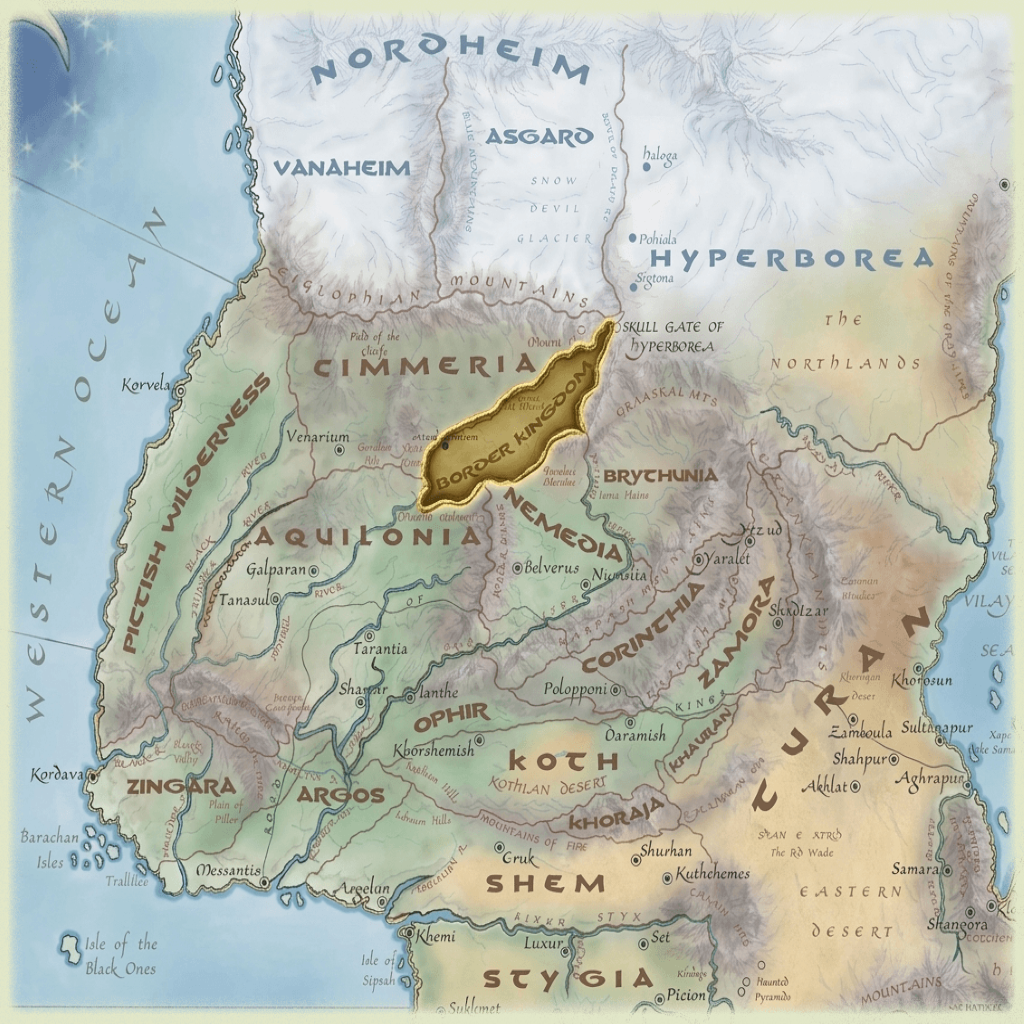

The Border Kingdom serves as a safeguard between the civilized nations of Brythunia and Nemedia against their savage northern neighbors. It is a Hyborian kingdom, home to exiled nobles, rebellious heirs, and criminals, serving as a dumping-ground for all manners of miscreants, outlaws, and unwanteds from across the lands.
The Borderland is a rocky and unwelcoming wasteland plagued by almost-constant rain. The cold, wet climate leaves much of the land as sodden moors cloaked in dense fog day and night. There are sparse forests along the edge, which play host to a number of dark and terrible creatures.
Notable Geographic Features: Landmarks
- Great Salt Marsh: A dreary basin that may be the remnant of a great inland sea created by the Cataclysm. Few venture into the marsh, preferring the treacherous but decidedly safer outskirts. It is a boggy, swampy, largely treeless land plagued by demon bats, feral wild dogs, and dangerous vipers. Beastmen hunt here freely and uninhibited.
- Skull Gate: A passage between the Border Kingdom and Hyperborea. The Skull Gate takes its name from the shape of the land surrounding the passage. It is rumored those who travel without permission through the Skull Gate do not return.
- Eiglophian Mountains: A huge mountain range that shields and separates the northern kingdoms of Vanaheim, Asgard, and Hyperborea from the south.
- Ymir's Pass: A rocky valley that passes through the mountains separating the Border Kingdom from Cimmeria. Although the hill-bred Cimmerians have no need for a pass-through, those traversing the mountain range on horseback or in wagons must make use of the pass or travel southward around the mountains.
Notable Settlements
To those unfamiliar with its harsh and unforgiving climate, the Border Kingdom appears uninhabited. Foot trails and secret passages scattered about the dense forests and foggy swamps are known only to those who live there. Small villages are scattered across the land, inhabited by a variety of people struggling every day to survive. There are nearly two thousand settlements hidden among the Borderlands, punctuated by nine large towns. Trade routes are established between towns by merchants who sell rare and sometimes illegal wares, which resident barons allow in exchange for a small cut of the profits.
Cragsfell
The largest of the Border Kingdom towns, Cragsfell exists on the west side of the borderlands. Its trademark is helmets with bull's horns and shields decorated with the head of a bull. The people of Cragsfell are generally fair-haired and blue-eyed, being distant relatives of the Gundermen. The town is run by a chieftain who may be either male or female. The surrounding area is heavily wooded, where pigs and crops are grown in abundance. Every citizen is armed with at least a spear, often accompanied by a hunting bow. Each autumn, the town celebrates the Festival of the King Bull. Cragsfell is home to over 4,000 people.
Atzel
Atzel is ruled by a Robber Baron and lies north of Cragsfell. Its fortress lies astride Ymir's Pass, and its walls stretch entirely across the pass-through. This strategic position allows the Baron to collect his toll from all who would pass through his gates.
Ramuda
A lively town focused on trade, Ramuda was once ruled by a Baron who claimed to be a scholar. His hoard boasted a tome that allegedly held the secrets of poisons, love potions, and spells to summon a demon. The townspeople eventually killed the Baron, only to discover the fabled tome was nowhere to be found. Some claim it vanished upon the Baron's death.
Ravengard
The Baron of Ravengard enforces taxes on trade caravans passing through his territory. He is known to send his men after those who do not stop to pay what he considers their fair share.
Regional Lore & References
Additional settlements and details regarding the specific political boundaries of the various petty barons can be found in The Road of Kings, pages 20-21.

The Border Kingdom is a kingdom in name only. It lacks a unifying monarch, central administration, or national law. Instead, the land is a fractured patchwork of petty fiefdoms, each ruled by a Robber Baron who operates with absolute autonomy.
The Rule of Barons
The political landscape is shaped by the "unwanteds" of the Hyborian world. These barons are almost exclusively exiled or rogue nobles from nations like Nemedia, Aquilonia, and Brythunia. When they flee their homelands, they bring their own customs, heraldry, and legal habits with them, resulting in a confusing mosaic of cultural rules that change every few miles.
- Absolute Authority: Within the shadow of his own keep, a baron is the law. They do as they wish, answering to no higher power than the strength of their own hired blades.
- Feudal Fragmentation: Because there is no king to settle disputes, these baronies are often in a state of cold or hot war with one another over border stones, livestock, or trade rights.
The Economics of Extortion
In a land where the soil is largely inhospitable, fit mostly for raising hardy goats or sheep, the primary "natural resource" is the flow of foreign commerce. Most larger towns are strategically placed along the few viable trade routes that cut through the moors.
- The Robber Baron Model: The primary source of income for these rulers is the systematic extortion of merchants. Barons provide "safe passage" through their territory in exchange for heavy revenues, tolls, and bribes.
- A Calculated Risk: Despite the constant threat of extortion, merchants continue to use the Border Kingdom as a transit point. This is because the bribes and tolls demanded by the barons, while steep, are still significantly lower than the official tariffs and heavy taxes imposed by the organized bureaucracy of Nemedia.
- Desperation and Looting: The stability of this arrangement depends entirely on the wealth of the baron. While the more established rulers understand the value of a recurring "customer," more desperate or impoverished barons will frequently abandon the pretense of protection and simply loot a caravan outright.
Subsistence and Survival
Outside of the trade-route towns, government is non-existent. Small pockets of land permit subsistence farming, where peasants live in a state of perpetual anxiety. They are technically subjects of whichever baron can reach them, paying taxes in the form of grain or livestock to avoid having their hovels burned.

In a land comprised of the world's "unwanteds," the social culture is defined by a razor-sharp focus on survival and a cynical tolerance for the bizarre. There is no national identity; instead, there is a shared understanding that everyone in the Borderlands is there for a reason, and usually, that reason is a dark one.
The Survivor's Mindset
Outsiders from other territories or non-Borderer nations are almost always viewed as a threat. They are treated with hostility, distrust, and a level of paranoia that is necessary for survival. Because the environment is so harsh and brutal, the inhabitants value tangible tools over currency or empty promises.
- Valued Commodities: A hot meal, clean water, or a heavy cloak to ward off the perpetual damp are worth more than a pouch of gold.
- The Importance of Mounts: Horses are the most valued commodity in the kingdom. They are the difference between life and death on the sodden moors, and many a man will kill without hesitation over the possession of a sturdy horse.
Magic and the Occult
Magic, particularly dark magic and curses, is more prevalent in the Border Kingdom than anywhere else in the Hyborian world. The lawless nature of the land makes it a sanctuary for those whose research was deemed too dangerous or heretical for civilized nations.
- Sanctuary for Sorcerers: Many who practice the dark arts are exiled from their homes and find their way here, where they can explore, learn, and practice uninterrupted by inquisitors or fearful mobs.
- A Wide Berth: Those who wield magic are granted an appropriate amount of respect, though it is a respect born of fear. Most commoners give sorcerers a wide berth to avoid becoming the subject of a curse or a living component in an experiment.
Exiles and Oddities
The Border Kingdom serves as a living museum of the aberrant. Because other nations purge "monstrous" traits from their populations, these individuals eventually drift to the moors.
- Monstrous Features: Individuals born with horns, tails, animalistic eyes, or fangs, as well as "those who walk in two skins" (lycanthropes), are common sights.
- Settlements of the Shunned: These oddities occasionally find like-minded folk and establish small, isolated settlements. However, in the Borderlands, kinship does not always bring safety; the desperate nature of the land often turns even the most similar of exiles against one another.
Social and Sexual Liberty
Many of those exiled to the Border Kingdom were cast out due to aberrant or unwanted sexual practices. In the rigid, patriarchal societies of most Hyborian nations, such deviations are often capital offenses.
- Open Practices: The Border Kingdom is one of the only places in the world where homosexuality and other non-traditional lifestyles are practiced openly, or at least without the fear of immediate execution. In a land where a neighbor might be a sorcerer or a beastman, the locals are far less concerned with whom one loves than with who can hold a spear in a raid.

The physical presence of the Borderers is as fractured and chaotic as the land itself. Because it is a refuge for the unwanted and the criminal, there is no single "look" for the people of this realm; instead, it is a mosaic of every race in the Hyborian world.
Criminals of all sorts find refuge in the Border Kingdoms, and many have been hiding here for generations. Some of these raise their families alone in the wild, creating inbred hamlets and villages that eventually deteriorate into something less than human.
- Deformities and Mutants: Many inhabitants are marked with severe deformities. Unwary travelers may accidentally stumble into small enclaves of horned and hooved creatures, never to be seen or heard from again.
- Diverse Stock: Because those living in the Borderlands were generally sent there for a reason, a variety of skin tones, hair colors, eye shapes, and body types can be found among the inhabitants.
- The Human Element: Humans with their own vices are sometimes worse than what lurks in the swamps and forests. The general population consists of a desperate mix of people from all across the continent.

The people of the Border Kingdoms dress in whatever they can find, by whatever means they are able to acquire it. They think nothing of looting a corpse or stealing from passing caravans.
- Sources of Attire: Those with means trade for what they need, provided they cannot steal it. Their attire is heavily influenced by the neighboring kingdoms that lie closest to their village or town, as that is generally where their stolen goods originate.
- Function over Fashion: Clothing is worn strictly for protection and survival, and garments are used until they are threadbare and ruined. Fashion is not a factor when one is struggling to survive; Borderers do not care how their clothing makes them look, so long as it keeps them alive in the cold, wet climate.

Life in the Border Kingdom is stripped of the social pretenses found in more settled Hyborian nations. When every day is a struggle against the elements and the predatory nature of the land, traditional hierarchies often crumble in favor of raw utility.
Since life on the Border is built around constant survival, there are no distinct gender roles. The harsh reality of the wasteland dictates that every man, woman, and child is responsible for looking out for themselves as best they are able. In this environment, those who are not able to perform necessary tasks for themselves simply perish.
- Fluid Unions: Marriage is not socially important in this region. People often throw their lives in together to increase their chance of survival or for passing enjoyment.
- Transience: These unions are rarely permanent. When the pleasure or the mutual benefit is gone, so, too, is the union, and all parties move on to whatever comes next.

Other than those who travel with the well-guarded caravans, people in the Border Kingdom tend to remain close to home for most, if not all, of their lives. Stepping too far beyond the familiar boundary of one's village is incredibly dangerous.
- Kidnapping: Predatory raids are a constant threat. Kidnapping and slavery are common occurrences, as human life is often viewed as just another resource to be exploited by the stronger barons or desperate outlaws.
- Non-Human Threats: The countryside is largely inhabited by sub-humanoid demons and degenerate species that view humans as prey. Notable threats include:
- The Yemli: Predatory entities found within the Haunted Lands.
- The Beast-Men: Feral hunters that dominate the Great Salt Marsh.
- The Degenerates of Eridu: Regressive populations that haunt the ruins and wastes of the eastern reaches.

Economic life in the Border Kingdom is a brutal cycle of subsistence, theft, and exploitation. Without a central government to regulate markets or mint currency, trade is a primitive affair governed by the immediate needs of survival.
Economy of the Wasteland
While much of the land is inhospitable and fit only for raising goats and sheep, a few small areas allow for a margin of subsistence farming. Beyond these meager agricultural efforts, the economy relies heavily on the movement of foreign goods through the territory.
- The Robber Baron Toll: Larger towns exist primarily on trade routes. Robber Barons earn their living by extorting revenue from traders in exchange for safe passage. While some desperate barons will loot caravans regardless of any promises made, merchants tolerate these indiscretions; despite the trickery and extortion, the cost is still lower than the tariffs and taxes levied by the bureaucratic machine of Nemedia.
- Production and Theft: Everything offered for sale in the Borderlands is either made locally or stolen. Most people do not engage in traditional trade, preferring to take what they need if they can. They only part with their own goods when it becomes absolutely necessary for their own survival.
Currency and Value
There is no centralized authority to mint coins, meaning the Border Kingdom lacks a formal currency. The economy operates on a raw metal standard.
- Metal Weight: The value of a coin is directly proportional to the amount of metal in it. The heavier the coin, the more value it holds, regardless of the specific metal it is made of or the kingdom from which it originated.
Daily Life and Movement
The settlements of the Border Kingdom are defined by isolation and the fear of the dark.
- The Draw of Towns: Youths in villages and small settlements often flock to the larger towns seeking romance and excitement, creating a bustling and lively environment during the daylight hours.
- Nightfall: Despite the bustle of the day, most people retreat into homes, inns, and taverns at night to stave off the cold and protect themselves from the predatory things that lurk in the alleys after nightfall.
- Danger of Travel: Outside of the fortified towns, people stay very close to home. Traveling is considered far too dangerous for the average person, as kidnapping and slavery are common practices across the countryside.

Faith in the Border Kingdom is a fragmented collection of ancient Hyborian traditions, imported northern cults, and strange, localized mysteries. Because the land is a haven for exiles, religious practice is often more raw and uninhibited than in the civilized south.
Major Deities
The religious landscape is dominated by the survival of older Hyborian beliefs alongside newer influences.
- Bori: The most commonly worshipped god is still Bori, the father of the Hyborian people. Most households maintain small shrines to him and make regular obeisance for blessings on crops, childbirth, and prosperity.
- Mitra: Worship of the Hyborian god of light has become common enough to maintain a significant presence, though it lacks the rigid institutional control seen in Aquilonia or Nemedia.
- Tharapita: Chief among the older gods is Tharapita, a storm and nature god known for breaking the statues of rival deities. His worship is primarily practiced by witches and shamans, typically within sacred oak groves.
- Ymir: The Frost Giant god of the north has dedicated worshippers scattered throughout the territory, likely influenced by the proximity to Cimmeria and Nordheim.
The King Bull
The King Bull is a sacred symbol in the western portions of the Border Kingdom, considered the living embodiment of luck and the fertility of the flocks and herds.
- The Living God: The spirit of the King Bull is believed to inhabit the body of an actual bull, which is treated as a deity. If the bull loses its virility and is not killed by a challenger, it is slain in a careful ritual using a specific ceremonial knife. Ancient custom forbids raising any other weapon against the King Bull.
- The Festival of the King Bull: An annual festival is held where all travelers are left unmolested and feuds are temporarily set aside.
- The Sacred Ritual: On the second day, noble women gather for a ritual that is forbidden for any man to witness, under penalty of death. This involves offering a sacrificial woman to the bull. While this usually results in the woman's death, any child born of such a union is considered blessed, though they rarely survive more than a few minutes after birth.
Witchcraft and Cults
The Border Kingdom is a sanctuary for those who practice the occult without interference.
- Witchcraft: This is far more common here than in any neighboring kingdom. Practitioners seek out the Borderlands for the freedom to act as they wish, often blending their arts with the worship of Tharapita or other dark entities.
- Chieftain Cults: In reclusive territories, some inhabitants worship former chieftains who built cult-like personalities around themselves, elevating these mortal men to the status of minor gods over generations.

To play a Borderer is to play a survivor in a land of lawless moors, jagged peaks, and ancient shadows. You hail from a realm where the law is only as strong as a baron's sword arm and where survival is a daily triumph over the elements, the occult, and the desperate. Whether you are an exile seeking a new life or a native born to the mist, you are defined by your resilience.
Core Identity
- Race: Primarily Hyborian (but with significant genetic variety due to exiles and refugees).
- Region: The Border Kingdom — The desolate buffer between Hyperborea, Nemedia, and Brythunia.
- Hair Color: Highly varied due to mixed heritage. You will find everything from the flaxen blonde of Brythunian refugees to the dark brown of Nemedian outlaws.
- Eye Color: Completely mixed. Brown, grey, green, and blue are all common, with no single color dominating the lawless settlements.
- Language: A rough, pragmatic trade-tongue. It is a melting pot of Nemedian, Brythunian, and Aquilonian dialects, often spoken with a harsh, survivalist brevity.
- Names: Often simple or stolen from other cultures.
- Male: Gorm, Kael, Rolf, Varek, Brand.
- Female: Elspeth, Mara, Thora, Helka, Sola.
Origins and Heritage
In the Borderlands, your history is often a secret you keep close to your chest.
- The Native Borderer: Born in a small, mud-walled village or a larger town like Cragsfell. You are pragmatic, wary of strangers, and value a sturdy horse or a warm cloak over gold.
- The Civilized Exile: You or your parents fled a nation like Nemedia or Aquilonia. Whether you are a disgraced noble, a criminal on the run, or a practitioner of forbidden arts, you carry the lingering habits of your homeland tempered by the harsh reality of the moors.
- The Monstrous (Optional): If you possess "oddities" like small horns or animalistic traits—often the result of the land's ancient sorceries or isolated bloodlines—the Border Kingdom is one of the few places you can walk somewhat openly, though you still face the dangers of a lawless land.
Personality Archetypes
Borderers have little patience for the flowery courtesies of the south.
- Straight-Talker: You value honesty in a deal, even if that deal is extortion, because you know how quickly things can turn lethal when words are wasted.
- The Superstitious Survivor: In a land where witches in oak groves and beast-men in marshes are real threats, you likely carry small charms or observe local taboos regarding the King Bull or the elder spirit Bori.
- The Rugged Individualist: You do not wait for a city watch to protect you. You assume that if you cannot solve a problem with your own hands, it will not be solved.
- The Fatalist: Living on the edge of the world breeds a dark sense of humor and a belief that today may very well be your last.
Combat Roles and Equipment
- The Moor-Scout: A master of stealth and navigation. You favor the hunting bow, the hatchet, and light leather armor that doesn't get bogged down in the sodden marshes.
- The Robber-Baron's Man: A heavy-hitter serving a local warlord. You wear mismatched pieces of mail and plate salvaged from battlefields and carry a heavy spear or an executioner's axe.
- The Hedge-Wizard/Witch: A practitioner of forbidden or "low" magic. You likely use herbal poisons, charms, and ancient staff-fighting techniques to keep enemies at bay.
- The Border Guardian: Defending the few stable settlements like Cragsfell. You are a versatile combatant, equally skilled with a crossbow from a wall or a broadsword in a skirmish.
Social Rank and Law
There is no central throne in the Border Kingdom. Society is a collection of small, isolated pockets of power.
- The Warlord/Baron: A leader who has carved out a small territory through violence. Your status is absolute within your walls and nonexistent ten miles outside of them.
- The Free-Villager: A resident of a town like Cragsfell. You enjoy the safety of numbers but pay a heavy price in taxes or service to the local lord.
- The Wanderer/Outlaw: Someone who belongs to no fief. You are free, but you are also fair game for any hunter or beast that finds you in the wilds.
- The Temple Outcast: Many who were expelled from the organized churches of Mitra or Ibis find a home here, practicing their faith in crude, wooden shrines.
Cultural Flavor and Visuals
- Appearance: Often weather-beaten and scarred. Tattoos are common, used to mark clan ties or to ward off "evil eyes" in the mist.
- Clothing: Practical and layered. Heavy wools, fur-lined cloaks, and waterproofed leathers are essential for surviving the damp, foggy climate.
- Weaponry: Practicality over beauty. You carry weapons that can also serve as tools: woodcutting axes, hunting knives, and sturdy spears.
Roleplay Hooks and Concepts
- Bounty Hunter: Tracking a Nemedian political prisoner who has vanished into the vast Borderland marshes.
- Relic Hunter: Seeking the lost sword of a giant-king rumored to be buried in a cairn near the Hyperborean border.
- Vengeful Peasant: Your village was razed by a marauding Brythunian lord; you are hunting him through the lawless moors.
- The Accidental Scholar: An exile from the Iron Tower of Tarantia who came here to study the ancient, pre-human ruins that dot the landscape.
- Protector of the Grove: A follower of Wiccana or Bori tasked with preventing a local baron from logging a sacred, haunted forest.

The Border Kingdom is a region of lawless transition, geographically analogous to the modern German Baltic Sea coast, the low countries, or the historic "Debatable Lands" between Scotland and England.
Primary Sources
- The Hour of the Dragon: Conan's travels through the region on his way to Nemedia provide the primary canonical context for the kingdom's role as a buffer state.
- The Road of Kings (p. 18): Detailed geographical and political overview.
- Return to the Road of Kings (p. 58): Expanded lore on the petty baronies and the culture of exiles.
- Faith and Fervor: In-depth analysis of the religious practices, including the worship of Mitra and the older Hyborian gods.
- King Bull (p. 94): Detailed information on the sacred bull rituals and western border traditions.
- Mitra (p. 90): Context on the spread of the Mitran faith into the northern borderlands.
Historical and Cultural Analogues
To better understand the "vibe" of the Border Kingdom, consider researching the following:
- The Anglo-Scottish Border Reivers: For the culture of "Robber Barons," cattle raiding, and lawless marshlands.
- The Teutonic Frontier: For the harsh, forested Baltic atmosphere and the clash between old gods and new faiths.
- The Medieval "Waste": For the concept of inbred hamlets and the deterioration of social order in isolated, hostile environments.