
The Lay of the Land
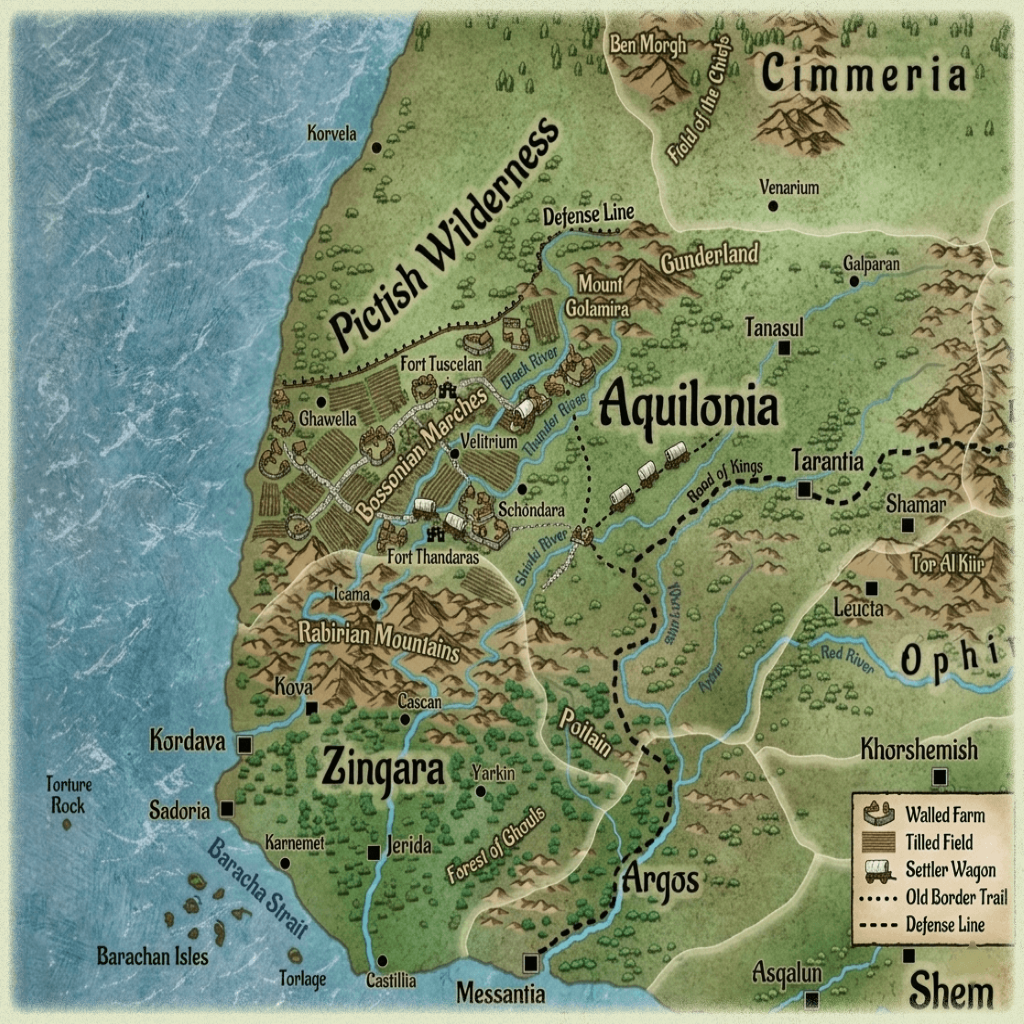
The Marches stretch from the confluence of the Thunder and Shirki Rivers in the south to the easternmost limits of the Border Kingdom. This territory encompasses unique regions such as the Tauran and Gunderland.
- Village Life: This is primarily a land of sturdy farmers and small, tight-knit villages. Due to the proximity of hostile neighbors, these settlements are almost universally walled for defense.
- Military Thoroughfare: The region is characterized by the constant movement of troops. Columns of soldiers are a common sight, either marching north and west to reinforce the borders or heading south when recalled to handle Aquilonia's internal conflicts or skirmishes with neighboring nations.
- The Frontier Trail: As the frontier is perceived to grow safer, the sight of settlers with their covered wagons and wains has become increasingly common along the trails, signaling a period of cautious expansion.
Notable Settlements
Galparan
Galparan is the largest settlement and the only true city within the Bossonian Marches. It is a thriving center for trade and home to tens of thousands of residents.
- Architecture: It is a heavily walled city. As the population swelled over the years, many new sections were added to the original fortress core, creating a sprawling, layered defense.
- Trade Hub: Situated on the Shirki River, Galparan serves as a bustling trade port and the primary gateway between the Aquilonian heartland and the Marches.
- Culture: While Aquilonian influence is felt strongly here, it acts more as an overlay upon an older, deeply rooted resident culture rather than a total replacement.
Velitrium
Though famous in frontier lore, Velitrium is the second-largest town in the Marches. It is a fortified settlement designed for war, surrounded by a massive defensive wall.
- Garrison: The town is held by a well-armed garrison of Aquilonian soldiers and Bossonian auxiliaries, always prepared to repel a Pictish assault.
- Strategic Importance: It stands as a vital military anchor for the defense of the western frontier.

The Bossonian Marches occupy a unique political position. While they are technically a province of the Aquilonian Empire, the region is governed with a heavy hand by military appointees rather than a local landed nobility.
The Rule of Duke Callius
The city of Galparan, and by extension the entire Marches, is ruled by Duke Callius. He was appointed to this position by King Numedides himself and remains a close confidant of the Aquilonian monarch.
- A Ruthless Governor: Callius is an ambitious and ruthless man who views the entirety of the Bossonian Marches as his personal domain. He is charged with the absolute defense of Aquilonia against threats from the north and west.
- Civil Unrest: His tenure has been marked by brutality; Callius has put down many attempted uprisings among the local populace. As a result, he is deeply despised by the Gundermen and Bossonians alike, and his name is a curse throughout the Westermarck.
- Economic Extortion: The Duke imposes increasingly onerous taxes on all trade goods heading toward the frontier. Additionally, he frequently forces settlers traveling through the region to pay for military escorts, regardless of whether the settlers want or need the protection.
Social Hierarchy and Leadership
Unlike the Aquilonian heartland, the Bossonian Marches possess a very flat social structure. There is a conspicuous absence of a local upper class.
- No Native Aristocracy: There are no Bossonian aristocrats. The people have no lords of their own blood to represent their interests to the King.
- The Common Classes: The population consists entirely of villagers, farmers, traders, and soldiers. Leadership within the villages is usually informal or based on military rank and experience rather than birthright.
- The Military Backbone: Because every man is a soldier by necessity, authority often falls to veteran bowmen or garrison commanders who have proven their worth in Pictish skirmishes.

The people of the Marches are a unique breed, distinct from the pure Hyborian stock found in the heart of Aquilonia. They are a frontier people, forged by thousands of years of holding the line against the most savage tribes of the world.
Ancestry and Temperament
The racial stock of the true Bossonians is older than the Hyborians who surround them, and even older than the Gundermen, who are considered the purest of the Hyborians.
- Aboriginal Roots: Originally descended from barbaric stock associated with the Picts, they are the remnants of an aboriginal people. Over centuries, they have intermingled with their Aquilonian conquerors, adopting their language and customs, while their own native tongue has faded into little more than a regional dialect.
- Resilience: In temperament, Bossonians are universally stubborn and resilient. Their culture is a direct result of being squeezed between the constant threat of Cimmerian and Pictish raids and the aggressive political pressure of Aquilonia.
- Honor and Survival: Many possess a strong, rough sense of justice. A civilized code of honor is common among the soldiery. In this land, dexterity and intelligence are prized above all else, as the ability to move silently, hide, and shoot accurately are the primary skills required for survival.
The Bossonian Longbowmen
No description of the Marches is complete without praising their archers, who are famed throughout the Hyborian kingdoms.
- A Lifetime of Training: A child born in the Marches has barely weaned when a bow is placed in their hands. By the time they reach adulthood, a Bossonian is deadly beyond compare with a sturdy longbow, perhaps matched only by the nomadic Hyrkanians of the far East.
- The Weapon: Strength is a necessity for these warriors, as the pull of a full-sized Bossonian longbow is immense. The weapon is designed for range and piercing power, capable of dropping a charging Pict or a plate-clad knight with equal efficiency.
- Warfare: Clad in distinctive armor consisting of tough boiled leather jackets and iron skull-caps, these archers are the backbone of Aquilonia’s border campaigns. Because the northern Cimmerians and Nordheimers generally despise archery as a "cowardly" means of battle, the Bossonians wreak havoc among their ranks, breaking charges before the enemy can even close for hand-to-hand combat.

The people of the Marches are physically distinct from the Aquilonians they serve, reflecting a lineage that predates the Hyborian migration into the West.
Most Bossonians are slightly darker in coloration than the average Hyborian. Their hair is typically light brown or brown, making the straw-blonde hair associated with the lineage of Bori a rare sight in the region.
- Aboriginal Heritage: Many in the Marches still display the features of their ancestral, aboriginal heritage, belonging to tribes that inhabited the land long before the Hyborians arrived.
- Physique: Those of true Bossonian stock tend to be darker-complected with darker hair and eyes. Physically, they are often shorter and squatter than individuals of pure Hyborian descent, possessed of a compact, powerful build well-suited for the strength required by their heavy longbows.

Bossonian clothing is practical and layered, designed to provide warmth and protection in the temperate but often damp frontier climate.
Women's Dress
- Undergarments: Women wear short, sleeveless slips called pelicons as their base layer.
- Chainses: Over the pelicon, they wear long-sleeved, ankle-length chainses.
- Kirtles: The outermost layer is the kirtle, which features a shorter skirt and long, flaring sleeves.
- Outerwear: Cloaks or capes are common, typically fastened securely at the throat.
- Hairstyles: Hair is traditionally worn in braids. However, unmarried women and young girls are permitted to wear their hair down.
Men's Dress
- Tunics and Surcoats: Men typically wear sturdy tunics paired with surcoats. On the frontier, these are often reinforced with leather or heavy wool to withstand the rigors of outdoor labor and military service.
- Military Gear: When on duty, the standard "uniform" consists of the famed boiled leather jackets and iron skull-caps, which provide essential protection without sacrificing the mobility needed for archery.

The social structure of the Bossonian Marches is a blend of traditional Aquilonian patriarchy and the harsh, practical demands of frontier survival.
As a province of Aquilonia, Bossonia is fundamentally a patriarchal society. However, the grueling reality of life on the border forces a level of self-reliance and versatility not seen in the more sheltered heartlands of the empire.
- Frontier Responsibilities: Bossonian women take on labor that their peers in the capital would rarely attempt. This includes homesteading, hunting, trading, chopping wood, and leatherworking.
- Defenders of the Hearth: When the men are called away to join the great Aquilonian armies, the protection of the household falls entirely on the women's shoulders.
- Combat Readiness: Bossonian females are famously fierce. Should Pictish, Cimmerian, or other northern invaders threaten their homes, they take up bows and short swords to defend the walls of their villages. They serve as a critical, often overlooked line of defense keeping the borders of the Hyborian kingdom safe.

The economic and social priorities of the Marches leave little room for the institution of slavery, which is common in other Hyborian nations.
- Absence of Slavers: There are no native Bossonian slavers. The culture is focused on production and defense rather than the subjugation of human property.
- Trade Priorities: For the people of the Marches, trading for vital survival goods, such as iron, grain, and livestock, takes absolute priority. This focus on essential commodities has made the slave trade virtually non-existent within the province.

The economic and professional life of the Bossonian Marches is defined by its role as a military buffer zone. Every profession, from the lowly farmer to the highest scholar, is viewed through the lens of frontier utility and survival.
Specialized Martial Professions
In the Marches, the line between "civilian" and "soldier" is often nonexistent. Many citizens possess skill sets that combine traditional labor with military application.
- The Archer-Hunter: Archery is the most important skill in the region. Bossonians are without equal in the Hyborian Age for bowmanship, which naturally translates into careers as master hunters and skilled trackers.
- The Soldier-Thief: Traditional thievery is rare among Bossonians. Instead, those with a penchant for stealth are trained as guerrilla fighters. These specialists combine sneak attacks with their legendary archery to harass invaders or scout ahead of Aquilonian legions.
- The Frontiersman: These are matchless warriors and rugged frontiersmen of formidable skill. They serve as the premier soldiers of Aquilonian expansionist armies, often being the first to break ground in new territories.
Trade and Commerce
Without trade, the frontier would cease to exist. The movement of goods is the lifeblood that keeps the walled villages populated and supplied.
- Daring Merchants: Bossonian free townsmen are known as bold merchants and daring tradesmen. They risk the dangers of the Pictish border and the extortion of Duke Callius to move goods.
- Primary Imports and Exports: Locals trade for spices, silk, and specialized equipment from the capital of Tarantia. In exchange, they provide cattle, food, and high-quality hides.
- Bossonian Whiskey: The region is famous for its whiskey, a potent and rugged spirit that is highly sought after in taverns across the western kingdoms.
Scholarship and Engineering
Scholars in the Marches are practical men. You will find very few sorcerers here; instead, the intellectuals focus on the physical sciences.
- Engineers: These scholars are tasked with building the fortified cities and defensive walls of the frontier. When military-minded, they specialize in the construction and operation of massive siege engines.
- Adjutants: These are scholar-soldiers who serve as advisors to military leaders. They combine historical knowledge and strategic theory with the practical realities of command.
Lore Note: Bossonian Whiskey
It is worth noting that in Howard's Beyond the Black River, the beverage of choice for frontier soldiers was often "ale" or "wine" imported from Aquilonia.

The spiritual life of a Bossonian is a peculiar mix of Aquilonian dogma and frontier superstition. While they claim to be civilized, the proximity of the ancient, dark forests forces them to keep one eye on the gods and the other on the woods.
Religion and Worship
Though primarily Mitran, it is not uncommon for Bossonian hunters to thank the "Beast Lord" (a vestige of their aboriginal, pre-Hyborian past) for a successful hunt. Their superstitious nature rationalizes this blasphemy easily; in a land so inhospitable, it is best to take a "better safe than sorry" attitude.
- Life's Fragility: In such a harsh land, a Bossonian is acutely aware of how quickly life can be extinguished. This awareness fosters a deep respect for the natural world. Every plant and every animal is seen as vital to their own survival.
- The Protector Instinct: This translates to Bossonians being very protective of those they deem less capable of defending themselves. They are famously shielding of children, small animals, and their homesteads. While the society is patriarchal, a Bossonian man views the protection of his family as his most sacred, god-given duty.
Cultural Allies and Enemies
The Bossonian perspective on the world is narrow and focused on the safety of the frontier. They judge other nations based on how much of a threat they pose to the peace of the Marches.
Allies
- Corinthia: Trade routes through the passes often link the two, and they share a common wariness of the larger expansionist empires.
- Gunderland: Although they have their squabbles, the Gundermen and Bossonians are the twin pillars of Aquilonia's military might. They share a mutual respect for each other's martial prowess.
Enemies
- The Picts: They are the eternal enemy. War along the border is a constant, bloody cycle of raids and counter-raids that has lasted for millennia.
- Cimmerians: These northern barbarians raid Aquilonian lands regularly, descending from their hills to loot Bossonian granaries.
- Nemedia: As the primary rival to Aquilonian supremacy, Nemedia has resisted the empire for generations. Bossonian archers are frequently deployed to the eastern borders to break Nemedian knight-charges.
- Stygia: While distant, the Bossonians revile them as "Setites." To a follower of Mitra, the snake-worshipping sorcerers of the south represent the ultimate moral corruption.

To play a character from the Bossonian Marches is to play the ultimate survivor of the Hyborian frontier. You are a product of a culture that values the steady hand, the keen eye, and the iron will required to hold the line against the encroaching dark of the Pictish Wilderness.
Core Identity
- Race: Hyborian (An ancient, sturdy branch of the race).
- Region: The Bossonian Marches — The western frontier of Aquilonia.
- Language: Aquilonian (A rough, military dialect with many loanwords from the Pictish and Cimmerian tongues).
- Hair Color: Uniformly dark brown or dull brown, typically worn in practical, un-ornamented styles.
- Eye Color: Striking, pale grey or cold blue eyes that sparkle sharply beneath their brows, famous for their legendary, long-distance vision.
- Names: Often short and blunt, reflecting their pragmatic nature.
- Male: Gorm, Hagar, Jarl, Brant, Tor, Kael.
- Female: Elspeth, Mara, Verna, Thora, Helga.
Cultural Archetype: The Frontier Shield
Attributes: Focus on Dexterity and Awareness. The ability to track a Pict through a silent forest and loose a shaft at fifty paces is the hallmark of your people. Willpower is also vital, as Bossonians are famously stubborn in the face of impossible odds.
- The Look: You have a sturdy, compact build. While your hair is typically brown, you likely possess the striking grey or blue eyes that mark your ancient lineage. You favor practical, layered clothing over the silk finery of the south.
Skills and Talents
- Master of the Longbow: You were born with a bow in your hand. You gain natural bonuses to Ranged Combat (Bows). You understand the mechanics of the Bossonian longbow, a weapon requiring immense strength to draw but capable of piercing heavy plate armor.
- Woodsmen and Scouts: Your childhood was spent in the walled villages and surrounding woods. You are proficient in Survival, Stealth, and Animal Handling, specifically regarding the livestock that fuels the Marches' economy.
- The Guard's Discipline: You have a high threshold for fear. Bossonians are trained to stand firm in their ranks even as a screaming horde of Picts or Cimmerians charges their position.
Combat Roles and Equipment
- The Longbowman: Wearing a brigandine or light mail hauberk, you carry a quiver of heavy, broad-headed arrows and the legendary longbow. You carry a short sword or a heavy knife for close-quarters work.
- The Frontier Pikeman: Specialist in holding the line. You carry a long pike and a large rectangular shield for defense against charging infantry.
- The Border Scout: Lightly armored in boiled leather, you are a master of forest warfare, using a hatchet and a light bow to pick off targets from the shadows.
Social Rank and Status
The Marches are technically under Aquilonian rule, but the social structure is shaped by military necessity.
- Garrison Veteran: A respected member of the local community who has survived multiple Pictish incursions.
- Village Elder/Yeoman: A land-owning farmer who manages the fortified hamlets and local defense levies.
- The Displaced: Many Bossonians have seen their homes burned by raiders, living as nomadic warriors or taking up the life of a mercenary in the south.
- The Military Attache: A rare Bossonian who has risen in the ranks of the Aquilonian army, serving as a tactical advisor on northern threats.
Religious and Cultural Beliefs
- Mitra of the Frontier: While they worship Mitra, the faith in the Marches is stripped of its southern finery. It is a god of walls, protection, and the strength to stand firm.
- The Pictish Taboo: Bossonians have a deep, ancestral hatred and respect for the Pictish Wilderness. They often observe small, practical taboos to avoid drawing the attention of forest spirits.
- Ancient Lineage: There is a quiet pride in the fact that Bossonians have held the frontier since before Aquilonia was an empire.
Roleplay Hooks and Concepts
- The Veteran: You served in the garrison at Velitrium and have seen the horrors of the Pictish frontier. Perhaps you are now a mercenary, or you have been sent to the capital as a military attache.
- The Oppressed Farmer: Fed up with the crushing taxes and arrogance of Duke Callius, you have left the Marches to find a fortune that the Duke cannot touch.
- The Adjutant: You are a man of letters and tactical maps, trained to advise the knights of Aquilonia on how to survive the "savage" north.
- The Avenger: Your fortified village was razed by a Pictish war-party; you travel the world to find the sorcerer-priest who led them.
- The Defector: A former scout who realized the "civilization" you were protecting was just as corrupt as the wilderness you were fighting.

The Bossonian Marches are a blend of military tradition and ancient, pre-Hyborian roots. They represent the wall that allows the rest of Aquilonia to flourish.
Core References
- The Hyborian Age (REH): The foundational text detailing the Bossonians as a "civilized" aboriginal hybrid and their critical role in the defense of the West.
- Beyond the Black River (REH): The primary narrative source for frontier life, depicting the archers' bravery and their specialized equipment like the iron skull-caps and leather jerkins.
- Aquilonia: Flower of the West: A deep dive into the province’s relationship with the capital, detailing the political tension between the local populaces and the appointed governors.
- Faith and Fervour: Information on the localized worship of Mitra and the lingering superstitions regarding the "Beast Lord" of the forests.
- Return to the Road of Kings: Essential for the geography of the Shirki River and the specific layout of fortified towns like Velitrium and Galparan.
Supplementary Materials
- The Compendium: Provides technical data on the construction and power of the Bossonian Longbow.
- The Warrior's Companion: Details the guerrilla tactics used by Bossonian "soldier-thieves" and the organization of the archery corps within the Aquilonian military.
- The Hour of the Dragon (REH): Highlights the loyalty, and the limits of that loyalty, of the Bossonian archers during the Nemedian invasion.