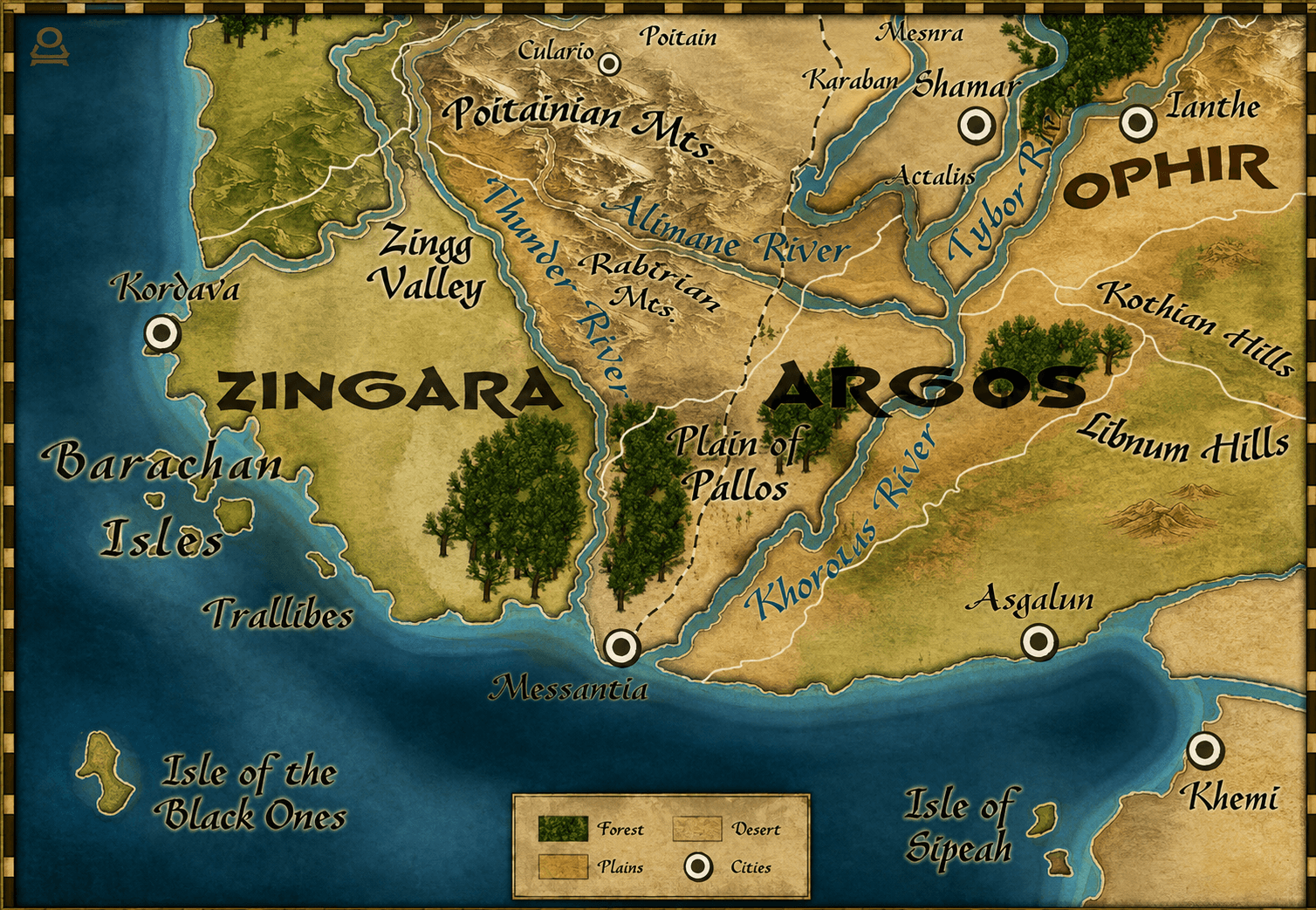

The coast of Argos has many harbors. Although most of them are not used for commercial reasons, they do serve as convenient hiding places for pirates and merchants hiding from pirates. The countryside of Argos is largely wooded, although large farms and orchards line the fertile Khorotas valley. Outside the valley and away from the coasts, the countryside slowly starts to resemble Shem, shifting from woodlands to rolling, bare hills. Towns and villages become rarer and further apart toward Shem and are more dependent on wells for water than on rains or rivers. On the other side of the Khorotas River, the landscape grows more and more wooded, eventually merging into the ghoul forests of Zingara.
The roads that interconnect all the various sea-ports run through knife-edged ravines and other convenient places of ambush for inland raiders. Approximately sixteen cities glitter along the beautiful coast of Argos, with an average population of around 11,800. Messantia, in contrast, is a metropolis with over 35,000 inhabitants. Most of the inland residents live in towns and villages; approximately 85 towns and 9,000 villages can be found throughout the wooded kingdom.
Notable Geographic Features: Rivers & Plains
- Alimane River: The Alimane has many fords, so it is not navigable for most of its reaches, although trade routes lie alongside the river. One such ford is the Nogara, which lies near the Saxula Pass of the Rabirian Mountains. It is one of three fords that lead from Argos to Aquilonia.
- Astar River: The Astar is an Argossian tributary of the Khorotas River. There is a ford in Hypsonia that crosses the river. The river forms a border between Hypsonia and the Plain of Pallos and flows to the south of the Rabirian Mountains.
- Khorotas River: This is Argos' major river, running through Poitain and Ophir and emptying into the sea at Messantia. Although it cannot be navigated by large vessels because of the cataracts it passes through in Poitain, some goods can be moved along it once it is joined by the Tybor. Goods being transported to Messantia from the caravan route through Ophir are placed onto barges at the Tybor-Khorotas junction. The region around the Khorotas River is Argos' most fertile area; its annual flooding brings soil from beautiful Poitain and its mountains.
- Thunder River: This is another important river for Argos and is a point of contention with Zingara, who covets it so it can have a port at its mouth. It is named the Thunder River for the long stretches of white-water rapids in northern Zingara and southern Bossonia. The port city of Napolitos sits at its mouth.
- Plain of Maru: This is a flat plain of grasses around the city of Athos. The plain is located in northeastern Argos.
- Plain of Pallos: This fertile plain lies at the foot of the Rabirian Mountains.
Provinces & Landmarks
- Arond: Arond is an eastern province of rolling, bare hills. It is lightly populated and is most noted for its artesian wells, which are wells of the necessary depth to produce water without the need for pumping. Arond is not a particularly fertile land.
- Didymian Hills: The Didymian Hills lie between Messantia and the Plain of Pallos. The area is famous for its olive production and its dairy products. Shepherds keep large herds of sheep and goats in these low-lying hills. Fiefs and manors in this area are sought-after by lords.
- Hypsonia: Hypsonia is a province in central Argos. The Astar River passes along the border of this province, separating it from the Plain of Pallos.
- City of the Ghouls: This city is somewhere deep within the primeval forests near the Zingaran border. The ghouls of the border country make their homes here, ranging out by night to capture and devour unwary travelers. (Detailed further in Ruins of Hyboria).
- Bezfarda: Bezfarda is a manor near a tangled forest where rumors claim a unicorn lives. Decades-old tales tell of a red-haired devil-woman who lives with the unicorn.
- Eidoran: Eidoran is a ruin on a plateau in the mountains of eastern Argos.
- Skranos: Skranos is a fortress in the Rabirian Mountains. It is built of concentric squares with thick walls. A herd of mammoths is maintained in the center. The fortress-city is home to some 300 warriors.
The Islands: Orabono and Orinolo
East of Messantia, several miles offshore of the Argossian/Shemite border, lie a pair of islands known to Argossians as Orabono and Orinolo.
- Orabono: The western island of Orabono is its brother's opposite in nearly every way. Orabono boasts a wide harbor on its northern shore, plentiful fruit trees, and grasslands. Certainly the most important feature of Orabono is the Argossian naval base and settlement at Trabatis. Logging camps and farmlands grow more prevalent outside the city as the merchant houses begin to exploit this virgin territory. What crops and timber are not needed in Trabatis itself are exported elsewhere, generally back to Messantia. On the shallow waters off the beach lies an enormous oyster bed, which is mined for pearls. Any slave who works the pearl beds for four months is freed. There are still occasional problems with crocodiles and poisonous snakes. The forests of Orabono are home to enormous bears, boars, leopards, and sabre-toothed cats, as well as several colonies of giant spiders on the southern coast.
- Orinolo: Orinolo is very nearly inaccessible. It is ringed on the south, west, and north by great crumbling cliffs, which offer no sanctuary or harbor to a ship. A ship attempting to drop anchor near one of these shores would likely be pulled toward the island and dashed against the rocks by the treacherous tides that swirl among the cliffs. Should someone manage to reach the cliffs without falling prey to any of the perils at their base, he would find the climb all but impossible. The very stone seems rotten with the sea's erosion, and firm handholds are difficult to find. On the eastern side of the island, the sea slowly gives way to land in a thick, fetid swamp haunted by saltwater crocodiles, poisonous snakes, spiders the size of a man’s head, and worse. Ships cannot reach the island by traversing the swamp; even a small boat will run aground or become lodged on the submerged trunk of a rotten tree.
Important Argossian Cities
Messantia
Messantia is the capital city of Argos and is Argos' richest sea-port. It lies at the mouth of the Khorotas River and has no walls, relying on the sea and its navy to protect it. The city serves as a trading center as well as a shipyard for much of the world. The city's laws are designed to protect the rich and those employed by the city, and those laws are often overlooked in regards to sea-rovers, especially the Barachan pirates. The city has an estimated population of 35,400, which fluctuates during the year, reaching its peak during the trading season. Here also resides King Milo of Argos and his court. Messantia is also an anchoring end of the Road of Kings and the beginning of many caravan routes into the interior nations. The main road to Tarantia first winds through the Argossian kingdom, then moves along the eastern border of Poitain. Another route to Tarantia goes northwest into the ghoul forests of Zingara, then along the Zingaran shore of the Alimane. (Detailed further in Messantia – City of Riches).
Athos
Athos is an upland Argossian city located on the plains of Meru whose citizens are "fat, richly-garbed, and cruel as fiends." It is a decadent city where pleasure is foremost on the minds of its citizens. Athos was once ruled by a queen and is still resplendent in its fabulous wealth. The turrets and towers of the city are made of ivory and many of its domes are gilded. Its population wears jewels from Khitai, and its streets are perfumed with oils from Vendhya to provide visual and olfactory pleasures to those that wander the city. It has enslaved its sister city across the river, Zotoz. The people worship the goddess Gita, an insect goddess. Every year Athos sponsors a sporting event called the Games of Gita.
Napolitos
Napolitos is a powerful city situated at the mouth of the Thunder River. It has a massive population exceeding 17,000 and is a growing trade city, a fact that infuriates Argos' rival, Zingara. Napolitos is a chaotic city that grows in a haphazard fashion as different conquerors add to it. It mixes Acheronian, Hyborian, Shemite, and Zingaran influences in its architecture and art. It is easy to get lost in Napolitos.
Venzia
Venzia is a seaport that has canals. The avarice of its merchants puts gods of greed to shame. Venzia has a population exceeding 13,000.
Zotoz
Zotoz is a city of the uplands of Argos. It lies on a small river across from the city of Athos. The impoverished population of Zotoz are subject to the city of Athos. The people of Zotoz are physically stronger than their masters but, due to their long struggles in abject poverty, are weak in spirit.

Argos is a feudal kingdom ruled by King Milo, yet its political heart beats in the ledgers of its merchant princes. While it follows the traditional Hyborian structure of fiefs, counties, and baronies, the true power is anchored in wealth and maritime supremacy.
Political Organization
The land of Argos is split into different fiefs, counties, and baronies, ruled by counts or barons. Unlike many other Hyborian nations where nobility is strictly a matter of bloodline, most of Argos’ wealth is held in the hands of the merchant houses. These houses hold much of the power as well, and most of Argos’ barons and counts come directly from these mercantile dynasties.
- Regional Sovereignty: The various fief-holders beneath King Milo administer their own estates and exercise their own justice. Most of them mint their own money, levy whatever taxes and tolls they want, and field their own private armies. Although each has pledged fealty to King Milo, these individual lords are supreme within their territory.
- Political Stability: Argos is more politically stable than most of the Hyborian realms. While Aquilonia seems to be constantly rebelling and fighting, with provinces ceding and being reacquired, the fighting between the various houses, nobles, and lords in Argos is largely economic and political; it rarely involves actual military action.
- Military Status: Beneath the king, the counts, the barons, and the houses are the military officers. As ship captains and generals of armies, these individuals hold significant status and respect in Argossian society.
The Social Ladder & Slavery
At the bottom of the social ladder in Argos are the slaves. Despite the stratification of its society along the lines of wealth, Argos remains fairly stable.
- Gladiators: The strongest and most spirited slaves fight as gladiators for the pleasure of the Argossians. Occasionally, slaves can win their freedom if their skills and prowess are spectacular.
- Slave Raiding: Argos raids for slaves along the coasts of Kush and the Black Kingdoms. Kushites are not the only slaves in Argos; people from other races also serve as personal slaves of important merchants.
Economy & Strategic Interests
Argos has much to defend. In addition to its trade routes and wealthy merchants, the land itself is economically vital.
- Natural Resources: Much of the forests of Argos are used for timber to build ships, as well as to grow fruits and nuts in well-tended orchards. Its large forests provide a massive economic advantage that the nation puts to good use.
- Prime Location: Argos possesses a central location on the coasts of the charted continent. The wide Tybor River channels a massive amount of trade from the interior Hyborian nations into Messantia, allowing Argos to dominate maritime commerce.
- Trade Partners: From its central location, Argos trades not only with Shem and Zingara but also with Stygia and, to a lesser degree, with the Black Coast.
Law, Piracy, and the Corsairs
Messantia and the other ports in Argos are famously lax about laws. Because they make their money from sea trade, they recognize that illegitimate trade is often just as profitable as the legal variety.
- Piracy: Argos often turns a blind eye to most acts of piracy. Interestingly, the Barachan pirates tend not to prey upon Argossian vessels, instead intercepting trade moving toward Argos’ ancient rival, Zingara.
- The Black Corsairs: The Corsairs are a different matter entirely. They burn and destroy anything they do not want, taking anything they do want without remorse or care. They do not, in general, trade. The Corsairs and their activities are not appreciated by the Argossians; they rather fear the Black Corsairs, including the legends of Amra, the bloodiest and most horrible of the Corsairs ever to sail the ocean.
- Judicial System: Killing town guards is strictly illegal, as is refusing to testify in court. However, the legal system is far from impartial; the courts heavily favor the rich in suits against merchants or commoners.

Argossian society is a study in contradictions: highly stratified by wealth yet remarkably stable, obsessed with public honor yet privately pragmatic, and possessing advanced medical theories despite a complete lack of formal schooling.
Social Stratification
Argos stratifies its society along wealth lines. This hierarchy dictates not only a person's power but their legal standing and social access.
- The Monarchy: At the top of society is the King and his royal family, extending out to cousins, uncles, and other extended family members.
- The Nobility: Beneath the King are the nobles of the merchant houses and interior fiefs.
- The Middle Class: Beneath the nobles are the wealthy merchants and ship captains.
- Freedmen: Freedmen living in the cities or working on the ships lie below the merchant class.
- The Laboring Order: Laborers, including peasants, serfs, and cottagers, are among the lowest of the classes.
- The Bonded: Slaves are the lowest of the stratum. Gladiators are among the lowest ranks, though their unique position gives them rare opportunities to mingle with the upper classes.
Reputation and the Code of Honor
Argossians do not believe in judging themselves; they always look to others to determine the opinion they should hold about themselves.
- Public vs. Private: Reputation is vital to the Argossians. Most hold, or pretend to hold, a civilized code of honor. However, this is largely performative. Argossians make sure others see them upholding the code, but when there are no witnesses, they do not feel compelled to hold to the code at all.
Health and Medicine
Cleanliness and Baths
A defining characteristic of Argossian medicinal theory is cleanliness. Virtually all Argossian cities have thermal baths, both public and private. Healers recommend cleanliness and moderation in diet and wine as the primary defenses against illness.
The Four Temperaments
Argossian doctors believe there are four basic temperaments that must remain in balance: Jovial, Amorous, Choleric, and Phlegmatic.
- Prescriptions: Treatments are usually based on diet to bring these into balance. For example, a "choleric" person is deemed to have too much fire in the body and is prescribed "cool" foods like fish.
- Behavioral Health: Sickness is attributed to three things: natural degeneration (aging), natural predisposition (genetics), and immoderate behavior or lifestyle excesses (sins against Mitra).
The Medical Profession
Healers are trained to "read" the body as a text, looking for imbalances in the skin or excreted fluids.
- Physicians vs. Surgeons: Trained healers of the clergy or noble orders rarely perform surgeries, as it is considered "labor" and unsuitable for their station.
- Barber-Surgeons: Minor surgeries, including amputations, tooth extractions, and cataract surgery, are performed by educated laborers like barbers. These surgeons are considered public servants rather than doctors and hold a low social status.
Education and Upbringing
Unlike most of their Hyborian neighbors, Argos has no schools or academies of any kind.
- Family Apprenticeship: Each family educates their offspring in the family craft or business.
- Tutors: Noble folk often hire tutors or highly-appreciated educated slaves to teach their children subjects the parents cannot.
- Alternative Paths: When parents have too many children, the younger ones are often taken in by priests of Mitra or merchant guilds to be taught a new occupation.
Piracy and the Law
While laws in Argos are generally lax, the state maintains a deliberate "blind eye" toward piracy, provided it serves Argossian interests.
- The Barachan Connection: Most Barachan pirates are Argossians. They leave Argossian ships alone and primarily target Zingaran vessels. Because of this, they enjoy a safe harbor in Messantia for their illegal business.
- The Black Corsairs: Unlike the Barachans, the Black Corsairs are not welcome. They do not discriminate when attacking, burning, and killing. They are the only type of pirate truly feared and shunned by the Argossians.
Entertainment and Sport
Social activities are essential to Argossian life across all classes.
- Gladiator Matches: Slaves and prisoners are forced to fight each other or animals. Under King Milo's rule, most matches are no longer to the death, except for cases where condemned men are slated for slaughter.
- Public Festivals: Argossians enjoy boat, horse, chariot, and foot races. Theater, music, and lavish feasts (both private and public) are common sources of entertainment. One of the most famous events is the Games of Gita, a sporting event sponsored annually by the city of Athos.

The people of Argos are a cosmopolitan mix. As a nation of sailors and merchants, their physical traits reflect centuries of contact with every corner of the Hyborian world.
Argossians tend to be tanned or swarthy, with dark hair and eyes. This coloring is a result of both their heritage and a life lived under the bright sun of the southern coast. Because Argos is a melting pot of trade, mixed blood is extremely common.
- Diverse Traits: While the "typical" Argossian has the olive skin of the coast, features vary wildly from person to person. It is not unusual to see Argossians with the height of an Aquilonian, the stocky build of a Shemite, or the sharper features of a Zingaran.
- Grooming: Men usually wear their hair short, a practical choice for life at sea or in the heat of the docks. The presence of beards and mustaches is a matter of personal taste, though well-groomed facial hair is common among the merchant class. Women traditionally wear their hair long, often intricate and braided among the wealthy.

The climate of Argos is generally warm, dictated by the proximity to the sea and the southern sun. Consequently, their fashion prioritizes light, breathable fabrics like linen, cotton, and light wool.
- Color Palette: The Argossian aesthetic favors white or muted, earthy colors. These shades are practical for reflecting the sun's heat. Vivid dyes are rare for daily wear among the commoners, though they are used as accents in embroidery.
- Men's Fashion: Men typically wear a distinctive type of robe that is knotted in the front. Over this, a cape is slung across the shoulders. For a commoner, this cape is a simple, protective garment. For a man of means, the cape is a status symbol, featuring detailed and rich embroidery that displays his family or merchant house's wealth.
- Women's Fashion: Women wear long, floor-length tunics. These garments are often pleated to provide a sense of volume and grace, with decorative patterns or contrasting colors along the edges. In the upland cities like Athos, these tunics become much more transparent and daring compared to the more conservative styles of the rural interior.
- Footwear: Sandals are the most common choice for the coastal heat. Ankle boots and sturdy shoes are used by sailors, laborers, and those traveling the ravines of the interior.
- Jewelry and Status: As with all things in Argos, wealth is the ultimate divider. The wealthy dress in far more luxurious fabrics, often incorporating silk from the East. They favor heavy gold jewelry, signet rings for business, and necklaces featuring pearls harvested from the beds of Orabono.

In Argos, the social dynamics between the sexes are slightly more fluid than in neighboring kingdoms, though the underlying traditional structures remain firm. While men and women mix more freely here than in many other Hyborian nations, women still navigate a society that places significant demands on their labor and loyalty.
Gender Roles and Expectations
Argossian women, whether noble or peasant, hold a difficult position in society. They are primarily responsible for the domestic sphere, yet the maritime and often volatile nature of Argossian life requires a certain degree of self-reliance.
- Domestic and Martial Duties: Women are often assigned tasks such as cooking, baking bread, sewing, weaving, and spinning. However, unlike the sheltered women of more "refined" southern courts, Argossian women are also expected to be capable with weapons to defend their homes and families when the men are at sea or away at war.
- Occupations: Because women outnumber men in Argos, it is not unheard of to encounter well-respected female blacksmiths, merchants, apothecaries, midwives, field hands, writers, musicians, dancers, and painters. Many women learn a trade from a father or husband and simply carry on the man's work as the head of the establishment after he dies.
- Urban vs. Rural Life: Women tend to have an easier time in rural settings where their labor is viewed as an essential partnership. Urban Argossian women tend to be more pigeonholed, as many guilds will not admit women except through the legal standing of their husbands. This often makes establishing oneself as a professional single woman in the city quite difficult.
Love and Marriage
Marriage in Argos is a bridge between families, serving as a tool for economic stability or political advancement.
- Paternal Control: Women remain under the legal control of their fathers until the day they marry, at which point authority is transferred to the husband.
- Arranged Marriages: Among the aristocracy, marriages are almost strictly arranged. In these circles, a woman’s lands and her potential children are considered too important to the family’s legacy to be given away indiscriminately. Marriage is a contract designed to merge merchant houses or consolidate fiefs.
- Peasant Unions: Peasants generally enjoy more free choice in their marriages. Because their dowries are either small or nonexistent, there is less pressure from the family patriarchs to use the marriage as a financial maneuver, allowing for unions based on mutual attraction or practical partnership.

While Argos prides itself on its civilized veneer and merchant laws, its economy and entertainment are fueled by a brutal system of human bondage and organized vice.
Slavery in the Merchant Kingdom
Slavery remains an active part of Argossian life, though its visibility varies. While the average Argossian owns no slaves, primarily because he has little need for them, the merchant and noble classes consider them a practical and status-driven necessity.
- The Oaring Benches: The majority of slaves owned by Argossian interests rarely set foot in a city. They spend their entire lives chained to the oaring benches of merchant galleys and warships. No free man will work the oars with the relentless consistency that a slave can be forced to provide.
- Labor and Construction: Other slaves are used as heavy laborers. Most of the massive coastal cities in Argos were constructed through the back-breaking work of slave labor.
- Origins: Most slaves are taken during raids along the coasts of Kush and the Black Kingdoms.
- Legal Standing and Treatment: The life of a slave in Argos is horrific. They are at the beck and call of their masters in all ways, including sexual. However, Argossian law provides one small protection: a master cannot legally kill a slave unless that slave has previously attempted to escape.
Gladiatorial Games
Argos is famed throughout the Hyborian world for its gladiatorial games. These exhibitions serve as a ritualized outlet for man's repressed savagery.
- The Arena: Slaves and prisoners are forced to serve as gladiators, fighting other slaves or wild animals. Condemned men are given no such chance to fight; they are simply slaughtered by professional butchers or fed to savage beasts for the crowd's amusement.
- Settling Disputes: Landowners, lords, and barons frequently use gladiatorial bouts to settle land disputes. Instead of going to war with a neighboring lord, they host a game to settle the matter. While this saves the peasantry from the ravages of war, it creates a constant demand for fresh slaves. Argos remains a heavy participant in the slave trade simply to supply the wealthy with enough gladiators to satisfy their needs.
Prostitution and the Port Cities
Prostitution is a venerable and accepted tradition in the ports of Argos, including the capital, Messantia.
- The Temptresses: Argossian temptresses are usually found in the port cities, entertaining sailors and pirates. Their goal is often to cash in on the loot brought in from the sea.
- Informants: Some of these women keep an ear out for news of rich hauls or vulnerable merchant ships, reporting this information to their "pet" pirates in exchange for a share of the plunder.
- Heritage: Many of the most sought-after temptresses in Argos are half-breeds, the beautiful sons and daughters of Argossians and foreign slaves, mistresses, or wives. These mixed heritages are prized for their exotic beauty in the crowded, cosmopolitan docks of the coast.

In Argos, commerce is more than a livelihood; it is the foundation of the state's power. As the self-proclaimed trading capital of the world, Argos boasts a professional landscape that is both specialized and highly organized.
Employment and Specialization
The majority of Argossians are employed by the age of 14 or 15. The range of possible occupations varies enormously, and all manner of jobs can be found within the kingdom, especially in the bustling coastal cities. While a wide variety of roles exist, certain crafts have become more relevant and specialized than others, leading to the formation of powerful guilds.
- The Guild System: Craftsmen such as bakers, stone masons, carpenters, and cobblers belong to influential guilds. These organizations serve to protect their members, regulate the quality of work, and ensure their respective businesses remain strong and exclusive within the city markets.
- Urban Opportunities: While men hold the vast majority of these specialized roles, the sheer density of the sixteen coastal cities provides a professional variety unmatched in most other nations.
The Merchant Houses
The true masters of Argossian trade are the members of the Merchant Houses. These are not merely businesses, but dynastic entities that bridge the gap between commerce and nobility.
- Mercantile Nobility: Because of their immense wealth and political leverage, the members of these houses are considered to be of noble blood. Their influence is so pervasive that the line between a "merchant prince" and a "fief-lord" is often nonexistent.
- Trade Control: The Merchant Houses maintain extensive influence over both maritime and land trade. They control the flow of goods, the setting of prices, and the security of the primary trade routes within Argos and its neighboring waters.
Global Commerce
Argos serves as the world's clearinghouse. Its central location allows it to act as the primary intermediary for goods flowing from the heart of the continent to the far-flung shores of the south and west.
- Trade Partners: Argos maintains a steady and lucrative trade with Shem, Kush, Zingara, Stygia, and the Black Coast.
- Commodities: They trade literally everything. As a global trading hub, Argos has nearly any resource available for purchase or barter. Whether the goods are produced domestically, such as timber, olives, and dairy, or imported from distant eastern or southern nations, one can find them in the markets of Messantia.

Religion in Argos is as varied as its ports. While Mitra is the primary deity of the kingdom, the Argossian spirit of trade and pragmatism has allowed for the inclusion of foreign gods and obscure, ancient mysteries.
The Cult of Mitra
Mitra is regarded as the one true god, a commander of a heavenly host standing in the universe with no pantheon nor even a consort to support his cosmic reign. The Argossians acknowledge a host of Mitran saints, similar to the devotions seen in Aquilonia.
- Tolerant Faith: Unlike their Aquilonian neighbors, Argossian followers of Mitra are generally apt to tolerate other cults. However, the worship of Set is still viewed with extreme suspicion and anger.
- Theology: The religion includes a concept of Judgment, implying a heaven and a hell for the faithful and the wicked.
- Aesthetic and Ritual: Even in Argos, the Mitran religion refrains from ostentatious displays. Temples are awesomely plain, stately, and artistic, lacking the ornate symbols prevalent in other Hyborian temples.
- Sacrifice: The altar is a symbolic gesture; the Mitran religion strictly forbids the sacrifice of humans or animals. An idealized statue of the deity is permitted to help the faithful visualize the divine, but the statue itself is not worshipped, as Mitra's true form is unknowable.
Bel (The Shemite God of Thieves)
Imported from the Shemite pantheon, Bel is the deity of thieves, freebooters, and fences. He is often depicted as an eagle carrying two thunders, symbolizing his ability to steal even the power of other gods.
Philosophy: Bel's priests, often experienced pirates and thieves, teach that all human skills, including the ability to sneak and steal, come from a divine source. Those with these talents are meant to use their "gifts" as a vital part of society.
Divine Roles: Surprisingly, Bel's priesthood is divided into specialized roles focusing on healing and the supernatural:
Asu: Dedicated healers.
Ashipu: Specialists who deal against the arcane and malevolent spirits.
Baru: Diviners and healers who read the past or future in the entrails of animals or humans.
Taboos: Bel's followers despise necromancy and strictly avoid any pacts with demons. Worship does not include sacrifice; offerings are generally kept to the level of lip-service.
Gita (The Spider Goddess)
Gita is an obscure goddess quietly worshipped in the backwoods and hills of Argos. She is viewed as the "weaver of the world," and her followers believe that every living soul is attached to her web of fate.
- Principles: The cult preaches cunning, patience, industry, and skill. They believe that art and beauty are the direct results of these virtues.
- Social Outlook: Followers believe in the superiority of noble blood. Some members of the cult even engage in specialized breeding programs designed to produce high-quality slaves.
- Worship: This is a religion based on deep mysteries. Unlike the Mitran or Belite faiths, worship of Gita includes blood sacrifices of both humans and animals.
To play an Argossian is to embody the spirit of a worldly, pragmatic survivor from a land defined by the salt of the sea and the weight of gold. Whether you are a merchant-prince, a hardened sailor, or a silver-tongued thief, your identity is rooted in the pursuit of wealth and the careful management of your public reputation.
Core Identity
- Race: Hyborian (often with Mediterranean-like features: olive skin and dark hair).
- Region: Argos — The Maritime Jewel of the West.
- Language: Argossian (A cosmopolitan tongue filled with nautical terms and loanwords from Shem and Zingara).
- Hair Color: Predominantly raven black or deep, dark brown. Thick and often styled to handle the sea wind.
- Eye Color: Typically dark brown or liquid amber, though ancient sea-faring bloodlines occasionally throw unexpected hazel eyes into the mix.
- Names: Often sound melodic or classical.
- Male: Publius, Ariosto, Milo, Titus, Santino.
- Female: Livia, Drusilla, Messalina, Nerina, Vespera.
Regional Backgrounds
The specific environment of your upbringing determines your comfort zone and starting expertise.
- Coastal Argossian (The Sea-Wolf): A child of the docks, shipyards, or merchant houses. You are comfortable in teeming crowds, savvy about maritime law, and likely speak a smattering of three or four different languages.
- Inland Argossian (The Valley-Dweller): From the fertile Khorotas valley or the rocky hills bordering Shem. You are more traditional, tied to the powerful trade guilds or the agricultural life of the interior. You view the sea with a mix of respect and caution.
- The Messantian Urbanite: Born in the capital, you are a master of the "street-deal." You know that a bribe is often more effective than a blade, but you carry a stiletto just in case.
Personality Archetypes
Argossians are civilized on the surface but possess a core of pure, mercantile iron.
- The Pragmatic Merchant: You view every encounter as a transaction. Everything—and everyone—has a price.
- The Worldly Sailor: You have seen the ivory towers of Stygia and the jungles of Kush. You are less prone to superstition than inlanders because you have seen the world's variety.
- The Reputation-Seeker: You care deeply about your "public" honor. You will go to great lengths to appear virtuous, even if your private dealings are shadows and lies.
- The Ancient Rival: You possess an instinctive, burning distrust for Zingarans, a rivalry that spans generations of naval warfare and trade disputes.
Combat Roles and Equipment
- The Marine/Sailor: You fight best in light or medium armor (leather or reinforced gambesons) to avoid drowning if you go overboard. You favor the cutlass, the boarding axe, and the crossbow.
- The Guild Assassin: A specialist in concealment. You favor short blades, poisoned darts, and weighted cloaks.
- The Merchant-Soldier: Well-equipped thanks to your wealth. You may wear a fine breastplate over silk and carry a high-quality rapier or broadsword.
- The Khorotas Archer: Inland defenders who use sturdy hunting bows to protect the trade caravans from Shemitish raiders.
Social Rank and Status
In Argos, blood is thin, but gold is thick. Your "rung" is determined more by your purse than your pedigree.
- Merchant House Scion: You belong to one of the great families that control the shipping lanes. You have resources but also immense pressure to turn a profit.
- Guild Freeman: A respected member of a professional organization (Shipwrights, Vintners, or Weavers). You have legal protections and a steady income.
- The Freedman: A former slave who has bought or earned their liberty. You are the ultimate self-made individual, often more driven and ruthless than those born to comfort.
- The Galley-Slave/Drifter: Those at the bottom of the cycle. You are looking for that one "big score" that will change your life.
Political and Religious Outlook
- Business Partners, Not Allies: Argos has no permanent friends. They maintain stable trade with Shem and Aquilonia, but only as long as the gold flows.
- The Zingaran Feud: Zingara is the eternal enemy. Whether on the battlefield or the trading floor, a Zingaran is never to be trusted.
- The Black Corsair Threat: Pirates are the one thing that can make an Argossian forget their greed and turn to genuine fear and hatred.
- Mitra of the Sea: While they worship Mitra, the Argossian version is less ascetic than the Aquilonian one. Here, Mitra is a god of contracts, safe voyages, and prosperous ventures.
Roleplay Hooks and Concepts
- Bankrupt Merchant: You lost your fleet to the Black Corsairs; now you are adventuring to pay off your debts to a dangerous crime lord.
- Disguised Noblewoman: Fleeing an arranged marriage to a Zingaran count, you've taken work as a ship's navigator.
- Caravan Guard: You know the trails to Shem like the back of your hand and seek a group to help protect a high-value shipment of "Lotus" or silk.
- Messantian Information Broker: You deal in secrets and ledgers, currently following a lead about a lost Acheronian artifact that could collapse a rival merchant house.
- Ex-Privateer: You spent years hunting Zingaran galleons with a letter of marque, but now the war is over and you're finding it hard to live a legal life.

To better understand the flavor of Argos, these Robert E. Howard stories provide the essential context:
- Queen of the Black Coast (REH): Essential for the atmosphere of the Argossian ports and the constant threat of piracy.
- The Hour of the Dragon (REH): Features Messantia and the Argossian coastline during Conan's escape and return.
- The Scarlet Citadel: Mentions the military and economic standing of Argos in relation to its neighbors.
- The Road of Kings: Provides the best geographical breakdown of the Khorotas River and the inland trade routes.
- The Warrior's Companion: Details the specific naval tactics and "ship-to-ship" combat styles unique to the Argossian marines.
- Black Colossus: Offers glimpses into the trade routes and mercenaries that flow through the Argossian interior.