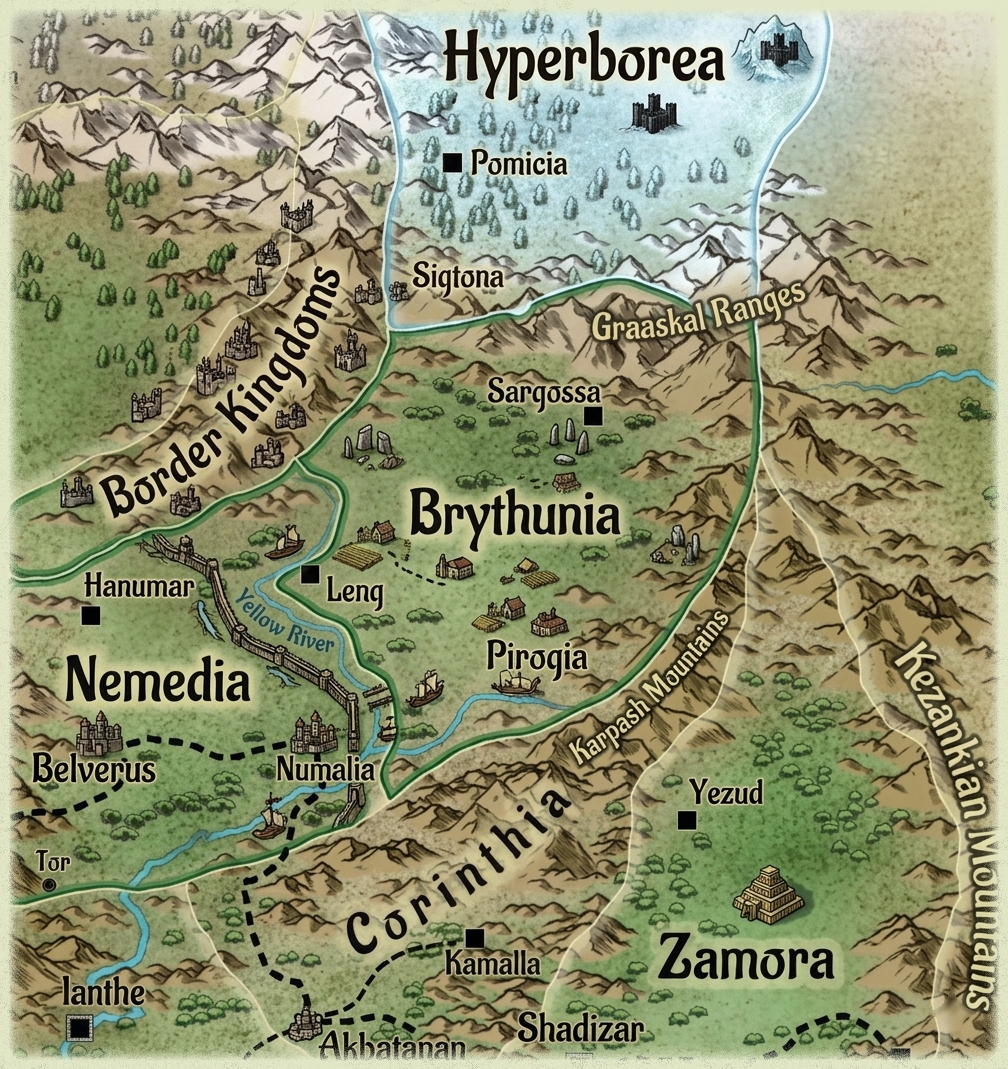

Southern Brythunia is largely forested but the northern reaches are considerably less so. Eastern Brythunia boasts a few swamps, many of which are reputed to be haunted. Eastern Brythunia is also rather mountainous and hilly, contrasting with the western plains. Many rivers bisect the interior of Brythunia, creating a very fertile, pastoral landscape.
Rivers and Waterways
- Danibos River: Danibos is a river. It flows south and west from Hyperborea. The city of Sargossa sits on its banks.
- Yellow River: This river runs along the western border of Brythunia until it forks in the southwest corner. Many historic battlegrounds lie on either side of the river, the sites of wars and skirmishes with Nemedia. This river flows to the north.
Mountains and Peaks
- Death Mask Mountains: The Death Mask Mountains can be found in central Brythunia. The range has four high peaks and contains a hidden valley. Dire wolves make their home in these mountains.
- Demon's Tooth Mountain: Demon's Tooth Mountain is a single mountain found in Brythunia, reputed to be the home of a sorcerer of dark power.
- Graskaal Mountains: These cold mountains form a harsh barrier against Hyperborea and are where Conan once found a sword in the crypt of a giant-king. These jagged mountains are cold and icy for much of the year. A frozen river runs eastward along the length of these mountains, which are wild, dark and gloomy even in the summer months. Pines and spruce and of great granite cliffs tower into the cold, icy sky. Numerous passes break through these mountains, especially in the northeast.
- Karpash Mountains: This long and rugged range of mountains forms the south-eastern border between Brythunia and Zamora. These mountains are known for volcanic activity and have pockets of gold and other rare ores. The mountains vary greatly in their composition and types of stone. Some areas are quite low and weathered; others rise up as monolithic monsters determined to stop all comers. Innasfaln is a village at the mouth of one of the few passes through this range, a pass called "The Path of the Serpent" for its winding, treacherous trail. Another notable mountain in the range is Broken Gray Mountain, which is said to house a crypt containing the Horn of Dagoth. A day's ride northwest of that mountain is Crater Lake. Another cave in this range is said to be the lair of a fire-drake. The Yezud pass cuts through these mountains between Brythunia and Zamora, leading toward Yezud.
- Kezankian Mountains: These mountains form a natural barrier between Brythunia and Turan. Many things lurk in these mountains, including ape-men and villages of hill people. The hill people of the Kezankians are notoriously hostile toward strangers. The range was created during the lesser cataclysm and is younger than some of the other mountain ranges in the known world. Ape-men dwell in the northern reaches of the Kezankians. Many passes breach this harsh wall of granite into the north-eastern portion of Brythunia.
Plains and Swamplands
- Lema Plains: This is a plains region in north-western Brythunia. It is composed primarily of prairies and ranges of open field. It lies to the south of the Great Salt Marsh of the Border Kingdom.
- Swamp of Souls: The Swamp of Souls is a desolate swamp. It is in north-eastern Brythunia, four days' ride from Bougankad.
Other Landmarks
- Phalander: Although this was once a town of southern Brythunia under the jurisdiction of Sargossa, it is now a volcanic ruin.
- Sacred Grove of Wiccana: The Sacred Grove of Wiccana is located near the Zamoran border and is an ancient grove of oak trees sacred to the worshippers of Wiccana.
Brythunian Cities and Towns
Brythunia boasts almost 26,000 small villages or hamlets and over 280 towns and cities of varying sizes. Only the largest Brythunian cities have walls. Most of the towns and villages, built against copses of coniferous trees or on mountainous crags, tend to be open to make entry easier for the farmers and herdsmen.
Fortified settlements tend to be built on hilltops, islands, peninsulas in the midst of lakes, rivers or swamps for better defence, especially against marauding Hyrkanian, Zamorian or Nemedian cavalry. If the Brythunians decide to fortify a town or area in a field or other flat land, they will divert a river to flood the plain and turn it marshy and soft to hamper potential enemies. Fortifications are usually wooden; stacks of wooden boxes filled with earth or rocks are often used. Water is essential to the lifestyle of the Brythunians, either to water crops or herds, so a strong river or babbling brook is always near a Brythunian village or town. Most Brythunian towns have a public bath or sauna for the men.
Major Cities and Settlements
- Berthalia: Berthalia has winding and narrow streets crowded with merchants. The city's biggest attraction is its bazaar, which is described as "well-stocked." It is governed by a weak and cowardly king who wears a horned crown. The city itself lies about six leagues from a particularly large mountain in the nearest range. It has a population of more than eight thousand people.
- Charnina: Charnina is a northern Brythunian city-state. The city itself is built around a feudal castle. Once the city state was ruled by King Brian but that king was killed in a war with Hyperborea. After Brian's death, the city-state fell into anarchy and two local lords, Pollus and Ludox, fought for the kingdom. Pollus was killed by his sorceress, Zuchan of Khitai, leaving a nearly levelled city in the hands of Lord Ludox. The city has since been rebuilt. The city has a wall around it and is supported by several village fiefs. Charnina has a population of nearly ten thousand people.
- Innasfaln: Innasfaln is a city in the Karpash mountains, reputed to have the smoothest ale in Brythunia and beautiful blonde Brythunian women who apparently live up to their reputation. The city lies on one of the few passes through the Karpash mountains. It is a small trading village of crude wattle-and-daub huts and a few stone, mud and pebble buildings. It has a population of approximately 500.
- Kelbaza: Kelbaza is a Brythunian city-state. Located on the Lema Plains in the north, this walled city has a notorious thieves' quarter and a well-known tavern known as "The Sword and Sky," where the lawless can gather upon the roof to fence items and tell tall tales. The roof is loaded down with stolen statues too heavy to carry off. Kelbaza's gate is closed at night. Kelbaza's ruler, Queen Thrine, sits on an ebon throne in the palace and is beloved by the people for her even-handedness. A mystical necklace of power is the holy symbol of her dynasty. Her brother, Throll, was king before her but was slain by her cousin, a sorcerer. The city itself has a population of almost 12,000.
- Leng: Leng is a walled town in the hills of eastern Brythunia. Its walls are made of rough stone and are in disrepair. Even the gates into the town are fallen and gone. Most of the buildings are also built low to protect them from the winds but the warehouses of the rich and wealthy tower four or five stories high. The town is largely lawless, used by bandits and vagabonds en route to other more prosperous places. The peasants here are herdsmen and wear tunics of hairy hides. The buildings are colourless and dreary but the city is polyglot and is host to a wide array of peoples and nationalities. Slavers use the town as a stopping point on the road to Zamora and the deserters of armies find a place of peace here. Conan calls the place a "ghost town come to life". It is an apt description. The city is large enough to support a population of over 6,000 but it currently houses only a few more than 2,000.
- Pirogia: Pirogia is a large walled city in the southeast of Brythunia. It is the capital of a large city-state broken up into smaller baronies. Built on the ruins of an older city, Pirogia is a favourite place for Zamorans to fence stolen goods or just relax among blond Brythunian women. A tavern known as The Pommel can be found in its seedier district and the Inn of the Golden Lion, which is located in a merchant quarter, is known for its beautiful dancers. The poorer buildings in the city are made of mud-brick and have crude roofs of wood smeared with pitch. The centre of the city comprises the deserted ruins of the older city. The ruins have been declared off-limits and the Pirogian guard chase away those who would trespass. This ancient centre is regarded with some superstition among the Brythunians. Eldran, the King of Pirogia considers himself the King of Brythunia and hopes to unify the city-states into a true kingdom. This metropolis holds 51,700 people within its boundaries.
- Potrebia: This is a southern Brythunian city-state. It boasts a shrine to Tolometh, a black god of the abyss. Potrebia boasts a population of approximately 10,000.
- Sargossa: Once ruled by King Typhas, Sargossa is a walled city in the northern portion of central Brythunia, capital of another powerful city-state. The metropolis is replete with seedy dives, brothels and criminals. Anyone the guard does not like is likely to find himself working in the hidden gold mines of the Karpash Mountains for the King of Sargossa. Prisoners in Sargossa are drugged with white lotus dust, a drug that blinds and paralyses, to keep them docile. The Danibos river waters Sargossa and creates lush, fertile terrain. The population is around 49,000.
- Shihar: Shihar is a frontier town in north-eastern Brythunia. The region is forested and is in sight of the great Kezankian Mountains. The town is protected by a wooden palisade of sharpened logs and the homes are also built out of logs.
- Sodgrum: This is a small village of central Brythunia that supports Sargossa as a fief. It has a population of 678 people.
- Urbander: The seat of one of the northernmost baronies in western Brythunia, Urbander is a provincial capital. It is strongly fortified to repel the attacks of the Border Kingdom robber-barons. It is a prosperous city, rich with trade and spoils from the Border Kingdom. Urbander hosts a powerful cavalry and is home to almost 16,000 people.
- Yarvash: Yarvash is a town in Brythunia with a temple to Amalias. This town is part of Sargossa's province. Yarvash supports a population of nearly 7,000.

While Aquilonia and Nemedia seem to have the feudal system down pat, Brythunia's government is less certain. Brythunia emerges as a kingdom without a sense of itself, a kingdom without a supreme feudal king or, rather, a kingdom with far too many "supreme" kings. Each city-state or province seems to fancy its capital as the capital of Brythunia and each king styles himself the King of Brythunia. Brythunia has its Gryphon Thrones, Ebon Thrones, and several others to be sure.
The governance of Brythunia is a fragmented patchwork of local authorities. Because there is no central crown, power is distributed through various titles and ranks:
- Kings and Ealdormen: Highest authority within a specific city-state or province.
- Palatines: These are the administrators of provinces, serving under a reigning king or a group of ealdormen. They often manage larger towns.
- Burgomasters and Elders: These officials run the smaller towns, handling daily civic duties and local commerce.
Land and Nobility
Aristocracy in Brythunia is based upon land ownership, and land in the fertile river valleys of the central and southern regions is considered particularly valuable. Nobility is not a matter of royal patents or the granting of fiefs, as it is in Aquilonia and Nemedia.
- Land-Based Power: Not all nobles own land, although the most powerful nobles always own land.
- Scale of Territory: This system creates much smaller provinces, counties, and minor kingdoms than is common in the more unified nations like Aquilonia or Nemedia.
The System of Law
The system of law in Brythunia is broken and disparate with little unity. It is a harsh and localized reality where the concept of "national justice" does not exist.
- Executions: In western Brythunia, slow impalement is the preferred method of execution.
- Penal Labor: Other places send criminals to work in secret mines in lieu of execution, such as the gold mines of the Karpash Mountains.
- Landowner Justice: Otherwise, punishment is meted out by the person who owns the land where a crime occurred.
- Appeals: Accused criminals usually do not have any opportunity for appeal unless the landowner "victim" owes some sort of fealty to a higher lord, which is highly unlikely in the fractured political landscape of Brythunia.

The social structure of Brythunia is a departure from the rigid feudalism of the western Hyborian empires. It is a nation built on clans, land ownership, and a pragmatic, if sometimes disorganized, approach to status and survival.
The Noble Class and the Clan System
Approximately 10% of the population belongs to the noble class. However, unlike in Aquilonia or Nemedia, these nobles are not tied to the land by feudal obligation, nor do they hold traditional hereditary titles.
- Functional Titles: Brythunian titles are job descriptions rather than birthrights. For example, a "Castellan" is the keeper of a castle, and a "King's Sheriff" is a high-ranking constable. Regardless of their specific job, members of this class refer to themselves as Lord or Lady.
- Clan Organization: Nobility is organized by clan. In times of war, clans fight together as a single regiment, sharing a common battle-cry.
- Political Power: Power is held by the Clan Ealdorman (the head of the clan). Each noble clan is permitted a single vote to confirm a king or make local decisions. This makes political allegiances and the courting of ealdormen essential for anyone seeking to control a region.
The Peasantry
The common folk are divided into three distinct classes based on their relationship to the soil:
- Landowners: Peasants who own their own land outright.
- Monetary Tenants: Those who pay a fee in currency to a noble or a land-owning peasant for the rights to farm.
- Labor Tenants: Those who pay for the use of the land through their own physical labor.
Honor and Foreign Influence
Allegiance and honor are important, but Brythunians are less rigid about these concepts than Nemedians. They are more accustomed to "unattached" persons and foreigners. Because of its location, Brythunia is a crossroads for Zamorans, Hyrkanians, and Corinthians, leading to a more polyglot and less insular culture than the larger Hyborian kingdoms.
Warfare and the Military
Brythunia follows the standard Hyborian tactical model, placing a heavy emphasis on cavalry, often at the expense of its own infantry.
The Three Stages of Battle
- The Volley: Armies exchange massive volleys of arrows.
- The Clash: Pikemen meet in the center until one line breaks.
- The Charge: Heavy knights in thick armor crash through the lines to decide the day.
The Infantry Deficit
Like many Hyborian nations (with the notable exception of Aquilonia), Brythunia lacks a trained professional infantry. Foot soldiers are viewed as "spear-fodder" rather than an honorable profession. Consequently, the local rabble is easily demoralized. To compensate, Brythunian city-states frequently hire foreign mercenaries to serve as their backbone on the ground.
Arms and Armor
- Standard Infantry: Most soldiers wear mail shirts under thick leather breastplates. They carry a diverse kit: bow and arrow, spear or pike, sword, pick, and axe.
- Noble Cavalry: These elites wear mail hauberks, breastplates, and distinctive fur-trimmed great helms. They charge with heavy lances, large shields, and greatswords.
The Hyrkanian Threat
Robert E. Howard records that Turanian raiders often ride through Brythunia with ease to reach Corinthia and Nemedia. This highlights the lack of national unity; Brythunians are often terrified of the wild Hyrkanian horsemen who sweep through the plains to burn, loot, and take slaves, with no central army capable of stopping them.

The Brythunians are a striking branch of the Hyborian race, shaped by their fertile environment and their proximity to the ancient, shadowed empires of the East.
General Appearance
While the Brythunians are primarily Hyborian, their lineage is more complex than the "pure" stock found in Gunderland.
- Physical Features: They are characterized by pale skin and blonde tresses. However, the golden hair of the Brythunians often has a softer, flaxen quality compared to the rugged North.
- Ancestral Blending: Their blood has intermingled significantly over the centuries. To the south, Zamorian influence has introduced occasional dark-eyed individuals, while to the west, the descendants of ancient Acheronians, refugees from a fallen, corrupt empire, have left a mark of high-bridged noses and a certain aristocratic "fine-boned" structure in some lineages.
- The "Brythunian Beauty": Across the Hyborian kingdoms, Brythunian women are legendary for their beauty, often cited as a primary "export" in the tragic slave markets of Zamora and Turan due to their distinctive fair features.

Brythunian fashion is a tapestry of Western structure and Eastern flair, heavily influenced by their neighbors and the varying climate of their plains and mountains.
The Nobility and Wealthy Gentry
The upper classes look toward Nemedia for style, but they are not afraid to incorporate exotic elements from the East.
- Sleeves and Pockets: A unique Brythunian trend involves over-long sleeves that often trail on the ground. These flamboyant sleeves frequently contain hidden pockets for personal items or small valuables.
- Eastern Influence: Turanian caftans are highly popular among the nobility. However, to adapt to the chilly Brythunian nights, especially in the north, they line these silk or cotton garments with thick, luxurious fur.
- Marital Status: Headwear is a significant social marker. Unmarried women never wear hats or caps. The act of placing a hat or cap upon a bride's head is a central and sacred part of the Brythunian wedding ceremony.
The Peasantry
Social hierarchy is strictly enforced through dress; peasants are legally forbidden to emulate the fashions of the nobility.
- Outdated Styles: Typically, peasants dress in simple, durable versions of fashions that were popular among the lords decades or even centuries prior.
- Practical Layers: The standard kit for a peasant man includes a linen shirt, woolen pants, a fur hat, and a heavy coat. Women wear one-piece pullover gowns paired with decorative corsets, jackets, and one or two outer gowns for layering.
- Survival Gear: Because of the harsh northern winds, almost all clothing, for both men and women, is lined with fur. Most peasants own at least one sturdy coat of wool or sheepskin, and the more prosperous among them keep a set of "festival clothes" for holy days.

As in all Hyborian nations, men take the dominant role in Brythunian society. The culture is deeply patriarchal, with strict social codes governing the interaction between classes and sexes.
- Social Reputation: A pervasive and often derogatory stereotype exists across the Hyborian Age regarding Brythunian women. Rumors and jokes portray them as being especially eager and willing for sexual play. This reputation, while largely a product of foreign prejudice, heavily colors how they are treated by outsiders and even by their own nobility.
- Marriage Customs: When a household has a young girl of marriageable age, the parents hang a wreath outside their door as a public signal. A man wishing to marry does not usually approach the family directly; instead, he consults a wise woman or a respected male elder to act as a marriage broker. This intermediary finds an interested household and ensures the courting and wedding proceed according to tradition.
- The Placing of the Cap: As noted in their attire, the transition from girlhood to womanhood is marked by the wedding ceremony, where the groom or an elder places a hat or cap upon the bride's head, signifying her new status.
- Class Restrictions: Nobles are strictly forbidden from marrying commoners. If a nobleman desires a common woman, he will typically purchase her from her husband or father to serve as a concubine. This transaction is handled with the same legal pragmatism as any other property exchange.

In addition to agricultural products from its fertile farms, Brythunia has one other major, tragic export: its own people.
- The Slave Trade: Brythunian women are among the most sought-after slaves in the known world. Their characteristic blonde hair, pale skin, and what foreigners describe as a "sprightly spirit" make them favored acquisitions for the rich and powerful in nations like Zamora, Turan, and Stygia.
- The Role of the City-States: Because Brythunia lacks a central government, there is no national law preventing the sale of subjects. Local kings and ealdormen often profit from the trade, or simply lack the military power to stop Zamorian and Hyrkanian slavers from raiding the unprotected hamlets of the plains.
- Prostitution: In large cities like Sargossa and Pirogia, prostitution is a major industry. These "seedy dives" and brothels are often populated by women who have been displaced by war or sold into debt-slavery. The international reputation of Brythunian women ensures that these establishments are always full of foreign travelers, particularly Zamorans looking to spend their ill-gotten coin.

Brythunia is a pastoral kingdom defined by the grit of its people. It is a land of calloused herders, sun-bronzed farmers, and wilderness-wise hunters who have mastered the art of survival in a beautiful but often unforgiving environment.
Agriculture and Husbandry
Despite the savage winters and a relatively short growing season, the Brythunian people are deeply attuned to the whims of nature and have turned their fertile river valleys into the breadbasket of the East.
- Crops and Orchards: The landscape is dotted with plentiful vineyards and orchards. Farmers cultivate wheat, barley, millet, rye, peas, broad beans, and lentils. Apples and pears are the primary fruit exports, thriving in the temperate interior.
- Livestock: The economy relies heavily on the breeding of animals. Pigs and cattle are vital, as are sheep, goats, and dogs. The horses of Brythunia are also highly regarded, providing the mounts for the kingdom's heavy cavalry.
- Climate Adaptation: Because the nation receives significant rainfall and heavy snowfall in the north, the Brythunians have developed specialized agricultural techniques to maximize their limited harvest windows.
Hunting and Foraging
The vast forests and mountainous borders make hunting a secondary but essential profession for many.
- The Wild Harvest: Brythunians frequently hunt for food to supplement their farm yields. Hare, fox, and elk are the most common game.
- Furs and Hides: Professional hunters and trappers provide the fur linings that are a staple of Brythunian clothing, ensuring the population survives the biting winters.
Mining and Secret Industry
While much of the nation's wealth is visible in its fields, there are darker, hidden industries that fuel the coffers of the elite.
- The Secret Mines: Legend and rumor speak of a secret gold mine hidden in the north, near the Kezankian Mountains. This facility is said to be operated by the government using slave labor.
- The Impossible Escape: These mines are reputed to be so well-guarded and remote that escape is considered impossible. Criminals from cities like Sargossa are often sent here in lieu of execution.
The International Trade
Trade is the lifeblood of the independent city-states, though it often takes a grim turn.
- Export of Goods: Brythunia exports grain, wine, fruit, and livestock to its neighbors, particularly Nemedia and Corinthia.
- The Human Trade: As previously noted, the nation's most "valued" export in the eyes of foreign powers is its people. The blonde and beautiful women of the plains are consistently trafficked into the slave markets of Zamora and Turan.

Brythunia is a spiritual crossroads. While the official dogma aligns with the Great Hyborian nations, the rural plains and independent city-states harbor older, more primal faiths that often clash with Mitran orthodoxy.
Mitra: The Universal God
As a Hyborian nation, the majority of Brythunians worship Mitra. He is regarded as the one true god, presiding over a celestial host of angelic beings and a legion of saints. In the larger cities and among the educated gentry, Mitra represents civilization, justice, and the light of the sun.
Amalias Pluvius: The Rain-Bringer
In the city-state of Sargossa, the local temples proclaim Amalias Pluvius to be the chief god of the Brythunians, in complete defiance of Mitra. While this claim is mostly political posturing by the Sargossans, Amalias holds a deep grip on the local populace.
The Nature of Worship: Amalias is worshipped as the reliever of droughts and the bringer of rain. His temples are ornate, filled with statues, and his followers are obsessed with omens and signs.
The Clergy: Priests of Amalias wear elaborate grey robes and carry a copper sacrificial knife on a cord around their necks. Many are considered charlatans with little true sorcerous power, though they are quick to hunt "witches" to maintain their authority.
Sacred Days:
The Feast of Amalias: A high holy day where gambling and all vices are illegal and profane. Blasphemers are sent to the secret mines for their crimes.
Naming Day: When a traveling priest visits a village, he names all virgin children of mature age. A copper knife is used to cut the child's forefinger, using the blood as ink to register them as eligible for marriage or concubinage.
Doctrine: The faithful are raised on the Amalian Laws, Prophecies, and Divine Revelations, which include the origin myths of the Brythunian race.
Wiccana: The Nature Goddess
In the rural backwoods and hidden valleys, the goddess Wiccana holds sway. This is a nature-based mystery religion that focuses on "good thought" and virtuous living rather than grand public displays.
- The Sisterhood: Wiccana accepts only priestesses, who never cut their hair and wear white linen dresses embroidered with mistletoe patterns. They carry golden sickles and are master herbalists and healers.
- The Sacred Groves: Worship takes place in ancient groves of oak trees. Men are generally excluded from these sites, except in rare instances involving ritual sacrifice.
- Protection and Persecution: While rural Brythunians will never lay a hand on a priestess of Wiccana, they are frequently targeted by outsiders. Mitran priests often burn them as witches, and Amalian priests occasionally hang them, though the latter risks inciting a peasant revolt.
- The Sacred Blade: The priestesses are rumored to guard a specific magical blade that is dangerous to the ancient "Acheronian beasts of fire" that still haunt the deep places of the world.
Bori: The Ancient Ancestor
Bori is the primitive warrior god of the early Hyborians. While his worship is uncommon and largely considered a relic of the past, he is still revered in isolated backwoods areas. His rituals are bloody, requiring animal or human sacrifice to appease the ancient spirit of the Hyborian progenitor.

To play a Brythunian is to embody the spirit of a fractured but fierce land. You are a product of independent city-states, ancient clan loyalties, and a landscape that demands both the strength to plow the earth and the skill to defend it.
Core Identity
- Race: Hyborian (with subtle Zamorian or Acheronian influences).
- Language: Brythunian (A Hyborian dialect peppered with loanwords from Zamora and Turan).
- Hair Color: Predominantly fair, ranging from flaxen blonde to dark blonde and light brown.
- Eye Color: Primarily green or light blue, reinforcing their distinct, northern-frontier appearance.
- Names: Hard, consonant-heavy names are common.
- Male: Thrain, Eldran, Ludox, Brian, Throll, Galter.
- Female: Thrine, Zuchan, Amalia, Kelba, Yarvia, Vina.
Personality and Archetypes
Brythunians are proud, practical, and deeply independent. They are shaped by tribal conflicts and the constant shadow of Eastern invasion.
- Stubborn Loyalty: Your word is your bond to your clan or city-state, though you likely view neighboring Brythunian cities with suspicion.
- Pragmatic Cunning: Growing up in a land of political backstabbing and shifting alliances has made you sharp-witted.
- Stoic Endurance: You are accustomed to savage winters and the hard labor of the frontier.
- Spiritual Tension: You may feel caught between the lawful structure of Mitra and the primal, protective mystery of Wiccana.
Combat Roles and Equipment
- The Knight (Noble): Heavy cavalry is the pride of the clans. You favor the heavy lance, greatsword, and large shield, protected by a mail hauberk and a fur-trimmed great helm.
- The Skirmisher (Rural): Expert with the bow and spear. You are likely a hunter or border warden who wears leather hauberks and mail shirts.
- The Mercenary (Professional): Since Brythunia lacks a national standing army, you are a trained infantryman who sells your blade to the highest-bidding King or Palatine.
- The Warrior-Witch: Rare but feared. You combine bladeplay with a knowledge of natural poisons or charms, often acting as a protector of rural groves.
Social Rank and Background
- Clan Noble: You carry a functional title like Castellan or Sheriff. You may not be wealthy, but you have a vote in the clan council.
- Freeholder: A veteran soldier who owns his own land and is respected in the local tavern.
- Tenant/Serf: You pay for your existence with coin or sweat. You are the backbone of the "Flower of the East."
- Outcast/Escaped Slave: You may bear the brands of the secret Northern gold mines or the scars of a Zamoran slave-pen.

To further understand the nuances of the Brythunian city-states and their place in the world, consult the following records of the Hyborian Age.
Primary Sources (Robert E. Howard)
- The Hyborian Age (Essay): The definitive account of the Hyborian tribes' expansion and the formation of Brythunia as a buffer between the North and the East.
- The Slithering Shadow: Mentions the legendary beauty and resilience of Brythunian women in the face of ancient horrors.
- The Devil in Iron: Further notes on the high value placed on Brythunian slaves in Turanian courts.
- The Frost-Giant's Daughter: Provides context for the northern borders and the harsh, icy environments near the Graskaal Mountains.
Supplementary Records
- Aquilonia: Flower of the West: Details the diplomatic (and often strained) relations between the Great Empire and the Brythunian city-states.
- Faith and Fervour: An in-depth look at the tension between the Mitran church and the "witch-cults" of Wiccana.
- Return to the Road of Kings: Essential for the geography of the Karpash and Kezankian ranges and the specific lawless nature of towns like Leng.
- The Warrior's Companion: Analysis of Brythunian cavalry tactics and their reliance on mercenary infantry.