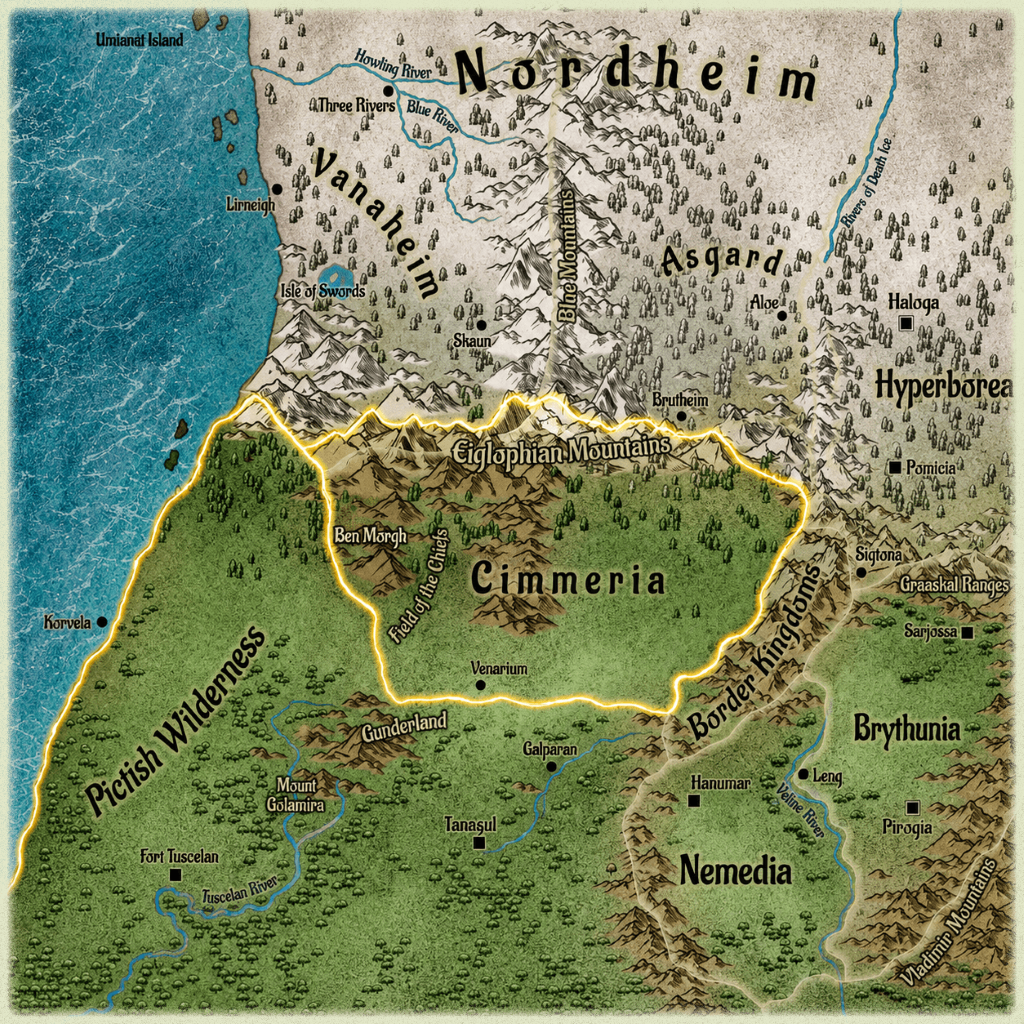

Cimmeria is bordered to the north by the cold, unforgiving peaks of the Eiglophian Mountains, to the east by the Border Kingdom, to the south by Aquilonia, and to the west by the rugged wilderness of Pictland.
- The Seasonal Cycle: Cold winds drive down from the mountains, bringing chilling autumns and freezing winters. In the winter, Cimmeria experiences daylight for only six or seven hours out of the day; even then, the light is frail and sombre, threatened constantly by the dark. Spring brings torrential rain that pours down across the whole land. Even the summer sun is not warm enough to pierce the gloomy country, as the woods are so dense that all sunlight is absorbed by the thick, dusky canopy.
- Territorial Markers: Natural features denote individual clan territories. The landscape is pock-marked with clan symbols such as cairns, henges, ghost fences, totems, gibbets, and burial mounds.
- Waterways: Many smaller rivers are found throughout the land, but none possess any kind of majesty, and many run entirely underground.
Mountains and High Country
- The Eiglophian Mountains: A huge mountain range covered in snow and dangerous slopes. Known for almost impassable passes, it serves as the northern border between Cimmeria and Nordheim.
- Ben Morgh (The Mountain of Crom): Located in the north-eastern part of Cimmeria, this is the tallest mountain visible from the gloomy lowlands. It is the holiest place for the fierce, black-haired tribes, who believe it is the home of their grim god, Crom. For this reason, it is usually referred to as Mount Crom.
- The Black Mountains: A range of mountains in south-western Cimmeria that forms a natural border with Pictland. The source of the Black River can be found within these peaks.
- The Breaknecks: A rough, broken terrain situated between the Broken Leg Lands and the lower Eiglophian Mountains. This area is full of canyons, thin forests, and jutting escarpments, containing passes that lead into the Eiglophians and through to Vanaheim.
- Broken Leg Lands: Located in north-western Cimmeria, just south of the Breaknecks. This is some of the most treacherous ground in all of Cimmeria, a high plateau country cut apart by narrow canyons and sharp-edged bluffs falling hundreds of feet into piles of boulders and white-water rapids.
- Hoath Plateau: A high plateau whose eastern end transitions into steppes. It lies north and west of the Frost Swamp, and east of the Black Mountains.
Valleys, Forests, and Passes
- Conall Valley: The ancestral home of the Gaud, Taur, and Cruaidh clans. The mountains that wall in this valley are known as the Teeth.
- Pass of Blood: A steep pass running through the Eiglophian Mountains at northern end of Conall Valley, leading directly into Asgard.
- Pass of Noose: A trail leading from Conall Valley into the Snowy River country.
- Murrogh Forest: An immense, tangled land of trees and thick undergrowth located to the south of Conall Valley. It features wide streams, numerous ponds, quiet glades, and sudden ridges, alongside dangerous marshes filled with quicksand.
- Snowy River: A Cimmerian river located three days' travel to the west of Conall Valley.
Landmarks and Fields
- Field of the Dead: Located at the base of Ben Morgh, this sacred ground is where the chiefs of the Cimmerian clans are buried.
- Field of the Chiefs: Located on the Hoath Plateau in north-eastern Cimmeria, this field is where clans gather for councils. It is dotted with ancient Atlantean stone structures, including the Standing Stone, which is a central shaft of mossy black rock. No single clan claims this land of eerie, carved stones, which depict a certain weird, non-human geometry.
Natural Resources
Despite its dismal climate, the land is rich in raw, practical resources:
- Minerals and Ore: Abundant deposits of coal and iron ore exist throughout the country. The Black Mountains in the southwest, as well as the hills of the west and northwest, contain rich veins of iron and copper.
- Timber: The endless, dusky forests provide an inexhaustible supply of sturdy timber.
- Salt: Cimmerians have the means to harvest salt from the Great Salt Marsh on their borders.
- Flora and Fungi: The interior vales hold a plethora of herbs and plants that form the basis for local medicines, salves, unguents, potions, and poisons. The dense, dark forests also provide a home to numerous species of both malevolent and benign fungi.

Cimmeria is, without doubt, a barbarian society. It has no cities, no centralized government, and few settlements that could even pass for small towns. There is an overwhelming, deep-seated reluctance among the people to embrace or develop urban structures or civilized political ideals. The harsh, grim, and forbidding landscape shapes the political reality of the country: power is entirely localized, decentralized, and maintained by strength of arms.
The Clan as the Political Unit
The foundational political and social unit of Cimmeria is the clan. There is no king of Cimmeria, nor is there any national council to unite the country.
- Composition: Clans are groups of extended families bonded together through common lineage, which can be either patriarchal or matriarchal. Their primary, driving purpose is mutual survival against the elements, wild beasts, and rival tribes.
- Size and Scope: A typical clan consists of roughly ten to fifteen families, ranging in total size from 40 to 500 individuals. Cimmerians typically do not have large individual families due to a brutally high infant mortality rate, though prosperous families within a clan can occasionally grow quite large.
- Inter-Clan Dynamics: Most marriages and births occur strictly within the clan to preserve its strength. However, unions with allied or semi-allied clans are used to enrich bloodlines. Marriages are also heavily used to seal peace treaties after a bloody feud has been settled, though such arrangements are never a guarantee of permanent peace.
Leadership and Social Hierarchy
Cimmerian hierarchy is strictly meritocratic and martial. The landscape does not tolerate weak rulers, and inheritance of titles means very little without the strength to back it up.
- The Clan Chief: Each individual clan is ruled by a clan chief. When multiple allied clans band together, they form a tribe, which is ruled by a supreme tribal chief.
- The Warrior Elite: Chieftains are drawn directly from the clan's warrior elite. The position is rarely hereditary; the most fit, capable, and respected warrior is chosen to lead, rather than the individual closest in descent to the previous chief.
- Specialized Roles: Beneath the chieftains, Cimmerian society recognizes a respected class of oracles (who interpret signs and the harsh will of the world) and skilled craftsmen (particularly blacksmiths and weapon-smiths who forge iron and copper, as well as jewelers).
- The Common Folk: All other members of the clan are expected to contribute directly to survival. They work as farmers, fishermen, hunters, trappers, and minor craftsmen. In times of war, every able-bodied Cimmerian, regardless of daily profession, is expected to pick up a weapon and fight for the clan.

No true Cimmerian has any time for deliberate complexities or subtleties. A man's word is his bond, and any man who breaks that bond pays with his life. Justice is fast, harsh, and retributional. Everyone works or everyone starves: raiding a neighboring tribe who has more than you is considered both work and survival. The strongest survive and the weakest die: it is evident all around. Cimmeria has no room for sentiment and little for sympathy. Yet Cimmerians are passionate and aware of the importance of certain conventions and constraints. For all their brutal hardiness every Cimmerian understands honor, integrity, and dignity.
The Cimmerian outlook revolves around five key facets: Devotion to Clan, Conformity to Tradition, Honor and Prowess, Blood Vengeance, and a Clean and Honest Death.
The Five Facets of the Cimmerian Mind
1. Devotion To Clan
The clan is everything to Cimmerians. The extended family nurtures and supports, creates a fabric of social values, educates, and perpetuates the Cimmerian warrior spirit. It is for the clan's honor that a Cimmerian makes war on his enemies; for the clan's prosperity that he raids his neighbors; and for its continued existence that he ultimately lays down his life.
Most Cimmerians are indivisible from their clans. Children are raised communally, by both the women and men, and schooled from the earliest possible age in the clan's ways, duties, allies, and enemies. Irrespective of its true position in Cimmerian society, the clan is the most noble, most hard-working, most potent in battle, and most blessed of all the clans scattered across Cimmeria's gloomy hills, valleys, and forests. For every Cimmerian the crowning moment is the clan adulthood ritual, the point where he ceases to be a child and becomes a man.
2. Tradition
Cimmerians dislike change; some hate it and others positively fear it. The Cimmerian outlook is founded on things that work and ensuring they continue to work with as little interruption as possible. This means that Cimmerians act and think the way they do because it has always been done that way. Change is destructive; Tradition preserves and endures. Change alters everything; Tradition ensures predictability, and, in a landscape as harsh as Cimmeria, predictability is fundamental to survival. These practices are developments from hundreds of years which have proved to be effective.
Few traditions are maintained for sentimental reasons; almost all of them are developments from practical necessity. Some traditions are based on superstition and folklore, but few are designed to appease the gods outright. Cimmerians who deny the traditions or actively balk at them are viewed with deep suspicion and hostility because, inevitably, such people are troublemakers. Traditions underlie the few laws Cimmerians have and, if these traditions are challenged, then so is the fragile rule of law.
Respect for the tradition and the "old ways, the right ways" is inculcated from birth and therefore any adult who willfully takes a stand against a tradition is rejecting the years of teaching and wisdom the clan has tried to instill. The honorable option is to leave the clan; any who attempt to stay and create or impose change are likely to pay with their lives.
3. Honor and Prowess
Cimmerians live by their own "Code of Honor" which consists of the following, with some additions that vary from clan to clan:
- Accept hospitality gracefully when it is offered, but always be wary
- Accept no imprisonment
- Accept no insult
- Defend the honor of kith and kin
- Defend those who need defending, attack those who need attacking
- Listen to those who seek your aid, but always be wary
- NEVER trust a sorcerer
- Offer foes clean and swift death
- Remain true to one's word
- Show no fear
- Speak only truth and punish liars
- Take no woman by force
- Take only what is necessary, taking more than that is theft
To Cimmerians, honor does not need to be any more complicated and should always be a straightforward business. Cimmerians do not make the mistake of confusing honor, honesty, and tact. Neither do they believe that politeness and gratitude need to be dressed in false sincerity or fawning courtesy. When a Cimmerian offers his thanks, he means it. When he wants something, he asks for or demands it, depending on urgency. Most Cimmerians speak and act plainly, clearly, and bluntly, but always honorably.
Prowess, personal excellence in a given area, is a matter of deep personal honor for all Cimmerians. Generally most Cimmerians place import on their prowess as hunters and warriors although, for some, prowess in other fields is held in higher regard. It is the desire of most Cimmerian youths to be considered fine fighters first and foremost, but not all: some are destined to be better craftsmen or herders and, whilst the hunter-warrior creed is expected of all Cimmerians, it is understood at a cultural level that a range of skills and talents are essential for the clan's survival.
What is most important is the honesty and honor of understanding where one's talents lie and achieving excellence in that field, whilst still cultivating the ability to both hunt and fight well. Thus all Cimmerians are geared towards being the best at what they do, because prowess yields success for both the individual and the clan. Every clan sincerely believes it produces the best fighters, hunters, crafters, herders, and so forth in Cimmeria.
4. Blood Vengeance
Insults and assaults against the family or clan are taken seriously and never allowed to rest. The desire for vengeance runs through every Cimmerian as freely as their blood. Insults and assaults must always be paid for, usually in blood. Because clan ties and personal honor are closely bound together, injury to an individual becomes the responsibility of the entire family or clan to avenge. Refusal or unwillingness to seek revenge is seen as a sign of weakness and is likely to attract further attacks.
Thus, any Cimmerian who feels his honor, or that of his clan, has been challenged, always seeks vengeance against the perpetrator; the matter cannot be allowed to rest until vengeance has been satisfied. Clans therefore can, and do, engage in feuds and war between themselves. Individuals may even accept the burden of extracting blood vengeance as a perfectly acceptable means of proving both their honor and prowess.
It is commonplace for Cimmerians to brood upon an insult or attack for days, weeks, months, or years before taking action, but action is always taken. Anything that challenges, insults, or harms the honor of a person or the honor of the clan attracts a furious response. And, naturally enough, vengeance begets further revenge, resulting in long-running and bloody feuds that persist long after the initial provocation has been forgotten. Grandsons seek vengeance for long-dead grandfathers; clans battle clans for decades, becoming ignorant as to why, but retaining the certainty that they must. A Cimmerian who has been wronged becomes a life-long enemy and, given the insular and sullen nature of each and every clan, it is impossible to gauge what is likely to provoke vengeance.
5. Clean and Honest Death
Cimmerians do not place any faith in their gods to provide them with a happy afterlife. Death is part of the natural cycle of things, and every Cimmerian knows that death is never far away. Death is not spoken of in hushed tones; it is discussed matter-of-factly and without sentiment. Every Cimmerian wants a death that is both clean and honest. That is, a death that would not bring shame on the clan or the individual.
Dying in battle, sword in hand, surrounded by the bodies of the enemy, is a good and honest death. Being executed after capture, pleading for one's life, is exactly the opposite. Dying whilst behaving with honor is the way every Cimmerian wants to die and they have no fear of it; but dying pitifully, weakly, and either denying honor or having it denied to them, shames the soul and clan.
Similarly, when dealing death, Cimmerians tend towards offering it cleanly and honestly. If a foe fights well and honorably, a fast, cleanly delivered death is an honorable thing to offer. A clean death is delivered without cruelty and without resort to unclean methods such as poisons or venoms, which are the weapons of cowards who lack the prowess to slay their foes cleanly. Death comes to everyone and one cannot choose when they will die or by what method; but how one dies is important. Those who die bravely are honored in song and reputation. Those who die weakly or with cowardice, are erased from the memory of the clan.

Tall and powerful are the Cimmerians, and their eyes sparkle blue or grey beneath their dark manes. Cimmerians are regarded as one of the most fierce and savage peoples in the world, yet many in the far south regard them as semi-mythical. The Aquilonians used to despise them, considering them rude villagers of small consequence.

The physical presence and traditional attire of the Cimmerians directly reflect the demands of their dark, unforgiving homeland, prioritizing raw utility and clan identity over comfort.
Everyday Garb
Cimmerians shun finery and ostentation. Typically, clothing for men and women consists of simple tunics or shirts of coarse wool and linen worn either with kilts or woolen trousers, dyed with simple, natural dyes derived from minerals or vegetables. This is everyday garb worn to protect against the seemingly incessant rain and cold, chilly nights.
- Footwear: Footwear, when worn, is a pair of simple leather sandals laced around the ankle and calf. Often it is not worn, as many Cimmerians go barefoot.
- Clan Colors: Every clan adopts specific colors that are displayed in the patterns woven into kilts, tunics, or trousers. These colors are often plaids or crude tartans, regular, geometric patterns that are simple to weave but intricate enough to promote clan identity.
- Cold Weather Protection: In cold weather cloaks are very common, being of either wool, sheepskin, goatskin, or, occasionally, leather.
- The Taboo of Headwear: Hats and other forms of headwear, with the exception of helmets for battle, are extremely rare amongst Cimmerians, although a cloak might have a hood stitched to it if lengthy travel in inclement weather needs to be undertaken. Cimmerians generally consider headwear to be a form of disguise as it shadows the eyes or masks the hair. Every Cimmerian is proud to be a Cimmerian; disguises, or attempts at them, are for cowards and thieves.
Hunting and Warfare
When it comes to hunting and warfare, dress changes radically. Loincloths of soft leather, sometimes accompanied by leather jerkins, replace the woolen shirt and kilt. Such everyday garb would easily snag when out in the wilds and, although it protects against the cold, Cimmerians would far rather shiver than be impeded when it comes to a high-speed chase through forest and briar, or across bleak moorland.
When going into battle, those Cimmerians who have armor, either taken from slain enemies, gifted by fathers or clan elders, or bought, though this is rare, wear it, especially helmets. Cimmerians, whilst proud of their prowess in battle and eager to display their strength and tenacity, are not fools and value good, solid protection.
Many outsiders view all Cimmerians as near-naked savages, running into battle nude, save for a loincloth and battle scars, but this is a rare sight. Cimmerian war bands wear whatever armor they can, and those that do choose to go semi-naked usually have a specific reason for doing so, the most common being that they cannot afford armor, or want to maximize their speed.

Cimmerians are practical people, and because strength survives and Cimmerian life is about survival, Cimmerian women are strong in body, spirit, and purpose. As the old claim goes, strong Cimmerian men can only be born of strong Cimmerian women.
Equality, Status, and Labor
Women are naturally expected to be hearth-makers and mothers, but they are not denied the occupations traditionally occupied by men. If a woman shows an aptitude with spear, sword, or bow, then it is quite acceptable for them to fight alongside the menfolk and, in some clans, even expected as a duty. Women are not perceived as being weak or inferior and, typically, they are anything but.
- Shared Rights and Chores: Women and men usually share equal status in terms of clan rights. Clan tasks and chores are shared; women chop wood and hunt, and men fix the hearth and cook.
- A Partnership of Equals: A wife is not a husband's property or chattel, but she is expected to be faithful to her man, and vice versa.
- Views on Foreign Cultures: In cultures where women take a more subordinate role, Cimmerian men naturally assume this is an inherent weakness and therefore have a propensity to treat foreign women as chattels rather than equals, to be taken as and when the man decides. Strong women of other cultures are admired, and Cimmerians tend to appreciate foreign females who display similar characteristics and personalities to Cimmerian women.
Marriage and Childbirth
One role that women cannot escape, though, is childbirth. Some Cimmerian women are quite content to do little but raise large families; others are content with raising only a few. Every woman is expected to bear at least one child, and usually within a few years of the adulthood rite.
- Early Unions: It is very common for Cimmerian women to be married as soon as puberty begins and to have borne their first child within the year.
- Arranged Matches: Marriages are quite often arranged affairs, usually by the parents, either because the match is considered to be one that will produce plenty of good, strong, handsome children, or because the union cements an alliance.
- The Absence of Romance: Marriage is very rarely for love, and it is considered against tradition for a woman to disagree with an arranged union because she does not love, or even like, the intended husband.

Cimmerian society deals with the concepts of forced labor and sexual commerce through a lens of raw pragmatism, personal shame, and clan communalism.
Slavery and Serfdom
The Nonchalant Attitude Toward Slaves
Cimmerians have a nonchalant attitude towards slavery. Slaves are taken whenever an enemy clan is vanquished in order to prove mastery, and the treatment slaves receive depends purely on the outlook of the owner. By and large, slaves are considered to be chattels and receive the most basic level of care, but they are often abused depending on the will of the owner.
- Role and Rights: Slaves are expected to do the drudge-work of the clan and to wait on the chieftain or owner. They have no rights within the clan other than to receive food, somewhere to sleep, and a few, exceedingly modest possessions.
- Trade Dynamics: Slaves might be traded between allied clans, much as any other goods might be traded. If a slave is especially fit, diligent, and obeisant, they are valued as highly as gold or silver. However, Cimmerian clans do not, as a rule, deliberately go in search of slaves or make a practice of trading them to further the clan's position. Slaves are an occasional necessity and a right of victory, but not a commodity to be farmed and bartered.
The Shame of Enforced Servitude
Cimmerian pride makes them poor slaves. To be taken into slavery is considered shameful, and no Cimmerian warrior worth his salt accepts slavery as an option in defeat. Acceptance of slavery automatically confers a position of weakness, and almost all Cimmerians prefer death to a life of enforced servitude.
- Demographics of Enslavement: It is rare to find strong warriors amongst Cimmerian slaves. It is more common to find the old and those less capable of fighting amongst the slave ranks. Invariably, Cimmerian slaves have a subdued, morose attitude because they are abundantly aware that, in being captured and enslaved, they have effectively failed to be good, proud Cimmerians.
- The Path to Freedom: If a slave proves to be hard-working and accepting of their lot, which is a rarity but a possibility, then, occasionally, a chieftain might grant the opportunity for the slave to become part of the clan.
- The Stigma of Weakness: Whiilst this transformation confers freedom, it does not necessarily confer respect and honor. Those who have risen from slavery to become clan members proper are always remembered as slaves and cannot count on being treated with the respect true clan members receive. To have been a slave is to have demonstrated a weakness of spirit, and no matter how well an ex-slave has behaved, the stigma of weakness is always there in the clan memory.
The Absence of Serfdom
Because individuals do not own property or land, save for the chieftain of a clan, who holds territory in the name of the clan, there are no serfs in Cimmerian society. Working the land is a communal activity, and the drudge work associated with serfdom is carried out by any slaves a clan owns. Other than this, the Cimmerian philosophy is to cooperate to survive, making the concept of serfdom entirely alien to their way of thinking.
Prostitution
Prostitution is considered the oldest profession in many cultures, and Cimmeria is little different. Men are always willing to pay for sex and there are always women willing to oblige. However, few Cimmerians would ever admit to taking pride in using prostitutes.
- Social Perception for Men: Every Cimmerian man is expected to have a woman, just as he is expected to have a sword and spear. Those that habitually pay for sex are considered to be, at best, unlucky or, at worst, weak and unable.
- Social Perception for Women: For women, prostitution is not considered to be a profession, but simply an activity that is indulged in when necessity dictates. Accepting payment in exchange for sex is sometimes the best way of preventing rape or rough, undesired union. Sometimes, it is used as a form of reward for Cimmerian men who might have made an impression, but to whom the woman does not want to grant unrewarded favor.
- The Hidden Trade: Prostitution therefore happens, but it is always behind closed doors and is never discussed. Professional whores do not exist in Cimmerian society, and clan settlements do not have regular streetwalkers or courtesans readily plying their trade. Usually, though, a few women who are known to accept payment for sex can be readily identified in any clan, although a great deal of euphemism and discomfort surrounds such identification.

Cimmeria is a land of subsistence, peopled for the most part by hunters and gatherers. Because the terrain and culture emphasize self-reliance, international trade is practically non-existent, and internal commerce is treated with immense caution and tension.
Mechanics of Trade
Most clans produce everything they need internally, but sometimes trade is necessary, either with neighbors or further afield.
- The Warrior-Trader: Cimmerians completely lack a merchant class. Because of this, most trade expeditions are conducted by warriors who explain what they want bluntly, are entirely unprepared to negotiate, and consider a refusal to trade to be a direct personal insult.
- The Tensions of Commerce: Trading expeditions tend to be incredibly tense affairs because Cimmerians lack the communication nuances essential to striking a standard mercantile deal. Trade is not an activity Cimmerians relish, since it goes against their gut instinct to simply take what is needed via a show of strength.
- Expansion of Markets: Trading within nearby clans means that local markets are strictly limited. Clans must frequently range further afield, taking them into unfamiliar territories where the chances of hostility are far higher owing to the fact that inter-clan relations are less assured or completely non-existent.
Currency and Wealth
Lacking a currency of their own, Cimmerians are prepared to deal in whatever treasure the clan owns as its collective Clan Property.
- Medium of Exchange: Coins, when a clan has them, are always valuable, especially when made of silver and gold. Usually, however, the clans must deal in whatever practical items are to hand.
- The True Measure of Wealth: True wealth in Cimmerian society is measured not in coin, but in cattle.
- Primary Commodities: Items of particular interest as tradable commodities include fresh and cured meat, timber, tin, iron, copper, weapons, and armor.
Views on Foreign Merchants
Merchants from outside Cimmeria are, at once, both admired and distrusted.
- The Suspicion of Deception: Cimmerians admire those who, through the gift of the gab and slick negotiation, can obtain a superb deal for minimum outlay. However, they are deeply suspicious and even contemptuous of these mercantile skills. Slick negotiation is viewed as being just one step up from lying, and lying is absolutely not in the Cimmerian character.
- The Dislike of Southern Speech: Few merchants speak plainly and say precisely what they mean. Many bend the truth to unacceptable lengths to get what they want at the lowest price.
- Forced Negotiation: Despite this contempt, their methods are sometimes recognized as valuable. On the odd occasion where foreign merchants venture into Cimmeria's dark vales and bleak territories, clans are prepared to hire them as negotiators. Alternatively, they may simply kidnap them for the exact same purpose, promising them freedom if a trade deal works out, and swift death if it does not. Because of the general danger, no trade caravans from the civilized lands make their way into Cimmeria willingly.
The Economics of Slavery
A Cimmerian does not keep a permanent workforce of slaves as a commodity, nor do they ever sell their own people into slavery.
- Slaver Avoidance: Cimmerians see slaves as fundamentally weak, believing that if they were not weak, they would not be slaves. For this reason, Cimmerians themselves make incredibly poor slaves, and foreign slavers avoid entering Cimmeria entirely. An adult Cimmerian would far rather die trying to escape slavery than meekly submit to an owner, destroying any potential profit for a slave trader.

Cimmerian Religion and the Grim Cult of Crom
The religious outlook of Cimmeria is as dark, cold, and unforgiving as the wind-swept hills of the country itself. Cimmerians do not possess a comforting faith, nor do they look to the heavens for salvation, mercy, or cosmic justice. Religion in this gloomy land is not a matter of devotion, but a stoic acknowledgement of grim, uncaring powers.
The Cimmerian Pantheon
Cimmerians believe in a rather dark pantheon of gods, all of whom are ruled by Crom and are of his race. These gods are not benevolent creators or protective guardians, but ancient, titanic entities that embody the harshness of the natural world.
Unlike the civilized nations of the south, who build glittering temples to Mitra or luxury-laden shrines to the gods of Shem, Cimmerians build no temples, carve no idols, and form no organized priesthoods for their deities. The gods exist, but they are to be left well alone.
Crom, the Lord of the Mountain
At the apex of this dark pantheon sits Crom, a dire god, as gloomy and dangerous as the Cimmerians themselves. He dwells atop the highest, snow-capped peak of the north-eastern country, Ben Morgh, which is often called the Mountain of Crom.
"Crom is their chief; he lives on a great mountain, whence he sends dooms and death. It's useless to call on him, because he's a gloomy, savage god, and he hates weaklings. But he gives a man courage at birth, and the breath and the will to slay his enemies; which is all any man ought to ask."— Robert E. Howard, 'The Tower of the Elephant'
The Taboo of Prayer and Worship
The Cimmerians do not pray to Crom, nor do they worship him or any of his kind. To a Cimmerian, the concept of kneeling, begging, or offering sacrifices to a deity is an act of repulsive weakness.
- The Wrath of the Petitioner: Crom and his race of gods despise weaklings who call on them for aid. If a foolish person dares to pray to Crom, the grim god is far more likely to send doom, madness, or sudden death to the petitioner rather than help them.
- The Gift of Courage: Crom does not grant blessings, wealth, health, or good fortune. His sole intervention in human life occurs at the exact moment of a Cimmerian's birth. At birth, Crom breathes soul, fury, and the unyielding courage to strive and slay into a newborn child. Once that gift is given, the god considers his obligation finished.
- The Pride of Self-Worth: The Cimmerians value individuality and self-worth, knowing their gods expect them to take care of life themselves. Indeed, Crom only takes pride in a Cimmerian if that Cimmerian never calls upon him for aid once in his entire life. Cimmerians are supposed to take what they want from life through their own prowess, strength, and steel.
The Cimmerian Afterlife
Cimmerians do not place any faith in their gods to provide them with a happy, rewarding, or golden paradise in the next world. The concept of an elite warrior's hall or a peaceful heaven is entirely alien to them.
- The Grey Realm: After death, Cimmerians believe their spirits travel to a grey realm, misty and icy, where they forever wander in cheerless gloom. In this dismal afterlife, the dead are merely flitting shadows, stripped of the warmth of the sun and the joy of the feast, left to listen to the eternal moaning of the cold winds.
- Defying the Grave: Despite the depressing nature of their promised afterlife, the Cimmerians do not fear death. They gladly meet it with steel in hand and a war cry on their lips, content in the knowledge that they lived proudly, stood on their own two feet, and never bowed their heads to man or god.

To play a Cimmerian is to play an outsider to civilization, a member of a fierce, dark-haired branch of humanity that has held its gloomy hills against empires, northmen, and savages alike. You are a product of decentralized clans, ancient blood feuds, and a raw, unforgiving landscape where survival is a daily triumph and weakness is a sentence of death.
Core Identity
- Race: Cimmerian (Direct descendants of ancient Atlantis).
- Language: Cimmerian (A rough, guttural tongue spoken with a harsh, survivalist brevity, entirely lacking a written form).
- Hair Color: Exceptionally dark manes, ranging from deep brown to raven black.
- Eye Color: Piercing blue or grey eyes that sparkle beneath their dark hair.
- Names: Short, blunt, and powerful.
- Male: Conan, Conall, Gorm, Kael, Rolf, Varek, Brand, Sualtam.
- Female: Elspeth, Mara, Thora, Helka, Sola, Verna, Murrogh.
Personality and Archetypes
Cimmerians carry themselves with a sullen, moody pride that civilized men often mistake for absolute savagery. They speak plainly and act bluntly, having no patience for southern complexities or false courtesy.
- Devotion to Clan: The clan is your entire world. Children are raised communally, and you are hard-wired to fight for your clan's prosperity, raid its neighbors for survival, and lay down your life for its honor.
- Conformity to Tradition: You dislike change and treat it as a destructive force. You respect the "old ways" because hundreds of years have proved they are the only things that ensure predictability and survival on the moors.
- Honor and Prowess: You live by a straightforward code of honor. A man's word is his bond, and breaking it is punishable by death. You strive for absolute personal excellence in your chosen craft, whether as a hunter, blacksmith, or herder, to ensure the clan thrives.
- Blood Vengeance: The desire for revenge runs as freely through you as your blood. Any insult or assault against your kith and kin becomes the responsibility of the whole clan, resulting in multi-generational feuds that you are honor-bound to maintain.
- Clean and Honest Death: You place no faith in your gods to grant a happy afterlife, believing all souls destination is a grey, misty realm of cheerless gloom. Therefore, you do not fear death, but you demand a clean one, dying bravely in battle, sword in hand, without the use of cowards' weapons like poisons.
Combat Roles and Equipment
Cimmerians value good, solid protection and are not the naked savages southern myths claim, though they will gladly discard heavy garments if they need to maximize their speed through forest and briar.
- The Clan Chieftain (Warrior Elite): Drawn from the most fit and capable combatants of the tribe. You wear high-quality mail, plate, and helmets salvaged from fallen enemies or passed down as family heirlooms, wielding a heavy broadsword or battleaxe.
- The Moor-Scout / Hunter: A master of forest and bog warfare. You favor soft leather loincloths and jerkins that will not snag in the briars, utilizing a hunting bow, a hatchet, or a light spear to strike from the dense mountain fog.
- The Shield-Wall Veteran: A resilient front-line fighter trained to stand firm against Cimmeria's hostile neighbors. You carry a sturdy spear, a heavy iron knife, and a large shield, clad in whatever armor your clan could afford to craft or plunder.
- The Oracle / Blacksmith: A respected specialist within the tribe. While you cultivate the essential ability to hunt and fight, your primary prowess lies in interpreting the grim signs of the world or forging the iron and copper weapons that keep the clan alive.
Social Rank and Background
Cimmerian society is entirely decentralized, lacking private land ownership, city watches, or feudal serfdom. Every free Cimmerian shares equal clan rights, sharing burdens like hunting, wood-chopping, and cooking based purely on practical necessity.
- Tribal Elite: You are a chieftain or a member of the inner warrior circle. Your status is strictly meritocratic; you hold your position through personal strength and tactical respect, not hereditary birthright.
- Clan Freeholder: A proud, independent hunter, herder, or crafter. You are a full member of the clan who has completed the adulthood ritual, entitled to a voice in the tribal council.
- The Outcast / Ex-Slave: You were captured in a raid and suffered the deep shame of servitude. Though your chieftain may have granted you freedom for hard work, you carry a permanent stigma of weakness in the clan memory.
- The Vengeful Wanderer: Your clan was wiped out in a generational feud or an Aquilonian border skirmish. With no home left to defend, you roam the world as a sullen mercenary, driven entirely by the memory of your grandfathers' oaths.

To fully immerse yourself in the gritty reality of Cimmeria as written by Robert E. Howard, consult the following foundational texts:
- "The Phoenix on the Sword" (REH): Features the famous introductory poem that immortalizes Cimmeria as a land of "hills, heavily wooded" and "dusky trees," establishing the sombre tone of the nation.
- "The Tower of the Elephant" (REH): Contains the iconic dialogue where Conan explains the nature of Crom to the Zamoran thief Taurus, providing the core philosophical foundation of Cimmerian self-reliance.
- "The Hyborian Age" (REH): Howard’s world-building essay detailing the prehistoric origins of the Cimmerians as the direct, shifted descendants of ancient Atlanteans, explaining their genetic isolation and barbarian status.
- "The Conan Compendium" (Mongoose Publishing): Offers an extensive breakdown of internal clan trade, geographical hazards like the Great Salt Marsh, and the strict communal laws governing the moors.