
Bloddolk Forest
The Bloddolk Forest is a reputedly haunted forest northwest of Mornstadinos. The forest is home to carnivorous trees, bizarre plants, and unseen denizens that dance just out of sight. Most of the inhabitants are not deadly, just curious, however, it is better not to rile them. Bloddolk is a dense wood and travel is difficult through it. A wide river also moves through the area with only two or three fordable spots, otherwise it is a deep river.
Dodligia Plain
The Dodligia Plain, north of the Bloddolk Forest, is a huge plain, flat and bare save for the occasional butte and a few rocky ridges. An odd peak sits alone on the plain, a mountain without a range. The mountain, called Castle Slott, is honeycombed with tunnels and rooms, although much of it is collapsed and destroyed.
River Corinthia
This river runs through the eastern part of Corinthia. It is a wide, easy-flowing river whose source lies in the Karpash Mountains.
Sea of Gray Despair
This sea was once the site of a great city during the years Acheron, Zamora, and Stygia ruled, and Corinthia was a fertile trading ground between the powers. The great city reared here was both powerful and rich, and a barbaric enemy from the lowlands, possibly another wave of Hyborians, razed the city and ruined the surrounding land with salt. Ultimately, a great curse was laid on the ground. Over the centuries the land has grown again, although it is still a bleak wasteland. This wasteland is in the central regions of Corinthia and men fear it, avoiding it. Werewolves haunt this foul plain.
Karpash Mountains
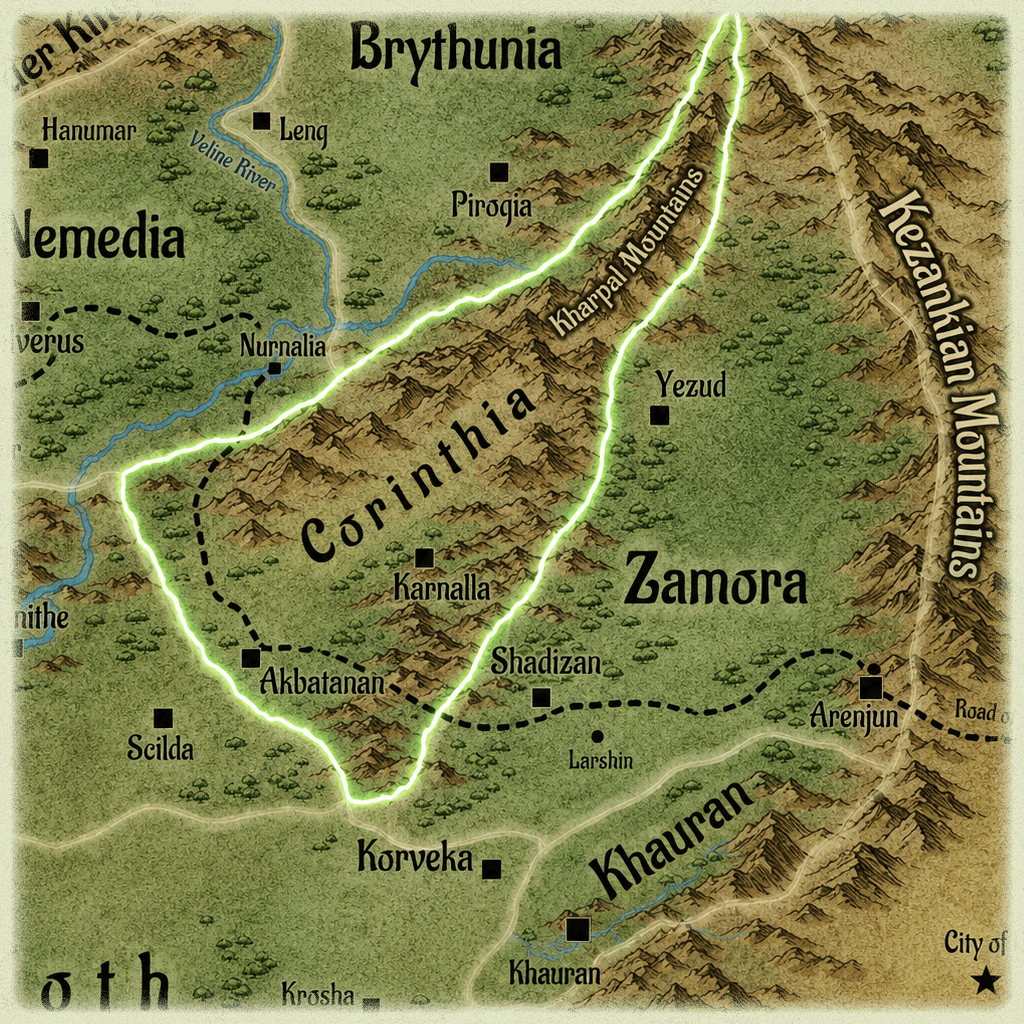
The Karpash Mountains are an extensive range of mountains extending from Zamora to Ophir. From the Corinthian side, the approach to the Karpash is one of many forested ridges that slowly build up to becoming the rocky Karpash range. Several passes between Corinthia and Zamora are named in the apocryphal texts, such as Donar Pass, Haraan Pass, and the Haunted Pass.
Black Caves
The Grotterium Negrotus is an extraordinarily vast cavern system beneath the Karpash Mountains of eastern Corinthia. Much of the system is overgrown with glowing fungi.
Haunted Pass
High in the Karpash Mountains on the north fork of the Corinthian Road, the Haunted Pass between Corinthia and Zamora is noted for the eerie sounds the winds make. A haunted lake, Spokesjo, lies at the top of the pass, where undines live.
Mount Turio
This ice-capped mountain was once the tallest peak in the Karpash range between Zamora and Corinthia, however, it turned out to be volcanic and the mountain exploded, blasting the top half of the mountain into volcanic ash ten million years ago, according to Steve Perry in his Conan the Freelance. Time healed the wounds and an icy, deep crater lake remained, filled with Sargasso weed. A recent re-eruption destroyed the lake.
Western Pass
With a creepy reputation for being peculiar, this little-used pass through the Karpash Mountains crosses from Corinthia to Ophir. A stark, square keep constructed of stone and manned by Corinthians watches the pass. A ghostly, ancient ruin, a temple to the demon Kthantos, haunts this lonely pass.
Important Cities and Settlements
Anuphar
Lying strategically upon the Road of Kings, Anuphar is a prosperous city-state in Corinthia.
Athros
This is an extremely powerful city-state that has a population of 12400 residents.
Atilleos
According to Roy Thomas, this is a Corinthian city-state bordering rival Menalos. It is not far from the ruins of Lanjau. It has a population of 5500 residents.
Ezar Bar Q'um
Ezar Bar Q'um vies for power over neighboring Khumar Rhun. It is located in a mountainous region.
Kamalla
According to Roy Thomas, Kamalla is a small city in the desert of south-eastern Corinthia. It is a walled city that once was visited by slug-like sorcerers from another dimension. 7800 people reside there.
Khishtam
Khishtam is a village in Corinthia where an inn outside the village is reputed to have excellent ale in their common room and a lot of lice in their beds. It has a population of 745 people.
Khumar Rhun
Khumar Rhun, located high in the mountains, battles primarily with their rival city-state, Ezar Bar Q'um. The spired city, accessed via an arched stone bridge over a deep cleft in the mountains, boasts of a labyrinth. Ishtar is worshipped here as the primary religion.
Lanjau
An ancient Corinthian city that is now in ruins. It was guarded by a giant lizard-dragon before it was destroyed in a great earthquake and spouts of flame. It had a rumored treasure horde that was guarded by giant mummies. It lies near the city of Atilleos but is located on no map.
Limnae
This is a small city-state of Corinthia.
Lonika
A city-state of the fertile meadowlands in central Corinthia.
Menalos
Another Corinthian city-state recorded by Roy Thomas, a rival of bordering Atilleos. It has a small population of 5400 people.
Mornstadinos
Mornstadinos is a city-state in eastern Corinthia. Its narrow cobbled streets are a confusing morass of alleys, dead ends, and by-ways. Stables are built next to grand temples next to open air markets. One of the inns in the city is known as the Milk of Wolves Inn. Destroyed by a tornado once, it has since been rebuilt. Another inn is the Smoking Cat Inn.
The guards of this city are corrupt and easily bribed and the merchants are willing to haggle. The citizens call Mornstadinos "The Jewel of Corinthia". It is a walled city with squat buildings. Some small industries work here. The buildings, even the small mansions of the wealthy, are made of adobe and stone. It has some 11000 residents.
Naplonia
Naplonia is a western Corinthian city-state created by James Owsley in Conan the Barbarian, Vol. 1, No. 204-205. The estate of Baron Strakkus, an elder statesman of Corinthia, lies here. Baron Strakkus is apparently a sorcerer who guards a gate to another dimension, his home dimension. In issue 205, the region was called Aplonia.
Nywenth La
This Corinthian city-state lies in the southern portion of Corinthia and is a sheep-raising community.
Polopponi
Polopponi is a marvelous city-state in the meadowlands of central Corinthia. It was built upon a tor along the Road of Kings, towering and majestic over the surrounding plain. This city-state exchanged royal children as hostages with the city-state Lonika at one time. The walls of this glittering city are decorated with fantastic designs.
It is ruled by King Kerbogha and his blind daughter, Kassa. The city is prosperous because the king did make a bargain with a demon, a deal that eventually lost him his son. It has 40800 residents.
Vesci
Vesci is a town of western Corinthia. Usually omitted from maps, its economy is virtually bankrupt, a forgotten village that now has turned decadent and villainous. Crime and sin abound. The worst of the criminals can be found in a tavern called "The Rat's Nest". A sorcerer obsessed with eyes lived far outside the city, but was later hanged for an inconvenience done to the Captain of the Guard. Despite its poverty, Vesci still had enough land to provide serfdoms for several barons.
Zahmahn
Zahmahn lies in Corinthia on the main pass between Koth and Corinthia. The city-state is ruled by Queen Yaila, a former slave until Conan made her a queen. Her husband is Lord Godrik. The city was founded by a Kothian exile named Zahmahn. After the Kothian's death, only queens have ruled the city-state. Zahmahn has a population of 13000 people.

Corinthia does not operate under a feudal system, meaning allegiances do not carry the same foundational weight as they do in nations like Aquilonia or Nemedia. Instead, political loyalty is highly fluid, typically aligning with political groups, secret societies, personal friends, and individual city-states. Corinthia is noted for shifting allegiances fairly easily and quickly, as Corinthians are not as formal with their loyalties as the people of the northern Hyborian nations.
The Monarchy and the Senate
The overarching government is a delicate balance of power between a supreme monarch and a complex web of local politicians.
- The King: Corinthia is ruled by a king who commands the imperial legions. The king reigns supreme over the senatorial council, and the absolute power to pass law rests solely in his hands.
- The Senate: The Corinthian senate is composed of delegates from each of the individual city-states. While the senate does not possess legislative power to pass laws, its primary purpose is to advise the king. Furthermore, this body exerts significant control over foreign affairs and internal political arenas.
- Opposing Factions: Because of the decentralized, city-state nature of the kingdom, opposing political factions are rampant throughout the cities, keeping the political landscape in a constant state of tension and intrigue.
Legal and Social Foundations
- The Law on Murder: As in many Hyborian kingdoms, murder is strictly illegal in Corinthia unless it is explicitly sanctioned by the king, or committed in the defense of oneself and one's home.
- The Institution of Slavery: Slavery is perfectly legal throughout the kingdom and forms a normalized part of the economic and social fabric of the city-states.

Social standing in Corinthia, like in most Hyborian nations, centers around land ownership. However, a strict distinction is made regarding who holds true political power: only a native-born, land-owning Corinthian male is considered a citizen, and only citizens have full legal protections and rights.
A woman belongs to the social class of her husband or father, while children belong to their father's class until they are on their own. For males, Corinthian society is stratified into five distinct social classes.
The Five Social Classes
1. The Nobles
The top rung of the social ladder is made up of the nobles. Corinthian nobles are wealthy landowners with large estates. Because they often have to defend their soil from rival city-states and foreign invaders, they are considered a warrior aristocracy. They are expected to serve as the city-state's cavalry, much like the knights of Aquilonia or Nemedia.
2. The Farmers (and Wealthy Merchants)
Below the nobles are the farmers, who run the agricultural operations outside the actual cities. Their estates are not as large as those of the nobles, and some farmers work directly for the nobility. Almost every land-owner falls into this category by default. If needed for military service, they are expected to step up and lead infantry units.
- The Merchant Blur: Wealthy merchants belong to this class by default if they own land. However, if a wealthy merchant does not actually own land, some traditionalist Corinthians will always consider them as belonging to the lower class of craftsmen. Because these wealthy merchants often possess far more coin than the farmers and exert more political influence, they constantly blur these class lines, deeply frustrating Corinthian traditionalists.
3. Urban Craftsmen
On the third rung of the social ladder are the urban craftsmen. They form the skilled labor backbone of the cities and can be levied by the state for three years of mandatory infantry service. Most standard Corinthian merchants are considered to be in this class, especially if they do not own land.
4. Foreigners and Freed Slaves
This social class encompasses foreigners, which explicitly includes individuals traveling from other Corinthian city-states, as well as freed slaves, who automatically enter this bracket upon gaining liberty. Members of this class are expected to engage in trade of some sort, but they are strictly prohibited from owning land or accessing citizen rights.
5. Slaves
The lowest social class are the slaves, who possess no political power or legal citizen status. Despite their low standing, Corinthian slavery allows for certain internal liberties: slaves are legally permitted to own personal property and raise a family, though they may never engage in politics. Furthermore, it is illegal to beat or kill slaves in most of the Corinthian city-states.

The physical traits and wardrobe of the Corinthian people reflect both their mixed ancestral lineage and a high cultural appreciation for classical, flowing drapery adapted for a trade-centric lifestyle.
Corinthians are no longer pure-blooded Hyborians. Centuries of intermingling with Zamorians, Stygians, and other trade races have darkened their skin, although they still remain stout and tend toward tawny hair.

Everyday Garb
Corinthians dress in loose clothing, especially tunics, peplos, and chitons. The clothing of the Corinthians heavily resembles drapery.
- The Tunic: Tunics are worn by both sexes and are worn with a belt. A Corinthian tunic is essentially a piece of drapery tied over the left shoulder. In cooler weather, a chlamys, a bordered cape pinned or tied at the right shoulder, might be added.
- The Peplos: A peplos is a tubular, body-length tunic worn primarily by Corinthian women. The peplos is folded inside out from the top down, so the top of the tube is at the waist. The fold is pinned at the shoulders and the whole thing gathered at the waist. It gives the appearance of being two pieces of clothing because of the way it drapes.
- The Chiton: A chiton is worn by both men and women and consists of two pieces of drapery that are belted either under the breast, around the waist, or both. The wealthy include hoods with their ornate chitons. For outdoor travel, a wide cloak or himation is added to the outfit.
- The Himation: A himation is made of a heavier cloth than a chiton and serves as a cloak, being similar to a toga. It can also be worn entirely alone, serving as both chiton and cloak.
Military Dress
Corinthian soldiers dress in whatever they can afford. Often, common infantrymen wear a chlamys and little else, for the chlamys can be wrapped around the arm and used skillfully as a light shield in combat. The knights wear heavy armor, while the standard pikemen wear less protection to maintain their mobility.
Footwear, Accessories, and Cosmetics
Corinthians tend to wear sandals in warm weather and leather boots in cooler weather. Jewelry and cosmetics are worn heavily by the women. Powdered lead is an exceptionally common cosmetic among Corinthian females, used to give the women a pale, ivory-skinned complexion to contrast with their naturally darkened skin tones.

Gender roles in Corinthia are highly rigid and deeply patriarchal, prioritizing the control of female lineage and the preservation of male citizen honor above all else.
Legal Status and Daily Life
Women are tasked with taking care of the household, a role common across most Hyborian nations. However, due to the widespread nature of the institution of slavery in Corinthia, their daily duties focus heavily on domestic management.
- Domestic Oversight: Corinthian women oversee the household slaves. Because even the poorest families typically own slaves to do the cooking and cleaning, a woman's role is primarily managerial within the home.
- Lack of Legal Rights: Females are not considered citizens, cannot own land, and are not directly protected by the law. They possess no independent legal rights.
- Protection Through Male Kin: This lack of independent legal standing does not mean women are completely devoid of protection. Because Corinthian society is intensely focused on male honor, a slight against a woman is automatically perceived as a direct slight to her father, her husband, or both, inviting swift retribution from her male kin.
- Economic Dependency: Women cannot work most jobs that fall outside of the immediate family business. They depend almost exclusively on their father until they marry, at which point they become their husband's responsibility.
Sexuality and Marriage
Arranged Alliances
Marriage in Corinthia is not a romantic endeavor, but a practical arrangement between two families. These unions can be negotiated and finalized whenever deemed convenient by the fathers of the respective households.
- Age Disparity: There is a significant age gap in Corinthian unions. Men usually marry in their mid-twenties, once they have established some standing or completed military obligations. Women, conversely, are married off while they are still in their early teens.
- Expectations of Fidelity: Females are expected to lay uniquely with their husbands. They are strictly forbidden from engaging in pre-marital or extra-marital relationships. The strict control of female sexuality is viewed as an absolute necessity for the stability of the state, and deviating from this expected behavior carries severe legal consequences.
Male Sexuality and Social Conventions
Men are granted immense freedom under Corinthian custom and can engage in most sexual acts as they wish, provided they maintain a specific social dynamic.
- The Active Role: A Corinthian man face no social stigma for his actions as long as he remains the active partner in the relationship. This standard allows married men to freely lay with other women without legal or social repercussions.
- Homosexual Dynamics: Same-sex relationships are not considered an issue per se within Corinthian culture. However, a strict social hierarchy applies: men who are on the receiving end of these interactions are viewed as less masculine and risk a high degree of social shunning. Because of this stigma, citizens commonly use household slaves for such purposes to protect their public standing.

The internal economy of Corinthia functions as a dual engine powered by a highly structured slave trade and its strategic position along the most vital commercial highway of the Hyborian world.
Slavery and Prostitution
Slavery is alive and well in Corinthia, serving as a foundational element of both domestic life and state bureaucracy.
- Domestic Slave Ownership: The institution is so deeply entrenched that even poor households usually own a slave or two to handle daily cooking, cleaning, and manual chores.
- Public and Specialized Slaves: In addition to privately owned slaves, Corinthia utilizes public slaves owned directly by the city-state. These state-owned slaves enjoy a unique status, usually living independently and receiving rigorous training for highly specialized jobs. Their roles include spotting counterfeit coins, serving at local temples, collecting taxes, and performing other administrative tasks.
- The Foreign Slave Market: The slave population is constantly replenished by foreign conflicts and neighboring markets. The Zamorans regularly sell captured women from Brythunia and other northern Hyborian nations into Corinthian hands, while the aggressive Kothians to the south sell captured Corinthian slaves back into the southern city-states.
- Prostitution Dynamics: As established by Corinthian social and sexual conventions, commercial intimacy is heavily intertwined with this slave dynamic. Because free citizens risk severe social shunning if they take the passive role in same-sex encounters, household slaves are commonly used for these purposes. For women, transactional sex is frequently used as a defensive mechanism to prevent outright rape or undesired unions, or as a transactional reward for men of influence.

Trade is the lifeblood that drives the entire economy of Corinthia, eclipsing all internal production.
- The Road of Kings: This legendary route serves as an all-important economic highway. Because Corinthia is fractured into fiercely competitive, decentralized city-states, the Road of Kings is probably the single most unifying factor across the entire nation, binding the individual cities together through shared wealth and commerce.
- The Deficiency of Mining: This absolute dependence upon trade indicates that mining is not an important resource in Corinthia. Two possibilities exist for this lack of industry: either the jagged Karpash Mountains of Corinthia are completely barren of usable ore, or the ranges are simply too dangerous to fully explore due to the monsters, haunted passes, and extensive cavern systems that plague them.
- The Dominance of International Commerce: The latter scenario is the more likely of the two. While actual mining does occur within the mountainous borders of Corinthia, the operations are rarely profitable enough to supplant international trade as the major economic force of the region. The city-states prefer to import their raw metals and focus their professions on craftsmanship, agricultural distribution, and the heavy taxation of passing caravans.

The religious landscape of Corinthia is a complex battleground between the dominant, austere faith of the civilized north and the ancient, primal cults of the east and south. Because Corinthia sits as a trade hub adjacent to Zamora and Koth, its populace is notably more tolerant of foreign religions than the strict kingdoms of Aquilonia or Nemedia. However, the individual cults themselves remain deeply zealous and fiercely distinct.
The Cult of Mitra
Mitra is worshipped widely throughout Corinthia as the universal god of the Hyborians. He is regarded by his followers as the one true god, a deity of light, justice, and righteousness who commands a celestial army and a host of saints.
- The Afterlife: The Mitran faith is absolute in its judgment, teaching that Mitra either condemns souls to the depths of Hell or raises them into the glories of Heaven. An intolerant piety heavily exemplifies this religion of supposed goodness.
- Austerity in Architecture: The Mitrans prize stately and almost plain architecture for their places of worship, preferring to emphasize the sheer, unadorned awesomeness of Mitra rather than relying on the sweeping, highly symbolic architecture found in the temples of rival gods. It is a major point of pride with the Mitrans that their temples, much like their god, are entirely different and visually superior to all others.
- Prohibition of Blood Sacrifice: In stark contrast to the darker religions of the Hyborian Age, the Mitrans do not worship physical statues, nor do they ever sacrifice humans or animals to Mitra. Worship is conducted through clean prayer, song, and virtuous living.
Anu and Foreign Deities
While Mitra dominates the public spheres, the god Anu is another major power worshipped in Corinthia, particularly among those influenced by southern trade.
- The Bull of the Sky: Anu is a Shemitish deity, a primordial sky-god symbolized as a great bull who holds absolute dominion over the weather. He is a creator god as well, having fashioned both the world and humanity entirely from his own thoughts.
- The Rite of Appeasement: Anu is a fearsome, distant deity who is not to be petitioned lightly. He does not like to be bothered with day-to-day human concerns, and his sudden attention is often wrathful. Therefore, his worship is meant purely to appease his anger, never to demand boons or blessings from him.
- Sacrifice and Idolatry: Unlike the plain temples of Mitra, Anu is worshipped with curious, deeply unsettling rites conducted in front of obscene brass idols. These ceremonies frequently involve the bloody sacrifice of bulls and cattle to sate the sky-god's hunger.
Other Border Cults
The firmly established presence of Anu in Corinthia indicates that other Kothian or Shemite gods are regularly worshipped within the city-states. Furthermore, due to the fluid nature of the Road of Kings, various bizarre Zamorian gods are openly worshipped in the regions closest to the eastern Zamorian border.

To play a Corinthian is to embody the fluid, opportunistic spirit of a fractured mountain kingdom. You are a product of fiercely competitive, independent city-states bound together only by the economic lifeline of the Road of Kings. Navigating a landscape of shifting political alliances, rampant secret societies, and rigid patriarchal laws, you know that survival requires a sharp mind, a willingness to compromise, and the pragmatism to thrive in the shadow of the Karpash Mountains.
Core Identity
- Race: Hyborian (with heavy Zamorian, Stygian, and southern trade influences).
- Language: Corinthian (A cultured Hyborian dialect rich with commercial jargon and loanwords from Zamora, Koth, and Shem).
- Hair Color: Tending toward tawny, though darker shades are increasingly common due to generations of intermingling with eastern and southern trade races.
- Eye Color: Highly expressive, ranging from dark amber and warm brown to sharp hazel or dark grey.
- Names: Classical, rhythmic, and melodic, often featuring distinct regional suffixes.
- Male: Athros, Atilleos, Godrik, Kerbogha, Mornstadinos, Ludox, Strakkus.
- Female: Yaila, Kassa, Amalia, Kelba, Vina, Yarvia, Thrine.
Personality and Archetypes
Corinthians are renowned for their cosmopolitan tolerance, fluid loyalties, and unyielding pragmatism. Unlike the rigid traditionalists of the north, a Corinthian adapts to the wind of opportunity.
- Fluid Allegiances: Your loyalty belongs to political factions, secret societies, close friends, or your specific city-state, rarely to a unified crown. You shift allegiances easily and quickly whenever a better deal or political survival dictates.
- Commercial Pragmatism: Growing up along the Road of Kings has made you highly adaptable. You view slick negotiation, haggling, and political posturing as essential arts of life rather than acts of deception.
- Rigid Class Pride: If you are a free citizen, you guard your land-owning status fiercely. You view foreigners, landless merchants, and freed slaves as legal subordinates, and you expect the lower classes to maintain the social fabric.
- Domestic Order and Lineage: You believe the strict control of family lineage and female sexuality is completely necessary to maintain the stability of the state. Marriage is a property alliance arranged exclusively by fathers to secure wealth or political safety.
- Spiritual Duality: Your soul is a battleground between the austere, zealous, and bloodless faith of Mitran light and the terrifying, transactional appeasement of the sky-god Anu, whose obscene brass idols demand blood sacrifice to ward off disaster.
Combat Roles and Equipment
Corinthians dress in flowing drapery, wearing sandals in warm weather and leather boots in cooler climates. Their warriors equip themselves based entirely on personal wealth and civic class requirements.
- The Landed Knight (Noble Cavalry): Drawn from the wealthy aristocracy of the large estates. You serve as the heavy cavalry backbone of your city-state, protecting yourself with high-quality armor and ornate helmets while wielding a heavy lance and broadsword.
- The Phalanx Pikeman (Craftsman / Farmer Levy): A citizen fulfilling your mandatory three-year military levy. You are trained to stand in disciplined infantry formations, utilizing less armor to maintain mobility, armed with a long pike, a short sword, and a sturdy shield.
- The Chlamys Skirmisher (Common Soldier): A pragmatic light infantryman or border scout. Often dressed in a simple chlamys cape and little else, you use your bordered cloak wrapped around your forearm as a light shield to deflect blades in fast-paced mountain combat.
- The Keep Warden (Professional Guard): A seasoned mercenary or corrupt city watchman stationed at vital mountain passes or city gates. You are clad in a leather jerkin or mail shirt, wielding a crossbow or spear, and you are highly receptive to a well-placed bribe.
Social Rank and Background
Corinthian society is strictly stratified by land ownership and native citizenship. Political power is held exclusively by native-born, land-owning males, while women hold the social class of their fathers or husbands.
- Landed Patrician: A noble landowner with a vast mountain or meadow estate. You hold immense political sway in the local senatorial council, command cavalry, and orchestrate marriages to cement strategic alliances.
- Wealthy Landless Merchant: You possess an immense fortune amassed along the Road of Kings, giving you massive practical and political influence. However, because you do not own land, traditionalists constantly frustrate you by treating you as a mere craftsman.
- Urban Artisan / Free Farmer: The sturdy backbone of the Corinthian economy. You own a modest farm outside the walls or run a skilled workshop in the city, subject to a three-year military infantry levy but fully protected by citizen rights.
- Foreign Trader / Freed Slave: You are permitted to live and conduct business within the city-states, but you are legally prohibited from owning land or engaging in politics. You must rely on wit, wealth, and powerful patrons for protection.
- Public Slave (State Bureaucrat): You are a specialized, state-owned slave who lives independently. Highly trained by the city-state, your daily life involves spotting counterfeit coins, collecting taxes, or serving the priesthood in grand stone temples.

To deepen your understanding of the intricate, shifting world of Corinthia or to ground your campaign in authentic pulp history, explore the following primary sources:
1. Canonical Literature
- "Rogues in the House" (Robert E. Howard): This quintessential Conan tale is explicitly set in a Corinthian city-state. It introduces the corrupt nature of local politics, the reliance on specialized court slaves, and features Nabonidus the Red Priest, an influential Corinthian politician who operates with immense legal autonomy.
- "The Hyborian Age" (Robert E. Howard): Howard's foundational historical essay outlines Corinthia's position as a fractured buffer nation of Hyborian ancestry that gradually absorbed southern and eastern genetic traits through its heavy reliance on the Road of Kings.
2. Expanded Universe and pastiche Novels
- "Conan the Free Lance" (Steve Perry): Explores the treacherous terrain of the Karpash Mountains and introduces Mount Turio, providing explicit historical world-building regarding the cataclysmic ancient volcanic eruptions that shaped the deep lakes of the range.
3. Classic Marvel Comics Continuity
- "Savage Sword of Conan" #227–228 (Roy Thomas): Documents the brutal military clashes between rival city-states Athros and Polopponi. This arc fleshes out the tragic tale of King Kerbogha, his blind daughter Princess Kassa, and the dark demonic bargains that funded the glittering walls of Polopponi along the Road of Kings.
- "Conan the Barbarian" Vol. 1 #204–205 (Jim Owsley & Val Semeiks): Focuses heavily on the western Corinthian region of Naplonia (or Aplonia), detailing the highly insulated, dark sorcery-laced estates of the elder statesman Baron Strakkus.
4. Roleplaying Game Supplements
- "The Road of Kings" / "Return to the Road of Kings" (Mongoose Publishing): Offers the definitive geographic, social, and economic breakdown of Corinthia's distinct five-tiered male caste system, the legalities of domestic versus state-owned public slave labor, and the specific guidelines detailing the austere, plain architecture of the zealous Mitran temples.