
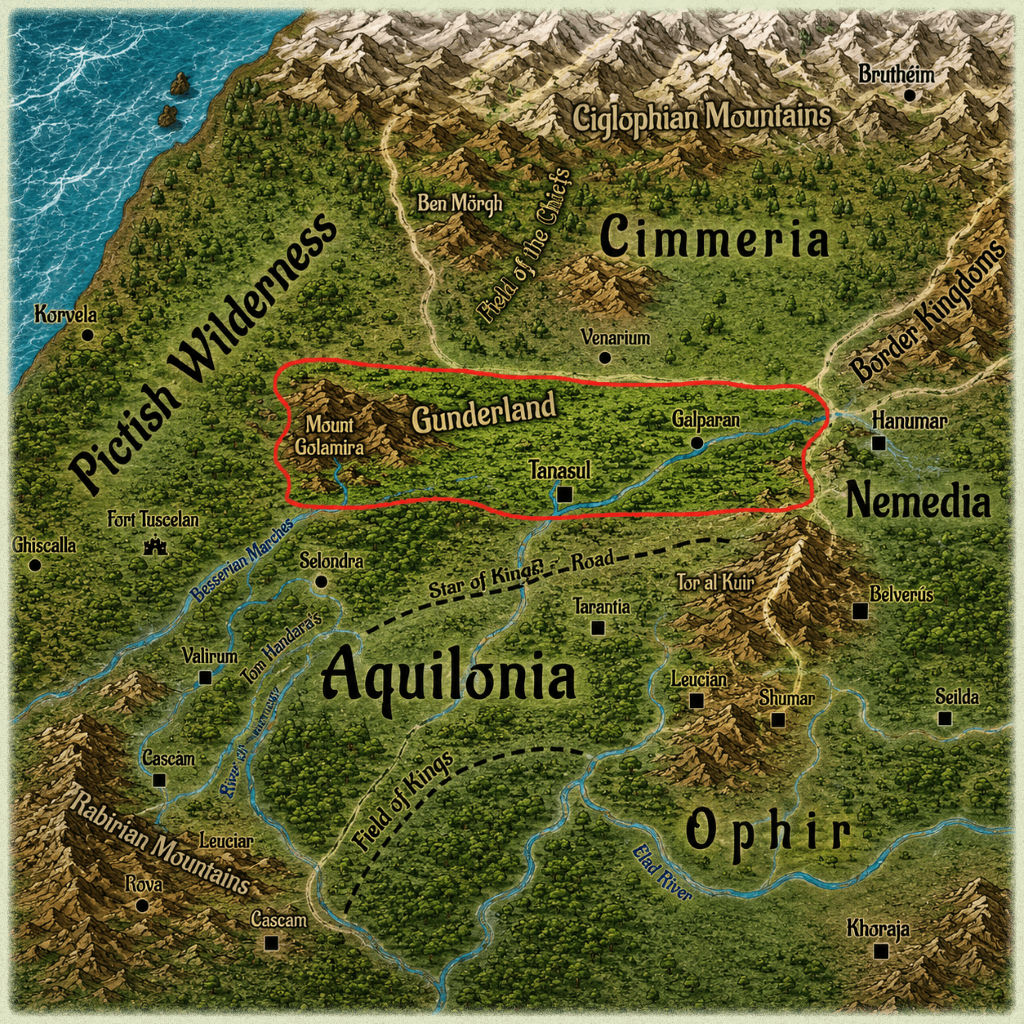

Gunderland was once a separate kingdom, but was brought into the larger kingdom, less by conquest than agreement. Its people never considered themselves exactly Aquilonians. Despite the concessions afforded to Aquilonia, the people of Gunderland view themselves as relatively independent.
The province is defined by its rugged, elevated terrain, acting as a massive buffer zone between the civilized southern nations and the wild barbarians of the north. Its geography features rolling, rocky hills, thick pine forests, and deep valleys that grow increasingly cold and unforgiving as one travels toward the mountains of Cimmeria. The natural landscape is demanding, forging a hardy terrain that naturally resists easy travel or cavalry maneuvers, forcing its inhabitants to become experts at traversing difficult ground on foot.
Geographical Features and Wilderness
The Northern Foothills
The northernmost boundary of Gunderland is characterized by steep foothills that gradually transition into the grim, jagged crags of Cimmeria. This wilderness is thick with dense timber and shadowed ravines, frequently masked by heavy mountain mists. It is a treacherous landscape where a traveler can easily go missing, and it serves as the primary avenue for raiding parties moving between the two regions.
The Barony of Raman
Raman is a barony of Aquilonia located along the border of northern Gunderland. Many border wars are fought here due to its position as a strategic gateway into the province. The old Baron of Raman is named Ulric; he fights against Conan in the civil war. He is a grey haired warrior, a veteran of those border wars with the wild Cimmerians and peoples of the Border Kingdom. The geography of Raman is highly fortified, dotted with stone watchtowers, hidden palisades, and defensive trenches designed to bottleneck invaders coming out of the northern wilderness.

Gunderland does not consider itself to be part of Aquilonia despite an agreement to the contrary. The divisions tend to undermine the sovereignty of the king and lead to inefficient government by the counts, barons and those subordinate to the upper nobility.
The political infrastructure of the province is heavily decentralized, functioning as a collection of militarized fiefdoms rather than a cohesive imperial state. While the King of Aquilonia technically holds ultimate feudal authority over the land, the geographic isolation of the province and the stubborn independence of its people ensure that local lords exercise near-total autonomy within their respective borders. Imperial decrees from the capital of Tarantia are frequently interpreted loosely, delayed, or entirely ignored if they clash with traditional Gunderlander customs.
The Ruling Nobility and Feudal Hierarchy
Gunderland does have a landed nobility. Predatory counts and hawk-like barons rule the various fiefs and manors of Gunderland. These rulers are aggressive, highly territorial, and deeply entrenched in the protection and expansion of their personal domains.
- The Warrior Aristocracy: Many of the ruling class have served in Gunderland's military forces as officers, often using a noble/soldier or noble/borderer combination. This shared martial background completely dictates their style of governance. Fiefs are managed less like civilian agricultural estates and more like active permanent military encampments.
- The Noble Disposition: Gunderland's nobles tend to have a military air about them, proud of their service and of their wars. They are strong willed, even for Gundermen, who are already stronger willed than most. This extreme willpower makes them notoriously difficult for the Aquilonian crown to manage, as they are entirely unafraid to challenge royal authorities or engage in localized private wars with neighboring baronies.
Regional Governance and the County of Raman
The constant political friction and border skirmishes frequently result in swift shifts of localized power across the northern marches. Gaeric the Gunderman is now the Count of Raman, a county of Gunderland. Under this martial leadership, counties like Raman function as primary defensive bulwarks, where the local count commands absolute loyalty from the lesser barons and knights stationed along the frontier.

People of Gunderland lead a rough life of small, walled villages, vast forests, and healthy farmland. They are stubborn, fierce fighters. Still, for all that, Gundermen are part of the greater empire. To them, being Aquilonian is better than constant war against that great nation. The rich soil and beauty of Gunderland are too prized by Aquilonian nobility to be left to rude people whose roots are so close to the sons of Bori.
Community life centers entirely around fortified agrarian settlements. Because the wilderness is vast and dangerous, isolated farmsteads are rare. Instead, families live inside heavily stockaded or stone-walled villages, venturing out daily to cultivate the healthy farmland and returning behind fortified gates before nightfall. This lifestyle blends hard, practical manual labor with absolute military vigilance.
Martial Reputation and Lineage
Gunderland provides some of the finest infantry in the Aquilonian host. They are known for valor by Nemedians and Picts alike. They are the most pure-blooded of the Hyborians and are excellent warriors.
- Purity of the Root-Stock: While other kingdoms have intermingled with neighboring races, the Gundermen have retained their original lineage virtually unchanged since the dawn of the Hyborian conquest. They remain culturally and physically closer to the ancient sons of Bori than any other civilized nation, a fact that fills them with a quiet, hardened pride.
- The Pike and Shield Formations: Gundermen, who excel at the spear and poleaxe and pike-and-shield fighting style has been the downfall of many raids. Their tactical cohesion is legendary. Where individualistic barbarians charge wildly, Gundermen lock their massive shields together, forming an impenetrable wall of iron and seasoned ash that can completely grind down a frontier invasion.
The Core Values of the Gunderman
Strength and resolution in the face of combat are the most prized abilities for the Gundermen. They as a whole, are strong willed and determined, ready to face down a crashing storm of armored knights without giving an inch of ground, determined to spill blood, horse and knight alike. They know how to absorb a cavalry charge.
- Psychological Grit: A Gunderman's mindset is defined by absolute stubbornness and psychological resilience. In battle, they view giving up a single step as a betrayal of their comrades and their village. This collective determination allows them to stand completely unfazed when the ground shakes beneath a heavy cavalry assault.
- Contrasting Northern Neighbors: While the Gundermen maintain iron discipline on the battlefield, the fierce reputation and grey-eyed stare of the long-limbed Hyperboreans allow them to end most conflicts before they even begin, but the warriors amongst them lean toward the barbaric weapons of the old tribes. Gunderlander society respects this raw, imposing strength found in their northern neighbors, yet they consciously choose to channel their own ancestral fury into highly organized, civilized military formations rather than returning to the chaotic savagery of the wilderness.

The visual presentation of the Gunderlander people is a direct reflection of their isolated geography, ancestral isolation, and practical military culture. They shun the elaborate drapery and changing fashions of the southern courts, preferring standard, hard-wearing attire suited to a rough life of farming and frontier defense.
The people of Gunderland have kept their race pure, leaving them tawny-haired and grey-eyed. With no slaves and little interbreeding with other peoples, are the purest of the Hyborian bloodlines.
- Physical Characteristics: Their lack of intermingling since the dawn of the Hyborian expansion has preserved a highly consistent look. Gundermen are typically broad-shouldered, tall, and robustly built, carrying themselves with a natural, steady military posture. Their skin is fair but deeply weathered by the cold northern winds and manual farm labor.
- Hair Styles: Hair serves as a clear indicator of social and marital standing within the communities. Women's hair is worn braided, although unmarried women and girls may wear their hair down. Gunderland men wear their hair long, usually held back in a pony-tail to keep it away from their eyes and weapons during daily chores or active combat.

Everyday Female Garb
The wardrobe of Gunderlander women is layered, durable, and designed to provide warmth against the harsh northern climate while allowing for mobility around the walled villages.
- The Foundation Layers: In Gunderland and Bossonia, women wear a pelicon, which is a short, sleeveless slip, as an undergarment. A long-sleeved, ankle-length chainse is worn over the pelicon.
- The Outer Layers: A shorter-skirted kirtle with long, flaring sleeves is worn over the chainse, creating a distinct, structured appearance. To protect against the mountain chills, a cloak or cape is often worn fastened at the throat with a simple iron or bronze brooch.
Everyday Male Garb
Men's clothing is equally functional, emphasizing freedom of movement for farming, hunting, and march defense. Men wear a tunic with a surcoat, usually crafted from heavy local wool or treated leather, and paired with sturdy leather boots designed to handle rocky terrain.
Military Dress: The Gunderland Pikemen
When the province calls up its legendary infantry levies to form their famous defensive squares, their equipment is uniform, heavy, and meticulously maintained.
Gunderland Pikemen: wear steel caps or visored bascinets, along with mail hauberks. They carry their famous pike and shield combination, plus some kind of backup weapon such as an arming sword or short sword. This protective harness ensures they can completely absorb a heavy cavalry charge or hold off a barbarian raid while dealing lethal damage from behind their interlocking shields.

People of Gunderland take their pride in pure bloodline. Marriages usually are monogamous and last the life time as these people tend to follow code of honor. Even though it is a Patriarchial society that is streightened by worship of the old gods, Women in gunderland have more freedom compared to other Hyborians.
The domestic structure is built on a foundation of mutual survival and deep-seated community honor. Because the entire province operates as a permanent frontier shield, the traditional patriarchal framework does not relegate women to mere property or passive roles inside the home. Instead, the daily realities of enduring Cimmerian raids and border wars have forged an exceptionally egalitarian standard of personal responsibility and resilience.
The Martial Expectations of Gunderlander Women
The harsh environment dictates that every free citizen must be capable of dynamic physical defense. A Gunderlander household cannot afford vulnerabilities when the regional forces are mobilized away from the walled villages.
- Defenders of the Homestead: When men go to battle or onto mercenary jobs women are expected to keep home safe, taking the arms to defent their family if needed. Girls are raised alongside boys to understand the utility of the hunting bow, the short sword, and the spear, ensuring that a village's defensive wall remains fully manned even when the main host has marched south.
- Companions on the Field: It is not rare for wife to accompany her husband and sons into the battle as well. Whether managing the critical supply trains, reinforcing the shield wall during a desperate siege, or actively picking up a dropped pike on the frontline, women participate directly in the survival of the state.
Lineage, Honor, and Mutual Respect
The absolute rejection of interbreeding and foreign slavery shapes how families view their personal unions.
- Lifelong Alliances: Because Gunderlander society is built around lifelong monogamy and a strict ancestral code of honor, divorce or infidelity is viewed as a severe breach of community trust that can destabilize a village. Marriages are partnerships of deep mutual reliance rather than decadent wealth transactions.
- Equality of Spirit: Within the home and the tribal assembly, mothers and wives are as strong and as honorable as their men. They are highly respected voices in village councils, recognized not just as caretakers, but as the literal guardians of the pure Hyborian root-stock who pass the ancient code of honor down to the next generation of warriors.

The economic and professional life of Gunderland is defined by a fierce commitment to personal liberty, agricultural self-reliance, and a massive export of highly specialized military labor. Because the territory shuns the soft luxuries of the southern kingdoms, every trade and profession is geared directly toward practical survival and the defense of the province.
The Absolute Rejection of Slavery
The social and economic framework of Gunderland completely sets it apart from the rest of the Aquilonian empire and the southern realms. The people of Gunderland, Nor take nor keep slaves and find even the mere idea of slavery distasteful.
They view slave labor as a corrupting, decadent practice that breeds physical weakness and moral decay in a society. To a Gunderman, an individual's worth is earned strictly through honest manual labor and personal martial prowess; therefore, owning another human being is a fundamental violation of their ancestral code of honor. Every field is plowed, every wall is built, and every weapon is forged by the hands of free, proud citizens.

Staunch Gundermen tend to be agrarian, so many of their skills reflect this background. Their adaptable skills turned tawny haired folk into great weaponsmith, Farmers and crafters of sort. They tend to have skills aimed for survival, having skilled huntsmen in their ranks.
- Agrarian Mastery: The primary backbone of domestic life is farming the healthy, rich soil of the valleys and managing livestock within the safety of the walled villages.
- Crafting and Forging: Gunderlander craftsmen do not waste time creating delicate jewelry or fine silks. Instead, they focus their adaptable skills on producing highly durable goods, turning their talents toward becoming great weaponsmiths who can hammer out the uniform steel caps, mail hauberks, and heavy iron heads for the province's massive supply of pikes.
- The Hunting Ranks: The vast, shadowed forests that blanket the northern frontier are managed by skilled huntsmen. These trackers provide a steady supply of wild game and timber for the stockades, while simultaneously acting as the first line of scouting defense against encroaching barbarian threats.
The Mercenary Rite of Passage
As a young man it is almost a rite of passage for a Gunderman to leave home and take up service as a mercenary. Many of these adventurous youths are never seen again. Those who return home do so as grizzled veterans of foreign campaigns, dangerous, shrewd and wealth.
A Gunderland mercenary is motivated not by patriotism, love nor discipline but money. Mercenaries have no concept of fair play or chivalry in battle. The Gunderland mercenary seeks an edge in battle and no target is off limits. They look for any weakness in an opponent's armour and will repeatedly strike at a weaker area, such as a shoulder, attempting to wear through armour. This cold, calculating pragmatism makes them terrifyingly efficient killers on foreign battlefields, as they treat warfare strictly as a highly lucrative, brutal trade rather than a theater for noble glory.
The Legendary Gunderlander Pikemen
Gundermen are also renowned for their skills with pikes. Gundermen Pikemen are reputed to be the bravest of the brave, the stoutest of the stout. They are deadly with their pikes and can quickly dispatch those who move within the reach of their pikes.
- The Battlefield Doctrine: They are almost barbaric as they defend their fields of battle, showing no quarter because they know that when an enemy cavalry charges, they will be given none. Their ultimate goal is to maintain an unbroken wall of ash wood and steel, impaling charging destriers and systematically butchering any infantryman foolish enough to step into their weapon's lethal reach.
- Defenders on and off the Field: They see themselves as the ultimate defenders, a role they live up to even off the battlefield. They are the first to defend a friend's honour in a tavern. They are the first to volunteer to defend a neighbour's home from man, beast or weather. This deep-seated protective instinct is hard-wired into their cultural identity, transforming their military training into a lifelong civic duty to safeguard their community and kin.

While the mainstream populace of Gunderland officially adheres to the state-sanctioned, austere worship of the Hyborian god Mitra, the deep forests and isolated valleys of the province harbor ancient, radical roots that tie the Gundermen directly to their primordial ancestors.
The Cults of Bori
The Gundermen originally worshipped bori, a primitive god from their early polytheistic Hyborian origins and small cults dedicated to that ancient god still exist. These small, highly secretive cults reject the modern, bloodless theology of Mitra in favor of raw, primal traditions that have remained unchanged for centuries.
- Animist Beliefs: The cult is primarily animist and prayers to the spirit world constitute the majority of actual practice. Followers believe that the natural world is densely populated by spirits, ancestors, and elemental forces that must be appeased or channeled through active devotion.
- The Spirits of Intoxication: Spiritual possession is a cornerstone of their religious experiences. Drunkenness is seen as a sign of Bori's favour, for he has seen fit to allow spirits to possess the drunk person. During sacred feasts, deep intoxication is pursued deliberately as a holy state, allowing the mortal vessel to speak with the voices of ancient spirits.
Ritual Magic and the Seidkona
The social hierarchy of the Bori cults dictates a strict gender division regarding the channeling of supernatural forces, viewing magical manipulation through a very specific cultural lens.
- The Seidkona Sorceresses: The practice of sorcery is considered unmanly among the Cults of Bori, so it is practiced by women called seidkona, who wear blue cloaks and black wool hoods trimmed with white cat fur. While male cultists focus entirely on martial strength, hunting, and physical sacrifice, these specialized women command immense spiritual authority, serving as tribal seers, herbalists, and spirit-mediums.
Sacrificial Rites and Fertility Traditions
The Cults of Bori maintain bloody, visceral rituals designed to ensure the physical survival and reproductive success of the pure-blooded clans.
- The Ninth-Year Mass Sacrifice: Every ninth year, in honour of the defeat of Ymir, human sacrifices are offered to Bori. Hundreds of prisoners or slaves are sacrificed and hung from trees. This mass human sacrifice is illegal in Gunderland but widely practised in Hyperborea. Because Gunderland is legally bound by Aquilonian imperial laws that strictly forbid human sacrifice, any local cultists attempting this ancient rite must do so in the deepest, uncharted border wilderness to escape execution by the local counts.
- Annual and Fertility Offerings: Other than the ninth year sacrifice, pigs and horses are the normal annual sacrifices for Bori. These animals represent the essential lifeblood of their agrarian economy. Following these seasonal slaughters, the penises of sacrificed stallions are given to women in order that they may perform a fertility rite with them, a traditional ceremony meant to secure the continuous strength, health, and purity of their ancestral bloodline.

To play a Gunderman is to embody the stoic discipline, martial supremacy, and unyielding pride of the true Hyborian root-stock. You are a product of a rugged, cold frontier kingdom that chose vassalage over subjugation, trained from early youth to stand shoulder-to-shoulder within the legendary infantry squares, knowing that your iron willpower and absolute refusal to break make you supreme in the Western world.
Core Identity
- Race: Hyborian (The purest remaining branch of the ancient, unmixed root-stock).
- Language: Aquilonian (Spoken with a sharp, no-nonsense northern accent, entirely stripped of southern courtly fluff or poetic idioms).
- Hair Color: Consistently fair, leaving them tawny-haired.
- Eye Color: Steady and piercing, leaving them grey-eyed.
- Names: Blunt, historic, and powerful, avoiding the elaborate stylistic flourishes of the southern nobility.
- Male: Gaeric, Ulric, Gurn, Holgar, Harek, Botho, Sigmund, Wulfgar.
- Female: Hilda, Sigrid, Freya, Elsa, Brunhild, Marta, Karla.
Personality and Archetypes
Gundermen carry themselves with a quiet, resolute confidence that civilized southerners often mistake for stubbornness or rustic simplicity. They speak with absolute honesty and judge men by their actions and their grit, not their titles.
- Iron Will and Resolution: Strength and resolution in the face of combat are the most prized abilities for the Gundermen. You are part of a people who, as a whole, are strong willed and determined, ready to face down a crashing storm of armored knights without giving an inch of ground.
- The Mercenary Pragmatism: If you wander south, you leave patriotism behind. A Gunderland mercenary is motivated not by patriotism, love nor discipline but money. Mercenaries have no concept of fair play or chivalry in battle, seeking every tactical edge to exploit an opponent's weakness.
- Egalitarian Martial Freedom: You come from a society where mothers and wives are as strong and as honorable as their men. You expect women to fully hold their own, protect the homestead, or actively march into the fields of battle alongside their families.
Combat Roles and Equipment
Gundermen value heavy, practical protection and absolute uniformity in disciplined formations, relying on time-tested weapons to break their foes.
- The Gunderland Pikeman (Elite Infantry Levy): The pinnacle of Gunderlander martial fame. You wear steel caps or visored bascinets, along with mail hauberks. You carry your famous pike and shield combination, plus some kind of backup weapon such as an arming sword or short sword.
- The Raman Border Ranger (March Scout): A veteran of the bitter frontier skirmishes. You favor quiet, supple leather armor and a heavy wool cloak that blends into the northern brush, utilizing a powerful hunting bow, a short sword, or a broad-headed hatchet to hunt Cimmerian raiders.
- The Seidkona (Bori Spirit-Medium): A rare female practitioner of the ancient tribal ways. You shun standard steel armor, dressing in a blue cloak and a black wool hood trimmed with white cat fur, utilizing animist prayers, herbs, and ritual trances to commune with the spirit world.
Social Rank and Background
Gunderlander society is decentralized and structured entirely around walled agrarian villages, livestock farming, and mandatory provincial military service.
- Militarized Nobility: You are a count, baron, or an officer subordinate to the upper nobility. You have served in Gunderland's military forces as an officer, using a noble/soldier or noble/borderer combination. You carry a heavy military air about you, proud of your service and your wars.
- Agrarian Freeholder / Crafter: The sturdy backbone of the province. Staunch Gundermen tend to be agrarian, so many of your skills reflect this background. Your adaptable skills turned tawny haired folk into great weaponsmiths, farmers, and crafters of sort, focused entirely on community survival.
- Raman Borderer: You hail from the highly volatile northern borderlands. Your entire life has been defined by generational defensive border wars against wild Cimmerians and the peoples of the Border Kingdom, making you hyper-vigilant and an expert at survival.

1. Canonical Literature
- "The Hyborian Age" (Robert E. Howard): Howard's foundational essay explicitly establishes Gunderland as the unique geographical sanctuary of the pure, unmixed Hyborian root-stock, defining them as the supreme infantry force of the Western world.
- "The Hour of the Dragon" (Robert E. Howard): Highlights the legendary tactical reputation of Gunderlander pikemen within the Aquilonian imperial army, showcasing their unmatched discipline, their refusal to break even when abandoned by cavalry, and their ultimate loyalty to the true values of the north.
2. Tabletop RPG Sourcebooks (Mongoose Publishing)
- Aquilonia - Flower of the West: Details the geopolitical tension between the Aquilonian crown and the Gunderlander province, including the decentralization of the northern fiefs and the role of the border baronies.
- Faith and Fervour: Provides the deep theological breakdown of the forbidden, underlying Cults of Bori, the animist spirit practices, the role of the blue-cloaked Seidkona sorceresses, and the sacred stallion fertility rites.
- Return to the Road of Kings: Offers the comprehensive cultural analysis of Gunderland's pure-blooded lineage, their total cultural ban on the taking or keeping of slaves, and the everyday layered attire of the populace (the pelicon, chainse, and kirtle).
- The Compendium / The Warrior's Companion: Breaks down the specific combat mechanics, equipment regulations, and tactical maneuvers of the Gunderland pikemen, including their ruthless armor-targeting fighting styles and their legendary ability to absorb heavy cavalry charges.