

Its foundation began when a single nomadic tribe, scarcely emerged from the polished-stone age, by a freak of chance learned the first rude principles of architecture. Turning abruptly from their wandering life, they abandoned their horse-hide tents for stone houses and reared dwellings of naked stone heaped to repel tribal attack. Protected by these cyclopean walls, the fierce kingdom grew mightily, transforming from a rude fortress of boulders into a stagnant, sinister empire of naked masonry trapped in perpetual winter.
The Natural Landscape and Climate
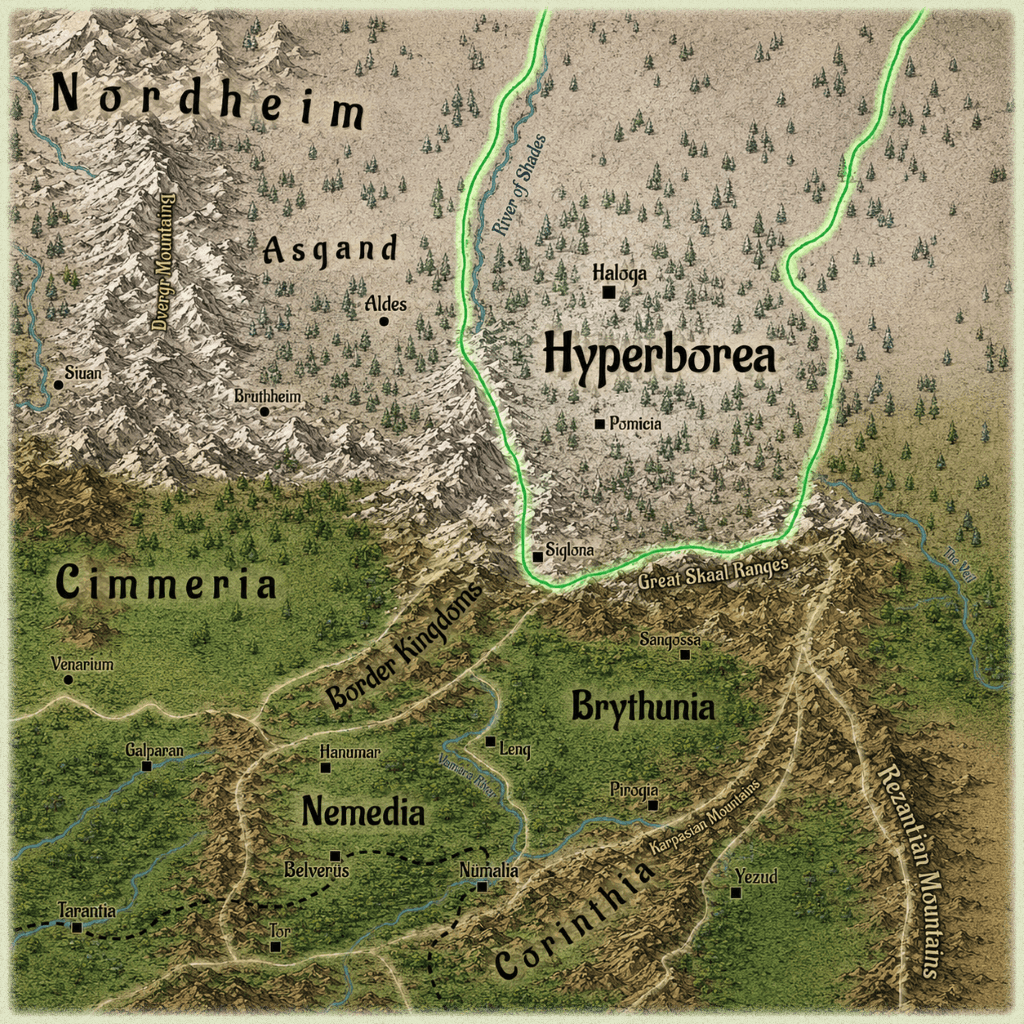
The geography of Hyperborea is defined by its sub-arctic isolation and a progression of increasingly hostile, frozen terrains that stretch toward the absolute northern edge of the known world.
- The Southern Reaches: Directly bordering the unstable Border Kingdom, Hyperborea takes on a sinister, mist-shrouded aspect of meres, swamps, and treacherous, fog-heavy wastelands.
- The Central Ridges: Moving further north, the miasma of the marshes gives way to a vast, brooding landscape of dark pines, dense coniferous forests, and rolling granite ridges that are buried under heavy snow for most of the year.
- The Arctic Interior: Beyond the tree line, the pine ridges flatten out into a brutal sub-arctic tundra, which ultimately dissolves into a trackless, lifeless arctic wilderness of ice sheets and screaming polar winds.
Mountain Ranges and Border Barriers
Hyperborea is heavily fortified by nature, shielded by titanic geological formations that separate the frozen empire from its hated neighbors to the west and south.
- Eiglophian Mountains: This huge, jagged mountain range acts as a massive northern shield, separating the northern realms of Vanaheim, Asgard, and Hyperborea from the softer kingdoms of the south. A specialized, mountain-dwelling tribe of Hyperboreans called the Verunians live in these peaks, perpetually guarding this frozen boundary from southern intrusion.
- Graaskal Mountains: Extending through the territory, this rugged, ice-locked range serves as a dangerous transit corridor. Hyperborean raiding parties routinely brave these peaks to transport foreign captives back into the interior.
- Snow Devil Glacier (The River of Death Ice): A titanic Eiglophian glacier that flows along the western borders of Hyperborea, separating it from Asgard and the Border Kingdom. It is known as one of the most dangerous parts of the land due to sudden avalanches, crumbling snow bridges, and hidden crevasses. Countless numbers have been lost in its depths, giving rise to horrific legends about ancient vampires or predatory, underdeveloped apes that feed on human flesh.
Strategic Passes and Gates
- Skull Gate: The primary, heavily fortified passage leading from the Border Kingdom into Hyperborea. The pass is set in between hills that naturally form the shape of a massive human skull, giving the place its ominous name. A stark warning written in the Hyperborean language adorns the entrance, explicitly intimidating travelers by referring to Skull Gate as the Gate of Death, to those who come hither without leave.
Notable Keeps and Cities
Though born from barbaric origins, Hyperborea has evolved into a realm where the people are civilized and dwell in cities. These settlements are not centers of culture or enlightened art, but grim, cyclopean fortresses designed for intimidation and absolute military defense.
- Haloga: A foreboding Hyperborean fortress nestled in the middle of a bowl-shaped valley. Built from massive, cyclopean stones, the structure features but a few windows and several narrow arrow slits. The masonry is so meticulously fitted and smoothed down that hand and toe holds are nonexistent, making the glass-smooth walls virtually impossible to climb. The inhabitants of Haloga wear dark clothing marked with a distinct red sigil, and they are ruled by Queen Vammatar the Cruel.
- Pohiola: A grim, massive stone fortress ruled by the powerful witch Louhi. The heart of the keep is a colossal central hall with a roof so high it can barely be perceived through the deep shadows cast by the torches. The piled stone walls of the keep are an astonishing twenty paces thick, flanked by several squat, crenellated turrets. Aside from a few crude wooden items, it is almost entirely unfurnished. Its defenses include a heavy iron portcullis and a gate constructed from a black wood, with iron nails explicitly marking out a darksome rune.
- Sigtona: A legendary, terrifying keep. It is the very first stronghold encountered on the road leading from the Skull Gate and the Border Kingdom toward Pohiola. Sigtona is spoken of in horrible tales told around campfires in cold Asgard, where cowering Northmen whisper rumors about its grim queen who is rumored to exist entirely on human blood.
- Krev: The heavily fortified capital of the principality of Pomicia. Several hundred elite soldiers sworn to the lord of Krev guard its tall walls, which are uniquely constructed from hardened oak rather than traditional stone. Krev serves as the primary, most lucrative slave market in Hyperborea. Because brutal slaver parties come directly here after crossing the Graaskal mountains on their way from raids in Brythunia, they are often eager to sell their human merchandise right in Krev to avoid further travel through the arctic cold.

The internal structure of Hyperborea is a stagnant, chillingly transactional feudal system. It is a nation deeply divided between the ruling class and the underclass, where thousands of years of isolation have warped the original Hyborian ideals of honor into a grim doctrine of absolute survival and exploitation.
Hyperboreans separate themselves into a feudal system, with nobles living in great stone keeps that squat atop hills and peaks, while serfs live below them, working the land and scraping by in service to their Lords. Hyperborean culture is split very much between the 'haves' and the 'have-nots'.
- The Citadel Lords: Hyperborean nobles live in great stone castles, aloof and distant from the serfs who live beneath them in stone-walled villages. Protected by their massive, cyclopean masonry, these rulers have completely detached themselves from the daily struggles of agricultural life. Most Hyperborean nobles dabble in magic or multi-class into scholars. They tend to be languid and bored, slow of speech and lacking in strength of character. They view the pursuit of physical governance as tiresome, leaving the administration of their domains to cruel overseers while they immerse themselves in dark sorcery or archaic philosophy.
- The Evolution of Total Servitude: The legal and physical distinction between a free laborer and a captive has completely dissolved over centuries of absolute aristocratic rule. The use of slaves in Hyperborea eventually gave way to the lords of that kingdom treating all people, even Hyperborean serfs, as slaves of a sort. Nobles live in great stone keeps, treating all people, slaves and citizens alike, as disposable tools to use and discard.

Hyperborea is not a populous kingdom, despite its large size. The warmer climes to the south were inviting to the original clans and most pushed on southward. Those that remained were a stubborn breed that loved the ridged hills and dark forests.
- Cultural Stagnation: Because they chose to remain locked within the frozen north, Hyperboreans are an aloof and insular people, shunning outsiders and eschewing the influence of other cultures. Because of this, they lag behind other developing Hyborian nations, lacking the art, metallurgy, and other cultural developments that naturally occur in collaborative environments over time. While southern kingdoms advance in fine steel-working and complex philosophy, Hyperborea remains culturally arrested, relying entirely on the crude architectural principles and brute force established by their ancestors.
- The Labor Shortage and Slavery: The hostile climate and low birth rates present a permanent challenge to the aristocratic keeps. The small population is often not enough to do the necessary work for the various lords in their stone citadels, so the Hyperboreans use slave labour extensively and are harsh taskmasters. To fill this chronic deficit, slaver parties launch brutal raids into neighboring territories, dragging captured Brythunians, Zamorians, and foreign travelers into the northern interior to build walls and mine frozen granite until they drop dead from exhaustion.
Morality and the Lack of Chivalry
The societal ethics of the frozen kingdom are stripped of all romantic notions of justice, chivalry, or religious piety.
- The Philosophy of the Strong: Morality and strength of character hold no sway over Hyperborean people. They value strength and wit, grit and cunning over displays of valor. Those who are strong survive; those who are not perish. Altruism is viewed as a fatal character flaw, and betrayal is considered an acceptable path to power if executed with sufficient cunning.
- The Absence of true Knights: Because physical labor and martial enforcement are viewed with aristocratic contempt, the culture does not support the social mechanisms for true knights. Few Hyperborean nobles have the drive to learn to fight as soldiers for an army. That is the purview of the lesser Hyperboreans.
- The Pragmatic Border Knights: The only notable exception to this military laziness occurs along the volatile frontiers where the kingdom faces constant physical destruction. However, some of the border nobles have learned to fight nomad invaders and do call themselves knights. These frontier commanders completely lack the refined, gilded armor of southern paladins. Instead, they wear mail shirts under scale hauberks with helmets stolen from Æsir, Cimmerian, Hyborian or Hyrkanian invaders, creating a cobbled, predatory appearance that reflects their brutal, opportunistic way of life.

The physical form and daily dress of the Hyperborean people reflect a thousands-of-years-old lineage shaped by a freezing, unforgiving climate and the dark social experiments of an insular ruling class.
The physical structure of Hyperborea’s population is starkly divided between the diverse, heavily intermingled underclass and the radically isolated, physically deteriorating aristocracy.
"There were tall Hyperboreans, gaunt, big-bones, of slow speech and violent natures...” — Black Colossus
- The Common Folk: The people are typically pale-skinned, extremely tall and gaunt, with white hair and green or pale blue eyes while many are as tall as seven feet. They are a superstitious lot who live as serfs in huts and hovels beyond the stone walls where they make out meager livings from gardening the stubborn soil and herding small numbers of shaggy cattle and reindeer.
- The Impact of Captive Bloodlines: While the classic, towering, white-haired phenotype dominates the major keeps, centuries of slavery and mixing blood with captured southerners (Mainly Hyrkanians, Zamorian and Aesir) have produced other hair colors in small villages. These variations are especially prevalent along the trade routes and borderlands where foreign captives are processed.
- The Noble Lineage and Mutations: This leaves pure blooded nobles as towering, alien like people who keep their heritage by arranging marriages inside the blood line. Because they completely reject the blood of lesser peoples or foreign captives to preserve their original Hyborian root-stock, this intense inbreeding has devastated their biology. Almost always, this pairing results in subtle or overwhelmingly obvious bodily defects and mutations. Therefore, most Nobles are often very weak, sickly looking, and deformed in some manner while exhibiting mental and/or physical deficiencies.

Hyperborean fashion is dictated by functional survival against perpetual winter, regional isolation, and strict factional or social allegiances. Prefered colors of attire are usually dark brown/black or white, creating a grim, monochromatic aesthetic across the landscape. Furs are commonly worn due to cold climate of the land.
Women's Dress
- The Serf and Free Woman: A Hyperborean woman usually wears a horn shaped cap, a long laced bodice, a hip-length jacket and a broad striped cloth skirt. Aprons are worn as well, as are warm cloaks for outdoor travel. These garments are thickly layered and constructed from heavy wool or coarse animal hides to ward off the sub-arctic chill.
- Maidens and Nobility: Girls wear silk or linen headbands instead of hats. Noble girls wear thin tiaras or more elaborate headbands, using fine metalwork and precious stones imported by slavers to signal their elevated, untouchable status above the serfs.
Men's Dress and Armaments
- Daily Garb: A Hyperborean man wears a simple shirt, long trousers, a jacket or coat, a hat or cap, and often a scarf about his neck during the long, cold winters.
- Weapons of War: The men usually wield broadswords or axes to defend their homesteads or enforce the will of their lords. However, the extreme cultural stagnation of the country is visible in its weaponry: stone weapons still see use in the backwoods,isolated areas of an already isolated nation.
Factional Garb
- The White Hand: Clothing serves as an absolute indicator of political and magical allegiance for the inner circles of the sorcerous elite. Members of the White hand only wear black and white, entirely eschewing the rustic browns of the peasantry.

The societal mechanics of Hyperborea are driven entirely by cold, transaction-based survival. In a frozen land where weakness is a death sentence, traditional southern concepts of gender hierarchy, romantic marriage, and moral empathy are entirely discarded.
While maintaining a baseline patriarchal structure in terms of lineage and title inheritance, the absolute brutality of the climate and centuries of unrelenting warfare have pushed Hyperborean men and women to a state of practical equality.
- Martial Self-Reliance: Women and men are almost close to be equal to each other in Hyperborea. Even though its Partiarchal stance women as in general everywhere in the north have rights to learn how to fight and survive the harsh wilderness. Do not mistake Hyperborean female as a lady in distress. They are as fierce as their husbands and brothers.
- Domestic and Military Defensiveness: Even though they do bare children and are expected to be in charge of house work hyperborean women with the history of wars with Nordheimer neighbours have learnt how to defend themselves and their own. A Hyperborean homestead or village is never left unguarded; when the men are away on slave-raiding expeditions, the women hold the stone-walled parameters with axes and broadswords.
- Sovereign Power and Authority: This egalitarian fierce nature extends directly into the highest echelons of the kingdom’s ruling class. Many of the notable artisans, sorcerers and nobles are Females. They have right of ownership of slaves and lands. Figures like Queen Vammatar the Cruel and Louhi the Witch are not cultural anomalies; they are the direct product of a society that bows blindly to iron-willed strength, regardless of gender.
The Pragmatism of Marriage
- The Rejection of Romance: Marriage is arranged by the parents of the bride and groom, and is used to cement alliances and family ties. Even among commoners, tying oneself to a spouse is a matter of survival and pragmatism, rather than based on something so fleeing and frivolous as love. A union is weighed strictly by how many shaggy cattle, reindeer, or sturdy walls it brings together to ensure winter survival.
- Aristocratic Inbreeding: Marriage in pure blooded hyperboreans usually is arranged by the parents of Bride and groom. To keep blood pure and untainted by south, families force these unions entirely within their narrow, ancestral bloodlines. This obsessive preservation of their original Hyborian stock directly fuels the horrific bodily defects, physical weaknesses, and mental deficiencies that plague the modern citadel nobility.

The entire economic engine of the frozen kingdom is lubricated by human suffering. Without the influx of foreign captives, the small, stagnant Hyperborean population would utterly collapse under the weight of its own environment.
- The Economic Backbone: Hyperboreans are known as ruthless taskmasters. Their boundless cruelty makes them excellent slavers, and their lack of morality leaves them free of remorse or empathy towards those they enslave. Slave trade, and the labor of slaves, forms the backbone of the Hyperborean economy, and it is said that Hyperborea was built upon the pain and suffering of their slaves.
- The Lifecycle of the Enslaved: Captives dragged across the Graaskal mountains or bought in the slave markets of Krev are stripped of all human identity. Those slave's and children of slaves are commonly used as a trade source, servants and prostitutes in brothels. They are treated as pure livestock, passed down as currency or used to fulfill the base desires of the bored, languid nobility.
- Ritualistic Disposal: When a slave’s physical utility is exhausted through age, freezing cold, or starvation, their ultimate end is frequently religious. It is not uncommon for such to be used as a sacrifice in the festivals of Bori. During these grim rites, their blood is spilled onto the naked stones or their bodies are hung by the hundreds from the dark pine trees of the northern wastes to satisfy the ancient, primal demands of the spirit world.

The inner workings of Hyperborea are heavily stagnated by its ancient history and deep geographic isolation. Its social order is preserved exclusively through structural fear, specialized craftsmanship, and two distinct spiritual paths that dominate the frozen landscape.
Hyperborean culture is ancient and slowly in decline. Although they were once a prosperous people, their isolationist tendencies have left them with little outside contact, next to no trade, and minimal industry. Still, they were first of the Hyborian nations to build stone fortresses, and are still skilled masons and stoneworkers, as well as wood craftsmen.
- The Agrarian Struggle: Commoners herd reindeer, serve in small military contingents funded by the nobles, and tend to small flocks of domestic animals, as well as forage in the forests for mushrooms and other small bits of edible vegetation. Surviving on the sub-arctic frontier requires constant, grinding manual labor just to secure raw sustenance from the unyielding wilderness.
- The Slave Industry: A portion of the hardier and more industrious in Hyperborean society make their living as slavers, and are feared throughout the neighbouring kingdoms, even by the fierce Nords. These brutal raiding parties serve as the single most dynamic sector of the declining economy, generating massive fortunes by capturing human chattel from Brythunia, Zamora, and the Nordheimer borders to fuel the labor needs of the stone fortresses.

The spiritual landscape of Hyperborea is divided between the ancestral, blood-soaked worship of their foundational patriarch and a highly organized, terroristic sorcery cult that dominates the political sphere.
The Cult of Bori
Bigger part of Hyperboreans Still worship and follow ancient Hyborian God - Bori. Bori is a god of Wisdom and War known as bringer of Victory. He was the one to cast down Nordheimer frost giant god Ymir to allow Hyborians to move to the south.
- The Warfare as Sacrifice: According to Nemedian Scholars every enemy killed by bori worshiper is considered as a sacrifice to him as well. This belief makes the traditional Bori-worshipping commoner an exceptionally lethal combatant who views the battlefield as a sacred altar.
- The Ninth-Year Rites: Once in every 9 years Human sacrifices are offered to Bori. Hundreds of Slaves are sacrificeed and hung on the trees in the name of god of War. This massive ritual is designed to commemorate their ancient victories over the frost giants.
- Pragmatic War Offerings: Other sacrifices to Bori are performed in order to gain a change in circumstances or weather; the sacrifice in these instances is usually chosen by lots among the warriors desiring the change. Sacrificing someone who will not benefit from the change in circumstance is not considered helpful. Therefore, the cult ensures that those selected for these specialized weather-sacrifices have a direct stake in the outcome of the impending conflict or climate shift.
The Witchmen and the Cult of the White Hand
Those that practice sorcery usually prefer to Go to the worship of Louihi. Her army of followers are known as Witchmen. They rule mainly from the fortress of Pohiola which is fueled by their religion. Following Louihi, Witchmen serve the queen and are usually dressed only in black and white, wearing masks.
- The Living Goddess: Louihi is mortal, living Sorcerress she is often called death goddess as her followers consider her as an avatar. Her word is absolute law, and her presence transforms the fortress of Pohiola into the literal holy center of Hyperborean occult power.
- The Pale Sorcerer Assassins: Worshiping of a death Goddess they created a cult called White hand. White hand is full of Pale Sorcerer assasins who are terorizzing whole Hyperborea. Those who serve in the cult undergo a lot of dangerous trials and mortifications of the body. Breaking their mind and will making them even more alienlike then their regular Hyperborean bretheren.
- The Fearless Enforcers: Witchmen of the louihi are considered deadliest fighters in the world showing no remorse or fear. They serve as the ultimate political and martial enforcers for the sorcerous elite. Some fables around the land tell that they dont even feel pain, a direct result of the brutal, systematic breaking of their minds and bodies during their initial induction into the White Hand.

To play a Hyperborean is to embody the chilling, towering presence of a stagnant and isolated empire of stone. You are a product of a brutal, unforgiving northern waste where the weak are systematically ground into the frozen earth and the strong rule from impregnable, cyclopean citadels. Navigating a landscape of harsh winters, absolute slavery, and dark sorcerous cabals, you know that survival requires a cold mind, an iron will, and the ruthless pragmatism to thrive in a society that values raw strength and cunning above all else.
Core Identity
- Race: Hyborian (Hyperborean). Pale-skinned, extremely tall, and gaunt, with many reaching up to seven feet in height. Commoners may show other hair colors in small villages due to centuries of mixing blood with captured Hyrkanian, Zamorian, and Aesir slaves, while pure-blooded nobles remain towering, alien-like figures.
- Language: Hyperborean (A slow, deep, and menacing northern tongue delivered with a deliberate cadence that trusts action over words).
- Hair Color: Predominantly stark white, though darker shades exist among the lower-class serf villages along the frontier.
- Eye Color: Cold, piercing, and pale, typically green or pale blue.
- Names: Heavy, guttural, and archaic, carrying a distinct northern ring.
- Male: Esca, Kaelen, Vammaton, Louhan, Gara, Toras, Borix, Hakon.
- Female: Vammatar, Louhi, Sinikka, Helmi, Aila, Kirsikka, Taimi.
Personality and Archetypes
Hyperboreans are renowned for their aloof, insular nature, lack of empathy, and unyielding psychological grit. Unlike the fluid and expressive southern races, a Hyperborean stands like naked stone against the wind.
- Aloof Isolationism: You treat all outsiders with cold suspicion, shunning foreign influence and avoiding the developments of neighboring nations. You prize secrecy and hold truth as an absolute, uncompromising reality.
- The Doctrine of Cunning: Morality and strength of character hold no sway over you. You value strength and wit, grit and cunning over displays of valor, believing that those who are strong survive and those who are not perish.
- Egalitarian Fierceness: You come from a society where women and men are almost close to be equal to each other. Whether male or female, you possess the rights to learn how to fight and survive the harsh wilderness, carrying an equally violent nature.
- Pragmatic Survivalism: You view concepts like romantic love as fleeing and frivolous. Every relationship, alliance, or forced marriage within your family is treated purely as a matter of winter survival and political advantage.
- Spiritual Extremism: Your devotion is divided between the ancestral worship of Bori, which demands blood sacrifice and absolute victory, and the terrifying, transactional submission to the living death-goddess Louhi, whose followers break their minds to become instruments of terror.
Combat Roles and Equipment
Hyperboreans dress in heavy, monochromatic clothing, favoring dark brown, black, or white colors. Furs are commonly worn due to the cold climate of the land. Their warriors equip themselves for brutal utility, utilizing massive broadswords, pikes, or woodsman's axes.
- The Border Knight (Frontier Cavalry): A noble or warlord patrolling the volatile marches. You wear a mail shirt under a scale hauberk with a helmet stolen from Æsir, Cimmerian, Hyborian, or Hyrkanian invaders, wielding a broadsword or heavy axe.
- The Gunderland-Border Pikeman (Guard Corps): A disciplined defender stationed at critical bottlenecks like the Skull Gate. You are trained to stand in rigid infantry lines, armed with a long pike, a short sword, and a heavy wooden shield to dispatch those who move within your reach.
- The Witchman of Louhi (White Hand Assassin): A pale sorcerer assassin who has undergone dangerous trials and body mortifications. Dressed only in black and white masked garb, you show no remorse, fear, or physical pain as you hunt the enemies of Pohiola.
- The Backwoods Hunter (Tundra Skirmisher): A gaunt commoner adept at foraging the forests. Dressed in heavy hides and a fur scarf, you utilize primitive hunting bows or ancient weapons of polished stone that still see use in the isolated areas of the nation.
Social Rank and Background
Hyperborean society is strictly split between the 'haves' and the 'have-nots', where the elite rule from great stone keeps that squat atop hilltops while the underclass scraps by in huts and hovels below.
- Citadel Scholar-Noble: A ruler born into a great stone castle, living aloof and distant from the serfs. To keep the blood pure and untainted by the south, your family practices intense inbreeding, leaving you very weak, sickly looking, or deformed in some manner while you dabble in runecraft, icy magic, and text-based scholarship.
- Industrious Slaver: A hardened commoner or noble agent whose boundless cruelty makes you an excellent taskmaster. Free of remorse or empathy, you spend your life running captive routes through the Graaskal mountains to feed the kingdom's massive slave-labor economy.
- Moneyless Stonemason / Artisan: A proud wood or stone craftsman belonging to the first Hyborian nation to learn the principles of architecture. You spend your life maintaining the cyclopean walls and keeps of the nobility, ensuring your own survival through vital technical skill.
- Tundra Serf / Herder: A deeply superstitious commoner living in a stone-walled village beyond the main keeps. You make a meager living gardening the stubborn soil and herding small numbers of shaggy cattle and reindeer, always subject to the harsh whims of your noble masters.
- Liberated Slave-Born: Born into the brothels or labor houses as human currency, you have broken free from your owners. You are a scarred, physically hardened individual who has survived through pure grit, carrying a deep-seated hatred for the towering, white-haired masters of the north.
Starting Package
Every Hyperborean character begins their journey with a set of rugged survival equipment tailored to the frozen north:
- A set of heavy winter garb, including a layered tunic or long laced bodice, trousers or striped skirt, a hip-length jacket, and a thick fur cloak or scarf.
- A pair of heavy, fur-wrapped leather boots suitable for traversing glaciers and snow bridges.
- A primary weapon of choice, typically a steel broadsword, a heavy battleaxe, or a long defensive pike.
- A small pouch containing dried mushrooms and salted reindeer meat gathered from the tundra.

- "The Hyborian Age" (Robert E. Howard): Outlines the foundational migration patterns, the accidental architectural discovery of stone building, and the climatic conditions of the perpetual northern winter.
- "Black Colossus" (Robert E. Howard): Provides the definitive physical description of the Hyperborean racial phenotype, emphasizing their tall, gaunt, big-boned statures and violent natures.
- "The Phoenix on the Sword" - First Draft (Robert E. Howard): Contextualizes their urban development, establishing that the Hyperboreans are a sedentary people who are civilized and dwell in permanent cities east of Asgard.
- Return to the Road of Kings (Mongoose Publishing): Offers a comprehensive cultural breakdown of the deep divide between the citadel nobles and the serfs, alongside detailed descriptions of regional garments like the horned cap and laced bodices.
- The Road of Kings (Mongoose Publishing): Details the geographic landmarks of the nation, providing historical reference for locations like the Snow Devil Glacier, the Skull Gate, and the mountain-dwelling Verunian tribes.
- The Compendium (Mongoose Publishing): Examines the structural decline of Hyperborean trade, industry, and metallurgy, detailing how their isolationist tendencies forced a heavy economic reliance on the foreign slave trade.
- Faith and Fervour (Mongoose Publishing): Supplies the complete theological architecture for the Cults of Bori and the living goddess Louhi, explaining the mechanics of the ninth-year human sacrifices, weather lots, and the physical mortifications of the White Hand Witchmen.