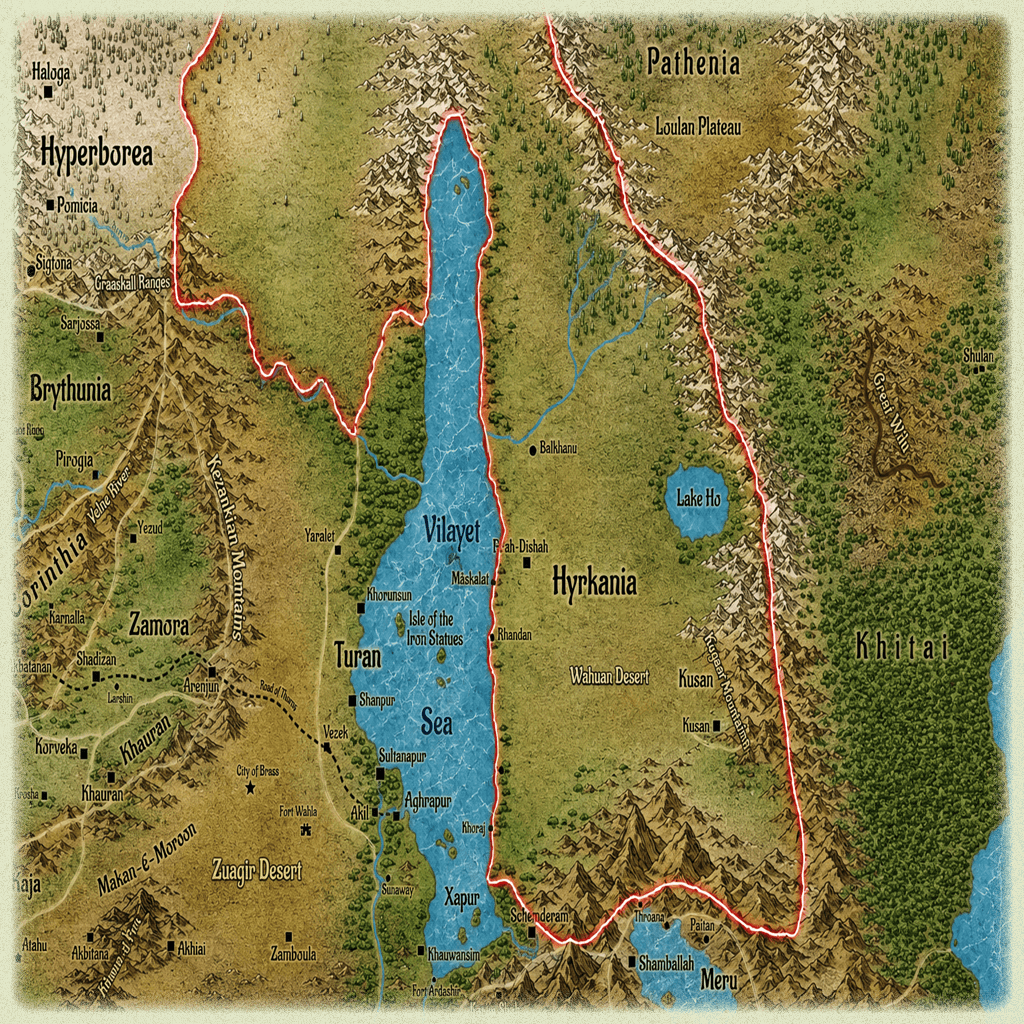

This immense, borderless expanse stretches across the easternmost reaches of the civilized world, serving as a harsh crucible that shapes the fiercely nomadic people who claim it. Lacking the defined, stone-walled boundaries of western kingdoms like Aquilonia or Nemedia, the geography of Hyrkania transitions dynamically from sun-scorched wastes to frozen, windswept peaks.
Regional Microclimates and Landmarks
The sheer scale of the Hyrkanian territory contains radically distinct environmental zones, each giving rise to specialized tribal sub-cultures.
Loulan Plateau
A rocky desert and steppe-land in the east. Hyrkanians that come from this place have strong Khitan bloodlines. Summers are hot and winters are frigid. The Loulan Plateau is essentially a cold desert; frost can be seen on the dunes and rocks, especially in the frigid winters. The extreme temperature swings require the local tribes to be highly adaptable, migrating constantly between the high gravel plateaus and the lower wind-sheltered basins.
Kara-Korum
Also called the Desert of the Black Sands. This is an area with great blasts of warm wind. Unlike the frigid steppes of the north and east, the Kara-Korum is dominated by shifting dunes of dark, mineral-heavy sand that retain intense daytime heat. Violent dust storms fueled by the warm winds frequently reshape the topography, making navigation through the interior treacherous to all but the native nomads.
Pathenia
This is a frozen mountainous area, north of the Loulan Plateau. It seems to be the place from where the shorter, slant-eyed hyrkanians come from after mixing blood with aboriginals. The nomads who live here worship Elrik. Locked in near-perpetual winter, the brutal mountain passes of Pathenia demand absolute physical resilience, forging isolated clans that are noticeably distinct in appearance and religious devotion from their steppe-dwelling kin.
Notable Settlements and Urbanization
Despite the fact that the vast majority of hyrkanians are nomadic, there are a few cities scattered around. These permanent hubs typically emerge around vital water sources or trade termini along the edges of the great wastes.
- Wan Tengri: One of the few hyrkanian cities is here: Wan Tengri. It is built upon the shores of the large lake Ho within the Kara-Korum region. Serving as a massive oasis city, it acts as a neutral ground where disparate nomadic clans, merchant caravans from Khitai, and western traders can exchange horses, silk, and weapons under the watchful eyes of the city's permanent garrison.
More information about these rare urban centers and their unique political functions in particular can be found in 'Return to the Road of Kings'.

The political landscape of Hyrkania stands in stark contrast to the hereditary monarchies of the Western kingdoms. It is a fluid, ruthlessly meritocratic system where authority is carved out through raw capability, spiritual mandate, and the unyielding respect of the steppe clans.
The Structure of Power
Hyrkania does not have a unified kingdom. Instead, there are several nomadic tribes that may or may not work together. The vast majority of day-to-day governance is decentralized, fluctuating between localized tribal management and temporary imperial unifications.
- The Tribal Chieftain: Most of the times, however, tribes are led by their own chieftain. These leaders oversee migration routes, hunting rights, and minor disputes among their immediate clan members.
- The Rise of the Khan: On some occasions, many different tribes may come under a single leader called Khan. Khans rule only in the few large sedentary cities than exist through Hyrkania. These high rulers manage regional trade, diplomacy with empires like Khitai or Turan, and coordinate massive, multi-tribal military campaigns across the steppes.
- Violent Succession: When a khan dies, all who wish to take his place (often the sons and daughters of the deceased khan) come together and fight it out. There is no concept of automatic birthright or primogeniture; succession is a literal trial by combat and political maneuvering where only the strongest claimant survives to claim the throne.
Meritocratic Nobility and Leadership
Tribes are divided into commoners and nobles (the chieftain, his immediate subordinates and their immediate family), although this works differently than in the rest of the world. In Hyrkania, status is a dynamic commodity rather than a permanent birthright.
Anyone can be recognized as a noble if they display the skill to lead the tribe.
A hyrkanian leader knows their title is not guaranteed: they must be prepared to defend it at all times, for they must prove they are able and worthy to lead their people. A hyrkanian noble won't be just as hard-working, strong and skilled as any other member of the tribe… they must be much more than just that. They must display courage, honor, wisdom, skill and many other qualities in order to keep their title.
This meritocracy dictates their entire approach to warfare and survival:
- Pragmatic Warfare: It is important to note that retreating is not seen as cowardly. To a Hyrkanian, a tactical retreat to preserve horses and archers for a better strike is a sign of brilliant wisdom, not a failure of nerve.
- Respect Over Convention: This is a reflection of the fact that hyrkanians won't follow a leader because of a title or a social convention. Nomads simply will not respect a weak or unworthy leader. If a chieftain falters in their judgment or loses their physical edge, the tribe will simply abandon them or follow a more capable challenger.
Shamanic Councils and Unwritten Law
Decisions are taken through councils, where shamans play a relevant role as well. Because Hyrkanians live in close communion with the natural and spiritual worlds, these holy figures act as vital political advisors. They are believed to be able to express the wish of spirits, so their words are often taken seriously by chieftains and commoners alike during times of war, famine, or migration.
The Perils of Urban Law
Most laws are not written, and in larger cities there are many ways to get punished by them. Nomad hyrkanians that happen to go into cities tend to often break these accidentally, since laws are not written and each city has a different set of laws. As such, nomadic hyrkanians are often put to death or exiled by minor transgressions.
The legal systems of the permanent Hyrkanian cities enforce strict, often surprising taboos that clash directly with the free-roaming lifestyle of the open steppes.
| Category of Offense | Specific Legal Transgressions | Typical Punishment |
|---|---|---|
| Social & Taboo Violations | Adultery, Homosexuality, Sorcery | Death or Permanent Exile |
| Hearth & Hospitality Breaches | Not offering food to a guest in a timely manner | Severe Social Banishment or Exile |
| Interference Offenses | Intervening in a quarrel as a third part, Giving food or clothing to a prisoner of another hyrkanian | Death or Execution by the city guard |
| Mishandling of Property | Beating animals | Execution or heavy corporal punishment |

Most of hyrkanians are nomads, living in clans and tribes that constantly travel through the land. It's only very few who choose to settle within cities, an idea that is rather unwelcome by the majority of hyrkanians. Their mindset and traits respond to their very particular style of life, shaped by the open horizon, the bond with the beast, and the merciless laws of nature.
The Saddle and Mastery of the Horse
Hyrkanians are born to the saddle. They learn to ride before even learning to walk, and their horses are traveling partners that go everywhere with them. A hyrkanian that needs to go somewhere will ride their horse; they rarely walk at all, unless it’s absolutely needed.
This total reliance on the equine shapes their daily society and leisure:
- Equine Companionship: Horses will always have their own name. They are seen not only as pets or mounts, but as true companions. To lose a horse is to lose a piece of one's own soul.
- Pastimes of the Steppe: Horse races, and mounted hunting and archery contests are common pastimes (as most if not all hyrkanians excel in these activities). These games double as vital training, ensuring every member of the tribe remains a lethal combat asset.
Survival and Gender Equality
All hyrkanians are taught how to survive. Both men and women sew, cook, hunt, etc. Because the margin between life and death on the steppe is razor-thin, there is no room for rigid, western-style domestic limitations. It is essential for a hyrkanian to be able to pull their own weight within the tribe.
Laziness and being unable to fend for oneself is seen as shameful. Being hard-working, honest and skilled is seen as an integral part of one’s honor for both men and women, regardless of their status or condition.
Reputations and the Honor Code
Reputation is also essential for hyrkanians. It is said a proper hyrkanian would rather die with a good reputation than live with a ruined one. Normally, a hyrkanian (male or female) will fight if their reputation is challenged, or if they’re insulted.
However, their honor is governed by pragmatic social context:
- Measured Responses: They are not senseless about it: if the person who is insulting them happens to be someone other hyrkanians do not take seriously, they will likewise not take the insult seriously.
- Verbal Caution: Because of this, hyrkanians are also careful with other people’s reputations as well. They know how serious it is to hurl an insult, treating spoken words as arrows that cannot be recalled once loosed.
The Hunt and Animistic Nature
Hyrkanians have strong animistic beliefs, and as such they respect all animals. This includes those killed during a hunt. They will kill animals only if needed, and when doing so, they will take their ‘ongon’ carefully and leave it intact – this is the head, the throat, the lungs and heart of the animal. This is because they believe it holds the soul of the animal, and it must remain undisturbed for the soul to move on peacefully.
Treatment of Foreigners
All of the above, however, apply exclusively among hyrkanians. Foreigners, their way and opinions mean nothing to them. While a hyrkanian would almost never lie, kill or rob another hyrkanian, they would not hesitate in doing so to a foreigner.
Overall, hyrkanians are extremely haughty when dealing with outsiders. They will be greedy, territorial, rude and stingy to them most of the time. Because of this, hyrkanians are a very insular lot and do not get along other non-hyrkanians.
Tribal Superstitions and Taboos
Hyrkanians have a very extensive set of beliefs regarding different things. Breaking some of these can even cause severe punishment from the tribe, as actions that offend the spirits threaten the spiritual safety of the entire clan.
Domestic and Taboo Laws
| Category | Forbidden Action | Consequence / Significance |
|---|---|---|
| Yurt / Home Etiquette | Leaning against the support column of a home | Brings bad fortune. |
| Yurt / Home Etiquette | Whistling inside a home | Brings bad fortune. |
| Yurt / Home Etiquette | Walking counter-clockwise inside a home | Disrupts the natural order of the world. |
| Threshold Law | Stepping on the threshold of a home instead of over it | Capital offense if done in the house of a chief or khan (Punishable with Death). |
| Resource Sacredness | Spilling milk intentionally onto the ground | Sacrilege against holy substance (Punishable with Death). |
| Resource Sacredness | Spitting out food | Absolute disrespect to survival (Punishable with Death). |
| Sanitation | Tossing trash or wastes into water | Contaminates the life-blood of the steppe. |
| Weather Taboo | Hanging clothes out to dry | Believed to directly conjure violent thunderstorms. |
The Sacred Laws of Fire
Fire is considered an active, living divinity. Its handling is governed by absolute spiritual laws:
- Never throw trash into it, or discard items into it.
- Never pour water on it or step on it, instead let the fire die by itself.
- Never pass a weapon through the flames and never put a blade near a fire (this includes not cutting meat near it).
Rituals of Sky, Earth, and Storm
- The Ritual of Pouring: Whenever a new bottle of liquor is opened, the first pouring must be done into a cup and offered to the Everlasting Sky and Mother Earth. This is done by going outside and flicking the cup three times in each of the four directions.
- The Corruption of Lightning: They deeply fear the lightning and storms, believing they bring misfortune and disaster. A hyrkanian that is killed by lightning is tragic, and the dead one’s possessions will never be touched or looted, for they are seen as permanently corrupted by the wrath of the sky.

The striking physical presence and functional dress of the Hyrkanian people are directly forged by their continuous life on horseback and the extreme weather conditions of the eastern steppes.
The peoples living east of the Vilayet Sea belong to a proud, ancient stock. Within the infinite stretches of the Hyrkanian wilderness, their physical forms have naturally evolved into two distinct racial phenotypes, determined entirely by geographic settlement and ancestral lineage.
- The Steppe Phenotype: There are two types of hyrkanian: one, the most common, is tall, dark and slender. This dominant strain features lithe, lean bodies built for rapid stamina over long distances, high cheekbones, and a hawk-like facial structure.
- The Mountain/Aboriginal Phenotype: The second type is shorter and slant-eyed due to the mix of bloods between them and the aboriginals that live east of the Vilayet. Primarily emerging from the northern mountains of Pathenia and the remote forest fringes, this group possesses stockier, heavily muscled builds designed to retain core body heat against freezing alpine winds.
Regardless of their height or tribal origins, a universal genetic marker unifies the entire race: in both cases, their eyes and hair are always dark.

Hyrkanian fashion is an absolute marriage of utility and eastern luxury. Because their nomadic lifestyle brings them into regular contact with the trade routes of Khitai, Vendhya, and the western kingdoms, they skillfully combine raw wilderness hides with exotic fabrics.
Headwear Traditions
Hyrkanians like hats. Leaving the head bare is uncommon, as headwear offers vital protection against the blazing sun of the Kara-Korum and the blistering frost of the Loulan Plateau. Most of them wear helmets, turbans or fur hats of some sort, with the style often revealing a nomad's specific clan affiliation or personal military rank.
Layering and Fabric Choice
Most of their clothing also tends to be made of silk and cotton. Rather than a sign of mere vanity, this material choice serves a vital tactical purpose:
- The Silk Undershirt: All hyrkanians wear loose silk undershirts beneath their armor and leathers. When an arrow penetrates a warrior's defense, the strong silk fibers do not break; instead, they are forced deep into the wound wrapped around the arrowhead. This ingenious property allows the arrow to be pulled out cleanly without tearing the flesh apart, preventing lethal infections on the battlefield.
- Outer Protection: Besides these, they wear sheepskins, leathers, silk sashes and sometimes, women go veiled when around strangers. Heavy sheepskin coats are worn with the wool facing inward during freezing tundra winters and flipped outward during sandstorms to deflect grit.
Personal Adornment
Despite their rugged lifestyle, Hyrkanians possess a deep appreciation for personal ornament and wealth that can be easily transported during migrations. Both men and women enjoy jewelry, especially bracelets and necklaces. These pieces are typically crafted from hammered gold, heavy silver, or polished jade bartered from eastern caravans, serving as an active display of personal honor and tribal standing.

The structure of gender dynamics on the eastern steppes is defined by strict functional equality, absolute pragmatism, and unyielding traditional expectations. Because survival in the wilderness demands total effort from every single individual, Hyrkanian society cannot afford the domestic restrictions or structural subjugation of women common in the Western kingdoms.
The Social Status of Women
Women have the same status as men. They are not subjugated in any way, and are viewed as sources of wisdom, believed to be often smarter and wiser than men.
This deep respect is codified directly into the tribal mindset and language:
There is a hyrkanian saying that states that a man who does not listen to his woman is unmanly and immature.
This egalitarian equality translates into concrete legal, familial, and military rights across all nomadic clans:
- Property and Family Headship: Women can inherit property and can be the head of a family. If a patriarch dies, the matriarch assumes absolute command of the family’s animals, tents, and weapons.
- Marital Independence: Widowed women can remarry as they wish and the new husband must treat her children as his own. There is no social stigma attached to widowhood.
- Martial Excellence: Females also learn archery, riding and hunting just as men do, and if they wish to they also learn how to fight as equal members of their battle groups. On the field of battle, a Hyrkanian composite bow drawn by a woman is just as lethal as one drawn by a man.
- Equal Labor: Within the tribe, they work no more and no less than men do, sharing equally in the grueling daily tasks of breaking camp, herding livestock, and preparing hides.
Sexuality, Courtship, and Taboos
Hyrkanian personal life is governed by a rigid code of personal conduct. Hyrkanian women are also notably chaste, and sexual relationships are strictly regulated by tribal law and shamanic oversight.
The Taboo on Deviations
Homosexuality is not accepted in any way, from neither men or women. It is seen as a deviation, and hyrkanians are not fond of deviations of any kind, especially the sexual kind.
They tend to be highly chaste and lay only with their wives and husbands (or future ones). Breaking these absolute sexual taboos within the clan or city limits is treated as a severe transgression, often resulting in swift execution or permanent exile into the wastes.
Foreigners and Warfare
All domestic moral standards completely dissolve when dealing with populations outside of the Hyrkanian bloodlines. While internal chastity is fiercely guarded, rape of foreigners is common during raids and such.
Marriage Rites and Customs
Marriage in Hyrkania is fundamentally a social contract designed to strengthen the clan, ensure survival, and blend powerful bloodlines.
Arranged Matches and Age Preferences
Most marriages are pre-arranged by the tribe’s shaman, who reads the portents, consults the spirits, and determines which pairings will bring good fortune to the camp. Age and love do not often play a part in this, although it is known most hyrkanian men actually prefer women that are older than themselves, for they are seen as wiser and more mature.
Ritual and Actual Abduction
An arranged marriage like this has its own traditions. The ceremony artificially mimics an abduction, where the groom and his companions "steal" the bride from her tent amid a display of mock resistance, which is immediately followed by a joyous feast for the entire camp.
However, another way of achieving marriage is through actual, literal abduction:
- Intertribal Theft: It is not unusual that both men and women abduct their desired mate from another tribe. If a warrior or maiden sets their sights on a prize from a rival clan, they will physically kidnap them under the cover of night.
- Feuds and War: These real abductions are highly volatile actions that have often led to bloody, multi-generational intertribal wars across the steppes.
- Raid Captives: Sometimes, foreign men or women captured during frontier raids can be taken back to the camps to become a legitimate bride or groom to the hyrkanian who put their eye on them, automatically absorbing them into the tribal structure.
Polygamy
It is worth noting that hyrkanian men can keep as many wives as they can keep and take care of. However, because a husband must provide horses, silk, and meat for every single household he establishes, large polygamous arrangements are typically restricted to wealthy chieftains, elite commanders, and city-dwelling Khans.

The economic and labor structures of Hyrkania reflect the resource dependencies of a migratory lifestyle. Because a nomad's wealth must be capable of moving at a moment's notice, the accumulation of static currency, massive slave populations, or specialized urban industries is entirely absent on the open plains.
The social taboos and material realities regarding involuntary labor and commercialized flesh vary drastically between the nomadic tribes and the permanent border settlements.
The Nomadic Perspective
Slavery does not exist in nomadic tribes. The idea of slaves is ridiculous to them, who do all the work by themselves (and wouldn’t have it any other way). Within the fluid, fast-moving environment of the steppe, an individual who cannot independently ride, hunt, or fend for themselves is a lethal drain on tribal resources.
Similarly, prostitution isn’t a thing either among the nomadic clans. The fierce tribal enforcement of internal chastity and the absolute lack of a monetary economy prevent the commodification of sex. However, as mentioned before, rape during raids is fairly common when dealing with foreign populations outside the Hyrkanian bloodlines.
Urban Adjustments
In hyrkanian settlements, however, slavery exists to a small degree. In permanent trading hubs like Wan Tengri, captured foreigners, debtors, or prisoners of war are bought and sold to maintain municipal infrastructure, tend to urban households, or perform heavy agricultural labor near oasis banks. It is not a widespread business however, as the cultural disdain for large-scale institutional servitude remains deeply embedded even among city-dwelling populations.

The Hyrkanian approach to commerce is defined by extreme pragmatic self-interest rather than a desire for capitalistic expansion or luxury.
[Economic Driver: Absolute Utility]
Hyrkanians do not trade to accumulate hoards of gold or silver coins.
Trade is executed solely to secure immediate, practical survival assets.
The Role of Women in Commerce
Hyrkanians are shrewd merchants and traders, since their economy is fairly self-sufficient. The little trade that exists is conducted by women. Because the men are primarily occupied with military readiness, hunting, and territorial defense, the matriarchs and women of the tribe manage the barter systems, assess the value of foreign goods, and negotiate terms of exchange.
Primary Commodities
The backbone of the entire Hyrkanian economic system rests upon domestic livestock. The most common activities is livestock breeding:
- Camels & Oxen: Bred primarily as heavy beasts of burden for transporting large family yurts and heavy camp gear across the rocky Loulan Plateau.
- Cattle & Sheep: Cultivated for their holy milk, meat, horns, and thick hides used to manufacture winter garments and insulating tent coverings.
- Horses: The crown jewel of Hyrkanian breeding. These mounts are bartered with extreme caution, as the clans will rarely trade away their finest warhorses to untrustworthy outsiders.
Foreign Merchants and the Purification Fire
Most traders in Hyrkania are actually Khitan, the only ones that go into these lands to attempt trading. Because of the hostile, unpredictable nature of the steppe tribes, foreign merchants from other nations rarely survive the frontier.
Even when dealing with trusted Khitan caravans, the nomads enforce a strict spiritual boundary to prevent spiritual contamination:
Hyrkanians will not trade with an outsider until they have walked between a pair of bonfires for purification.
This ritual, overseen by the tribal shamans, is believed to burn away malignant foreign sorceries, curses, and ill fortune before the guest can approach the tents or livestock of the clan.
Professions and Universal Labor
Unlike the highly specialized guilds of Aquilonia or Nemedia, where a man might spend his entire life practicing a single craft, the Hyrkanian workforce relies on universal competency.
While there are many different occupations in Hyrkania, most people do all of them to some degree. Riding, hunting, sewing, cooking, crafting bows and arrows, etc…: most know how to do them, since they are necessary for survival and to aid the tribe.
The Master Bowyer Craft
While every nomad can execute minor field repairs on their gear, the construction of the iconic Hyrkanian composite bow, fashioned from meticulously layered horn, wood, and sinew bound together by fish glue, is a highly respected skill. It requires years of curing under specific weather conditions, making those elders who possess superior bow-crafting knowledge highly revered assets within the tribal council.

Hyrkanians are not a particularly religious lot. They are more superstitious than spiritual. Their uncaring attitude towards religion makes them fairly tolerant to other beliefs: they will probably just relate other religions to their own, and simply toss the idea aside.
Animism and Nature Spirits
Despite this lack of centralized dogma, all of them respect the spirits of nature and the more religious tribes do regular offerings in their honor.
- The Living Steppe: Rather than kneeling before stone temples or bowing to a distant pantheon, Hyrkanians view the world through an animistic lens. The grass, the wind, the rivers, and the mountains are all host to unseen spirits that must be respected or appeased to avoid bad fortune.
- The Everlasting Sky and Mother Earth: While their faith is decentralized, the ultimate cosmological forces they recognize are the supreme expanse of the sky and the nurturing floor of the steppe. The ritualistic flicking of liquor toward the four cardinal directions when opening a new bottle is a direct expression of this cosmic respect.
- Shamanic Intermediaries: Because the spirit world is volatile, tribal shamans hold massive political and social sway. They read the shifting patterns of thunderstorms, interpret the nightmares of the sick, and pass judgment on whether a chosen migration route or an impending intertribal war has the backing of the local elements.

To play a Hyrkanian is to embody the fluid, unyielding spirit of the boundless eastern steppes. You are a product of a vast, wild landscape where deserts of black sand, frozen tundras, and rolling green pastures are navigated entirely from the back of a horse. Bound together by ancestral clan ties rather than a unified crown, you know that survival requires total self-reliance, an absolute mastery of the bow, and a fierce dedication to personal and tribal reputation.
Core Identity
- Race: Hyborian (Hyrkanian). Most commonly tall, dark, and slender with lithe, lean bodies built for long-distance riding. Alternatively, you may hail from the northern or forest fringes, appearing shorter and slant-eyed due to the mix of bloods between your people and the aboriginals east of the Vilayet Sea.
- Language: Hyrkanian (A swift, rhythmic dialect well-suited to commands called out across a roaring wind, supported by a deliberate cadence that trusts physical action over spoken words).
- Hair Color: Universally dark, ranging from a rich, deep brown to an absolute, midnight black.
- Eye Color: Piercing and uniformly dark, well-adapted to the blinding glare of the steppes.
- Names: Sharp, rhythmic, and traditional, carrying an eastern cadence.
- Male: Arban, Borchu, Chuluun, Elrik, Ganzorig, Kadan, Subotai, Temür.
- Female: Altani, Bayarmaa, Khulan, Ouna, Sarnai, Terbish, Yesui.
Personality and Archetypes
Hyrkanians are renowned for their insular, haughty nature when dealing with outsiders, balanced by a profound, merit-based sense of internal honor and family duty.
- Equine Companionship: You are born to the saddle, having learned to ride before you could walk. Your horse is not property or a mere pet, but a named, true companion that goes everywhere with you. Walking on foot is a rare, desperate last resort.
- The Merit of Leadership: You do not recognize hereditary titles or western social conventions. You follow a chieftain or Khan only because they have proven themselves to be harder-working, stronger, and more skilled than anyone else. To you, a tactical retreat is a mark of wisdom, never cowardice.
- Universal Self-Reliance: You hold a deep disdain for laziness and material comforts. Both men and women are taught to sew, cook, hunt, and pull their own weight, viewing absolute self-sufficiency as the baseline of human honor.
- Insular Haughtiness: To other Hyrkanians, you are honest, helpful, and fiercely protective of personal reputations. To foreigners, however, you are greedy, territorial, rude, and stingy. You think nothing of lying to, robbing, or killing an outsider who hasn't been purified by fire.
- Superstitious Discipline: Your daily actions are dictated by deep, practical taboos. You would never step on a home's threshold, whistle inside a tent, throw trash into a holy fire, or spill a drop of sacred milk, knowing that such actions bring immediate doom or execution.
Combat Roles and Equipment
Hyrkanians wear loose silk undershirts beneath their armor and leathers to ensure clean arrow removal on the battlefield. They heavily favor helmets, turbans, or fur hats, and fight as equal members of their battle groups regardless of gender.
- The Steppe Horse Archer (Light Cavalry): The classic, terrifying backbone of the Hyrkanian war machine. Clad in light leathers, a silk sash, and a pointed fur cap, you utilize a masterfully crafted composite bow to rain death upon your enemies while riding at a full gallop.
- The Border Guard / Scout (Pathenian Ranger): Hailing from the frozen northern mountains. You wear heavy sheepskins flipped outward against the wind, carrying a long spear, a short sword, and a composite bow, specialized in tracking invaders through blizzard conditions.
- The Vanguard Shock-Rider (Chieftain's Elite): A heavily muscled warrior who breaks enemy lines. Dressed in layered lamellar leather or iron scale armor over loose silk, you ride into combat wielding a heavy broadsword or battleaxe, your wrists adorned with gold and silver bracelets.
- The Tribal Shield-Matron (Hearth Defender): A fiercely independent warrior who stays back to guard the camp's migration. Armed with a heavy bow and a broadaxe, you are fully trained to butcher Nordheimer or Cimmerian raiders who target your family’s livestock.
Social Rank and Background
Hyrkanian society is split into commoners and recognized nobles based strictly on active skill, with a small underclass of slaves existing only within the sedentary border cities.
- Nomadic Noble / Chieftain's Kin: A leader or immediate subordinate within the clan who has displayed superior courage, honor, and wisdom. Your position is not guaranteed by birth; you must constantly defend your title and prove you are worthy to guide the migration routes.
- Shamanic Acolyte: A spiritual advisor who sits on the tribal councils. You are trained to read the sky, communicate with nature spirits, and offer proper sacrifices to the wind and earth, making your voice a powerful force that chieftains must take seriously.
- Livestock Breeder / Trader: A shrewd merchant, typically a woman, who manages the tribe's primary wealth: camels, oxen, cattle, and horses. You treat Western coins with utter disdain, bartering purely for practical assets and forcing all outsiders to walk between bonfires before trading.
- Oasis Outcast / City Exile: A nomad who accidentally broke one of the unwritten laws of a permanent Hyrkanian city, such as intervening in a third-party quarrel or stepping on a Khan's threshold. Permanently banished from the urban centers, you survive on the open plain by your wits alone.
- Raid-Absorbed Spouse / Captured Serf: Originally a foreigner from a neighboring kingdom who was stolen during a frontier raid. Chosen for your beauty or strength, you have been fully adopted into the tribe as a chaste spouse or worker, learning the ways of the saddle out of sheer survival.
Starting Package
Every Hyrkanian character begins their journey with a set of versatile survival gear designed for an active life on the open move:
- A set of traditional steppe garb, including a loose silk undershirt, a cotton tunic or long dress, loose trousers, a silk sash, a heavy sheepskin coat, and a distinctive fur hat or turban.
- A pair of soft, flexible leather riding boots designed specifically to lock securely into stirrups.
- An iconic Hyrkanian composite bow made of layered horn and sinew, a quiver of twenty arrows, and a primary melee weapon of choice (a steel broadsword or a heavy woodsman's axe).
- A small horn cup for spiritual offerings, a named riding horse equipped with a nomad saddle, and a leather pouch filled with dried meat and a small bladder of holy milk.

- "The Hyborian Age" (Robert E. Howard): Outlines the eastward migration of the original Lemurian descendants, their settlement along the shores of the Vilayet Sea, and their evolution into the dominant horse-riding culture of the world.
- "A Witch Shall Be Born" (Robert E. Howard): Provides extensive contextual reference to the terrifying military precision, speed, and composite bow mastery of the Hyrkanian mercenary corps.
- "The Devil in Iron" (Robert E. Howard): Details the geography of the islands and eastern coastlines of the Vilayet Sea, showcasing the interactions between Hyrkanian nomads and foreign elements.
- Return to the Road of Kings (Mongoose Publishing): Offers an in-depth breakdown of the sedentary Hyrkanian cities like Wan Tengri, their unique oasis legal systems, and the structural trade roles held by Khitan merchants.
- The Road of Kings (Mongoose Publishing): Supplies the definitive geographic breakdown of internal Hyrkanian landmarks, defining the boundaries of the Loulan Plateau, the Kara-Korum desert, and the mountain passes of Pathenia.
- Faith and Fervour (Mongoose Publishing): Explains the decentralized animistic beliefs of the steppe, detailing the specific rituals dedicated to the Everlasting Sky, the lightning corruption taboos, and the political power of the shamans.