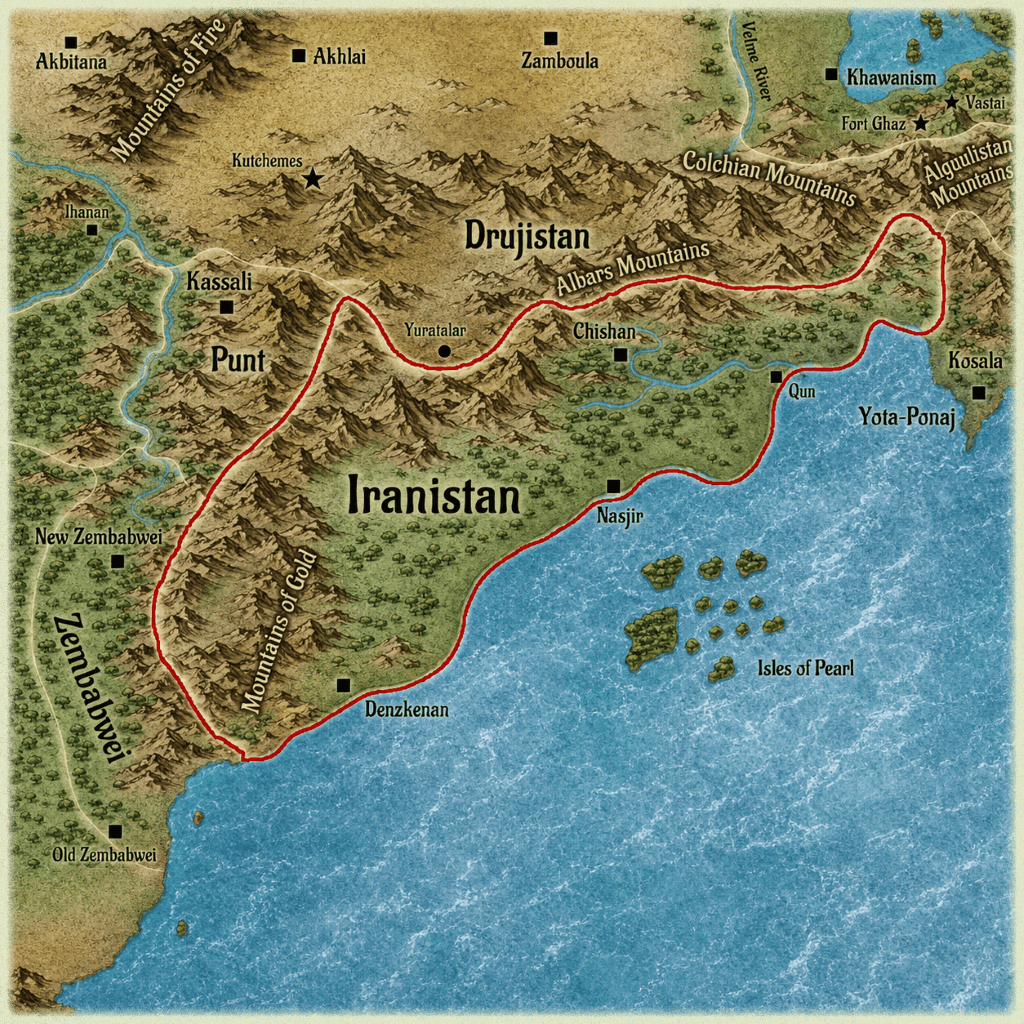

Iranistan serves as a vital geopolitical bridge between the kingdoms of the west, the exotic empires of the east, and the brutal plains of the north.
Mountain Ranges and Borders
The natural boundaries of Iranistan are defined by massive, inhospitable mountain ranges that trap moisture, hide lost cities, and yield immense mineral wealth.
Colchian Mountains
The Colchians mark the border between Iranistan and Turan. Drujistan and the Gorge of Ghosts lie in the southern reaches of the mountains. Passes such as the Kasmar Pass allow for trade between Iranistan and Turan. This range collects moisture and feeds the Iranistan River, serving as the northern lifeblood of the kingdom.
Drujistan
Drujistan is the name given to the southern portion of the Ilbars Mountains, a haunted place where few could live. It lies beyond a deep canyon called the Gorge of Ghosts. Drujistan is a 'forbidding array of black crags and frowning cliffs, a wild, haglike chaos of broken black rock.' Drujistan is a day's ride south of the Kushafi country. The city of Yanaidar hides in its mountains.
Mountains of Gold
These mountains form Iranistan's southern border. The Iranistani mine gold and other precious ores from these peaks, as well as pan gold from the rivers and run-offs. Iranistan often runs into conflict with Zembabwei over the rights to the mountains and the gold.
Major Watercourses and Settlement Economics
The interior of Iranistan relies entirely on its river systems and oases to support both sedentary agricultural life and nomadic pastoralism.
Iranistan River
This river is the main watercourse of Iranistan. It drains into the ocean, carving a fertile valley through the heart of the country.
Rural Architecture and Symbiotic Economy
Villages in Iranistan are comprised of mud-brick houses (although the wealthy might have stone-walled homes) surrounded by a low wall. Nomads in Iranistan use tents instead of houses. The village economy is agricultural, based on whatever a village specialises in, such as grapes and wines, wheat and barley, or various nuts or teas.
The division of labor and the relationship between the sedentary and nomadic populations is highly structured:
- Village Labor: The men of the village work the fields and the women perform the household duties. Older children herd the animals, a form of wealth for the Iranistani, or help the men in the fields.
- The Symbiotic Loop: The civilised villagers and the barbaric nomads have a symbiotic existence. The villagers allow the nomads' herds of goats and sheep to graze their fields after harvest and again before planting, because the animals' droppings help to fertilise the ground. In return, the nomads purchase supplies from the villagers and the villagers buy wool, milk and slaves from the nomads.
Notable Cities and Settlements
Iranistan's permanent settlements are world-renowned hubs of commerce, trade, and luxury, though they remain vulnerable to frontier warfare.
Anshan
Anshan is the glittering capital of Iranistan and the Anshan tribal lands. Anshan is situated on the Anshan River on a tall mound. Anshan is the chief economic and cultural center of Iranistan, where the king of Iranistan rules. The city produces textiles and wood products.
- Origins & Growth: Anshan was founded by traders who used the location to transfer goods from Vendhyan, Kosalan and the Black Kingdom caravans to Turan-bound caravans. The location proved prosperous and soon satellite villages sprung up, growing almonds, junipers, pistachios, grapes, wheat and barley.
- Population & Military: This spired city and its surrounding villages boast a population of over 166,660 Iranistani ruled by a powerful king. Kobad Shah was the ruler during the period described by The Flame Knife and could easily raise a heavily armoured infantry army in excess of 10,000, a pitifully small number compared to his stronger ancestors. Thus, Kobad Shah used mercenaries to bolster his army, especially kozaki or Hyrkanian cavalry. Kobad Shah's son, Arshak Shah, now rules Anshan.
- Cultural Codes: This proud city is distinctly civilised and holds to a civilised code of honour as befitting its cultivated culture. The uncouth nomads and outlying Iranistani tribes live by a much more barbarous code of honour.
Ghaza
Ghaza specialises in vineyards and wine, competing with Kyros, a city in Shem. It is located between the Iranistani River and the volcanic mountains of the west, utilizing the rich volcanic soil to yield legendary vintages.
Green Water
Green Water is a caravan town a day's ride southeast of the Iranistan River. It is built around a large oasis and is a major caravan town leading into the Kharamun Desert. Green Water has a fine bazaar and many taverns. The town is surrounded by low, ruined walls and the oasis is surrounded by orchards. It is built in a square pattern, with a large open plaza at its centre to serve as a marketplace and seat of government. A spectacular fountain can be found in the centre of the plaza.
Kasfir
Kasfir is an Iranistani city with a well-known slave market. Only the most beautiful of slaves are sold here and the slave market pays a premium for such slaves to sell. Kasfir raiders and traders travel as far as Brythunia, Vendhya and Kush to gain the prettiest slaves. They will pay fathers for their daughters or steal them if the fathers will not sell them. Many Iranistani and Turanian harem-girls come from the flesh market of Kasfir. Kasfir has a population of more than 8,000 people.
Regional Tribes and Factions
The wilds of Iranistan are occupied by distinct tribal groups that fiercely guard their territorial routes and engage in ancient blood feuds.
The Kushafi
Three days away from Anshan, Kushaf is the tribal land of the Kushafi in the Ilbars Mountains. Howard's original tale indicates that the chief commanded three hundred swordsmen. Based on military capability, this tribe has about 5,000 members among its various familial villages. Their villages are about a day's journey northward from Drujistan.
The Bajkari
The Bajkari are a nomad tribe of Iranistani allied with the Kaklani. They wear distinctively striped kaffiyehs. They are familiar with the coastlines of Iranistan and usually range to the east of the Kaklani. They travel with crossbowmen and most of them know how to swim.
The Kaklani
The Kaklani tribes live in the southern lands of Iranistan near the shore. Their robes and sashes are yellow with red stripes. They have a long-standing blood feud against the Zariri tribe. They number around 6,700. They are considered to be a very barbaric people who practice shamanism.
The Zariri
The Zariri are an Iranistan tribe who hate the Kaklani with a passion that can only exist in the confines of a generational blood-feud. They are a nomadic tribe led by a sheik named Jaral. This tribe boasts of more than 3,000 members among its wandering people. They live in tents, primarily, and move from north to south and back again throughout the year. They are not as strong in battle as they would like and often hire foreign mercenaries to bolster their numbers when they feel the need to go to war.

The political structure of Iranistan is an unstable, highly volatile system of nominal feudalism. While a singular monarch sits upon the throne in the glittering capital of Anshan, true power is decentralized, held in the calloused hands of autonomous tribal chieftains and independent warlords who rule the mountains, deserts, and valleys through military might and a brutal code of honor.
The Illusion of Feudal Allegiance
The government of Iranistan is nominally feudal. The king of Iranistan is theoretically supported by the tribal chiefs but this rarely proves to be the case in reality. Rather than operating as submissive vassals to a centralized crown, the leaders of Iranistan's disparate clans view themselves as sovereign lords of their own territories.
- Defiance of the Court: The tribal lords, if they disagree with the king, simply leave the court and ignore him. There are no bureaucratic systems or legislative bodies to compel their obedience; a chief who feels insulted or restricted by royal decree will simply pack up their retinue, ride out of Anshan, and return to their ancestral strongholds.
- Enforcement through Arms: If the king wants to enforce his will, he has to send his army out of Anshan to do it by force of arms. Executive power in Iranistan extends only as far as the reach of the King's royal guard. To collect taxes, secure borders, or punish rebellious behavior, the sovereign must launch a literal military invasion against his own subjects.
The Code of Honor and Martial Retribution
When the crown marches to enforce its dictates, it is never met with immediate submission or administrative negotiation. The foundational psychology of the Iranistani people turns every political disagreement into a violent standoff.
The Iranistani will not run from such a fight, for their code of honour prohibits such a thing. They are honour bound to protect what is theirs, be it land, women or personal honour.
Because backing down from a royal challenge is viewed as an act of absolute, irredeemable cowardice, provincial clans will eagerly clash with the superior numbers of the royal army.
Royal Justice and Succession Disputes
Royal disputes are settled in this way. When the King's forces successfully crush a defiant tribe, the retribution meted out by the crown is public, visceral, and intentionally terrifying to deter other watching factions.
- The Price of Defiance: Often the royal troops return with the offending chief’s head or with the chief himself.
- The Iron Cages: A captured rebel lord is rarely afforded a swift execution; instead, he may then be hung in an iron cage for the birds to slay, left to die of exposure and thirst above the city gates of Anshan as a grim monument to royal authority.
The Role of the Sovereign
Despite the constant threat of internal rebellion, the King of Iranistan (such as Kobad Shah or his successor Arshak Shah) fulfills vital geopolitical functions that keep the fractured nation from disintegrating entirely.
- National Decision-Making: The king does make decisions for the nation as a whole, directing foreign policy, managing international trade routes with caravan empires like Khitai and Vendhya, and regulating the massive currency influx from the south.
- External Defense: The crown actively protects the various chiefs who are in his good graces from outside invasions, using the heavy infantry of Anshan and elite foreign mercenaries to repel incursions from hostile neighbors like Turan or Zembabwei.
- Neutrality in Internal Feuds: While the king will fiercely defend his own direct interests, he rarely intercedes on any one side in the case of an internal blood feud. The crown recognizes that local conflicts are an essential pressure valve for tribal aggression.
- The Legality of Revenge: Iranistani code permits wars of revenge. Generation-spanning vendettas, such as the bitter blood feud between the Kaklani and Zariri tribes, are viewed as entirely legal and socially necessary mechanisms for maintaining personal and tribal honor without royal interference.

The social fabric of Iranistan weaves together an intense aesthetic pride, unyielding familial devotion, and a strict psychological architecture based on personal honor and hospitality. Whether dwelling in the spired palaces of Anshan or the goat-hair tents of the southern deserts, every Iranistani’s daily life is governed by these foundational pillars.
The Universal Love of Art and Aesthetics
An absolute love of art is one common element among the Iranistani. Virtually everything the Iranistani make is attractive. Unlike the purely utilitarian cultures of the north, the Iranistani believe that everyday items should reflect the beauty of creation.
- Elevated Daily Life: Even the most common items, such as bags to carry produce to the bazaars, are embroidered and decorated.
- Adorned Livestock: This aesthetic passion extends even to their animals; horses, camels, and oxen are frequently dressed in woven finery, displaying vibrant tassels, bells, and intricately dyed saddlecloths.
- Architectural Grandeur: In permanent settlements, fine calligraphy and visual arts are displayed in the beautiful trimmings that adorn the buildings, covering structural arches and domestic doorways with complex geometric flourishes and painted epics.
- The Spoken Word: The Iranistani respect both the arts and artists. Poetry and story-telling are time honoured traditions among the Iranistani, with traveling bards holding high social status and serving as the primary keepers of tribal lineages and historical military victories.
Family Structure and Governance
Beyond art, the vital importance of family is another common element found in the Iranistani culture. Families are extremely close-knit, acting as the fundamental political, economic, and defensive unit of the entire country.
The administrative hierarchy of Iranistan adapts seamlessly across its varying environments:
[The Family Unit] ➔ [The Headman / Leader] ➔ [The Tribal Chief / Lord] ➔ [The King (Nominal)]
- Tribal Lineages: A tribe is simply several branches of a single family led by a tribal chief whose word is law.
- Village Architecture: Rural settlements are built physically and socially around the family unit. These are self-sufficient groups that follow a headman, usually the oldest male in the village, who handles local disputes and agricultural distribution, who in turn follows the tribal chief.
- Urban Khans: In the larger, highly civilized cities like Anshan or Kasfir, the headman role shifts from elder patriarch to a wealthy landowner who is called a khan.
- Desert Sheiks: Conversely, the fierce, wandering nomads call their headmen sheiks, selecting them for their survival wisdom, raiding capabilities, and tactical mastery.
The Code of Honor (Something Undesirable in my Beard)
Iranistani tribes have their own codes of honour that is similar across the entire nation, a code that teaches family honour, pride and hospitality. Within this system, family is more important than the individual. Family defines the individual. Personal honour is also family honour and vice versa.
An Iranistani's loyalty is strictly tiered, moving from the immediate domestic circle outward to broader national structures:
1. Immediate Family ➔ 2. Extended Kin ➔ 3. Remote Clan Members ➔ 4. The King (Anshan)
Pride is another word for personal honour for the Iranistani. Honour and pride define respect for oneself. Insults must be paid for, no matter how great or small.
A man refers to an insult as "something undesirable in my beard."
To leave an insult unanswered is to allow a permanent stain to settle upon one's facial hair and family name. This hypersensitivity to personal respect means that minor slights routinely escalate into swift duals or generation-spanning tribal wars.
Hospitality and the Bond of Salt
Hospitality is also important to the Iranistani. Generosity is honourable, so food and drink must be given to anyone who comes to them in peace. All guests must be protected; the Iranistani take responsibility for all who are in their homes. Their honour depends on this.
This absolute law of protection is known across the eastern kingdoms as the bond of salt, or eating a man's salt:
Once a person is a guest in an Iranistani’s home, that person is safe.
If an individual, even a bitter enemy or an outlaw running from the King’s justice, manages to enter an Iranistani home or tent and consume bread and salt offered by the host, the master of the house is honor-bound to defend that guest with his life. Violating the bond of salt is considered a cosmic sacrilege that permanently curses the bloodline.
Religious Fatalism and Asura
The Iranistani people, regardless of tribal affiliation, tend to be deeply fatalistic, willing to follow whatever fate they believe their god, Asura, has given them.
- The Loom of Destiny: Fate is important to the Iranistani and they believe the gods command their destinies, both as individuals and as a nation. They view the trials of life not as random occurrences, but as pre-written chapters dictated by the divine.
- Stoic Acceptance: Because of this religious conditioning, they do not get depressed at the idea of certain doom; they merely accept it. Whether facing a devastating drought along the Iranistan River, an overwhelming cavalry charge from Turanian conquerors, or a sudden sentence to the iron cages of Anshan, an Iranistani meets their end with a calm, stoic resignation, murmuring that it is simply the immutable will of Asura.

The physical presentation of the Iranistani people mirrors the natural wealth and fierce cultural pride of their homeland. Combining a naturally robust build with a cultural obsession for artistic embellishment, they present a striking, ornate appearance that distinguishes them across the eastern kingdoms.
The people of Iranistan are described as being black haired and broad in the shoulder. Built for both the physical demands of mountain survival and the balance required for desert riding, they possess a naturally sturdy, muscular build.
- Physical Phenotype: They have a dark complexion and dark eyes. Exposure to the intense sun of the Kharamun wastes and the high altitude of the Colchian peaks has burnished their skin to a rich, weather-hardened hue.
- Ancestral Lineage: The people of Iranistan are of the same root stock as those of Ghulistan; they are likely a relatively hairy race. Thick, robust hair is a hallmark of their lineage.
- Tribal Variations: Although the Iranistani population is composed of many distinct tribal units, much of their way of life is essentially the same. While various tribes of Iranistani vary slightly in description, such as variations in height or facial features between coastal wanderers and alpine hillmen, they are instantly recognizable as a singular, unified ethnic stock.

True to their profound love of aesthetics, everything the Iranistani wear, from the basest of clothing to armour and weaponry, is ornate and decorated. They reject plain garments, treating clothing as a canvas for complex embroidery, vibrant dyes, and personal status.
Male Garb and Armament
Iranistani males wear baggy silk or cotton pantaloons and long shirts or striped robes that hang nearly to the knees. These flowing garments are specifically tailored to allow maximum air circulation in the sweltering heat while remaining comfortable in the saddle.
- The Waist Sash: These are belted at the waist with wide sashes and accompanied by embroidered vests. These sashes serve a vital defensive purpose; they hold weapons and often bristle with multiple knives, daggers, and jambiyas.
- Facial Hair: Most adult males are heavily bearded. A thick, well-groomed beard is a universal symbol of maturity, wisdom, and masculinity across all social ranks.
- Headwear Styles: Headwear is highly varied and dictates tribal affiliation or military rank. Many wear turbans with a long strip hanging down the back or large sheep-skin caps. Others, particularly the nomads, wear kaffiyehs, striped to identify their tribes (such as the distinctively striped kaffiyehs of the coastal Bajkari).
- Military Helmets: Many of the soldiers wear turbans wrapped around their spired steel caps, offering a brilliant blend of spiritual style, heat deflection, and battlefield protection against slashing broadswords.
Female Dress and Ornamentation
The women of Iranistan mirror the men in their choice of comfortable, fluid fabrics, but elevate their appearance through extensive cosmetic adornment and precious metals.
- Garments: The women also wear baggy silken trousers and vests. These silks are typically dyed in brilliant jewel tones, heavily stitched with gold thread along the borders.
- Modesty Custom: Veils may also be worn but are not required. The use of the veil varies by tribe and local customs rather than absolute religious law.
- Adornment and Hair: Jewellery is worn by many of the women. Armlets, bracelets, necklaces, tiaras, headbands and thin gold or platinum belts are common adornments. Women’s hair is kept long and held in pony-tails by jewelled bands.
Footwear and Details
Both genders share an identical preference for distinct, specialized footwear well-adapted to indoor carpets and outdoor sand tracks.
Iranistani men and women both wear soft shoes with upward-pointing toes.
Ultimately, no element of dress is left untouched by the artisan's hand. Everything they wear is embellished and decorated, transforming even a simple peasant's tunic or a scout's leather bracer into a detailed work of cultural art.

The internal mechanics of Iranistan balance highly civilized, lucrative international trade networks with rigid, ancient social institutions. While its markets overflow with foreign luxury, its social order relies heavily on a strictly demarcated division of gender and a thriving, ruthless human labor trade.
Iranistan is a patriarchal society that gives women considerably more freedom compared to Hyborian nations. While ultimate political authority remains consolidated under male rulers, women possess unique legal protections and avenues for personal advancement.
[Domestic Expectation] ───► Modesty and mastery of domestic arts
[Economic Legal Rights] ──► Direct ownership of businesses, lands, and private wealth
[Political Barrier] ─────► Absolute exclusion from statecraft and governmental affairs
- Social Expectations: Females are expected to be examples of modesty and show their domestic skills, especially within rural families where maintaining the household and tracking family lineages are considered vital spiritual and social duties.
- Economic Independence: Despite these traditional expectations, they also have rights to own a business, enjoy power and wealth. It is entirely common to find wealthy urban matriarchs running textile workshops, owning vast agricultural vineyards in Ghaza, or managing profitable trade stalls within the grand bazaar of Anshan.
- The Glass Ceiling: However, women are not involved in governmental affairs. They cannot sit on the king’s formal councils, hold regional governorships as khans, or command the heavy standing infantry armies of the crown.

Human trafficking is a foundational column of the domestic and international Iranistani economy. Unlike the nomadic tribes of the Hyrkanian steppe who reject involuntary labor, the urban elite of Iranistan view the accumulation of human property as a major status symbol.
Slave trade and Slavery is very common in Iranistan. It serves both the domestic labor needs of agricultural villages and the luxurious demands of noble estates.
The Flesh Market of Kasfir
The epicenter of the high-end human trade is situated in the specialized city of Kasfir:
Kasfir is an Iranistani city with a well-known slave market. Only the most beautiful of slaves are sold here and the slave market pays a premium for such slaves to sell.
- Global Sourcing Networks: Kasfir raiders and traders travel as far as Brythunia, Vendhya and Kush to gain the prettiest slaves. They will pay fathers for their daughters or steal them if the fathers will not sell them, operating extensive criminal and mercantile webs across multiple continents to satisfy market demands.
- The Harem Demand: Many Iranistani and Turanian harem-girls come from the flesh market of Kasfir. Possessing a population of more than 8,000 people, the entire economy of this specialized city is optimized around housing, grooming, training, and auctioning premium captives to the highest bidding khans, sheiks, and foreign kings.

Situated at the focal nexus of the civilized world, Iranistan acts as a massive international clearinghouse. As a crossroads of trade between the Black Kingdoms, Turan, Stygia, the Golden Kingdoms, Ghulistan, Vendhya and Khitai, Iranistan has grown wealthy.
The nation’s economy relies on a powerful mixture of refined domestic craftsmanship, raw mineral wealth, and high-value cash crops:
Major Domestic Commodities
| Category | Primary Exports & Goods |
|---|---|
| Crafts & Textiles | Hand-woven rugs, embroidered clothing, luxury silks, raw wool, and treated cotton. |
| Agriculture & Narcotics | Nuts and fruits, legendary Ghaza wines, premium opium, and high-grade hashish. |
| Minerals & Metallurgy | Coal, copper, talc, barites, sulphur, lead, zinc, iron ore, salt, and precious/semiprecious stones mined from the Mountains of Gold. |
| Oils & Fluids | Refined petroleum seeps and agricultural olive oils. |
Geopolitical Friction with Turan
Because of this immense mercantile wealth, neighboring empires constantly plot to exploit or strangle Iranistan's trade routes. Turan hungers after this trade and recently captured Zamboula in order to control (and profit from) trade coming from Iranistan headed to the West. This aggressive westward expansion by King Yildiz and his Turanian satraps remains a constant source of military tension along the northern borders.

The religious life of Iranistan reflects the deep geographical and cultural divide between the civilized urban centers of the north and the wild, untamed expanses of the southern deserts and mountains.
The Chief Cult of Asura (Northern Iranistan)
The northern Iranistani primarily worship the Vendhyan god Asura. This religion was imported from the highly advanced eastern kingdom of Vendhya as Iranistan struggled toward civilization. Over centuries, the Iranistani have heavily flavored their worship of Asura with their own culture, turning it into a pillars of national identity.
- The Cosmic Order: Born of enormously complex rituals derived from four great Vendhyan books, this faith celebrates a strict cosmic order and a belief in cause and effect that extends beyond the physical realm.
- Divine Justice: The system operates with absolute spiritual precision. Failure to perform the proper ceremonies or keep sworn oaths would result in a disturbance of the cosmic order. As a result of this deep sense of cosmic order and justice, Iranistani believe in a heaven, a hell, and the judgment of souls.
- Grim Fatalism: The Asuran religion, with its strong belief in cause and effect, embraces an idea of fate, a fate that becomes a grim duty. To the Iranistani, there is no fate but the fate Asura gives, and man has little say in the matter.
The Ban on Divination
Because the northern Iranistani are deeply fatalistic, believing that path of the future is immutable and already woven by Asura, their scholars and priests completely avoid trying to peek ahead. They view searching for omens as a foolish, disrespectful exercise.
Spiritual Law: Innate fatalism steers Iranistani scholars away from attempting to divine the future. As a result, divinatory magic styles are not taught to Iranistani worshippers or priests in northern Iranistan.
Southern Shamanism (Southern Iranistan)
The southern Iranistani follow a variety of more shamanistic, primitive faiths and are not bound by the strict theological restrictions or anti-divination laws of the northern Asuran temples.
- Animism and Spirits: In the dry, sun-scorched dunes and jagged southern crags, nomadic clans worship local spirits, ancestral ghosts, and elemental forces.
- Ecstatic Magic: Southern shamans actively practice primitive sorceries, using trances, herbal hallucinogens (like hashish and opium), and spirit-binding to protect their tribes, heal the sick, or curse their enemies.
The Iranistani Shaman/Scholar
Whether operating as an orthodox Asuran priest in a grand stone temple or a tribal shaman in a desert camp, the religious leaders of Iranistan share a distinct psychological and elemental profile.
- The Medium of Fire: Fire is an important tool for the Iranistani shaman/scholar, who lives in the hot climate of that shrouded kingdom. Fire is used to burn holy resins, seal binding oaths, purify sacred spaces, and serve as a focal point for deep meditation.
- Volatile Temperament: Reflecting the crackling flames they tend, an Iranistani holy man tends to be restless and energetic, passionate and enthusiastic. He is hard to pin down and often gets carried away by sudden bursts of divine inspiration, theological fury, or spiritual ecstasy.

To play an Iranistani is to embody a vibrant, fiercely proud, and fatalistic soul from the wealthy crossroads of the East. You are a product of a land where intense artistic beauty meets an unyielding code of personal honor. Navigating a landscape of autonomous tribal warlords, shifting desert sands, and bustling, wealthy slave-marts, you know that your life is entirely guided by the immutable threads of fate. You carry yourself with the confidence of a culture that respects the arts, guards its guests with its lives, and answers every single insult with swift, uncompromising steel.
Core Identity
- Race: Hyborian (Iranistani). Dark-complexioned, broad-shouldered, and physically robust. They are of the same root stock as the hillmen of Ghulistan, making them a relatively hairy race.
- Language: Iranistani (A rich, poetic, and highly expressive tongue laden with metaphors of honor, art, and the weaving of fate).
- Hair Color: Universally thick, deep black hair. Adult males are heavily bearded.
- Eye Color: Dark, intense, and expressive brown or black eyes.
- Names: Flowing, noble, and distinctly eastern, often carrying titles of status or lineage.
- Male: Kobad, Arshak, Khosrow, Zandar, Bahram, Rostam, Kaveh, Dariush.
- Female: Shirin, Roxana, Yasmin, Tahmina, Azar, Pari, Ziba, Mitra.
Personality and Archetypes
The Iranistani psyche balances a deep, emotional passion for beauty and family with a stoic, unshakeable acceptance of destiny.
- Aesthetic Passion: You possess an innate love of art. You believe that even the most mundane tools of survival should be beautifully decorated, and you hold poets, calligraphers, and storytellers in the highest regard.
- The Tiered Code of Loyalty: Your life is defined entirely by your family, whose honor is indistinguishable from your own. Your loyalty is strictly absolute: first to your immediate family, then to your extended kin, then to your broader tribe, and finally to the nominal King in Anshan.
- Hypersensitive Honor: You are incredibly proud. Any insult, which you refer to as "something undesirable in my beard", must be paid for immediately, no matter how small. You will happily engage in a lifelong blood feud to avenge a slight against your kin.
- The Sacred Bond of Salt: You practice radical hospitality. If anyone comes to you in peace and eats your salt, you are honor-bound to protect them with your life. A guest under your roof is entirely safe from all enemies, including the law.
- Absolute Fatalism: You believe that your chief god, Asura, has already woven your destiny. You do not fear doom, failure, or certain death; you merely accept it with calm, stoic resignation, knowing that man has no say against the cosmic order.
Combat Roles and Equipment
Iranistani dress in highly embellished, flowing garments that protect against the fierce heat while allowing freedom of movement in battle. Their gear is heavily decorated, with weapons and armor featuring intricate filigree, engravings, and fine silks.
- The Gholam Warlord (Tribal Cavalry): A proud noble or raiding chieftain fighting for his clan's honor. You wear baggy silk pantaloons, a striped knee-length robe, an embroidered vest, and a spired steel cap wrapped in a thick turban, carrying a fine scimitar and multiple sashes bristling with daggers.
- The Desert Raider (Nomadic Skirmisher): A swift, light warrior loyal to a tribal sheik. Dressed in a striped kaffiyeh to identify your tribe, loose cotton trousers, and soft, upward-pointing leather shoes, you utilize light bows, lances, and curved knives to strike caravan routes.
- The Asuran Fire-Scholar (Volatile Priest): A northern holy man or southern shaman who uses the sacred medium of fire. Energetic, restless, and deeply passionate, you wear flowing ceremonial robes and carry braziers or fire-staves, using narcotics like opium or hashish to enter spiritual states while refusing all forms of predictive divination.
- The Khan’s City Guard (Urban Infantry): A disciplined defender of a wealthy urban market like Kasfir or Anshan. You wear reinforced scale vests over long shirts, wielding heavy pikes or scimitars to protect the lucrative slave blocks and exotic bazaars from desert bandits.
Social Rank and Background
Iranistani society transitions dynamically from the heavily stratified, wealthy merchant cities to the fierce, egalitarian patriarchal families of the wilderness.
- Urban Khan / Landowner: Born into a position of massive wealth in a major metropolis. You manage sprawling merchant estates, control highly profitable trade blocks or agricultural vineyards, and live in luxury surrounded by fine calligraphy and expensive hand-woven rugs.
- Independent Merchant / Craftsman: A highly respected artisan or trader who navigates the global crossroads of trade between Khitai, Vendhya, and the West. You might specialize in embroidering luxury clothing, weaving world-renowned carpets, or dealing in high-value oils, gems, and metals.
- Kasfir Flesh-Trader: A hardened, opportunistic agent tied to the notorious slave markets of Kasfir. You spend your life traveling to far-flung kingdoms like Brythunia or Kush to purchase or violently kidnap the most beautiful women to sell to the elite harems of the East.
- Nomadic Herder / Tribesman: A fiercely independent wanderer following a desert sheik or village elder. Your life revolves around herding livestock, defending your family's water rights against rival clans, and fiercely protecting the ancestral territories of your bloodline.
- Autonomous Business Matriarch: A woman who has used Iranistan's progressive economic laws to carve out her own power. While completely excluded from the king's government, you independently own lands, run textile or wine businesses, and command massive private wealth.
Starting Package
Every Iranistani character begins their journey with a set of ornate, highly functional equipment suited to the crossroads of the East:
- A set of flowing, embellished garb, including baggy silk or cotton pantaloons, a long shirt or striped robe, a wide waist sash, and an intricately embroidered vest.
- A pair of soft, beautifully stitched leather shoes with distinct, upward-pointing toes.
- A primary weapon of choice, typically a curved steel scimitar, an ornate lance, or a fine hunting bow,alongside at least two decorated daggers tucked into your waist sash.
- A small pouch containing a block of mineral salt, a handful of dried fruits or nuts, and a small, wrapped ration of regional opium or hashish.

- "The Flame Knife" (Robert E. Howard & L. Sprague de Camp): This is the definitive literary source for Iranistan. It establishes the capital city of Anshan, introduces the reigning monarchs Kobad Shah and his son Arshak Shah, and describes the heavy armored infantry, the utilization of Hyrkanian and Kozaki mercenaries, and the distinct cultural geography of the region.
- "The Hyborian Age" (Robert E. Howard): Howard’s foundational world-building essay outlines the geopolitical layout of the eastern world. It positions Iranistan south of the Vilayet Sea and Turan, framing it as a wealthy, ancient civilized bulwark holding the line against Turanian expansionism.
- "The Devil in Iron" (Robert E. Howard): Provides critical geographical context for the northern borders of Iranistan, detailing the volatile frontier where the southern reaches of the Ilbars and Colchian mountain ranges meet the expanding empire of Turan.
- The Road of Kings (Mongoose Publishing): This comprehensive d20 setting guide provides the absolute breakdown of Iranistan’s internal geography. It introduces the slave markets of Kasfir, the volcanic vineyards of Ghaza, the caravan hub of Green Water, and details the specific tribal territorial boundaries of the Kushafi, Kaklani, and Zariri clans.
- Return to the Road of Kings (Mongoose Publishing): Expands heavily on the economic mechanics of the nation, detailing its status as the supreme trading crossroads between Khitai, Vendhya, and the West. It also codifies the political friction caused by Turan's capture of Zamboula to strangle Iranistani trade.
- Faith and Fervour (Mongoose Publishing): The primary source for Iranistani spiritual mechanics. It details the northern adoption of the Vendhyan god Asura, the strict theological belief in the cosmic order of cause and effect, the total ban on divinatory magic styles among northern scholars, and the primitive fire-shamanism of the southern wastes.