
Khitai thrived long before the Atlantean Cataclysm and has remained stubbornly sovereign throughout the millennia. Historically unconquered, it even subjugated and enslaved the ancient refugees of Lemuria for centuries following the sinking of their eastern homeland, branding a legacy of xenophobia and cold superiority into the Khitan identity.
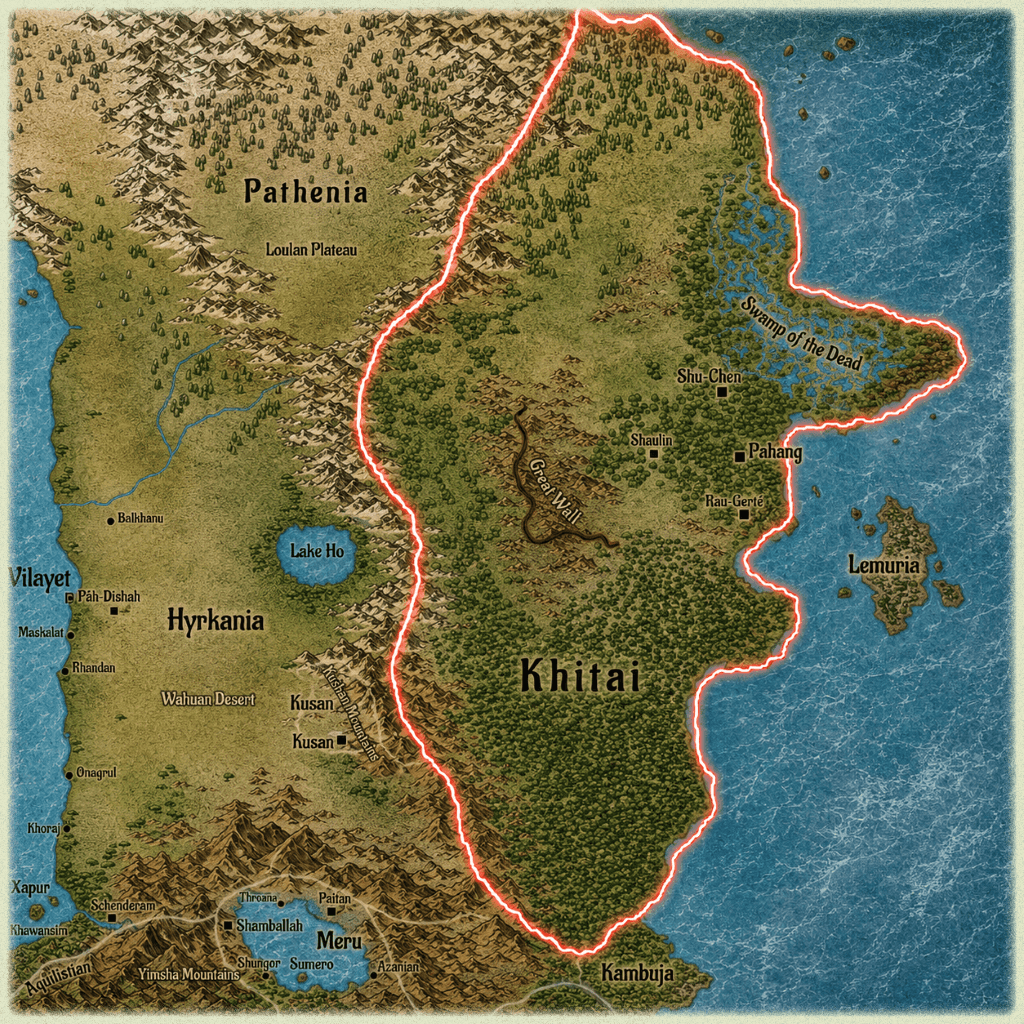
Khitai is a land bounded by extreme natural and artificial borders, keeping the "barbarian" influences of the West completely at bay:
                  [ NORTH: River of Yellow Curses ]
                                 │
 [ WEST: The Great Wall ] ◄───── KHITAI ─────► [ EAST: The Endless Ocean ]
                                 │
                  [ SOUTH: Bamboo Jungle & Kambuja ]
- The West (The Great Wall): A staggering, serpent-like architectural marvel stretching 1,500 to 4,000 miles along the western frontier. It stands 100 feet tall, constructed of solid stone and reinforced by garrisons stationed every 3 miles.
- The North (The River of Yellow Curses): A wide, treacherous river separating the green plains of Khitai from the shifting steppes of Hyrkania and the arid horrors of the Desert of Black Sand (Kara Korum). Its waters are choked with foul, sorcerous energies, and legend says strange, mutating beasts crawl out from its depths.
- The East: A vast, endless ocean that covers everything the eye can touch, defining the edge of the known world and protecting the empire's merchant-dominated coastlines.
- The South (The Bamboo Jungle): Any border gaps not covered by stone or water are sealed by a dense, suffocating wall of towering bamboo jungle. This hyper-dense canopy stretches south toward the savage kingdoms of Kambuja, choking out cavalry paths and harboring lethal, prehistoric fauna.
Key Regions and Territories
Tai D’Shan (The Celestial Peak)
The greatest and most revered mountain in Khitai, located at the heart of the Great Highlands. It is a finger-like, sheer stone peak permanently shrouded in rolling mists. Throughout the millennia, it has been worshiped alternatively as a god, a slumbering demon, or a cosmic ancestor. It acts as the spiritual anchor of the empire, and many ascetic sorcerers climb its cliffs to meditate upon the heavens.
Chosain Province
Situated in the northeast, Chosain is an idyllic yet war-torn landscape blending forested hills, twisted valleys, and fertile river plains.
- The Fractured West: The western territories of Chosain are lawless, dominated by heavily armed criminal clans who constantly wage blood feuds against one another and ruthlessly ambush caravans traveling to the capital.
- The Civilized East: Considerably more stable and refined. It houses Hein-Lu, a powerful city-state that sits adjacent to the small buffer kingdom of Kusan.
The Desert Marches
Lying just inside or abutting portions of the Great Wall, this is a harsh, rocky scrubland with bitterly scarce water resources. It is sparsely populated by outcasts, escaped criminals, and social renegades. The Imperial government tolerates their presence on one condition: they are periodically conscripted as forced labor to rebuild and maintain the Great Wall.
The Great Desert (Kara Korum / The Desert of Black Sand)
A searing, bleak expanse of shifting sand and parched earth. It is arguably the most unforgiving terrain in the empire, interrupted only by a few secret oases and narrow, disappearing rivers. Small, insular clans of camel-riding nomads call this desert home, earning a meager living as specialized guides for heavily armored merchant caravans brave enough to risk the crossing.
The Dark Secrets of the Great Wall
To outsiders, the Wall is merely an incredible feat of masonry built to keep the rebellious Lemurians out after their ancient uprising against the Khitan city-states. To the peasants, it is a massive state-run employment engine requiring endless labor. However, its true nature is fundamentally sorcerous and horrific:
The Bone Wall: Beneath the outer stone facades rests the original, ancient wall—constructed entirely of woven bamboo and the bones of millions of Khitai's ancient enemies.
Through the forbidden sorcery of the ancient demon-gods, Khitan necromancers trapped the souls of those whose skeletons were crushed into the foundation. Along certain cursed stretches of the wall, the weeping and agonized screams of these trapped spirits can still be heard on windy nights.
This serves a terrifying defensive purpose: if a foreign army manages to breach the wall, the Kang-Ka (the dreaded skull-faced necromancer-sorcerers who guard the ramparts) will cast dark incantations to rip the stone away, reanimating the ancient, calcified skeletons into an unstoppable, un-living legion to consume the invaders.
Major Cities of the Empire
While all regional kings and satraps pay heavy tithes and nominal homage to the central Emperor, each major Khitan metropolis operates effectively as an autonomous, walled city-state with its own internal laws and military forces:
| City-State | Leadership | Character & Political Climate |
|---|---|---|
| Paikang | The God-Emperor | The absolute center of power, luxury, and spiritual dominion in Khitai. Its gleaming purple-towered minarets dominate the vine-choked southern jungles, serving as a monument to imperial supremacy. |
| Ruo-Gen | The Quan Dynasty | An incredibly ostentatious, wealthy city that rivals Paikang in architectural splendor. It is a hotbed of treason, as its ruling elite are actively consolidating armies and resources to march against the God-Emperor. |
| Shaulun | Priest Hu-Suei | The peaceful City of the Moon-Goddess. It is a serene, elegant metropolis characterized by white stone and quiet gardens. Remarkably, its bold ruler openly defies and bans the dark, demonic sorceries practiced throughout the rest of Khitai. |
| Shu Chen | Parochial Factions | A swamp-locked jungle city permanently blanketed by the legendary, echoing "moaning mist." It is deeply sectarian, completely fragmented into hostile, walled neighborhoods that each run their own insular micro-governments. |

The political structure of Khitai is a rigid, multi-layered autocracy. While the entire empire operates under the spiritual and absolute authority of a single ruler, the sheer geographical scale of Khitai requires a highly structured, feudal hierarchy of autonomous city-kingdoms and strictly enforced social castes.
The Imperial Throne and City-Kingdoms
The Paradox of the God-Emperor
The absolute ruler of Khitai sits upon the Jade Throne in the capital city of Paikang. Officially revered by the populace as a divine entity, the God-Emperor is, in reality, a completely mortal being belonging to a hereditary imperial dynasty.
- Succession: The imperial title is passed strictly from father to son, though the Emperor can choose any of his sons based on capability and favor—it does not automatically default to the oldest.
- Dynastic Warfare: Because the office holds god-like authority and immense wealth, Khitai’s history is defined by constant, bloody internal struggles between rival branches of the royal family seeking to overthrow the sitting Emperor and establish a new dynasty.
The Feudal City-Kingdoms
Beyond the walls of Paikang, Khitai functions as a network of independent city-kingdoms. Each major city acts as a sovereign domain with its own standing army, localized taxes, and ruling noble family. While these regional rulers exercise absolute control over their individual territories, they are legally bound to pay heavy tithes, perform sacred court rituals, and obey the direct edicts of the God-Emperor.
The Four Social Castes
Social mobility within Khitai is almost completely non-existent. A citizen's entire life, profession, legal rights, and marriage prospects are entirely dictated by their birth. Every individual falls into one of four immutable castes:
[ ZHOU ]    ─── Imperial Family & The Emperor's Inner Circle
   │
[ ZHUHOU ]  ─── The Feudal Nobility (Princes, Dukes, Barons)
   │
[ QING ]    ─── The Gentry (Military Officers & Court Officials)
   ▼
====== WEAPON BARRICADE: Castes below this line cannot carry arms ======
   ▲
[ HAN ]     ─── Commoners (Divided into Daifu, Shi, and Shumin)
1. The Zhou (The Imperial Court)
The highest and most exclusive caste in the empire, composed solely of individuals directly related by blood to the Emperor.
- The Seven Advisors: The Emperor governs the empire with the assistance of an inner council of seven highly powerful advisors, all of whom must belong to the Zhou class.
- Privileges: Members of the Zhou caste hold exclusive rights to command the largest imperial armies, perform state religious rites, and establish officially recognized royal clans and sub-dynasties.
2. The Zhuhou (The Nobility)
The Zhuhou caste comprises the hereditary aristocracy, politicians, and high ministers who manage the empire's lands. Every title is strictly hereditary, passing from father to son. The internal noble hierarchy is organized into seven distinct ranks:
| Rank | Title | Role & Scope of Power |
|---|---|---|
| 1. Gong | Prince | The sovereign rulers of the individual city-kingdoms. |
| 2. Kung | Duke | High-ranking governors overseeing vast provincial territories. |
| 3. Hou | Marquis | Wardens responsible for securing volatile frontier borders. |
| 4. Peh | Earl | Masters of major trading hubs and secondary interior cities. |
| 5. Bo | Count | Overseers of large agricultural valleys or vital mining operations. |
| 6. Tszi | Viscount | Local lords governing fortified towns and essential outposts. |
| 7. Nan | Baron | Minor landowners commanding localized garrisons and estates. |
3. The Qing (The Gentry)
The Qing caste functions as the bureaucratic and military backbone of Khitai. They are court officials who directly serve the higher nobility, predominantly holding specialized military commands, captaincy roles, and provincial administrative positions.
The Right to Bear Arms: Under strict Khitan imperial law, the Qing are the lowest caste permitted to carry weapons. Anyone belonging to the lower Han caste caught armed without an explicit imperial wartime dispensation faces immediate execution.
4. The Han (The Common Folk)
The Han caste encompasses the overwhelming majority of the Khitan population. While they lack political power and the right to defend themselves with steel, they are internally divided into three distinct sub-ranks based on education and economic utility:
- Daifu (The Professional Class): Positioned at the apex of the common caste. These are educated folk who practice highly specialized, non-noble professions, including doctors, teachers, wealthy merchants, and literate scholars.
- Shi (The Artisans): The skilled craftsmen of the empire. They are responsible for weaving silk, forging the armor of the Qing, cutting jade, and constructing the architectural marvels of the nobility.
- Shumin (The Laborers): Standing at the very bottom of the social pyramid. These are the vast, impoverished masses of farmers, peasants, and field laborers who build the walls, harvest the rice, and harvest the bamboo jungles under the watchful eyes of their noble masters.

Khitan society operates like a massive, perfectly calibrated clock. Every citizen is a gear that must turn precisely as ordained by tradition, ancestry, and imperial decree. Order, hierarchy, and public harmony are the supreme virtues of the empire.
Rigid Etiquette and Public Harmony
A Khitan's social rank is not a private matter; it must be visually and behaviorally demonstrated at all times.
- The Chain of Respect: A person’s caste dictates the manner in which they speak, act, and dress. Lower-caste individuals must always bow to those of higher rank. This unbroken chain of deferential submission flows upward through the entire population, terminating only at the Jade Throne of the God-Emperor.
- The Petition System: Openly arguing, screaming, or debating in public is viewed as an uncultured, animalistic breakdown of societal order. Lower classes are strictly forbidden from voicing public disagreement with a noble's decision. If a citizen has a grievance, they must lodge a formal, spoken petition directly to an official of a superior rank than the person they disagree with, letting the hierarchy handle the friction quietly behind closed doors.
The Concept of Ancestral Justice
To a Khitan, the word "Justice" has nothing to do with western concepts of personal freedom, equality, or human rights.
The Justice of the Ancestors: True justice means that every single person receives exactly what their cosmic birthright dictates—no more and no less than what one’s station gives.
Demanding higher social mobility, questioning the caste system, or asking for privileges above what your ancestors earned is viewed as a form of spiritual theft. Justice is achieved when the peasant farms without complaint, the soldier executes orders without hesitation, and the prince rules without mercy.
The Dual Nature of the Khitan Psyche
The internal culture of Khitai stands in stark, baffling contrast to how the empire interacts with the outside world.
                   ┌─────────────────────────────┐
                   │   THE TWO FACES OF KHITAI   │
                   └──────────────┬──────────────┘
                                  │
         ┌────────────────────────┴────────────────────────┐
         ▼                                                 ▼
  [ AMONGST THEMSELVES ]                            [ TOWARD FOREIGNERS ]
  • Warm and welcoming                              • Cold suspicion and disdain
  • Prone to laughter and jokes                     • View westerners as "civilized beasts"
  • Rare violent outbursts                          • Obsessive boundary enforcement
Warmth Among Peers
Despite their absolute obsession with protocol, courtesy, and rigid legalism, Khitans are remarkably warm, light-hearted, and welcoming when interacting within their own social circles. They are highly communal, enjoy jokes, and are not easily provoked into angry, violent outbursts. Harmony at home is fiercely protected.
Disdain for the Outsider
This jovial, light-hearted nature completely evaporates the moment a foreigner enters the room. The Khitan people view all outsiders with deep suspicion and visceral disdain, firmly believing that the chaotic, fluid ways of western barbarians are a spiritual disease that can bring ruin to the empire.
Imperial scholars openly state that while westerners might be trying their best to act civilized, they are fundamentally little better than dressed-up beasts.
The Path of the Tolerated Stranger
Foreigners are not explicitly banned from entering Khitai—the lucrative silk and lotus trade demands their presence—but they are closely watched, heavily taxed, and treated with cold isolation. However, a rare exception exists for those willing to fully surrender their homeland's customs:
- Proving Trust: An outsider must actively prove their absolute loyalty over an extended period.
- Exhibiting Courtesy: They must master the dizzying complexities of Khitan bows, honors, and formal speech patterns.
- Total Adaptability: They must discard foreign dress, weapons, and religious habits, adopting Khitan ways entirely.
Only when a foreigner successfully mirrors the empire's rigid behavioral standards will the local populace drop their cold mask and extend the warm, light-hearted hospitality normally reserved for their own bloodlines.

The physical presence and traditional dress of the Khitan people are deeply intertwined with their geography and their rigid caste system. Every garment worn serves as a visual passport, instantly communicating an individual's region of origin and exact place within the imperial hierarchy.
The people of Khitai are physically distinct from the tall, broad-shouldered Hyborians of the West, possessing a compact build and features shaped by their ancient bloodline.
Stature: They are a short, lithe, and leanly built race, prioritizing agility and fluid grace over raw, muscular bulk.
Complexion: Their skin possesses a distinct, slightly yellowish undertone. This varies dramatically by latitude:
Northern Regions: Khitans from the cold northern provinces and river valleys exhibit much lighter, pale skin.
Southern Regions: Khitans from the tropical bamboo jungles and coastal wetlands possess much darker, heavily bronzed skin from a lifetime under a fierce sun.
Hair and Eyes: Both sexes almost universally possess dark, deep black eyes and straight, midnight-black hair. Hair is considered a sacred gift from the ancestors and is worn long by both men and women, often meticulously braided or pinned up with ornate ornaments.
Facial Hair: Khitan men almost completely avoid growing beards or mustaches. Facial hair is culturally viewed as coarse, unclean, and highly impolite, associated with the wild, unkempt "beasts" of the western steppes and kingdoms.

Khitan textiles are world-renowned, focusing heavily on locally harvested cotton for the masses and fine, shimmering silk for the upper echelons. Their wardrobe is strictly categorized into three timeless, traditional styles:
┌─────────────────────────────────────────────────────────────────┐
│                     THE THREE GARMENTS OF KHITAI                │
├─────────────────┬──────────────────────────────┬────────────────┤
│ Style Name      │ Composition                  │ Primary Wearer │
├─────────────────┼──────────────────────────────┼────────────────┤
│ 1. Pien-fu      │ Two-piece ceremonial suit    │ Royalty, High  │
│                 │ (Tunic and knee-length skirt)│ Priests, Lords │
├─────────────────┼──────────────────────────────┼────────────────┤
│ 2. Shen-i       │ Combined tunic and skirt     │ Gentry, Clerks,│
│                 │ (Cut separately, sewn as one)│ Daily Nobles   │
├─────────────────┼──────────────────────────────┼────────────────┤
│ 3. K’ang-po     │ One-piece robe/tunic         │ Peasants, Shi, │
│                 │ (Loose, durable cut)         │ Laborers       │
└─────────────────────────────────────────────────────────────────┘
The Pien-fu (Ceremonial Dress)
The absolute pinnacle of Khitan fashion, reserved exclusively for the high nobility, the imperial court, and high priests during religious rites or official state functions. It is an ornate, two-piece ensemble consisting of a formal tunic extending to the knees worn over a coordinating skirt that sweeps the ankles. It is frequently heavily embroidered with intricate threadwork depicting dragons, moons, or ancestral symbols.
The Shen-i (The Daily Tunic)
The most common garment worn in the daily life of the upper and middle castes, including the Qing (gentry), scholars, and off-duty nobility. The tunic and skirt are meticulously cut from separate pieces of cloth but are seamlessly sewn together into a singular, flowing garment. It is designed to look structured and elegant while allowing complete freedom of movement.
The K’ang-po (The Peasant Robe)
The universal uniform of the lower Han caste. It is a simple, loose-fitting, one-piece garment crafted from durable, coarse-woven cotton. It is designed entirely for utility, allowing the Shumin (farmers) and Shi (artisans) to labor efficiently in the rice fields, workshops, and along the grueling scaffolding of the Great Wall.
The Social Code of Color
In Khitai, color is not a matter of personal preference—it is a matter of law. The empire uses color to instantly distinguish the rulers from the ruled:
The Contrast of Status: Dark, deep colors—such as midnight black, rich plums, and deep crimson—are strictly preferred and claimed by the nobility, high bureaucrats, and dark sorcerers. Conversely, the common folk and peasants are relegated to wearing lighter, muted colors, such as un-dyed whites, pale grays, and soft creams.

Gender in Khitai operates on a fascinating paradox. While the political, noble, and imperial structures are strictly patriarchal and ruled by men, the culture’s underlying sorcerous and spiritual beliefs grant women an extraordinary degree of personal autonomy, intellectual respect, and sexual supremacy unmatched in the Western kingdoms.
On a daily level, the vast majority of Khitan women, particularly within the lower Han caste, occupy traditional roles centered entirely on managing the household and raising children. In public and domestic spheres, societal etiquette demands that they show deference and submission to men.
However, unlike the rigid glass ceilings of the Hyborian West, Khitan society believes that genius and spiritual capability are blind to gender:
- No Closed Doors: If a Khitan woman possesses undeniable talent, intellect, or spiritual aptitude, absolutely no profession or societal role is barred from her.
- Scholars and Bureaucrats: A significant percentage of Khitai’s most revered medical doctors, literate scholars, and high-level court bureaucrats are female.
- The Martial Exception: While noble aristocratic titles are strictly patriarchal and pass only from father to son (wives receive only a symbolic, non-governing title), military titles are completely open to women. A exceptionally skilled female warrior can rise to command imperial garrisons and lead armies of the Qing gentry into battle.
The Sorcery of Sexuality
To understand Khitan gender dynamics, one must understand their view of sex. In Khitai, sexuality is not viewed as a taboo or a mere physical urge; it is treated as a critical, highly potent magical component driven by the balance of cosmic energies.
┌─────────────────────────────────────────────────────────────────┐
│                    THE COSMIC ENERGIES OF SEX                   │
├────────────────────────────────┬────────────────────────────────┤
│ Female Force (Yin-aligned)     │ Male Force (Yang-aligned)      │
├────────────────────────────────┼────────────────────────────────┤
│ • Infinite and self-generating │ • Finite and easily depleted   │
│ • Must be cultivated & peaked  │ • Must absorb female energy    │
│ • Complete freedom (Unmarried) │ • Restricted to single climax  │
└────────────────────────────────┴────────────────────────────────┘
The Khitan believe that both sexes carry innate magical forces within their bodies that complement one another. However, the female magical force is infinite and self-renewing, whereas the male magical force is strictly finite and easily drained.
Because of this metaphysical dynamic, sexual intimacy is viewed as a vital necessity for men to absorb and replenish their mystical energies from women:
- The Sexual Center: Women are the absolute focus of all sexual activity in Khitai. To maximize the transfer of energy, it is expected that a woman climaxes multiple times during an encounter.
- Male Restrictions: To prevent the total depletion of his vital essence, a Khitan man is culturally and medically advised never to climax more than once per encounter. Furthermore, because it results in a volatile, destructive clash of finite forces, men are strictly forbidden from lying with other men.
- Unmarried Freedom: Prior to marriage, Khitan women enjoy absolute, unregulated sexual freedom. They are encouraged to explore their desires freely, and relationships between women are completely accepted and viewed as a natural, harmonious cultivation of infinite energy.
The Sacred Bond of Marriage
The fluid freedom of youth changes dramatically once a formal marriage contract is signed. While lower-caste marriages are frequently born out of genuine affection, marriages among the gentry and high nobility are strictly transactions of political and economic convenience.
The Marital Sanctification: Marriage is believed to mystically lock, sanctify, and vastly intensify the energetic transfer occurring between a husband and a wife, binding their cosmic fates together.
This spiritual locking mechanism introduces a harsh double standard under Khitan law:
- The Unforgivable Sin: If a married woman sleeps with another man, she shatters the cosmic order, corrupts her husband’s spiritual reservoir, and actively weakens his life force. Consequently, any wife found guilty of infidelity is immediately sentenced to death.
- The Husband’s Dispensation: Conversely, it is entirely legal and socially acceptable for a married man to sleep with concubines or unmarried women. Because he is the recipient of energy, laying with other women is viewed as a practical method of bringing outside magical strength back into his household and lineage.

In Khitai, the institutions of slavery and prostitution sit on completely opposite ends of the moral, legal, and spiritual spectrum. While slaves are stripped of all human dignity and treated as worthless property, prostitutes are regarded as vital, spiritually gifted members of society who help maintain the mystical equilibrium of the empire.
The Brutal Reality of Slavery
Slavery is an incredibly common, normalized engine of the Khitan economy. However, unlike other nations where slaves might find roles as respected tutors or skilled artisans, in Khitai, falling into slavery is viewed as the ultimate cosmic and social shame. Consequently, slaves are granted absolutely no respect, protection, or human dignity.
Origins and Demographics
The slave population of Khitai is drawn almost exclusively from two distinct sources:
- Internal Criminals: Khitan citizens from any caste who have committed serious crimes against the state, failed to pay debts, or crossed the nobility.
- Foreign Prisoners: Captured Hyrkanian raiders and border tribesmen dragged from the bloody skirmishes along the northern frontier and the River of Yellow Curses.
Legal Status and Treatment
Under imperial law, a slave is strictly a piece of property—and an easily replaceable, low-value one at that.
The Law of Property: Murdering a slave is completely legal for their master. If a third party kills a slave, it is handled not as murder, but as a minor civil dispute for "property damage."
Beatings, starvation, and severe exploitation are daily realities. To systematically break their spirit, a slave's birth name is legally dissolved upon purchase. Masters bestow new, derogatory names meant to humiliate the individual, usually mocking a physical deformity, a facial feature, or a perceived flawed habit.
The Slave Markets
Every major city-kingdom in Khitai hosts a sprawling, centralized slave market. While the high nobility (the Zhuhou) hold the exclusive right to own and trade slaves freely, commoners can purchase them if they obtain a formal bureaucratic permit.
The market is highly polarized: exceptionally healthy, beautiful, or uniquely skilled slaves command staggering prices at noble auctions, while old, sick, or broken laborers are sold for a pittance, cheap enough for even the lowest Shumin peasant to buy for harsh field labor.
The Sacred Prestige of Prostitution
While the West views prostitution as a vice or a desperate survival mechanism, Khitai elevates it to a respected, spiritually significant profession. Khitan prostitutes are held in high social regard, and the occupation carries absolutely no stigma or shame.
┌───────────────────────────────────────────────────────────────────┐
│              SLAVERY VS. PROSTITUTION IN KHITAI                   │
├────────────────────────────────┬──────────────────────────────────┤
│           The Slaves           │        The Prostitutes           │
├────────────────────────────────┼──────────────────────────────────┤
│ • Stripped of all legal rights │ • High-status, independent       │
│ • Trapped in ultimate shame    │ • Revered as spiritual anchors   │
│ • Treated as disposable goods  │ • Channels of infinite energy    │
│ • Mixed gender & nationalities │ • Strictly female Khitan citizens│
└────────────────────────────────┴──────────────────────────────────┘
The Magic of the Courtesan
This high societal status is rooted directly in Khitai's sorcerous views on sexuality. Because women possess a self-renewing, infinite well of magical energy, a woman who intimately engages with multiple men is believed to act as a hyper-concentrated reservoir of cosmic force.
Prostitutes are viewed not as merchants of flesh, but as vital spiritual conduits who revitalize the finite energies of the male population.
Rules of the Trade
- Strictly Female: The profession is exclusively populated by women. Because male-on-male intimacy is believed to cause a destructive, volatile clash of finite energies, male prostitutes are non-existent and strictly forbidden.
- Never Enslaved: A prostitute is never a slave. Forcing a woman into sexual labor by chain or whip would corrupt the purity of the magical transfer. They operate as independent, free citizens.
Integration with Daily and Religious Life
Visiting a prostitute is considered a healthy, highly respectable act of self-care and spiritual preparation. It is entirely common, and socially encouraged, for a Khitan man to sleep with his wife before a major religious offering, state trial, or business venture—and then immediately visit a local prostitute afterward just to accumulate an extra, potent layer of good fortune and vital essence before facing his duties.

Khitai’s economic engine is a massive, highly insular machine. While the empire produces some of the most sought-after luxury goods in the known world, its rulers harbor a deep-seated aversion to foreign influence. As a result, the overwhelming majority of Khitan commerce is conducted internally, with international trade strictly managed to protect the empire's borders.
When Khitai does turn its gaze outward, it operates through heavily guarded, immense merchant caravans. These massive trains travel immense distances to trade with nations such as Kusan, Turan, Stygia, Vendhya, Meru, and Iranistan.
┌─────────────────────────────────────────────────────────────────┐
│                    THE TRADE BALANCE OF KHITAI                  │
├────────────────────────────────┬────────────────────────────────┤
│ EXPORTS (The World's Desires)  │ IMPORTS (The Empire's Deficit) │
├────────────────────────────────┼────────────────────────────────┤
│ • Shimmering Silks & Brocades  │ • HIGH-QUALITY IRON & STEEL    │
│ • Sacred Jade & Carved Silver  │   (Required to forge weapons   │
│ • Imperial Porcelain & Gold    │    and reinforce armor for     │
│ • Rare Herbs & Spices          │    the Qing gentry, as native  │
│ • Sorcerous Lotus Varieties    │    Khitan ore is brittle).     │
└────────────────────────────────┴────────────────────────────────┘
These international caravans, along with a few desperate or politically exiled Khitans, represent the absolute limit of the empire's contact with the West.
The Isolationist Navy
While Khitai possesses advanced, formidable sailing ships, they are strictly forbidden from voyaging outside of domestic coastal waters. The Imperial Court has zero interest in colonizing, exploring, or expanding relationships with foreign nations.
However, ancient imperial records hint that in the distant past, before the borders were sealed, legendary Khitan treasure fleets sailed across the oceans to the far West, bringing back bizarre treasures that still sit locked deep within the subterranean vaults of the God-Emperor in Paikang.
The Merchant Class (Daifu)
Under the strict laws of the caste system, the high nobility (the Zhuhou) and royal family are legally forbidden from engaging in trade, viewing the haggling of markets as an undignified task far beneath their station.
- The Wealth of Commoners: Consequently, almost all merchants belong to the Daifu rank—the educated, professional tier of the commoner Han class.
- Economic Might vs. Social Restrictions: While a merchant can never cross the caste barrier to become a noble or legally carry weapons in daily life, their economic wealth is completely unrestricted. Many Daifu merchants amass staggering fortunes that dwarf those of minor provincial barons, buying massive urban estates and living in immense luxury.
- Private Armies: Because traveling the trade routes (especially through provinces like western Chosain) carries a lethal risk of ambush by ruthless bandit clans, wealthy merchants routinely spend fortunes hiring large squads of professional bodyguards and foreign mercenaries to protect their cargo.
Currency and Financial Systems
The transaction of wealth in Khitai shifts dramatically based on proximity to the imperial centers of power:
- Urban Coinage: Most major cities and bustling commercial towns deal strictly in standardized imperial coins minted from copper, silver, and gold.
- The Gem Currency: High-value transactions, large-scale property purchases, and noble briberies frequently utilize precious gemstones—particularly flawlessly cut jade, sapphires, and rubies—as a universally accepted premium currency.
- Frontier Barter: Out in the remote mountain settlements, swamp villages, and the rocky scrublands of the Desert Marches, coinage completely loses its value. Here, a pure barter system is prevalent, with citizens trading raw grains, silks, pottery, and physical labor directly for one another's goods and services.
Common Professions of the Han Caste
The lower caste (Han) forms the vibrant, diverse backbone of Khitai’s cities. Depending on their specific sub-rank (Daifu, Shi, or Shumin), citizens fill a wide array of specialized urban professions:
The Professional Class (Daifu)
- Scholars & Clerks: Highly literate individuals who maintain the dizzying, massive imperial bureaucracy, record taxes, and copy ancestral texts.
- Healers & Physicians: Medical experts, many of whom are women, who mix advanced herbal remedies and balance bodily vital energies.
- Architects: Engineers skilled in the complex geometric principles required to construct towering pagodas, palace compounds, and maintain the structural integrity of the Great Wall.
The Artisan Class (Shi)
- Craftsmen & Weavers: Specialized laborers who transform raw cotton and silkworm cocoons into luxurious textiles, carve delicate imperial jade, and bake high-grade porcelain.
- Armorers & Weaponsmiths: Highly supervised workers tasked with shaping imported steel into the specialized armaments required by the state.
The Military and Laborers (Shumin)
- The Imperial Soldiers: Commoners who show exceptional physical grit are drafted directly into the military. They serve the noble echelons and regional princes directly, functioning as palace guards, border scouts, or wall sentries, executing the martial will of the Qing gentry.
- Farmers & Construction Workers: The massive underclass that tills the endless rice fields and provides the brutal, endless manual labor required to clear bamboo jungles and reinforce the empire’s fortifications.

In Khitai, religion, statecraft, and the dark arts are entirely indistinguishable. The Khitan do not bow to distant, abstract deities; instead, their complex theological system is anchored in the literal, physical presence of summoned entities, a profound reverence for the dead, and the constant, industrialized shedding of blood.
Ancestor Veneration and Blood Sacrifice
The spiritual framework of every Khitan citizen centers on an absolute duty to their lineage. However, keeping the dead content requires far more than simple prayers or incense.
[ Mortal Request / Ancestral Need ] ───► [ The Catalyst of Blood ] ───► [ Cosmic Order / Divine Favor ]
- The Nourishment of the Dead: The Khitan believe that the spirits of their ancestors actively regulate the tides of reality but grow weak and faded over time. To retain their power and watch over their living descendants, these spirits must be nourished directly by blood.
- The Currency of the Altars: Human and animal sacrifice is a universal, daily reality across the empire. It is culturally viewed as a noble, deeply pious undertaking rather than a cruel act.
- The Law of the Request: Imperial theology states that any serious request or pact made by a mortal must be accompanied by a letting of blood. To ask the cosmos or the ancestors for a favor without offering a life in return is considered a grave, dangerous insult to the cosmic balance.
- Ceremonial Music: Khitan rituals are massive, highly theatrical productions. Great bronze bells, echoing gongs, and droning flutes play a vital role in their ceremonies, setting a hypnotic rhythm that aligns the minds of the worshippers before the sacrificial blades fall.
The Pantheon of Demons and the Afterlife
The religious pantheon of Khitai is volatile, rapidly expanding, and terrifyingly concrete. Because Khitan sorcerers regularly summon their demon-gods directly to the earth, many of these entities possess a very physical, terrifying presence within the empire's walled temples.
The Splitting of the Soul
This physical relationship with divinity is tied directly to the Khitan understanding of what happens when a human dies. Upon death, it is believed the soul divides cleanly into two distinct aspects:
- The Celestial Soul: This half ascends directly to heaven, where it resides peacefully with the older ancestors and assists in ordering the grand architecture of the cosmos.
- The Underworld Soul: This half descends to the subterranean underworld. Free from mortal constraints, this aspect continues its life in the dark, learning monumental secrets and ancient, forbidden knowledge.
The Evolution into Demigods: Over centuries of wandering the underworld, an ancestor's soul can accumulate so much cosmic secrets and mystical power that it evolves into a literal demigod. Once it reaches this state, living Khitan sorcerers can summon that specific soul back to the mortal world to manifest its dark power on the battlefield or in the court.
The Great Cults
Khitan temples double as highly selective, politically powerful sorcerous academies. They are dedicated to cosmic beings whose tangible existence is an undeniable fact to the population, most notably:
- Yogah of Yag: The ancient, elephant-headed alien being imprisoned for centuries within the notorious, gleaming Elephant Tower.
- Cheng Ho: A revered, ancient divinity associated with high scholarship, protective sorceries, and imperial mandate.
The Prestige of Sorcery
While the kingdoms of the Hyborian West fear sorcerers as heretics, witches, and monsters to be burned at the stake, Khitai views sorcery as a legitimate, highly revered profession. Because magic flows directly from the underworld—a place of sacred ancestral evolution—the practice of dark sorcery is seen as a natural extension of higher education and state service.
- Political Pillars: Sorcerers are deeply entrenched in the imperial government, playing a critical role in court politics, balancing the caste systems, and maintaining social order through mystical intimidation.
- The Sponsored Masters: Every local prince (Gong), duke, and regional governor actively seeks out powerful sorcerers to sponsor. These masters are brought into palace courts, given massive wealth, and tasked with putting their reality-bending powers to practical use—such as cursing rival cities, predicting crop yields, or commanding the bone legions of the Great Wall.
- Itinerant Casters: While true mastery is rare, magic is common enough that low-level, itinerant sorcerers wander the trade roads freely. These traveling mystics openly sell their specialized services to merchant caravans, wealthy farmers, and urban khans, mixing herbal potions, binding local spirits, and warding off bad fortune for a handful of silver coins.

To play a Khitan is to embody the poised, calculating, and ancient soul of an empire that has outlasted cataclysms and shackled legends. You are a product of a world governed by rigid caste lines, flawless etiquette, and the tangible, blood-slicked reality of dark sorcery. Navigating a landscape of autonomous city-kingdoms, massive frontier walls, and secretive lotus temples, you know that your exact place in the cosmos was carved out long ago by the deeds of your ancestors. You carry yourself with a calm, light-hearted warmth among your peers, but meet the uncultured "beasts" of the West with a mask of cold, absolute disdain.
Core Identity
Race: Hyborian (Khitan). Lean, agile, and short in stature, prioritizing fluid grace over raw muscle. They are a physically distinct, ancient race whose bloodline has remained sovereign for thousands of years.
Language: Khitan (A highly sophisticated, tonal language where meaning shifts based on pitch, rich in formal idioms, poetic court titles, and ancestral proverbs).
Hair Color: Universally straight, midnight-black hair worn long by both sexes, carefully braided or pinned up. Men are culturally required to remain clean-shaven, viewing facial hair as impolite and barbaric.
Eye Color: Dark, intense, and deep black eyes.
Complexion: Possesses a distinct, slightly yellowish undertone.
Northern Origins: Notably pale and light-skinned.
Southern Origins: Richly bronzed and darkened by the tropical jungle sun.
Names: Short, sharp, and structured, frequently featuring hyphenated family lineages.
Male: Hu-Suei, Kuan-Zhi, Chen-Gong, Feng-Yi, Kang-Ru, Zhao-Hui, Meng-Te, Lun-Shao.
Female: Mei-Lin, Xiu-Ying, Zhu-Mei, Yan-Fei, Shao-An, Qing-Xuan, Ling-Yun, Na-Zhi.
Personality and Archetypes
The Khitan psyche splits sharply between absolute inner harmony and absolute outer exclusion, bound by a cosmic devotion to ancestral justice.
- Obsessive Etiquette: Your position in the cosmos must be displayed in every bow, word, and garment. You never argue in public, viewing emotional outbursts as animalistic. If you have a grievance, you lodge it through a quiet, formal spoken petition to a superior rank.
- Ancestral Justice: You do not believe in Western equality. To you, justice means that everyone receives exactly what their birthright dictates—no more and no less. To demand a higher social station or query the caste system is a sacrilege against your lineage.
- The Dual Mask: Among your own caste and peers, you are remarkably warm, light-hearted, and quick to laugh or joke. The moment a foreigner enters the room, you adopt a mask of cold suspicion and profound disdain, viewing their chaotic ways as a spiritual disease.
- The Paradigm of Ambition: While you respect traditional roles, you know that the empire bows to absolute talent. If you are gifted enough, no office is barred to you—allowing women to rise as lethal military commanders, high-level physicians, or master scholars.
- Shedding of the Catalyst: You understand that the universe operates on a system of cosmic exchange. You do not fear the supernatural; you know that any great request made to the ancestors or the demon-gods must be paid for in the noble currency of poured blood.
Combat Roles and Equipment
Khitan warriors reject the heavy, monochromatic furs of the north, dressing instead in meticulously structured cotton or fine, deep-colored silks that signify their state rank.
- The Qing Garrison Officer (City Guard Leader): A disciplined commander belonging to the gentry caste, legally permitted to bear arms. Wearing a structured Shen-i tunic and skirt in deep, dark crimsons or blacks, you wield a flawlessly balanced scimitar or a long-handled halberd forged from precious imported steel.
- The Kang-Ka Skull-Sorcerer (Wall Necromancer): A sponsored master of the forbidden arts who uses magic derived from the underworld. Dressed in dark, sweeping ceremonial robes, you use ritual music, gongs, and the sacred catalyst of blood to bind spirits, curse enemies, or command the calcified bone armies built into the Great Wall.
- The Chosain Clan-Blade (Mercenary Highwayman): A ruthless combatant from the fractured, lawless western valleys. Wearing a rugged, dark K'ang-po cotton garment and hired by wealthy Daifu merchants, you utilize swift, dual-wielded short swords and throwing daggers to ambush rival caravans or clear out frontier bandits.
- The Lotus Huntress (Imperial Skirmisher): A highly talented female warrior who has bypassed traditional domestic roles through sheer martial genius. Moving with lethal agility through the dense southern bamboo jungles, you utilize compact composite bows and jade-tipped spears to enforce the borders of the God-Emperor.
Social Rank and Background
Khitan backgrounds are defined by an absolute lack of social mobility. You are born into your caste, and your profession is your destiny.
- Zhou Royal Scion: Born directly into the bloodline of the God-Emperor in Paikang. You live in a world of absolute luxury, deep purple towers, and shifting dynastic betrayals, possessing the exclusive right to command imperial host armies and establish royal sub-clans.
- Zhuhou Aristocrat (Regional Lord): A hereditary noble holding a title ranging from a minor estate Baron (Nan) to the sovereign Prince (Gong) of a walled city-state. You own vast ancestral lands, govern thousands of commoners, and actively sponsor court sorcerers to strengthen your family's leverage against rival kingdoms.
- Daifu Master-Merchant: An incredibly wealthy commoner belonging to the professional tier of the Han caste. Though legally barred from carrying weapons, your financial empire spans international caravan networks, allowing you to buy sprawling urban estates that rival the castles of the nobility.
- The Sacred Courtesan: An independent female citizen holding high social prestige. Celebrated as a respected spiritual anchor and a reservoir of infinite cosmic energy, you are regularly visited by high-ranking officials and scholars looking to replenish their vital essence before major state rituals.
- Liberated Frontier Renegade: A former criminal or escaped laborer from the Desert Marches. Having survived the brutal, property-level conditions of Khitan slavery or forced labor gangs along the Great Wall, you are a hardened, deeply scarred survivor who relies on pure grit and local barter to survive.
Starting Package
Every Khitan character begins their journey with an elegant, highly organized set of equipment reflecting the timeless traditions of the East:
- A set of traditional garments matching your caste—either an elegant, separate-cut Shen-i tunic and skirt in lighter tones (commoner) or deep, dark hues (gentry/noble), or a durable, loose-fitting K'ang-po peasant robe.
- A pair of soft, meticulously stitched cotton or silk slippers designed for fluid, silent movement.
- A primary weapon of choice—typically a curved steel scimitar, a long-handled halberd, or a lacquered composite bow—bearing detailed aesthetic engravings along the grip or guard.
- A formal, lacquered writing kit or an ornate bronze incense burner used for ancestral offerings.
- A small silk pouch containing a polished stone of pure jade (used as currency), a vial of soothing herbal medicine, and a dried ration of compressed tea leaves or local lotus petals.

- "The Tower of the Elephant" (Robert E. Howard): This foundational tale introduces the ancient, elephant-headed alien being Yogah of Yag, establishing his cosmic flight from the green jungles of Khitai and providing the earliest descriptions of the country’s ancient, sorcerous heritage.
- "A Witch Shall Be Born" (Robert E. Howard): Contains critical references to the "purple-towered" architecture of Paikang, framing it as the supreme center of mystical knowledge and imperial wealth in the Far East.
- "The Hyborian Age" (Robert E. Howard): Howard’s world-building essay outlines the ethnic and historical origin of the Khitan. It codifies their ancient enslavement of the Lemurian refugees, their eventual war of expulsion, and their total isolation from the young Hyborian kingdoms behind geographical barriers.
- The Conan the Avenger / Conan the Buccaneer series (L. Sprague de Camp & Lin Carter): These pastiche novels expand heavily on the physical journey into Khitai, detailing the court dynamics of the God-Emperor, the visual aesthetics of the Shen-i garments, and the trade routes snaking into the West.
- Khitai (Mongoose Publishing - Conan RPG line): The absolute definitive source book for this region. This source codifies the complete breakdown of the Zhou, Zhuhou, Qing, and Han caste system, introduces the specific noble ranks (Gong down to Nan), details the dark necromantic secrets embedded inside the Great Wall, and establishes the metaphysical rules governing Khitan sexual sorcery and ancestor evolution.
- Return to the Road of Kings (Mongoose Publishing): Expands on Khitai’s isolationist maritime laws, its international caravan networks trading jade and lotus to kingdoms like Stygia and Iranistan, and its critical reliance on importing high-grade Western steel to counteract its poor native iron ore.