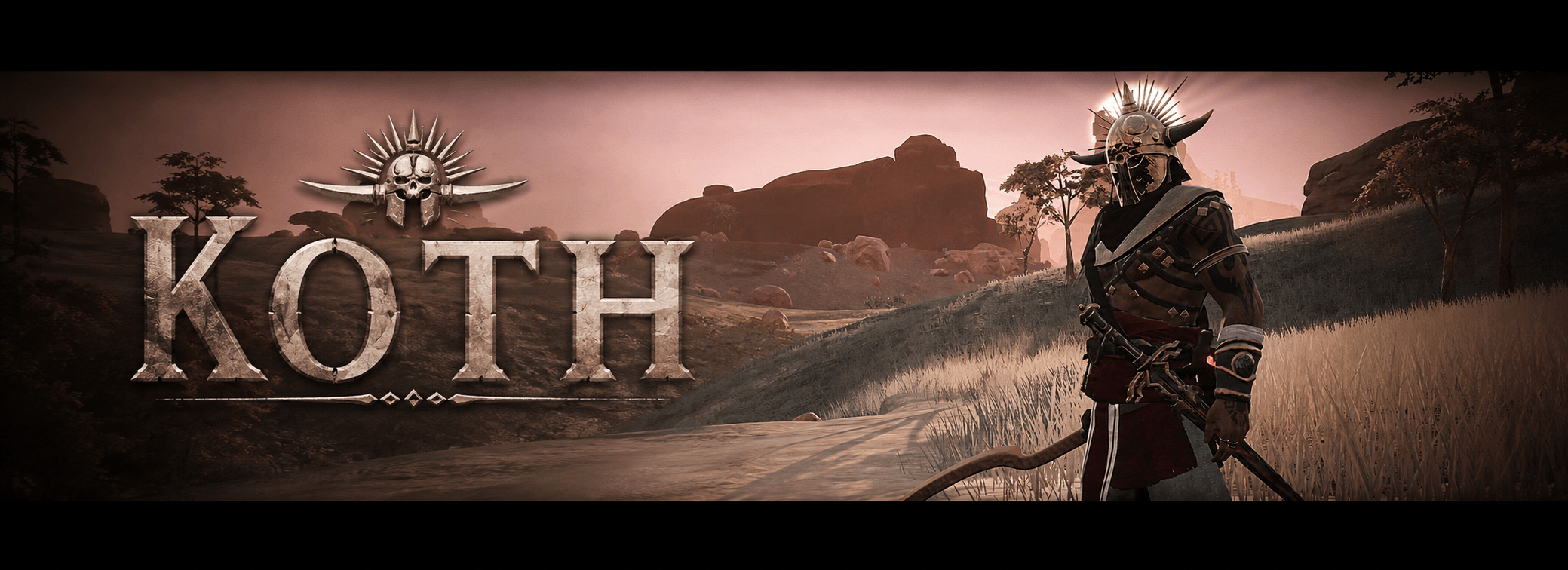
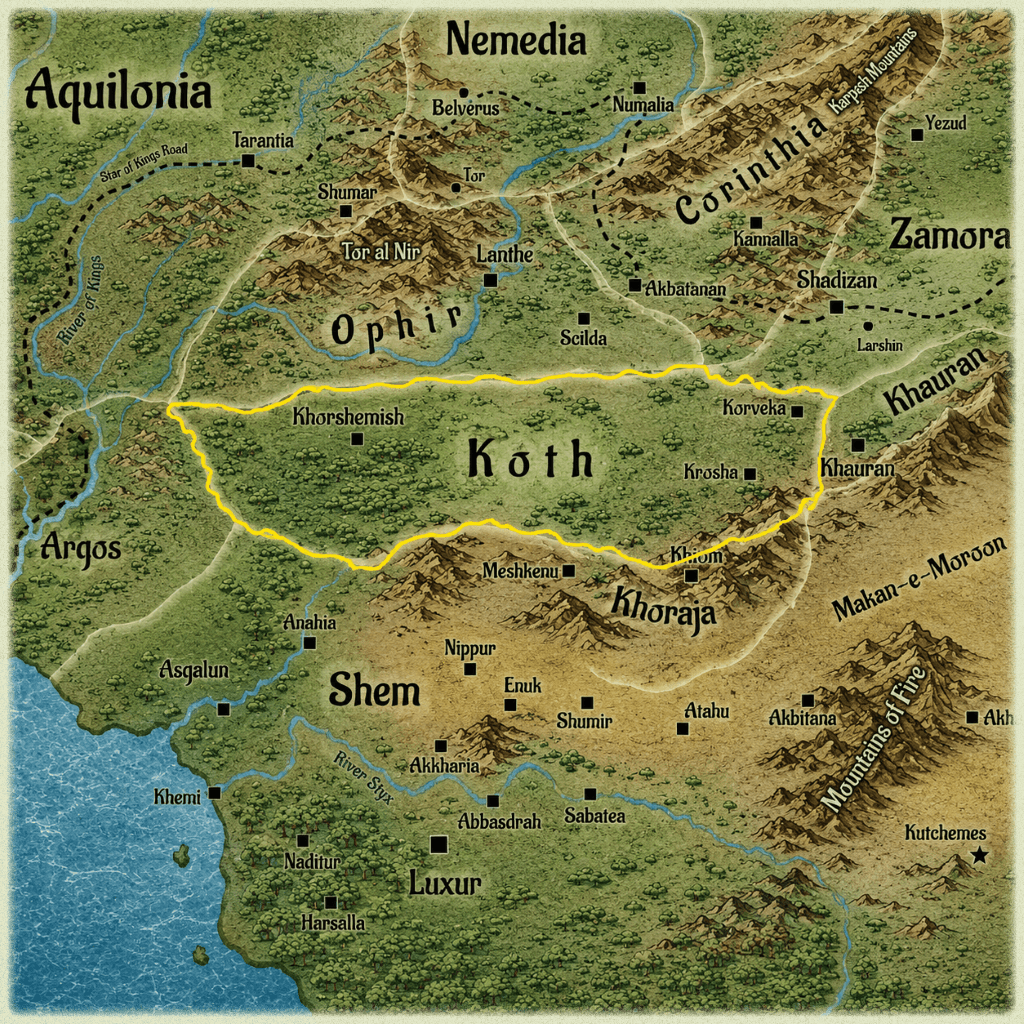

"A week’s ride northward, the desert ran into a tangle of barren hills, beyond which lay the fertile uplands of Koth, the southernmost realm of the Hyborian races. On the southern side the hills fell away sheerly, marking a distinct geographical division between the Kothian uplands and the southern desert. The hills were the rim of the uplands, stretching in an almost unbroken wall. Here they were bare and desolate…"
— Robert E. Howard, Black Colossus
Koth occupies a crucial geopolitical space as the southernmost Hyborian kingdom. Entirely landlocked and without access to any sea ports, the nation is divided by contrasting landscapes. Its territory shifts from rich, water-abundant agricultural regions in the west to volatile volcanic ranges and haunted badlands along its borders.
The Great Border Escarpments and Mountain Passes
The physical boundaries of Koth are defined by monumental geological formations that naturally isolate the kingdom from its neighbors. The most prominent of these is the Kothian Hills, a continuous barrier of steep, barren hills forming a sheer escarpment that runs for a thousand miles past the Shamla Pass. This natural rock wall marks a stark geographical division between the fertile uplands of Koth and the sweeping northern deserts of Shem.
Because of this brutal topography, travel and trade into the kingdom are heavily restricted, relying entirely on a select few natural mountain fissures:
- The Shamla Pass: Located within the vassal principality of Khoraja, this acts as the primary southern gateway through the Kothian Hills.
- The Zahmahn Pass: Situated along the northern frontier, this steep path cuts directly through the Karpash Mountains to connect Koth with the kingdom of Corinthia.
- The Border Flank Passes: A southern mountain gap allows access near the Shemite city of Eruk, while at least two distinct northern passes puncture the mountains to link Koth with Ophir.
Regional Geography and Internal Landmarks
The Fertile Western Uplands
Western Koth is a prosperous, sub-humid prairie characterized by sweeping meadowlands, dense forests, structured farms, and vibrant orchards. The landscape is kept rich and fertile by an abundance of blue lakes and meandering water systems.
- The Khorgas River: This slow and shallow river rests in a narrow, shallow valley that snakes through regional farmlands and pastures. The surrounding steep hills are dotted with the small homes of rural serfs and the stone keeps of lesser Kothian nobles. While easily fordable across most of its length, the river breaks into deep pools and cascades near the border of Khoraja, where the hills become mountainous and the river thins into a mere brook. A square military tower watches over this valley from the mountains marking the Khorajan border.
- The Festering Swamp: Located in the far west near the Argossean-Kothian border, this swamp sits to the west of Suthad and a spine of wooded hills. It is highly avoided by travelers due to being the natural breeding source for many foul diseases.
The Central Basins and Eastern Lowlands
As the geography shifts away from the fertile prairies, the terrain becomes increasingly arid, desolate, and superstitious.
- The Lake of Salts: A massive, dead body of water spanning several leagues across the central barren region of Koth. The basin is surrounded by cacti and thorny desert foliage. Hidden deep within the center of this salt lake lay the Islands of Pearl, though very few people in the world know of their existence.
- The Yivga River: A slow-moving watercourse that flows exclusively through the eastern plains of Koth.
- Dagoth Hill: An infamous, dreaded elevation of land that features ancient, pre-human ruins. The site is widely reputed to be haunted by active demons who are willing to sleep with human women.
- Zamanas Mesa: A notorious triangular plateau located along the Kothian Escarpment between Khoraja and Khauran. Regarded by locals as a haunted and fundamentally "bad place," the mesa is entirely surrounded by deep canyons. Its only approach is a steep, natural causeway that runs along a razor-backed mountain ridge. Two unequal outcroppings of stone stand prominently in the center of the mesa. The Harangi hillmen live near this cursed site, dwelling in fortified villages constructed with plaster-stoned walls and conical roofs.
The Mountains of Fire
The Kothian Escarpment rises to its highest and most violent peaks where a chain of active volcanoes forms the Mountains of Fire.
- Mount Khrosha: The most prominent volcano within the range. Plumes of thick smoke regularly rise from the unholy fires seething within the cauldron of this angry volcano. The extreme, supernatural heat of this volcanic fire-pit is highly prized by regional weapon smiths, as iron forged in the fires of Khrosha has absolutely no equal for hardness.
Ancient Road Networks
Travel through the interior of Koth takes significantly longer than most foreign merchants anticipate. The roads tend to meander wildly and are rarely built in a straight line. Instead of following efficient routes, these paths find the most inconvenient trajectories imaginable, climbing over steep hills and plunging deep into rugged gorges.
This layout is entirely deliberate; the roads are ancient structures built by long-forgotten civilizations to pass directly by prehistoric eldritch sites and religious shrines rather than to facilitate the rapid movement of caravan traffic.
Important Cities and Holds
Khorshemish
Widely celebrated as the "Queen of the South," Khorshemish is a massive walled capital of 44,253 residents characterized by its tall, soaring spires. The city is built directly onto the crest of a sheer hill and is bordered to the east by a grand forest. It is regarded as a place of immense wonders, ranging from its gold-chased entry gates to the architecture of the royal palace itself.
The city has a complex structural history spanning over three thousand years:
- The Foundation: King Khossus V originally constructed the city over the ruins of an older settlement following the historic fall of the Acheronian Empire.
- The Palaces: The initial palace of Khossus V was built directly over the location of the pre-existing Scarlet Citadel. He eventually abandoned this site to build a secondary palace in the suburbs, before ultimately moving the capital to a separate city in eastern Koth.
- The Citadel: Many years later, King Akkuth chose to rebuild the original Khorshemish palace, transforming the site into an unassailable military fortress. Still later, the sinister sorcerer Tsotha-lanti used that exact fortress as the foundation to erect the nightmare-inducing Scarlet Citadel.
Tantusium
A powerful Kothian city-state built entirely upon the slopes of a steep hill. The city relies on a unique defensive architecture to protect its wealth:
- The Main Gate: The entry is imposing, flanked by two stout, round stone towers. The gates themselves consist of heavy, metal-studded wooden valves. There are no defensive machicolations or overhanging works directly above the gates.
- The External Bulwark: To compensate for the lack of overhanging defenses, a massive stone bulwark is constructed directly in front of the gate. This wall is specifically positioned to block the swinging motion of a battering ram, forcing incoming caravan traffic to slowly file underneath the defensive towers.
- The Interior Layout: Immediately inside the gate is a bustling plaza filled with inns, retail shops, and temporary merchant stalls. The streets are heavily winding and cobbled in most places, though many routes consist entirely of steep stone steps due to the hill-sloped terrain.
- The Hidden Citadel: The ruling prince’s central citadel is completely obscured from street level, hidden directly behind a false façade of tall civilian buildings.
- Military Doctrine: When the prince of Tantusium decides to wage war, the city-state completely bypasses traditional feudal levies, relying exclusively on the Free Companions, which are highly trained companies of independent mercenaries.
Suthad
A city located high on a strategic hill amidst the fertile western lands. Suthad was originally founded by ancient Stygians long before the historic fall of Acheron. Because of this heritage, the city's monumental architecture still heavily reflects old Stygian structural forms.
El-Shah-Maddoc
A walled city built within the rich meadow regions of Koth, containing an original population of 12,300 people. The city was initially conquered by King Irham of Syreb in an effort to control the lucrative trade networks of the territory. At a later point in its history, the entire settlement was utterly destroyed in a catastrophic magical blast.
Syreb
A prominent meadow city-state known historically for its elite warriors. Its most famous champion was the gladiator Jahib-Re, who served Prince Irham for many years. In his later years, the retired Jahib-Re served Irham as a trusted political councilor before he was ultimately killed by a summoned demon. The ruler, King Irham, is remembered as a foolish monarch who initiated the conquest of El-Shah-Maddoc and later launched a disastrous rebellion against King Strabonus.
Meshken
A boisterously happy, lively little town located exactly thirty miles west of the Khorajan border. The settlement is famous among travelers for its colorful night life and its abundance of loud taverns. A half-day ride further into the territory leads directly to the stronghold of the provincial king at Castle Vhalken.
Daramish
A small, isolated backwater city located in eastern Koth at the base of a low mountain range. Reflecting its proximity to conservative eastern cultures, the women of Daramish dress in an extremely conservative fashion, strictly wearing full-body cloaks, heavy robes, and face veils.
Barony of Korveka
A frontier barony situated directly against the borders of Khauran. The primary agricultural produce of the territory is melons. Because of its geographic position, most residents of Khauran feel very strongly that Korveka should rightfully be integrated into Khauran rather than remaining under the banner of Koth.

The government of Koth operates as a highly centralized, absolute feudal monarchy that exhibits a far more authoritarian nature than its northern Hyborian neighbors, such as Aquilonia or Nemedia. This political landscape is heavily shaped by historic Stygian and Acheronian cultural influences, leading the King of Koth to rule with an overtly despotic hand.
While the crown represents the supreme authority in the land, controlling all aspects of statecraft and national oversight, the king's power is not entirely absolute. Kothian history is defined by a volatile political balancing act; the kingdom's powerful aristocrats and regional lords are notoriously rebellious, actively checking the monarch's overreach whenever their personal autonomy or land holdings are threatened. Directly beneath the king sits a formal Council of Nobles, which serves as an advisory body and an arena for the realm's high aristocracy to negotiate with the throne. Aside from this heightened imperial despotism, the day-to-day bureaucratic machinery of Koth closely mirrors the standard feudal systems found in Aquilonia.
Social Stratification
Kothian society is organized into a rigid, steeply hierarchical ladder. Social station dictates an individual's legal protections, economic obligations, and quality of life.
- The King and the High Nobility: The supreme ruling class. They possess total ownership over the kingdom's vast estates, private armies, and volcanic iron resources.
- Free Peasants: A class of non-noble citizens who reside directly within the manors and lands owned by the aristocracy. They retain their personal freedom but are legally required to provide regular economic payments or agricultural tithes to their noble landlords in exchange for residency and military protection.
- Craftsmen and Artisans: The professional urban workforce. Positioned beneath the rural peasantry, this class handles the manufacturing, building, trade, and famed metallurgy that drives Koth's internal economy.
- Slaves: Settled at the absolute bottom of the social ladder. Slaves possess no legal rights and are forced to perform the bulk of the manual agricultural labor in the fields, as well as all other menial or hazardous jobs throughout the kingdom.
Law and Judicature
Legal doctrine is rigidly enforced across Koth, backed by the administrative weight of the crown. Interestingly, standard punishments for common offenses tend to be surprisingly humane when compared to the brutal codes of nearby wilderness nations.
However, the legal system completely abandons this leniency when dealing with offenses that threaten the core economic, supernatural, or social stability of the despotism. There are four capital crimes in Koth that carry zero mercy. If an individual is convicted of any of these infractions, the law mandates a sentence of severe, prolonged torture, execution, or both:
- Sorcery: The practice of forbidden, underworld, or unsanctioned magical arts.
- Slave Disobedience: Any act of rebellion, defiance, or escape attempted by the slave caste.
- Crop Destruction: Deliberate sabotage of agricultural fields or orchards, which directly threatens the kingdom's landlocked food supply.
- Rape: Violations of bodily autonomy, which are met with absolute severity under imperial law.

Kothian culture is fundamentally feudal, rooted in an agrarian, manor-based economic system where land ownership equates directly to power. The nobility sits firmly at the top of this social order, commanding vast estates and absolute regional authority.
The structure of the high aristocracy is deeply nepotistic. The vast majority of Koth's noble houses are related to the reigning monarch through blood or strategic marriage alliances, as the king systematically assigns the kingdom's most vital territories, resources, and border passes to members of his own family. Despite these tight familial ties to the crown, the nobility is fiercely independent and rebellious by nature. They place an immense cultural value on autonomy and personal sovereignty. This cultural respect for independence extends to noble women, who enjoy a distinct degree of social latitude and are well-known for speaking their minds openly in political and private matters.
Social Castes and Property Rites
The non-noble population is divided into precise legal tiers, with property rights and inheritance serving as the main distinctions between the classes:
- Free Peasants: This class resides on the lord's manorial estates in exchange for regular financial payments or direct labor. Free peasants possess the legal right to pass their property down to their sons, provided the lord of the manor grants formal approval.
- Artisans and Craftsmen: Positioned directly beneath the free peasants, these skilled laborers also live on the noble manors under similar obligations. However, they are denied hereditary property rights. Upon an artisan's death, their property and all accompanying civic obligations are liquidated and sold. The lord of the manor must approve the prospective buyer, and the entire financial income generated from the sale goes directly into the lord's coffers.
- Slaves: Occupying the absolute bottom of Kothian society, slaves endure brutal and severe lives. Kothian masters possess the absolute legal power of life and death over their human property. Slaves are entirely excluded from the legal system, possessing zero rights and zero protections under imperial law.
Military Organization and War Culture
The Kothian military machine is a formidable, highly structured force built around a core of heavy cavalry and specialized auxiliary units. All official imperial troops wear standardized livery proudly embossed with the Golden Helmet of Koth. Visually, most Kothian soldiers sport thick, prominent beards, often styled in the ringleted fashion borrowed from the neighboring cultures of Shem.
                  [ THE KOTHIAN TACTICAL HEIRARCHY ]

        ┌──────────────────────────────────────────────────┐
        │                 HEAVY CAVALRY                    │
        │  • Dark-faced Knights (7 years of elite training)│
        └────────────────────────┬─────────────────────────┘
                                 │ Supported By
                                 ▼
        ┌──────────────────────────────────────────────────┐
        │                 INFANTRY CORE                    │
        │  • Kothic Spearmen (Giants in mail brigandine)   │
        └────────────────────────┬─────────────────────────┘
                                 │ Flanked By
                                 ▼
        ┌──────────────────────────────────────────────────┐
        │               LIGHT AUXILIARIES                  │
        │  • Spahis (Light cavalry scouts & skirmishers)   │
        │  • Shemitish Archers (Hired mercenary lines)     │
        └──────────────────────────────────────────────────┘
The army is organized into four primary tactical components:
- The Knights: The crown jewel of the military consists of dark-faced knights and heavy cavalry. These elite warriors are trained at immense state expense for seven rigorous years before they are ever unleashed on the field of combat.
- The Spearmen: The heavy infantry core is comprised of giant Kothic spearmen. They march into battle heavily armored, outfitted in protective steel caps and dense mail brigandine (a coat of iron plates riveted to canvas or leather).
- The Spahis: A specialized domestic cavalry of light horse skirmishers. The Spahis are utilized as the vanguard of the army, deployed ahead of the main host to scout out enemy territory and systematically ravage the countryside to choke off opposing supply lines.
- Mercenary Archery Lines: To compensate for a lack of domestic missile troops, Koth relies heavily on foreign mercenary companies, most notably hiring elite Shemitish archers to anchor their backlines.

The people of Koth are physically distinguished by their tall statures and dark or olive-toned complexions. Both their hair and eyes are universally dark.
Within Kothian society, tightly curled hair is culturally viewed as the pinnacle of beauty and physical desirability. Because of this strong aesthetic preference, individuals born with straight hair commonly use artificial means to tightly curl their locks. Among the male population, facial hair is a standard cultural staple, with almost all men sporting prominently kept beards and moustaches.

Urban Citizens and Working Classes
City-dwelling Kothians are known to dress exceptionally well, taking pride in their public presentation. Members of the working and merchant classes commonly wear specialized aprons over their primary garments. The material, cut, and style of these aprons vary significantly depending entirely on the specific trade or craft of the wearer.
Urban Kothian women favor highly expressive apparel, dressing in brightly colored shifts and elegant dresses adorned with intricate, detailed embroidery.
The High Nobility
The wealthy, olive-skinned aristocracy uses luxury fashion to overtly broadcast their status, heavily favoring rare textiles imported from foreign kingdoms.
- Noble Men: The gentlemen of the court dress in rich velvet pantaloons paired with fine silk shirts of foreign manufacture. They pay obsessive attention to grooming, styling their hair with perfumes and elaborate curls, while trimming their moustaches into sharp, distinct points.
- Noble Women: The women of the high houses wear extravagant, brightly colored dresses featuring heavy, masterwork embroidery.
- Ceremonial and Battle Dress: When donning panoply for court or war, the nobility wears elite, custom-forged armor. This protective gear is highly celebrated across the continent for its artistic craftsmanship, featuring beautifully embossed designs and stylized iconography.

In stark contrast to many of the more restrictive patriarchies found throughout the Hyborian kingdoms, women in Koth occupy a position of notable legal and social autonomy. While everyday domestic tasks like cooking and household management—or the supervision of servants and slaves in wealthier estates—typically fall to women, they are not legally or socially confined to the domestic sphere.
Most top-tier political and military offices are traditionally occupied by men, yet Kothian law and custom treat women with a high degree of equality. Kothian women possess substantial civil liberties that set them apart from their continental peers:
- Economic Independence: Women have the full legal right to own property, manage estates, and independently engage in any mercantile business or trade they desire.
- Professional Mobility: Though it is uncommon for a woman to leave her traditional household role, she is legally permitted to do so. Women can work almost any job a man can, including serving in the military or holding high-ranking administrative positions, provided they possess a high social standing.
- Social Expression: Kothian women are famous across the civilized world for speaking their minds freely and assertively, a cultural trait highly respected by Kothian men but viewed with surprise by foreign visitors.
Marriage Dynamics
The institution of marriage in Koth varies significantly depending on an individual's social class, but it fundamentally rejects the concept of a wife as the property of her husband.
| Social Stratum | Primary Catalyst | Marital Structure and Rights |
|---|---|---|
| High Society | Arranged strictly for political alliances, territorial expansion, or business mergers. | Structured as a mutual partnership rather than female subordination; wives are not expected to show blind obedience. |
| Common Folk | Formed freely based on personal affection, romance, or mutual choice. | Governed by shared domestic responsibilities and personal autonomy. |
Sexuality and Ritual Customs
Kothian society views sexuality as a fundamental, natural driving force of human existence. Driven by their unique religious outlook and worldview, Kothians approach human sexuality with a high degree of freedom and minimal social restraint.
This open perspective manifests in both private life and public worship:
- Religious Rites: Both men and women participate freely in large-scale orgiastic rituals when dedicated religious holy days or seasonal festivals demand them.
- The Marital Bound: While personal and ritual expression is highly unrestricted, a distinct double standard does not exist regarding marital fidelity. Once married, individuals of both genders are culturally and socially expected to remain faithful to their spouses outside of sanctioned religious exemptions.

A massive portion of Koth’s infrastructure and economic wealth is directly extraction-based, reliant on an unceasing supply of slave labor.
Global Slave Trade
Kothian slavers are notorious across the civilized world, trading human cargo extensively across international borders. Kothian kidnapping rings and press-gangs are so notoriously efficient at tracking and capturing targets that some factions regularly travel into Zamora—a kingdom famed for its own legendary thieves—just to compete for dominance in the global human trafficking market.
Domestic Conditions
Slaves are integrated into every level of Kothian labor. They work the agricultural fields, clear dangerous irrigation networks, and handle the backbreaking, hazardous tasks within the crown's deep mineral mines.
As dictated by Kothian custom, the lives of these laborers are exceptionally severe. Slaves are legally viewed as inanimate property rather than human beings; they possess absolutely zero legal rights, civic protections, or avenues for appeal. Under imperial law, a master holds undisputed power of life and death over their slaves, and an owner may torture, mutilate, kill, or dispose of their human property at any time without facing legal consequence.

The economy of Koth is a complex machine that bridges rich internal production with aggressive international commerce. While the nation is entirely landlocked, it serves as a massive trade hub and manufacturing powerhouse, balancing its agrarian foundations with a ruthless martial doctrine. If the kingdom lacks a specific resource, the traditional impulse of the Kothian crown is not to negotiate, but to launch a military campaign to seize the lands containing those assets.
                    ┌───────────────────────────────┐
                    │     THE KOTHIAN ECONOMY       │
                    └───────────────┬───────────────┘
            ┌───────────────────────┼───────────────────────┐
            ▼                       ▼                       ▼
┌───────────────────────┐ ┌───────────────────────┐ ┌───────────────────────┐
│ MAIN AGRICULUTRE      │ │   CROWN METALLURGY    │ │ INTERNATIONAL TRADE   │
│ • Wheat & Barley      │ │ • Khrosha Volcanic    │ │ • Global Slave Trade  │
│ • Honey Cultivation   │ │   Weapons Grade Iron  │ │ • Aggressive Conquest │
│ • Long-Horned Cattle  │ │ • Copper, Silver, Lead│ │   of Resource Lands   │
└───────────────────────┘ └───────────────────────┘ └───────────────────────┘
Agriculture, Livestock, and Mining
Agrarian Yields and Diet
The bedrock of Kothian daily life is its manorial agriculture, particularly across the fertile western prairies. The primary grain crops cultivated by the peasantry are wheat and barley. In terms of local diet, honey is harvested in massive quantities and serves as a major, universal staple of Kothian food and drink.
Livestock and Herding
Beyond farming, a massive sector of the domestic economy relies on livestock husbandry. The eastern plains and central basins are dominated by the herding of distinctive long-horned cattle. In more watered regions and wetlands, herds of water-buffalo and sheep are meticulously raised for leather, meat, and wool.
Crown Mining and Metallurgy
Koth sits atop rich subterranean mineral deposits, making mining a highly lucrative state industry. All mines producing copper, lead, silver, and iron are the exclusive property of the crown, which delegates their direct operation and administration to highly favored nobles.
Koth is one of the world's premier producers of high-grade iron. The finest ores are forged near the active cauldrons of the Mountains of Fire, yielding weapons and armor prized across the continent for their unrivaled density and hardness.

The spiritual history of Koth is defined by a massive cultural pivot away from its Hyborian roots. When the kingdom was first carved out by northern invaders, the people originally revered the ancestral hero-god Bori. During the great continental religious revolution centuries later, Koth was swept up in the holy fervor and officially converted to Mitraism, adopting the worship of Mitra, the single, stately god of justice and light.
However, the worship of Mitra never truly took deep root in Kothian soil. Approximately 900 years before the era of Conan the Cimmerian, the Kothians committed a grand national apostasy. Finding the orderly, stately processions of the Mitran priests too rigid, the people formally abandoned Mitra. They turned their devotion south, fully adopting the highly ecstatic, unrestrained, and orgiastic religious practices of neighboring Shem.
The Cult of Ishtar: Queen of Heaven
Today, Kothian religion is centered entirely around the fearsome and sensual goddess Ishtar, the daughter of Anu. As the Queen of Heaven, Ishtar is revered as the cosmic ruler of the universe, the stars, and fate.
                       ┌──────────────────────────────┐
                       │   ISHTAR: QUEEN OF HEAVEN    │
                       └──────────────┬───────────────┘
            ┌─────────────────────────┼─────────────────────────┐
            ▼                         ▼                         ▼
┌───────────────────────┐ ┌───────────────────────┐ ┌───────────────────────┐
│   ASTROLOGICAL FATE   │ │   SACRED JURISPRUDENCE│ │  CELESTIAL SORCERY    │
│ • The Zodiac is her   │ │ • Breaking secular    │ │ • Priestly casting of │
│   mystic girdle.      │ │   law is viewed as    │ │   cosmic horoscopes.  │
│ • Star alignment      │ │   dire sacrilege.     │ │ • Creation of potent  │
│   governs all actions.│ │ • Priests train the   │ │   charms, hexes, and  │
│ • Divination is a     │ │   populace to obey    │ │   protective wards    │
│   mandatory civic duty│ │   kings blindly.      │ │   imbued with magic.  │
└───────────────────────┘ └───────────────────────┘ └───────────────────────┘
The tenets and cultural impact of her priesthood are highly organized:
- Astrology and the Zodiac: Kothians firmly believe that celestial alignments strictly govern all human behavior. The twelve constellations of the Zodiac are viewed symbolically as Ishtar's mystic girdle. Because of this, divination is treated as a vital, mandatory aspect of everyday life.
- Priestly Sorcery: The temples are staffed by powerful priests and priestesses who actively work magic. They specialize in weaving cosmic horoscopes, reading the movements of planets, and crafting protective charms or active hexes for the nobility.
- The Divine Law: In Koth, secular laws are treated as a direct manifestation of divine magic. Breaking a royal law is not merely a civil offense—it is viewed as an act of absolute sacrilege against Ishtar herself. To maintain order, the temple hierarchy works hand-in-hand with the despotic kings and queens of Koth, explicitly training the populace to view obedience to the state as a sacred religious duty.
Religious Iconography
When crafting idols, reliefs, or paintings of the divine pantheon, Kothian artists follow a highly rigid, traditional iconographic code that mirrors their own high-society fashion sense:
Male Deities
Portrayed as regal, bearded figures. They are universally depicted wearing high, pointed hats, distinct boots with curled toes, and short, tightly belted robes.
Female Deities
Portrayed with absolute celestial authority. Goddesses are depicted wearing heavy, square hats and long, meticulously pleated dresses.
Tribal Shamanism of the Escarpment
While the urban centers and fertile plains bow to the complex astrology of Ishtar, the fiercely independent mountain clans—such as the Harangi Hillmen who dwell along the desolate canyons of the Kothian Escarpment—completely reject the Shemite pantheon.
The mountain cultures practice an ancient, animistic form of shamanism centered around communion with nature spirits and ancestral ghosts. These hill shamans undergo extreme, gruesome physical mutilations to heighten their magical awareness. According to local legend, one prominent escarpment shaman went so far as to deliberately pluck out his own eye, giving the organ a full, formal ritual burial in consecrated soil so that it could continually peer into the hidden depths of the spirit world while his remaining eye navigated the physical realm.

To play a Kothian is to embody the stark contradictions of a powerful, despotic kingdom. You are a product of a land where fertile meadows abruptly end at volcanic escarpments, and where absolute tyranny walks hand in hand with fierce, rebellious independence. Bound by a complex web of feudal manors, cosmic astrology, and the harsh realities of a massive slave economy, you know that survival requires a sharp mind, a mastery of high-grade steel, and a willingness to navigate the orgiastic and terrifying rites of Ishtar.
Core Identity
- Race: Hyborian (Kothian). Most commonly tall with dark or olive-toned skin, bearing a proud and cultured posture.
- Language: Kothian (A civilized, complex tongue that leans heavily on formal jurisprudence, often layered with Shemitish idioms and aristocratic nuance).
- Hair Color: Universally dark. Tight, curly hair is considered the absolute pinnacle of beauty, prompting those with straight hair to artificially curl their locks. Men proudly sport prominent beards and finely pointed moustaches.
- Eye Color: Dark, expressive, and intense.
- Names: Regal and ancient, often carrying a pseudo-Babylonian or Assyrian cadence.
- Male: Akhirom, Almaric, Chelis, Ishtaro, Kratos, Sargon, Strabonus.
- Female: Ishme, Salome, Tanith, Tashmetum, Zula.
Personality and Archetypes
Kothians are renowned for their highly cultured, fashionable exteriors, which mask a deeply pragmatic, superstitious, and ruthlessly ambitious core.
- Rebellious Independence: You respect authority only so far as it serves your interests. Even under a despotic king, nobles and commoners alike value personal autonomy. Both men and women are culturally expected to speak their minds freely and assertively.
- Egalitarian Ambition: You reject the strict patriarchal limits found in other Hyborian lands. You view men and women as capable equals. Women own property, run businesses, and fight, acting as true partners in marriage rather than subordinates.
- Cosmic Fatalism: You firmly believe the stars dictate human behavior. The Zodiac is the girdle of Ishtar, and you actively consult astrology, horoscopes, and temple divination before making any major life choices.
- Ruthless Pragmatism: You understand that your kingdom's wealth relies on international commerce, conquest, and the brutal exploitation of slaves. If you need special resources, your first instinct is not to trade, but to take them by force.
- Ecstatic Devotion: You embrace the unrestrained, orgiastic religious rituals of Ishtar, viewing sexuality as a natural, driving human force. However, you balance this freedom with a strict cultural expectation of marital fidelity.
Combat Roles and Equipment
Kothian military doctrine revolves around highly trained, heavily armored troops and rapid light cavalry. All official soldiers wear livery embossed with the Golden Helmet of Koth, and weapons are forged from the legendary, impossibly hard iron of the Mount Khrosha volcanoes.
- The Dark-Faced Knight (Heavy Cavalry): The terrifying, elite core of the army. Trained for seven grueling years at great state expense, you are clad in artistic, beautifully embossed armor, riding a massive warhorse to shatter enemy lines.
- The Kothic Spearman (Heavy Infantry): A towering giant of the infantry core. Wearing a protective steel cap and heavy mail brigandine, you form the unbreakable, disciplined wall that anchors the battlefield.
- The Spahi Skirmisher (Light Cavalry): A swift, lightly armed scout. You ride ahead of the main host into enemy territory to track movements, ravage the countryside, and mercilessly burn supply lines.
- The Escarpment Hill-Fighter (Tribal Warrior): A hardy, shamanic combatant from the Zamanas Mesa or Harangi hills. Rejecting traditional military structure, you fight with vicious zeal using iron axes, guerrilla tactics, and a fierce devotion to local spirits.
Social Rank and Background
Kothian society is rigidly feudal and agrarian, with status defined entirely by land ownership, royal bloodlines, and a complete lack of rights for the enslaved bottom class.
- Rebellious Aristocrat / Royal Kin: A high-ranking noble tied to the despotic king by blood or marriage. You command a vast manorial estate, wear velvet pantaloons and foreign silks, and constantly plot to maintain your regional independence from the crown.
- Astrologer-Priest / Priestess of Ishtar: A powerful temple official who views secular law as a form of divine magic. You cast celestial horoscopes, train the populace in blind obedience, and wield immense political power through prophecy and charms.
- Free Peasant / Agrarian Settler: A commoner bound to a noble's land. You pay tithes in wheat, barley, or honey, but possess the rare, highly valued legal right to pass your property down to your children.
- Guild Artisan / Khrosha Smith: A skilled urban worker or master metallurgist. You dress well, wearing an apron specific to your trade. You craft the finest goods in the world but cannot inherit property, knowing your life's work will be liquidated by your lord upon your death.
- Slaver / Mercenary Captain: A ruthless opportunist who profits off Koth's aggressive international commerce. You travel the continent capturing thralls, or you command companies of hired Shemitish archers to supplement Koth's forces.
Starting Package
Every Kothian character begins their journey with a set of refined gear that reflects their wealthy, civilized, and highly martial homeland:
- A set of culturally appropriate clothing. For women, a brightly colored, heavily embroidered dress or shift. For men, a quality tunic covered by a trade-specific apron, or rich velvet pantaloons and a silk shirt.
- A pair of high-quality, curled-toe leather boots and a sturdy cloak for traveling the meandering, ancient roads of the kingdom.
- A piece of high-grade Kothian iron weaponry forged in the volcanic heat of the escarpment, such as a perfectly balanced broadsword, a heavy spear, or an embossed dagger.
- A personal grooming kit containing curling tongs and fragrant perfumes, alongside a small talisman or horoscope scroll dedicated to the Queen of Heaven.
- A leather coin purse filled with trade silver, and a travel ration consisting of barley bread and sweet honey-cakes.

When writing your character's backstory, use these direct lore anchors to ground them in the world:
- The Great Apostasy: Occurred 900 years ago. Your ancestors abandoned the orderly processions of Mitra to embrace the sensual, ecstatic rites of the Shemitish goddess Ishtar.
- The Four Sacrileges: Under Kothian judicature, Rape, Sorcery, Slave Disobedience, and Crop Destruction are not just crimes—they are violations of divine magic punished by horrific torture and execution.
- The Golden Helmet: The universal crest stamped onto the livery and embossed shields of all official Kothian military personnel.
- Shemitish Influence: Because Koth borders Shem, your character might style their beard in tight ringlets, use Shemitish idioms, or have experience fighting alongside hired Shemitish mercenary archers.
- Resource Aggression: Koth’s foreign policy is simple: If they need a resource, they attack whoever owns it. Your character’s past military campaigns likely involved invading neighboring lands simply to seize mines, timber, or cattle.