
While Nemedian culture mirrors Aquilonian society in its sophistication, the two realms diverge sharply in their civic philosophy. Nemedia places an immense emphasis on structured feudal bonds and much less on personal freedoms. Ironically, this strict social control coexists with unparalleled scholastic and intellectual freedom. The empire is universally well regarded as the epicenter of higher learning, home to the greatest historians, the most celebrated philosophers, and the pinnacle of powerful orators in the Western world.
Boundaries and Territorial Defense
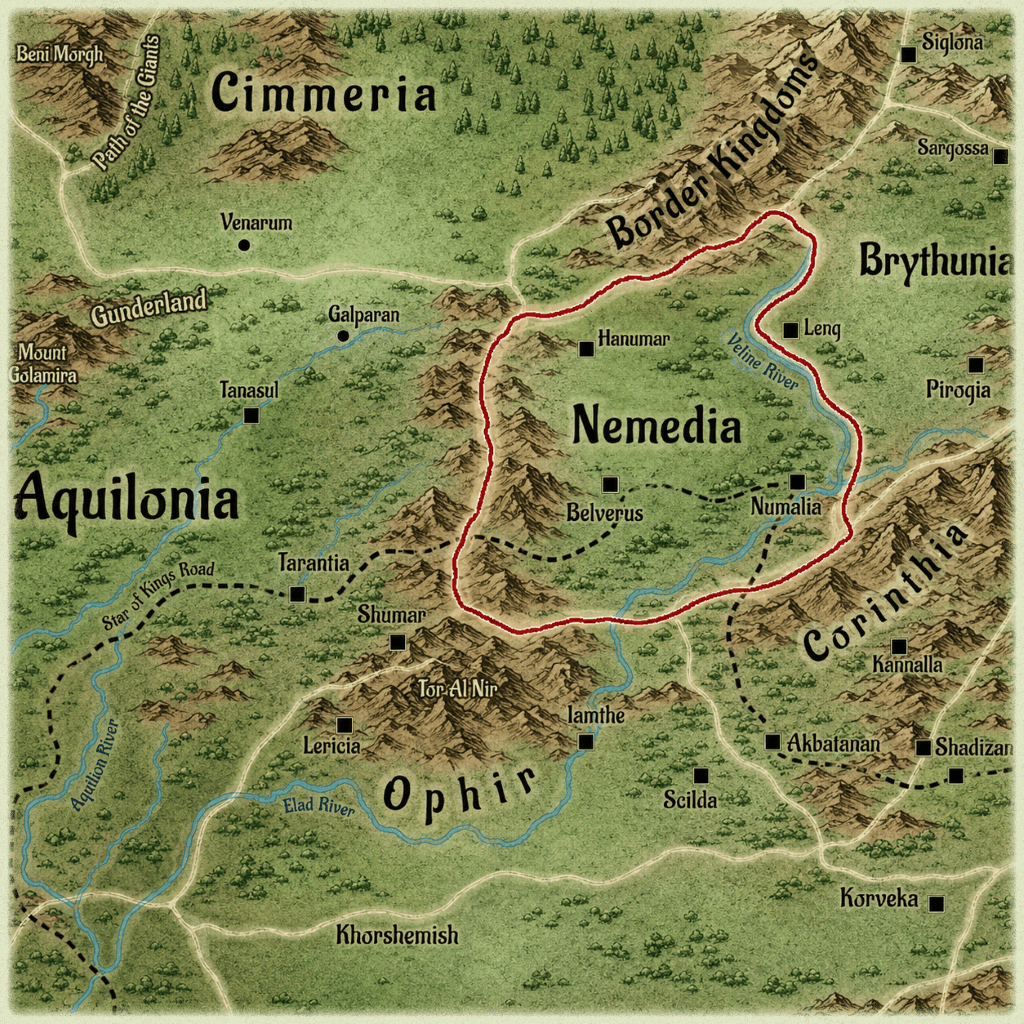
Nemedia is a highly fortified, landlocked kingdom defined by distinct natural borders that isolate it from its neighbors:
- The Western Frontier: Rugged, heavily wooded mountains and rolling hills create a natural barrier against Aquilonia. Only a few strategic mountain passes breach this range. To the immediate east of these peaks lie vast, desolate grasslands. This territory contains very few farms and villages, as rural settlers avoid the plains out of a constant, justified fear of Aquilonian border raiders.
- The Northern Border: Nemedia drops off into the lawless, barren expanses of the Border Kingdom. This frontier is completely choked by the Great Salt Marsh, a treacherous wetland that acts as a natural shield against northern incursions.
- The Eastern Border: The majestic Yellow River marks the geopolitical boundary separating Nemedia from Brythunia.
- The Southern Border: The landscape rises into the rugged, mineral-rich hills of Ophir.
The various mountain ranges crisscrossing the Nemedian interior sport a vast assortment of profitable mines. Rich veins of copper, gold, and silver are aggressively extracted across the realm, heavily reliant on the brutal manual labor of massive slave gangs.
Regional Geography and Internal Landmarks
Administratively, the empire is fractured into several highly organized provinces, baronies, and duchies to split the land into governable pieces. There are approximately forty-five distinct baronies and counties across the realm.
The Darkwood Forests
Extending deep along the eastern frontier of Nemedia, these dense, ancient pine forests are notoriously perilous. Very few travelers are brave enough to navigate the faint, overgrown trails snaking through this permanently shadowed canopy. While natural wildlife like wolves and bears abounds within the thickets, the forest also hides brooding, dark stone castles and stalking werewolves hungry for human prey. It is a favored sanctuary for desperate bandit clans who establish hidden lairs beneath the tall pines.
The Urlaub River and Fiefdoms
The Urlaub is a winding, snaky river that snakes through central Nemedia, providing the ancient land with immense agricultural fertility. The river features lush, deep green fields on either side and is deep enough that it remains unfordable along most of its length.
- Edram Castle: This imposing fortress sits directly on the shores of the Urlaub within the province of Dinander. A magnificent triple-arched stone bridge crosses the river at this exact location. This architectural marvel gives the local fief-holder an absolute stranglehold on all regional traffic, allowing them to amass immense wealth via aggressive trade taxation and checkpoint tolls. Beyond the rich fields lining the riverbanks, the terrain gives way to lightly forested foothills.
- The Varakiel Marshes: Situated in northeastern Nemedia, this desolate, isolated wetland is filled with snakes, wild cats, and marsh bears.
[ Dinander Capital ] ──► [ Urlaub Fief / Edram Castle ] ──► [ The Varakiel Fields & Marshes ]
The outer edges of the swamp gradually give way to a highly fertile agricultural region simply called the Varakiel, which is dotted with farming villages and tilled fields. This entire territory is subject to the master of Edram Castle, who oversees the collection of taxes from the Varakiel before answering directly to the Baron of Dinander.
The Yellow River
Flowing strictly northward until it empties into the Great Salt Marsh of the Border Kingdom, this major river runs directly along the western frontier of Brythunia before it forks in the southwest corner. The banks on either side of the Yellow River are highly historic, serving as the grim sites of countless legendary battlefields, ruined fortifications, and violent skirmishes fought between the armies of Nemedia and Brythunia over the centuries.
Important Cities and Capitals
Nemedian urbanization is incredibly precise; each of the kingdom's forty-five baronies and counties features a centralized, heavily fortified capital city, completely supported by an interconnected network of surrounding agricultural villages, trading towns, and rural hamlets.
┌─────────────────────────────────────────────────────────────────┐
│                    THE METROPOLISES OF NEMEDIA                  │
├───────────────────┬────────────┬────────────────────────────────┤
│ CITY              │ POPULATION │ SIGNIFICANCE                   │
├───────────────────┼────────────┼────────────────────────────────┤
│ Belverus          │ 55,707     │ Imperial Capital of the Realm  │
│ Numalia           │ 45,379     │ Commercial Hub, Road of Kings  │
│ Tor               │ 19,776     │ Sorcerous Hub, Home of Amalric │
│ Hanumar           │ 11,762     │ Northern Cult City of Ibis     │
│ Dinander          │ 8,558      │ Northern Military March Hold   │
└───────────────────┴────────────┴────────────────────────────────┘
Belverus
Belverus is the grand, walled capital of Nemedia. Housing 55,707 citizens, the metropolis is entirely surrounded by a sprawling ring of rich meadowlands, manicured gardens, fruit orchards, rolling vineyards, and extravagant pleasure villas belonging to the high nobility. At night, trusted slaves armed with heavy pikes patrol the perimeters of these private villas and gardens to maintain casual security. Exactly one mile outside the city walls, nestled within a sacred ring of ancient oak trees, stands the historic Fountain of Thrallos.
Numalia
Numalia stands as the second largest city in Nemedia, a gleaming Hyborian Age metropolis boasting a population of 45,379 residents. Situated directly on the legendary Road of Kings, it also commands the southern caravan route, a highly traveled merchant highway that plunges south through Ophir, Koth, and Khoraja.
The city is highly distinct, characterized by shining spires and a unique civic guard:
- The Scarlet Police: Law enforcement within Numalia is managed by a distinct police force easily identified by their bright scarlet tunics. They patrol the streets armed with short stabbing-swords and heavy bills.
- The Elite Class: The city's governance is overseen by Lord Ostorio Bragorus, the Governor of Numalia. The immensely wealthy citizens of the metropolis reside in luxury villas and favor traveling through the urban thoroughfares via private chariots. One of the most famous and wealthy avenues in the city is the Palian Way.
Tor
Tor is a powerful, heavily fortified walled city of 19,776 people, serving as the absolute capital of the prominent Barony of Tor. The city is historically famous as the seat of Baron Amalric, the ambitious noble who sponsored the scholar Orastes in his deep historical and forbidden pursuits, ultimately leading to the dark, cataclysmic resurrection of the ancient Acheronian sorcerer Xaltotun.
Hanumar
A fair-sized city of 11,762 residents located deep within northern Nemedia. Positioned away from the direct military roads leading to Aquilonia, Hanumar acts as a major spiritual and philosophical sanctuary. It is canonical as the holy home of Kalanthes, the highly revered and courageous priest of the god Ibis.
Dinander
Dinander is a fortified northern city of 8,558 residents that serves as the capital of its namesake barony. Located directly north of Belverus, this walled stronghold holds absolute administrative oversight over the Urlaub fiefdom, Edram Castle, and the eastern territories of the Varakiel.
A significant portion of the Varakiel under Dinander's control consists of uninhabited swamp, while another major section is comprised of a bleak, uncultivated wasteland. This uncultivated area was once the site of a historic, bloody battlefield and is universally avoided by locals due to lingering superstitious dread.

The government of Nemedia, ruled under the iron-clad authority of King Tarascus, stands as a prime example of a highly organized, classic feudal system. The king holds ultimate sovereignty over the realm, but to manage its vast territories, he delegates his land and administrative responsibilities to a top-tier network of trusted counts and barons.
                       [ THE ROYAL CROWN ]
                               │
            Divides land via Royal Patents & Titles
                               ▼
                    [ COUNTS AND BARONS ]
            (Govern thousands of acres, pay tribute)
                               │
            Subdivides land into smaller fiefdoms
                               ▼
                    [ LESSER LANDED NOBLES ]
            (Manage manors, castellanies, and cities)
                               │
            Enforces oaths of labor and military aid
                               ▼
                    [ THE FEUDAL BASEMENT ]
               (Free Commoners ──► Serfs ──► Slaves)
This structural delegation relies on a formalized legal process:
- The Royal Patent: To legally govern a portion of the kingdom, an aristocrat must secure official permission from the king, known as a patent. This document grants the nobleman total administrative rights over his assigned territory.
- Fealty and Obligations: In exchange for their patents, counts and barons swear absolute fealty to the king. They are legally obligated to perform civil and military duties in the monarch's name, pay regular financial tribute to the royal treasury, and raise private armies for the crown during times of national war.
- Sub-Infeudation: Because Nemedian baronies and counties are immense—often spanning thousands of acres—the high aristocracy cannot rule them efficiently on their own. Consequently, they subdivide their granted territories into smaller and smaller fiefs, assigning them to lesser nobles who swear fealty to the presiding baron or count in exchange for localized power.
- Border Frictions: Because the boundaries of these subdivided fiefs are not always precisely mapped or defined by the crown, overlapping claims are common. Disagreements over territorial rights and local duties frequently escalate into localized, armed warfare between rival noble houses.
Fiefdoms, Manorialism, and Inheritance
A fief granted under Nemedian law is a dual package, encompassing both a hereditary noble title and immense private property. The physical estate typically includes a central manor house or a fortified stone castle, alongside one or more cities, merchant towns, and agricultural villages.
The Manorial Economy
The division of land and labor within a fief is split into a strict three-part system:
- The Demesne: Exactly one-third of the fief's arable land is set aside exclusively to support the lord, his immediate family, and his military retinue.
- The Serf's Obligation: Bound agricultural serfs are legally required to spend at least half of their working time cultivating the lord’s personal demesne and harvesting his crops.
- The Lord's Covenant: In exchange for this heavy manual labor, the serfs receive full military protection from the lord's garrisoned knights and soldiers against bandits, foreign invaders, and rival lords.
Laws of Succession
Nemedian noble titles are inherited strictly through the male bloodline, though the king retains the absolute right to strip a title from a family at his pleasure. The title almost universally passes to the eldest surviving son, or to the husband of the eldest daughter if no direct male heir exists.
Importantly, Nemedian law separates the title from the property. While the title must go to a single heir to maintain the feudal chain, the actual land, castles, and physical wealth of the fief can be divided among the lord’s various heirs however he sees fit in his final will. If a chaotic inheritance dispute arises—particularly when a nobleman dies without producing an heir—a higher-ranking noble in the chain of fealty will intercede, using highly complex rules of chivalry to legally appoint a successor.
Judicature and the Slave Class
Positioned beneath the commoners and the legally bound (but still technically free) serfs sits a massive underclass of slaves. Unlike more brutal nations such as Zingara, where field slaves are openly beaten with whips, Nemedia utilizes a highly calculated, paternalistic legal framework to govern its enslaved population.
Nemedian law explicitly prohibits the exceptionally harsh or sadistic treatment of slaves. This leniency is entirely pragmatic rather than humanitarian; the Nemedian government recognizes that a well-treated slave is far less likely to launch a violent uprising. While slave rebellions are a frequent, bloody occurrence across the rest of the continent during the Hyborian Age, they are incredibly rare in Nemedia.
This deep social conditioning is highly effective. Many Nemedian slaves would actively refuse freedom if it were offered to them, asking who would provide them with daily food and shelter outside the safety of their master's estate. The populace as a whole recognizes and accepts their exact place within the complex feudal hierarchy, viewing the rigid stability of Nemedia's social structures as a welcome shield against chaos.

In Nemedia, the law is the ultimate bedrock of social stability. The kingdom operates a highly sophisticated, civilised court system that attempts to balance meticulous legal process with absolute state authority.
                       [ KING'S HIGH COURT ]
                (Belverus: National Jurisdiction)
                               ▲
                               │ Appeals / Major Cases
                               │
                      [ COURTS OF JUSTICE ]
              (City Level: Managed by Noble Judges)
                               ▲
                               │ Direct Oversight & Warrants
                               │
                  [ INQUISITIONAL COUNCILS ]
              (Investigative, Fact-Finding & Prosecutorial)
                               ▲
                               │ Command Line
                               │
                     [ THE CIVIC POLICE ]
          (All-Powerful Enforcers; Confessions via Torture)
The judicial architecture is divided into clear tiers of authority:
- The Hierarchical Courts: Local municipal courts, known as the Courts of Justice, are established in every major city, presided over by judges appointed directly by the ruling nobility. Above these sits the King's High Court in Belverus. Staffed by royal appointees, this supreme tribunal hears cases of national jurisdiction, major treason, and disputes between high-ranking barons.
- The Inquisitional Councils: Operating as the investigative and prosecutorial arm of the Courts of Justice, these specialized panels are charged with uncovering crimes, gathering evidence, and bringing formal charges against suspects.
- The All-Powerful Police: The civic police (such as the famed Scarlet Police of Numalia) serve directly under the Inquisitional Councils. In the execution of their duties, their authority is virtually absolute. Nemedian citizens rarely dare to resist arrest or question an officer. To secure swift convictions, the police are culturally and legally permitted to utilize severe beatings and judicial torture against commoners to extract confessions.
Juridical Philosophy and Punishments
While Nemedian jurists pride themselves on making punishments fit the crime and ensuring fair financial restitution to victims, the system is fundamentally merciless. The courts aggressively seek to exonerate the innocent if the true culprit can be caught. However, if a crime goes unsolved, Nemedian judges will occasionally condemn an innocent scapegoat to execution or the mines—ensuring that the illusion of absolute state justice and public order is never compromised.
┌─────────────────────────────────────────────────────────────────┐
│                    THE CRIMINAL CODE OF NEMEDIA                 │
├────────────────────────┬────────────────────────────────────────┤
│ OFFENSE                │ LEGAL PUNISHMENT                       │
├────────────────────────┼────────────────────────────────────────┤
│ Attempted Theft        │ 10 Years of Hard Labor in the Mines    │
│ Unpaid Civic Debt      │ Debt Slavery (Entire family liquidated)│
│ Murder of a Commoner   │ Lifetime Condemnation to the Mines     │
│ Murder of a Tradesman  │ Death by the Public Gallows            │
│ Murder of a Rich Man   │ Death by Burning at the Stake          │
└────────────────────────┴────────────────────────────────────────┤
│ Note: Debt slaves are permanently branded on the shoulder.      │
└─────────────────────────────────────────────────────────────────┘
Debt Slavery
Those who cannot satisfy their creditors are systematically stripped of their freedom. If the outstanding debt is high enough, an entire family may be seized and sold into slavery to raise the necessary revenue. To ensure they can never trick their way back into free society, debt slaves are permanently branded on the shoulder before being sold.
Social Etiquette: The Art of Honeyed Speech
As a hyper-civilized people, Nemedians place immense value on social decorum, etiquette, and linguistic refinement. Citizens routinely gild their words in honeyed, elaborate phrases, intentionally veiling their true meanings behind layers of rigid politeness to preserve a public sense of respectability.
- The Danger of Directness: Blunt or aggressive individualists are deeply disliked and viewed as dangerous unfortunates. Anyone who asks questions too directly will be met with immediate social hostility and freeze-outs; they are highly unlikely to ever find the information they seek.
- The Social Dance: The foundational challenge of navigating Nemedian high society is the art of self-presentation. A cultured citizen must subtly signal that they are willing to cooperate and trade favors without ever openly saying so.
Feudal Awareness and Aristocratic Monopoly
The Nemedian people possess a deeply ingrained, almost subconscious awareness of their exact place within the kingdom's complex schedule of masters, servants, privileges, and duties. Concepts like chains of command, processional walking order, and complex heraldry are second nature to even the lowest commoner.
[ NOBILITY ] ──► [ MERCHANT CLASS ] ──► [ ARTISANS ] ──► [ SERFS ] ──► [ SLAVES ]
This rigid class divide creates an absolute aristocratic monopoly over the state apparatus:
- The Caste Divide: Highly successful merchant traders and international sellers command vast wealth, yet they remain socially and legally secondary to the lowest noble descended from historic, pure bloodlines. Skilled artisans and guild-masters sit firmly below the merchants.
- Monopoly of Office: Noble lineage is an absolute prerequisite for holding public office. Only those of noble birth are legally permitted to sit as judges on the Courts of Justice or act as the heads of the feared Inquisitional Councils.
- The Military Elite: High-ranking military commands and the prestigious rank of Knighthood are reserved strictly for the aristocracy. Despite this class barrier, the knights take their feudal contracts seriously, offering genuine, martial protection to all Nemedian citizens regardless of their rank or station.

The Nemedian population displays a distinctly civilized, uniform Hyborian physical aesthetic, showing little of the rugged, weathered variance found on the wilder frontiers.
- Physique: Nemedians are generally of average height, possessing well-proportioned, lean frames sculpted by an urban lifestyle or the structured, repetitive labor of the feudal system.
- Complexion: They naturally possess a healthy, smooth olive skin tone, a trait shared across the prosperous central Hyborian kingdoms.
- Hair and Eyes: Their hair is meticulously kept and traditionally spans two primary colors: a striking, bright blonde or a deep, rich dark brown that can border on midnight black. Eyes are dark, sharp, and highly expressive.

In Nemedia, fashion is a strict legal and social boundary. Because citizens take immense pride in their culture and the stability of their feudal hierarchy, no Nemedian would ever dare to dress outside of their social station. Clothing serves as an instant visual shorthand for an individual's rank, duties, and privileges.
[ NOBILITY ] ──► Pleated Silk Shirts, Fur/Leather Kilts, Cavalry Boots
     │
[ PRIESTHOOD ] ─► Fine Silken Robes
     │
[ MERCHANTS ] ──► Elegant Togas and Layered Robes
     │
[ SERVANTS ] ───► Woolen Tunics (Men) / Embroidered Blouses & Wool Skirts (Women)
     │
[ COMMONERS ] ──► Coarse, Knee-Length Shirts bound with Rope
The Peasantry and Commoners
The baseline of the Nemedian workforce dresses entirely for utility and humility. Common laborers, field serfs, and urban laborers wear coarse, un-dyed, knee-length shirts. They secure these loose garments around the waist using simple pieces of rough, knotted rope.
Servants and Attendants
Domestic servants, estate pages, and castle attendants are given higher-quality, orderly textiles to reflect the wealth of their masters without stepping above their place.
- Men: Wear durable, clean woolen clothing configured into long, belted tunics.
- Women: Wear crisp, embroidered fabric blouses paired with heavy, long woolen skirts.
The Merchant Class
Successful traders, guild masters, and international caravan rollers distance themselves visually from manual labor by wearing flowing, non-restrictive garments. They favor structured, classical togas and layered robes made of dyed linens and lightweight wool, mimicking the highly civilized styles of the ancient world.
The Priesthood
Spiritual leaders, astrologers, and temple officials—such as the highly revered priests of Ibis—wear long, sweeping silken robes. These vestments are typically left flowing or loose to indicate their detachment from mundane, physical tasks, colored according to their specific deity's holy dictates.
The Aristocracy and Nobility
The ruling elite display an active combination of absolute luxury and martial readiness. A Nemedian lord's attire is crisp, expensive, and imposing:
- Torso: They favor highly distinct, pleated silk shirts, showing off their access to expensive, imported eastern textiles.
- Lower Body: They wear heavy, structured kilts crafted from cured leathers or fine, dark exotic furs.
- Footwear: Their ensembles are always anchored by tall, beautifully polished leather cavalry boots, an immediate status symbol indicating they ride purebred destriers while the common folk walk.

In alignment with the vast majority of the civilized Hyborian nations, Nemedia operates under a strict, deeply entrenched patriarchal framework. Within this social hierarchy, authority flows directly down the male line, from the King to the individual patriarchs of every household.
- Filial Obedience: Women are culturally and legally expected to remain completely obedient to their fathers throughout their youth. A woman's legal status, protection, and social positioning are entirely tethered to her primary male guardian until she is formally transferred to the household of a husband.
- The Blueprint of Station: Because the Nemedian social ladder is so rigid, every citizen is expected to know their place. Men find their path through hereditary titles, guild apprenticeships, or military enlistment, while women navigate a landscape where their public leverage is largely dictated by domestic alliance.
Noble Alliances and Arranged Marriage
Within the Nemedian aristocracy, marriage is treated as a solemn, high-stakes political contract rather than a romantic endeavor. It is the primary mechanism for consolidating territory, merging wealth, and cementing feudal alliances.
                      [ ARISTOCRATIC PATRIARCH ]
                                  │
                 Selects & Vet Candidates for Alliance
                                  ▼
                        [ MARRIAGE BROKERS ]
              (Draft contracts, assess dowries/patents)
                                  ▼
               [ ARRANGED UNION / FEUDAL CONTRACT ]
        (Consolidates family estates, titles, and political ties)
- Paternal Sanction: Noble-born girls have virtually no agency in choosing their partners. They are methodically married off through highly structured, arranged unions. The father takes absolute charge of searching for, vetting, and approving a suitable suitor who can maximize the family’s political standing.
- The Professional Broker: Due to the complexity of matching vast estates, royal patents, and bloodline lineages, marriage brokers find themselves constantly busy in metropolitan centers like Belverus and Numalia. These brokers serve as elite legal matchmakers, drafting the rigorous contracts required to merge noble houses.
Class Strata and Marital Mobility
While the feudal system aggressively locks citizens into the station of their birth, marriage represents one of the only recognized avenues for social mobility in Nemedia—though it remains heavily gatekept by class division.
┌─────────────────────────────────────────────────────────────────┐
│              MARITAL DYNAMICS BY NEMEDIAN CLASS                 │
├───────────────────┬─────────────────────────────────────────────┤
│ SOCIAL CLASS      │ COHORT FREEDOM & ADVANCEMENT PATHS          │
├───────────────────┼─────────────────────────────────────────────┤
│ High Nobility     │ Zero freedom. Total reliance on arranged    │
│                   │ unions to protect bloodlines and patents.   │
├───────────────────┼─────────────────────────────────────────────┤
│ Wealthy Merchants │ Moderate freedom. Focused on purchasing     │
│                   │ entry into aristocratic favor or alliances. │
├───────────────────┼─────────────────────────────────────────────┤
│ Free Commoners    │ High freedom. Allowed personal choice, as   │
│                   │ no property patents or titles are at stake. │
└───────────────────┴─────────────────────────────────────────────┘
- The Class Divide: It is exceptionally rare for individuals from different social classes to interact intimately or truly get to know one another. The rigid spatial divide between the rich man's pleasure villa and the commoner's mud-walled hamlet prevents casual intermingling.
- The Comely Advantage: Because Nemedians prize physical refinement and impeccable decorum, a comely, well-spoken commoner girl has a significantly higher chance of marrying up into a wealthier tier of society than a common man does. A wealthy merchant or a minor noble looking for a mistress or a lower-tier spouse may elevate a beautiful woman, whereas a lower-class man faces an insurmountable barrier when attempting to court a noblewoman.
- Commoner Autonomy: In stark contrast to the stifled elite, Nemedian commoners and field serfs enjoy far greater personal freedom when selecting a mate. Because they possess no royal patents, sprawling baronies, or hereditary titles to preserve, commoners are largely left to their own devices, granting them the liberty of marrying out of genuine choice or mutual affection.

In the grand hierarchy of Nemedia, slaves occupy the absolute lowest tier, positioned beneath the commoners and the legally bound (but technically free) agricultural serfs. Despite their lack of freedom, the lives of Nemedian slaves are governed by a highly calculated, paternalistic legal framework that distinguishes them from the rest of the Hyborian world.
       [ FREE POPULACE ]
 (Nobles ──► Merchants ──► Commoners)
               │
               ▼
       [ BOUND POPULACE ]
  (Agricultural Serfs: Free but tied to land)
               │
               ▼
       [ ENCOUPLED LABOR ]
  (Nemedian Slaves: Protected by welfare laws)
               │
               ▼
       [ DEBT SLAVES ]
  (Branded on shoulder, permanently disenfranchised)
The Pragmatism of "Humane" Bondage
Nemedian law explicitly prohibits the exceptionally harsh physical abuse or sadistic treatment of slaves. Nemedian intellectuals frequently contrast their system with that of Zingara, where field slaves are routinely beaten with whips.
This leniency is entirely pragmatic rather than humanitarian. The Nemedian government recognizes that a well-treated slave is far less likely to launch a violent uprising. While bloody slave rebellions are a frequent occurrence across other Hyborian kingdoms, they are practically unheard of in Nemedia.
The Psychology of the Hierarchy
This deep social conditioning creates a unique psychological dynamic within the kingdom:
- Welfare Dependence: Many Nemedian slaves would actively refuse freedom if it were formally offered to them. The systemic conditioning causes them to rationalize their bondage with a simple question: "Who would feed and shelter us if we were freed?"
- The Debt Brand: While born-slaves or captured house-slaves enjoy these paternal protections, debt slaves (commoners sold to satisfy creditors) face a harsher social stigma. Permanently branded on the shoulder, they are visually marked as individuals who failed the system, preventing them from ever reintegrating into free society.
- The Illusion of Safety: To the Nemedian mind, this rigid stratification is not viewed as cruel, but rather as civilized. The population accepts their exact place within the feudal structure, choosing the guaranteed safety and predictability of a stable hierarchy over the chaotic dangers of absolute freedom.
Prostitution within the Feudal Framework
While not explicitly detailed as a separate civic guild, prostitution in Nemedia operates cleanly within the boundaries of the nation's hyper-civilized, honeyed social culture and class divides:
- The Courtly Courtesans: In high-society metropolitan hubs like Belverus, elite courtesans are highly educated in philosophy, history, and the intricate arts of etiquette. They cater exclusively to the nobility and wealthy merchants, utilizing the "honeyed phrases" and veiled language characteristic of the Nemedian elite.
- Street-Level and Brothel Commerce: In the bustling tavern districts and trade ports, commoner prostitutes operate under the watchful, authoritative eye of the civic police. Because the courts demand strict public order, any transactional sex must conform to local municipal ordinances to avoid the attention of the Inquisitional Councils.
- The Slave Sub-Class: Enslaved women owned by wealthy citizens or specialized brothel-masters have no legal bodily autonomy under the patriarchal system. However, they still fall under the umbrella of Nemedia’s protective laws against "excessive harshness," meaning their masters are expected to keep them well-fed, sheltered, and free from disfiguring physical abuse.

Because Nemedia values intellectualism, military might, and meticulous record-keeping, its economy supports a highly specialized array of urban and rural professions.
┌─────────────────────────────────────────────────────────────────┐
│                 THE PROFESSION SPECTRUM OF NEMEDIA              │
├───────────────────┬─────────────────────────────────────────────┤
│ CLASS STRATA      │ RECOGNIZED CIVIC ROLES                      │
├───────────────────┼─────────────────────────────────────────────┤
│ The Intelligentsia│ Scholars, Historians, Philosophers, Scribes │
├───────────────────┼─────────────────────────────────────────────┤
│ The Martial Elite │ Knights, Professional Soldiers              │
├───────────────────┼─────────────────────────────────────────────┤
│ The Civic Core    │ Wealthy Merchants, Priests & Priestesses    │
├───────────────────┼─────────────────────────────────────────────┤
│ The Agrarian Base │ Peasant Serfs, Free Common Laborers         │
└───────────────────┴─────────────────────────────────────────────┘
1. The Intelligentsia (Scholars, Historians, Philosophers, Scribes)
Nemedia is world-renowned as the intellectual heart of the Hyborian Age. The kingdom actively employs an immense class of learned citizens:
- Historians and Scribes: Responsible for maintaining the complex genealogies of the noble bloodlines, recording legal patents, and drafting the intricate histories of the Western world (such as the famous Nemedian Chronicles).
- Scholars and Philosophers: They congregate in academy districts, debating ethics, law, and natural sciences. Their presence cements Nemedia's reputation as a highly civilized, reflective society.
2. The Martial Elite (Knights and Soldiers)
- Knights: Positioned at the pinnacle of military prestige, knights are always of noble birth. They are bound by complex rules of chivalry to offer martial protection to all Nemedian citizens, serving as heavy cavalry during national wars.
- Soldiers: The rank-and-file infantrymen, city watchmen, and frontline guards. These professional warriors enforce the absolute will of the Inquisitional Councils and secure the kingdom's disputed borders.
3. The Civic Core (Merchants and the Priesthood)
- Merchants: Though socially beneath the old-blood nobility, wealthy traders control the flow of exotic goods, silks, and spices across the kingdom. They are the financial engine of Nemedia's large cities.
- Priests and Priestesses: Serving deities like Ibis, these religious figures command massive spiritual authority. They act as keepers of ancient wisdom, astronomical records, and temple wealth.
4. The Agrarian Base (Peasants)
The foundational bedrock of the entire kingdom. Making up the vast majority of the population, peasant serfs work the sprawling, thousands-of-acres baronies. They split their lives between feeding themselves and cultivating the lord's personal crops under the watchful protection of the local garrison.

Despite the rigid social engineering of the feudal system and the near-absolute authority of the Inquisitional Councils, Nemedia stands out as the most religiously tolerant nation in the Hyborian West. While its eternal rival, Aquilonia, enforces a highly strict, monolithic adherence to a single faith, the Nemedian crown’s deep scholastic nature and active promotion of philosophical debate have fostered a diverse spiritual marketplace.
In Nemedia, intellectual discourse operates as a shield for faith. So long as a religious sect does not openly disrupt public order or violate feudal contracts, the state generally tolerates a wide variety of belief systems, ranging from traditional Hyborian theology to forbidden southern sorcery and radical secular philosophy.
The Dominant Faith: The Cult of Mitra
As a proud Hyborian empire, Nemedia honors Mitra, the supreme, universal god of justice, light, and right living. Nemedian intellectuals openly credit the teachings and organizational works of Mitra's priesthood with creating the foundational power, architectural splendor, and civilized stability of the Western world.
                         ┌──────────────────────────────┐
                         │    THE COGNITIVE PANTHEON    │
                         └──────────────┬───────────────┘
            ┌───────────────────────────┼───────────────────────────┐
            ▼                           ▼                           ▼
┌───────────────────────┐   ┌───────────────────────┐   ┌───────────────────────┐
│     CULT OF MITRA     │   │     CULT OF IBIS      │   │  THE NEMEDIAN SKEPTICS│
│ • Universal State God │   │ • God of Knowledge    │   │ • Secret Intellectual │
│ • 7 Heavens / 9 Hells │   │ • Self-Created        │   │   Order               │
│ • Judgement of Souls  │   │   Moonlight Deity     │   │ • Deny all divinity   │
│ • Rules via Honor     │   │ • Ex-Scribe of Set    │   │ • Masked as Mitrans   │
└───────────────────────┘   └───────────────────────┘   └───────────────────────┘
The Nemedian iteration of the Mitran faith is highly structured and complex:
- The Heavenly Hierarchy: Mitra is believed to command a massive heavenly host of celestial messengers and warrior angels.
- The Afterlife and Judgment: The theology dictates a strict, moralistic afterlife. Upon death, a mortal's soul faces absolute divine judgment based on their adherence to honor and justice, sending them eternally to either one of the Seven Heavens or down into the depths of the Nine Hells.
- Veneration of Saints: The church recognizes and venerates historical saints—mortal men and women who performed miraculous deeds or suffered martyrdom in Mitra’s name.
The Scholar's Patron: The Cult of Ibis
Ibis, the god of moonlight, alchemy, and absolute knowledge, occupies a unique and highly precarious position within Nemedian society. Fully banned and persecuted in the dark empire of Stygia, Ibis exists in a delicate, complex relationship with the dominant Mitran church of Nemedia.
Theological Profile
According to temple scrolls, Ibis is a self-created deity who originally served as the cosmic scribe to the serpent-god Set before his ultimate rebellion and banishment. He is artistically depicted either as a literal ibis bird or as an ibis-headed human holding a quill pen and blank parchment scrolls, acting as the eternal recorder of all universal events. He is universally credited by scholars with inventing the science of alchemy.
The Ecclesiastical Strain
Because both Mitra and Ibis are united in absolute, cosmic opposition to the dark works of Set, they share a common defensive cause. This allows the high priest Kalanthes of Hanumar to operate openly. However, many conservative Mitran priests view the worshippers of Ibis with deep suspicion, deeply distrusting any deity with such deep, historical roots in the sinister land of Stygia.
The Undercurrents: Skeptics, Shemites, and Sorcerers
The true breadth of Nemedian tolerance is revealed in the kingdom's darker or more clandestine spiritual circles, which flourish beneath the polite veneer of its cities.
1. The Nemedian Skeptics
Representing a radical order of academic thought unique to the empire’s universities, these secular philosophers openly claim that gods do not actually exist outside of the desperate imaginations of mankind. Because the lower courts still view absolute atheism as a threat to feudal oaths, the Skeptics are highly pragmatic; they maintain a meticulous, flawless public facade of worshipping Mitra to ensure they are never formally questioned or executed as heretics by the state.
2. The Cult of Ishtar
The exotic, highly sensual pantheon of Shem has found a surprising foothold among the Nemedian populace. The intensely sexual, ecstatic, and uninhibited aspects of Ishtar’s faith offer a welcome, therapeutic release for an otherwise heavily reserved, socially restricted population that is constantly stifled by rigid etiquette and rules of station.
3. The Shadow of Set
Incredibly, due to the empire's overarching academic shield, even votaries of the serpent-god Set can be found operating within Nemedia. They gather in heavily obscured, subterranean temples hidden away in the dark alleys of metropolises like Numalia or deep within the trackless expanses of the eastern Darkwood Forest, quietly practicing their grim, ophidian rites under the nose of a tolerant crown.

To play a Nemedian is to embody the poised, aristocratic, and fiercely intellectual spirit of the West’s second greatest empire. You are a product of a society that values the absolute stability of feudal contracts above personal whims, yet fiercely guards your right to debate philosophy, history, and law in the open forum. Whether you are a highly educated scholar from the universities of Belverus, a disciplined knight guarding the Aquilonian passes, or a ruthless baron squeezing wealth from river tolls, you carry yourself with a polished, haughty confidence. You view the neighboring Aquilonians as chaotic individualists and the rest of the world as uncultured unfortunates who have never tasted true intellectual enlightenment.
Core Identity
- Race: Hyborian (Nemedian). Typically tall, well-proportioned, and dark-haired, exhibiting the classical, refined physical features common to the civilized northern kingdoms.
- Language: Nemedian (A highly sophisticated, precise, and grammatically complex dialect of the Hyborian tongue, perfectly suited for legal arguments, philosophical debates, and grand public orations).
- Hair Color: Predominantly dark brown or midnight black, styled meticulously by the upper classes or kept clean and practical under armor.
- Eye Color: Varying shades of brown, hazel, or piercing grey.
- Names: Structured, elegant, and traditional, often bearing a classical Hyborian or pseudo-Gallic weight.
- Male: Amalric, Bragorus, Kalanthes, Ostorio, Orastes, Tarascus, Nimed.
- Female: Zenobia, Altara, Carala, Diana, Faustia, Lucina.
Personality and Archetypes
Nemedians balance a rigid devotion to social contracts with a profound, haughty appreciation for logic, debate, and historical legacy.
- Feudal Rectitude: You view personal freedom without order as animalistic chaos. To you, safety, honor, and prosperity exist only when every man honors his exact contract to his lord, and every lord protects his vassals.
- Scholastic Pride: You are deeply proud of your nation’s intellectual superiority. Whether you can read or not, you value logic, historical precedent, and sharp rhetoric, frequently using biting wit and well-structured arguments to dismantle opponents.
- Haughty Sophistication: You carry a natural, baseline arrogance when dealing with outsiders. You view Aquilonians as dangerous, ungrateful renegades, Brythunians as simple rustics, and southern cultures as decadent tyrannies.
- Urban Discipline: Unlike the wilder frontiers, you respect civic infrastructure. You are used to walled cities, structured police forces, paved ways, and night watches, adjusting poorly to lawless wilderness zones.
Combat Roles and Equipment
Nemedian warriors reject disorganized brawling, heavily prioritizing formation warfare, high-grade steel craftsmanship, and institutional uniform identity.
- The Knight of the Western Pass (Heavy Cavalry): A disciplined noble guardian tasked with holding the mountain passes against Aquilonian raiders. Clad in heavy, beautifully articulated plate and mail armor, you ride a barded destrier, wielding a long lance and a master-forched Nemedian broadsword.
- The Scarlet Billman (City Guard): A disciplined urban protector from metropolises like Numalia. Wearing a striking, signature scarlet tunic over a steel breastplate, you carry a heavy bill and a short stabbing-sword to enforce the governor's peace.
- The Fief Sniper (Urlaub Ranger): A scout from the foothills of Dinander or the fringes of the Darkwood. Wearing practical green and brown woolens, you utilize a heavy hunting bow and a shortsword to hunt down bandits, wolves, and more sinister predators.
- The Chariot Shock-Rider (Numalian Noble): An elite, incredibly wealthy aristocrat who scorns standard cavalry. Operating from a fast, beautifully lacquered war chariot along paved highways like the Palian Way, you rain down javelins or sweep through enemy infantry with long lances.
Social Rank and Background
Nemedian backgrounds are firmly defined by your place within the kingdom’s forty-five legal baronies and your adherence to state-sanctioned contracts.
- Dinander Fief-Holder / Tax Collector: An ambitious minor noble stationed at an outpost like Edram Castle. You use strategic positioning—such as holding a vital river bridge—to tax merchant caravans, managing rural serfs while maximizing your personal leverage in the court.
- Belverus Philosopher / Historian: A highly respected intellectual trained in the grand academies of the capital. You spend your days debating cosmic logic near the Fountain of Thrallos, working as a political advisor, an oracular scribe, or an expert chronicler of the Hyborian Age.
- Nemedian Guild Craftsman: A highly skilled professional operating within a strict urban trade guild. You enjoy legal protections under your baron's charter, manufacturing luxury textiles, gold-chased gates, or fine porcelain for the aristocracy.
- The Ibis Acolyte: A devout priest or priestess practicing the enlightened, protective faith of Ibis within northern centers like Hanumar. You stand as a beacon of wisdom, counteracting dark sorceries and offering medical or spiritual aid to the populace.
- The Mineral Thrall / Escaped Miner: A hardened, deeply scarred survivor of the brutal silver, gold, or copper mines located in the southern hills. Having broken your chains, you rely on pure physical resilience and a hatred of tyranny to forge a new destiny.
Starting Package
Every Nemedian character begins their journey with a collection of fine, orderly equipment demonstrating the high economic baseline of their empire:
- A set of traditional Nemedian clothes matching your station—either a finely tailored linen tunic and wool hose, a striking scarlet garment (civic alignment), or a rich velvet court doublet.
- A pair of durable, expertly cobbled leather riding boots or refined urban slippers.
- A primary weapon of choice made of superior Nemedian steel—typically a heavy broadsword, a precise stabbing-sword, or a beautifully balanced bill—stamped with the maker's guild mark.
- A formal copy of a legal contract, a philosophical treatise scroll, or a holy symbol of the god Ibis.
- A small leather belt pouch containing several heavy silver and copper coins minted in Belverus, a traveling ration of salted meat, and a small vial of ink paired with a writing quill.

- "The Hour of the Dragon" (Robert E. Howard): This epic narrative heavily features Nemedia, detailing the political machinations of Baron Amalric of Tor, the scholarly obsession of Orastes, and the dark resurrection of Xaltotun that shook the foundations of the Western world.
- "The God in the Bowl" (Robert E. Howard): Set directly within the metropolis of Numalia, this story establishes the urban aesthetic of Nemedia, detailing the Scarlet Police, the wealthy elite traveling via chariots along the Palian Way, and the rule of Governor Lord Ostorio Bragorus.
- "The Hyborian Age" (Robert E. Howard): Howard’s foundational world-building essay explicitly crowns Nemedia as the second greatest Hyborian kingdom, codifying its intellectual, scholastic, and architectural superiority over neighboring realms.
- The Nemedian Chronicles: The legendary, definitive historical texts of the Hyborian world. Every single Conan story traditionally begins with a direct quote from these chronicles, establishing Nemedia as the ultimate keeper of continental history and lore.
- The Cult of Ibis: Headquartered canonically in northern sanctuaries like Hanumar under the protection of the high priest Kalanthes, this faith provides a stark, enlightened contrast to the dark sorceries of the Stygian or Acheronian traditions.