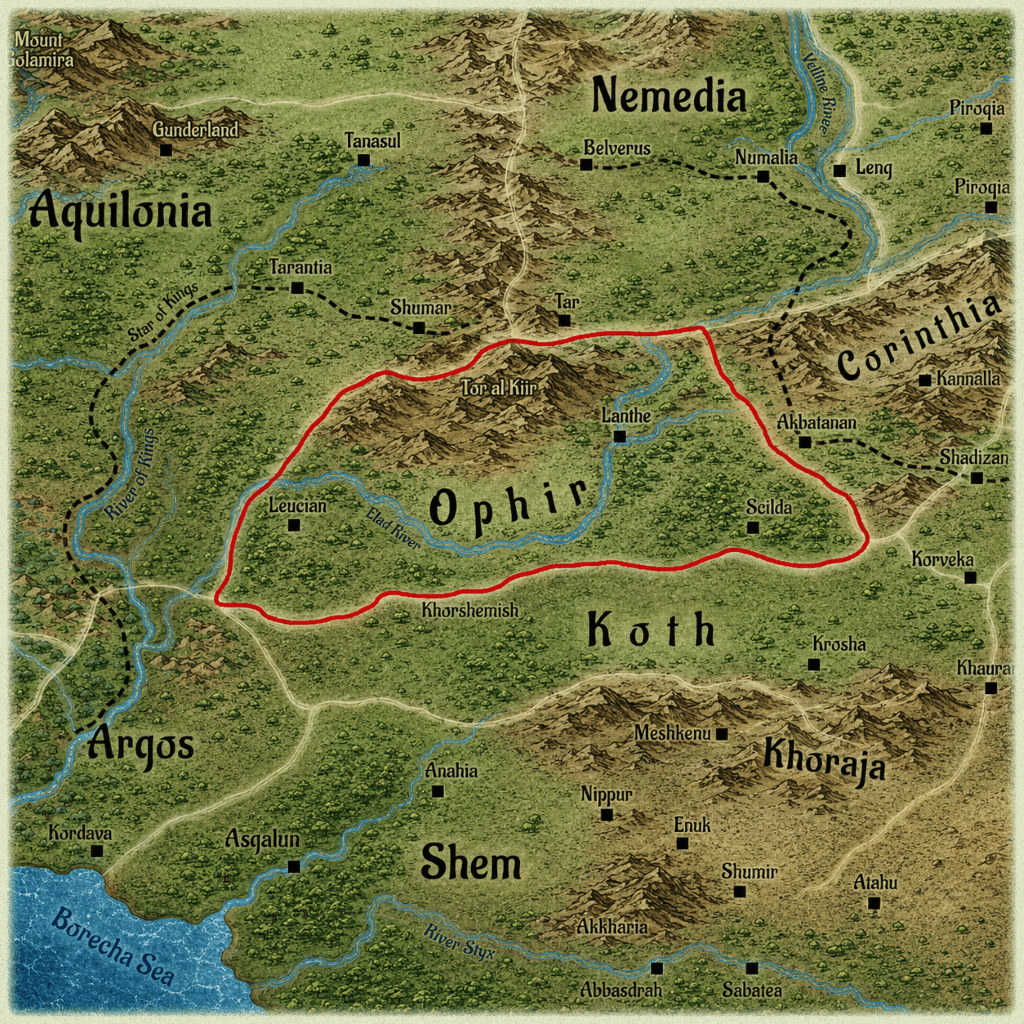

The topography of Ophir transitions dramatically from west to east:
- The Western and Central Regions: A lush, highly fertile landscape characterized by rolling meadows, dense forests, and expansive agricultural plains. The country is meticulously irrigated by an intricate network of placid rivers and freshwater streams. The Ophirean populace heavily utilizes this terrain to cultivate massive grain crops and manage extensive herds of livestock.
- The Eastern Frontier: The fertile plains end abruptly as the terrain rises sharply into rugged, jagged mountain ranges that form a natural defensive wall bordering the kingdom of Corinthia. These eastern peaks are incredibly rich in mineral deposits, particularly gold and silver.
Major Waterways and Regional Fields
Ophir's immense wealth and agricultural sustainability are driven directly by its vital rivers and historic lowlands:
- The Tybor River: This massive, placid river forms the official northern geopolitical border separating Ophir from the empire of Aquilonia. Deep, wide, and remarkably calm, the Tybor is a major commercial highway experiencing heavy merchant boat traffic. Because of its depth, it cannot be easily forded; travelers and caravans traditionally cross the river via heavily guarded ferries at Shamar, a fortified Aquilonian border city.
- The Plain of Shamu: Located directly south of the Tybor River, this sprawling, sun-drenched meadowland serves as Ophir’s premier pastoral zone. It is a vital economic engine for the kingdom, carpeted in rich grasses perfect for herding livestock and staging cavalry maneuvers.
- The Red River: A major internal tributary of the great Khorotas River system. This scenic waterway snakes through the heart of the kingdom, providing essential freshwater to the capital metropolis built upon its banks.
The Imperial Capital and Provincial Fiefdoms
Ophir is organized into a tight feudal network of counties, baronies, and crown fiefs. The kingdom's political landscape is famous for its heavily populated urban centers and specialized provincial industries:
┌─────────────────────────────────────────────────────────────────┐
│                    THE URBAN CENTERS OF OPHIR                   │
├───────────────────┬────────────┬────────────────────────────────┤
│ CITY / REGION     │ POPULATION │ STRATEGIC SIGNIFICANCE         │
├───────────────────┼────────────┼────────────────────────────────┤
│ Ianthe            │ 21,600     │ Imperial Capital of the Realm  │
│ Mecanta           │ ~15,000    │ Military March, Elite Arbalests│
│ Vendishan         │ 12,339     │ Major Commercial Capital       │
│ Frosol            │ >12,000    │ Massive Agrarian Powerhouse    │
│ Lodier            │ ~11,000    │ Powerful Southern Barony       │
│ Terson            │ >10,000    │ Crown Gold-Mining Fiefdom      │
│ Theringo          │ N/A        │ Historic Battlefield Plain     │
└───────────────────┴────────────┴────────────────────────────────┘
Ianthe
Ianthe is the glittering capital city of Ophir. Straddling the banks of the Red River, it is an architectural marvel renowned across the continent for its majestic skyline of soaring towers and grand domes heavily ornamented with precious metals. The city’s residential houses are uniformly roofed with distinctive red tiles, with the taller estates easily visible rising over the massive outer defensive walls.
The Royal Palace of Ianthe is a formidable structure, built directly upon the fortified stone ruins of the kingdom's original ancient citadel. The city boasts a population of 21,600 citizens and maintains absolute economic dominance over eight surrounding satellite towns that owe direct fealty to the King of Ophir. Among its bustling entertainment districts sits The Wild Boar, a famous and highly frequented tavern.
Mecanta
A powerful, heavily militarized county situated near strategic border zones. Housing nearly 15,000 residents in its capital, Mecanta is governed by exceptionally influential counts. The region is militarily famous for its specialized tactical doctrine, pioneering the deployment of deadly, guerrilla-style arbalesters (heavy crossbowmen) who specialize in defending the rugged countryside from foreign invaders.
Vendishan
A prominent and wealthy jurisdiction categorized as either a county or a barony. Its urban capital, also named Vendishan, is a bustling hub of 12,339 residents, supported directly by the labor, taxes, and resources of four dedicated agricultural towns.
Frosol
A massive, highly prosperous agrarian county. The region is incredibly dense, boasting an impressive six towns within its immediate fiefdom. The capital city of Frosol reflects this regional wealth, housing a thriving population of more than 12,000 citizens.
Lodier
A highly stable southern Ophirean barony. The domain includes four highly organized manufacturing and farming towns that answer directly to the capital city, which is home to nearly 11,000 Ophireans.
Terson
Terson is a wealthy, heavily guarded barony nestled deep within the mineral-rich eastern mountains. More than 10,000 people reside within its collective manors, processing camps, and support villages. The primary economic engine of this fief relies entirely on four specialized industrial towns whose populations labor unceasingly within the deep, lucrative crown gold mines.
Theringo
Theringo is a historic county built upon a vast, open plain. Two hundred years ago, this region was the site of the legendary Battle of the Hundred and One Swords, a bloody conflict that defined the modern boundaries of the realm. While the old castle of Theringo now stands as a crumbling, uninhabited ruin and no centralized capital city remains, the territory is still highly valuable—four surrounding agricultural towns continue to faithfully owe their taxes and martial fealty to the Count of Theringo. The region is also politically famous as the ancestral birthplace of Queen Marala’s noble bloodline.

The Fractious Feudal Structure
Ophir operates as a classical feudal kingdom, sharing a structural blueprint that is fundamentally identical to Aquilonia's. However, beneath the gleaming, gold-chased surface of its architecture lies a volatile, deeply fragmented political landscape.
Unlike the highly unified and ordered legalism of Nemedia, or the fierce nationalist pride that bonds Aquilonia, Ophir is a highly fractured realm. It is subdivided into a chaotic patchwork of numerous semi-independent fiefs, sub-fiefs, baronies, and counties.
                         [ THE GOLDEN THRONE ]
                  (King Ludovic - Aquilonian Vassal)
                                  │
         ┌────────────────────────┴────────────────────────┐
         ▼                                                 ▼
[ COUNTS & BARONS ]                               [ MILITARY COMMAND ]
• Fragmented Local Powers                         • Gilded Knights (Star Emblem)
• High Civic/Judicial Autonomy                    • Professional Arbalesters
• Enforce Quotas & Collect Taxes                  • Focus on Border Security
         │                                                 │
         └────────────────────────┬────────────────────────┘
                                  ▼
                        [ THE POPULACE & LAND ]
              (Fiefs and sub-fiefs bound by rigid quotas)
- Fragmented Aristocracy: Real day-to-day power rests in the hands of a treacherous, intensely greedy aristocratic class. Local counts and barons exercise supreme civil, judicial, and military authority within their respective boundaries.
- Feudal Functions: These provincial rulers administer high and low justice, command regional garrisons, and extract heavy agricultural and mineral quotas from the populace—all ostensibly performed "in the name of the King," though usually served to advance their own personal agendas.
A History of Royal Treachery
The kings of Ophir are historically infamous throughout the Hyborian kingdoms for their weak leadership, effeminacy, and utter lack of political honor. The throne is consistently occupied by monarchs who prefer backstabbing, ransom, and geopolitical betrayal over open, honorable warfare.
Timeline of Modern Ophirean Rulers
Pre-Conan Era: Reign of King Moranthes II
A weak, highly effeminate ruler who relied entirely on his strongest barons to maintain his grip on power. Moranthes II committed multiple historical atrocities:International Double-Cross: He treacherously captured the rightful ruler of Khoraja, holding him for an exorbitant ransom and threatening to sell him to the sinister kingdom of Koth.
Domestic Cruelty: He imprisoned his own wife, Queen Marala, citing lewd behavior among his courtiers during his absence from the capital.
Filial Betrayal: He callously sold his own daughter, Princess Olivia, into slavery because she refused an arranged political marriage to a prince of Koth.
Early Reign of Conan: Reign of King Amalrus
Following the pattern of his predecessor, Amalrus was a weak monarch whose own brother openly fought him for the right to wear the crown. His reign was defined by a cataclysmic geopolitical betrayal:The Aquilonian Betrayal: He broke Ophir's long-standing alliance with Aquilonia, secretly siding with Koth to ambush King Conan. He successfully captured Conan and marched Ophirean troops into Aquilonian territory before the tide of war ultimately turned against him.
Present Era (2026): Reign of King Ludovic
The current ruler of Ophir. Stripped of the nation's former geopolitical independence due to the disastrous betrayals of past monarchs, Ludovic rules not as a sovereign king, but as an Aquilonian vassal-king. The Golden Throne now answers directly to the imperial dictates of Aquilonia.
The Nobility: Opulence and Cruelty
The noblemen of Ophir mirror the treacherous and grasping nature of their kings. They are universally driven by a bottomless greed for gold and a total disregard for the lives of the lower classes who enrich them.
- Tyrannical Rule: The lengths to which the nobility will go to secure their wealth is exemplified by Baron Rigello, a cousin to King Moranthes II. When a severe drought prevented the peasants of his fief from delivering their mandatory quotas of crops, Rigello ordered ten entire villages to be burned to the ground as a warning to the rest of his subjects.
- Aristocratic Attire: Ophirean nobles dress in the absolute height of decadent luxury. They walk the marble halls of Ianthe draped in shimmering silks and heavy cloth-of-gold, their garments lavishly ornamented with gleaming, expertly cut jewels. At their hips, they carry slender, elegant swords designed for dueling rather than the brutal frontline butchery of northern broadswords.
The Military: The Gilded Knights
The pride of Ophir's martial strength lies in its heavy cavalry. While the nobility may be corrupt, the knights of Ophir are an imposing, highly disciplined force on the battlefield, easily recognized across the continent by their uniform, brilliant panoply.
    ▲   [ PLUMED HELMET ] ──► Towering feathers colored by house
   /__\
   (OO) [ GILDED MAIL ] ────► Highest-grade iron mail dipped in real gold
  /[  ]\
 //|  |\\ [ STAR EMBLEM ] ──► Star-shaped heraldry stamped on tabard and shield
- Gilded Armor: Reflecting the kingdom's immense mineral wealth, Ophirean knights ride into battle wearing heavy suits of iron or steel mail that has been magnificently gilt with real gold.
- Heraldry and Trappings: Their armor is topped with high, brilliantly colored plumed helmets that dance in the wind. Both their silken tabards and the caparisons of their warhorses proudly bear the traditional star-shaped emblem of Ophir, a universal symbol of their chivalric status and military allegiance.

The Rural Divide: The Country Folk
In stark contrast to the shimmering, gold-plated aesthetics of the capital, the rural populace of Ophir lives a harsh existence under the thumbs of greedy feudal lords. This intense economic pressure has forged a distinct regional temperament.
- Surly Isolationism: The country folk of Ophir are notoriously silent, suspicious, and surly. Generations of enduring tyrannical noble quotas and sudden border conflicts have left them deeply distrustful of outsiders, mercenaries, and traveling adventurers.
- The Monosyllabic Wall: When approached by strangers or questioned about local geography, movements, or politics, an Ophirean peasant is highly unlikely to offer an open conversation. During times of civil unrest, this defense mechanism hardens completely. Inquiries are almost universally met with simple grunts, curt head shakes, or tight, monosyllabic replies meant to drive the traveler away as quickly as possible.
The Urban Class Structure
In the major metropolitan hubs and fortified provincial seats, Ophirean society transforms into a highly stratified, hyper-civilized hierarchy. The social classes of Ophir mirror those of Aquilonia in almost every structural respect.
| Class | Expectations & Lifestyle |
|---|---|
| The Aristocracy | Draped in silks, gold cloth, and jewels; entirely obsessed with court intrigue and duels. |
| The Gentry | Landowners, wealthy merchants, and mining overseers balancing nobility and trade. |
| The Clergy & Academics | Scribes, scientists, and architects mapping city domes and metallurgical advances. |
| The Guild-Masters | Elite artisans, armorers, and weaponsmiths who engineer high-tension steel arbalests. |
| The Peasantry & Serfs | Farmers, miners, and herders bearing the heavy financial burden of royal quotas. |
Ancient Antiquity and Supreme Wealth
Ophir is an extraordinarily old realm, pre-dating the founding of neighboring giants like Aquilonia, Argos, or Nemedia. During the ancient past, Ophir co-existed with the cruel empire of Acheron. For part of that dark era, it operated either as an absorbed territory of Acheron or paid regular tribute to it as a vassal kingdom. This ancient heritage gives the nation a deep, historic foundation.
Over these millennia, Ophir has amassed staggering, legendary wealth. The kingdom sits upon rich mineral veins, and gold flows through its economy like water. The true scale of this treasure was demonstrated when an Ophirean queen once casually offered an entire roomful of solid gold as a reward just for the safe return of a single stolen ring.
Ingenuity and Scientific Reputation
The kingdom maintains a formidable continental reputation for practical science, metallurgy, and engineering. Rather than focusing purely on abstract philosophy, Ophirean minds excel at mechanical and architectural problem-solving. This culture of tactical ingenuity thrives within the workshops of the capital.
In the engineering quarters of Ianthe, inventors successfully created climbing claws. These are specialized, highly resilient mechanical attachments designed to slip onto a rogue's or a soldier's hands and feet to drastically aid in the ascension of sheer stone walls. This environment of active invention regularly draws scouts, siege engineers, and thieves from across the Hyborian kingdoms, all seeking to buy, steal, or replicate the advanced apparatuses crafted behind Ophir's red-tiled walls.
Military Doctrine and Battle Formation
The Ophirean military utilizes a standardized, highly structured formation typical of the grand Hyborian hosts, relying on a calculated, multi-tiered advance to crush enemy lines.
       [ LEFT WING ]                              [ RIGHT WING ]
  (Lighter Cavalry / Gilded Mail)            (Lighter Cavalry / Gilded Mail)
                 │                                          │
                 ▼ Moves in Advance                         ▼ Moves in Advance
  (Infantry Conscripts & Mercenaries)        (Infantry Conscripts & Mercenaries)
                 │                                          │
                 └───────────────────┬──────────────────────┘
                                     │
                                     ▼ Creates Opening
                          [ THE CRUSHING CENTER ]
                        (Elite, Gold-Gilt Knights)
                        (Enormous Armored Destriers)
The Tactical Wings
The wings form the outermost sections of the army. They are composed of lighter cavalry units clad in magnificent gilded mail. Depending on the engagement, these cavalry units are heavily supported by defensive infantry conscripts and specialized mercenary archers. The wings are deployed to move forward in advance of the rest of the host, attempting to harass, flank, or pin the enemy army.
The Mounted Core
Once the wings have engaged and created an opening, the secondary cavalry units move in to press the advantage.
The Crushing Center
The absolute strongest, most devastating section of the Ophirean army is its center. This core is comprised entirely of the elite, heavily armored knights of the realm. Wearing full suits of gold-gilt armor and sporting tall plumed helmets, these noble warriors ride into battle atop enormous, heavily armored warhorses, serving as an unstoppable iron fist to smash through the center of the enemy formation.

The people of Ophir possess a distinct, elegant look that sets them apart from the pale-skinned inhabitants of northern realms like Nemedia, as well as the ruddier, broader complexions of neighboring Aquilonians.
       [ THE OPHIREAN PHYSIQUE ]

        ( Hair )  ► Deep Black / Dark Brown
           │
        ( Eyes )  ► Shimmering Brown or Green
           │
        ( Build)  ► Lean, Athletic, and Lithe
           │
        ( Skin )  ► Richly Tanned / Olive
- Coloring and Features: Ophireans are universally dark-haired, with thick locks ranging from deep brunette to raven black. Their eyes are predominantly shades of warm brown or striking green, contrasting vividly against their skin.
- Physique: They typically boast lean, agile bodies rather than bulky, heavily muscled frames. This lithe athleticism is highly valued, influencing both their fighting styles and the cut of their clothing.

Fashion in Ophir is used intentionally as both a status symbol and a practical tool for societal manipulation.
Merchant Fraudulence
Within the bustling markets of Ianthe and regional trade hubs, wealthy merchants favor massive, voluminous robes complete with deep, oversizing hoods. Far from a simple fashion choice, these billowing garments are intentionally chosen to help cozen unsuspecting customers. The expansive fabric easily conceals slight of hand, hidden measuring weights, and doctored ledger slips, allowing merchants to swindle buyers right before their eyes.
Servants and Status
The serving class is instantly recognizable by their specialized, utilitarian smocks. The fabric, coloring, and overall tailoring quality of these garments are completely dependent upon the rank of the master they serve. A servant tied to a minor provincial baron wears coarse, roughly stitched cloth, while a domestic servant serving a high count or royal family wears finely tailored linen smocks stamped with noble house crests.

Ophirean society mirrors the highly stratified, civilized gender dynamics found within Aquilonia. While the culture remains structurally patriarchal, it offers unique avenues of authority compared to more oppressive eastern and southern kingdoms.
For the vast majority of the population, traditional labor divisions apply. Women are largely tasked with balancing domestic industries, including spinning, weaving, sewing, and running household economies. In urban environments, trade guilds remain tightly restricted, meaning common women usually enter these professional spaces through their husbands' credentials.
Exceptional Liberties of Noble Women
Because Ophir treats land and wealth as the ultimate measures of authority, high-born women enjoy significant legal and political advantages.
- Feudal Land Ownership: Aristocratic women frequently receive substantial estates, castles, and titles as marital gifts or direct inheritances. Unlike women in neighboring Koth, an Ophirean lady is considered a fully vested feudal lord over her property.
- Judicial and Military Power: Wealthy landholding women possess the legal right to settle disputes among lower vassals, manage structural fief budgets, and even field their own private armies, leading their personal banners directly into geopolitical conflicts when necessary.
- The Mitran Path: For noble women of independent wealth who choose to remain single, the clergy of Mitra provides an honorable, highly respected alternative to arranged marriages, granting them high academic and societal autonomy.

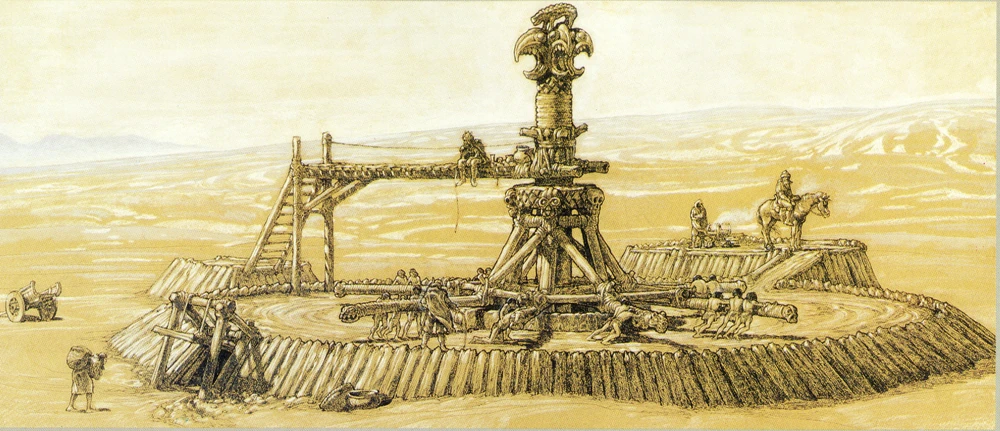 While neighboring Aquilonia prides itself on a more restricted, legally bounded approach to servitude, Ophir embraces slavery as a widespread, completely normalized economic pillar. In the minds of the Ophirean upper classes, human lives are fundamentally no different than the gold veins running through their mountains—simply another resource to be mined, traded, and liquidated for liquid capital.
- The Ultimate Opportunism: Treachery and financial greed run so deep within the cultural DNA of the Ophirean aristocracy that traditional family bonds offer no protection. Nobles routinely view their own flesh and blood as economic collateral. If a lord finds himself in sudden debt, facing a bad harvest, or requiring immediate funding for a political scheme, he will not hesitate to sell his own children directly into the slave markets for the right price. This was famously demonstrated when King Moranthes II sold his own daughter, Princess Olivia, to Kothi flesh-merchants when she defied an arranged marriage.
- The Aristocratic Ransom Market: Captivity is a highly lucrative industry at the highest levels of society. Rather than fighting honorable wars or settling political disputes through legal arbitration, Ophirean nobles actively plot the capture and kidnap of competing aristocrats. Rival lords, counts, and even foreign rulers are routinely held in hidden dungeons, their captors demanding astronomical ransoms to fund their own lavish lifestyles, private mercenary banners, or courtly ambitions.
Prostitution and the Courtly Vice Economy
The pervasive philosophy of finding profit in any situation directly shapes Ophir's massive vice industry. In a kingdom where gold is the supreme authority, the human body is heavily commodified.
Street-Level and Tavern Brothels
In the crowded lower wards of Ianthe and the bustling commercial districts surrounding the mining hubs, prostitution is a highly visible, heavily taxed trade. Brothels cater directly to foreign caravan guards, mercenary archers, and local tradesmen. These establishments operate openly under the watchful eyes of municipal overseers, who ensure that local barons receive their mandatory cuts of the profit.
The Decadence of the High Courts
In the gilded estates of the nobility, the line between courtly companionship, political espionage, and prostitution blurs entirely.
| Venue | Clientele | Nature of the Trade |
|---|---|---|
| Gilded Court Salons | Royal courtiers, foreign ambassadors, high barons | High-class courtesans trained in rhetoric, music, and statecraft; used as political tokens. |
| Urban Brothels | Merchants, guild-masters, wealthy travelers | Registered houses producing heavy tax revenue directly for regional counts. |
| Dock and Tavern Dens | Mercenaries, sailors, rural laborers | Rough, dangerous venues where indentured or enslaved workers labor under brutal oversight. |
As seen during the scandalous reign of King Moranthes II, the royal courts are notorious for rampant, opportunistic hedonism. Noble courtiers regularly utilize sexual favors, secret trysts, and carefully engineered compromises to secure titles, trade monopolies, or military exemptions from weak rulers. In the high salons of Ophir, intimacy is treated exactly like a merchant's voluminous robe: a beautiful facade used to cozen a partner, extract wealth, and seize a sudden political advantage.

The entire economic foundational base of Ophir relies completely on heavy extractive industry. Massive gold ore reserves and highly valuable mineral deposits are pulled day and night out of the rugged eastern mountains, satisfying the kingdom's obsession with precious metals.
       [ THE EASTERN MOUNTAINS ] ──► Continuous extraction of gold & minerals
                  │
                  ▼
         [ METALLURGIC HUBS ] ────► Refined into bullion, jewelry, and gilt mail
                  │
                  ▼
       [ THE DIPLOMATIC MARKET ] ─► Traded via treaties to bypass global trade routes
Despite sitting on these immense physical veins of treasure, Ophir is hardly the wealthiest or most prosperous of the Hyborian realms. The kingdom faces a critical geographical vulnerability: it is relatively small, and many of the continent's most lucrative international trade routes bypass little Ophir entirely.
To survive and keep their economy afloat, Ophireans aggressively chase treaties and exclusive trading agreements with foreign superpowers like Aquilonia, Nemedia, and Koth.
Treachery as a Diplomatic Art
Because Ophir lacks the sheer geographic size and massive agricultural surplus of its larger neighbors, the kingdom relies heavily on fluid alliances, political maneuvering, and cutthroat opportunism.
- The Pragmatic Betrayal: The treacherous Ophireans have zero concept of permanent national loyalty. When a geopolitical crisis arises, the crown and the high nobility will invariably side with whichever faction offers the most immediate advantage, whether that comes in the form of raw coin, military protection, or lucrative trade monopolies.
- The Statecraft of the Elite: Because words are just as vital to the kingdom's survival as swords, diplomacy is regarded as a supreme, highly sophisticated art form. Ophir’s kings, counts, and barons are usually superb diplomats, universally trained from youth in the complex arts of negotiation, honeyed rhetoric, and psychological leverage. They use this silver-tongued talent to manipulate foreign courts, secure vital economic treaties, and mask their own internal plots.
Common Professions of the Realm
Ophir's specialized economic focus on mining, luxury goods, and political defense supports a highly distinct array of urban and regional professions.
| Profession | Economic & Societal Role |
|---|---|
| Miner | The foundational bedrock of the kingdom's economy. These laborers toil in the dangerous, deep subterranean shafts of the eastern mountains to extract raw gold ore and precious stones. |
| Jeweller | Master artisans who refine the raw mountain yields, crafting the highly complex, gem-encrusted ornaments, signet rings, and luxury baubles demanded by the decadent aristocracy. |
| Alchemist | Specialized chemical engineers highly valued for their practical knowledge of metallurgy, acid refining, and the creation of specialized formulas, including the compound coatings used for the kingdom's gold-gilt mail. |
| Merchant | Shrewd, aggressive traders who navigate international markets, utilizing their voluminous hooded robes to hide slight of hand while brokering imports to offset Ophir's small domestic territory. |
| Scribe | Essential administrative professionals tasked with drawing up intricate mining registries, managing financial ledgers, and drafting the highly complex, delicate international trade treaties required by the crown. |
| Knight | Elite, noble-born heavy cavalrymen who protect the aristocratic estates, enforce the extraction of resource quotas from the peasantry, and lead the charge in gilded plate armor. |
| Soldier | The rank-and-file infantrymen, city watchmen, and specialized border arbalesters tasked with guarding the vulnerable mountain passes and keeping foreign raiding hosts at bay. |

Ophir serves as a cultural bridge between the northern Hyborian kingdoms and the exotic civilizations of the south. Because of this constant contact with Kothian and Shemite cultures, Ophir is significantly more religiously tolerant than its rigid, monolithic neighbors. While the state religion remains the veneration of Mitra, the worship of Ishtar has woven itself deeply into the kingdom's social fabric.
The Cult of Mitra: Stately and Severe
The Ophirean Mitran faith holds Mitra as the one true god, offering a structured spiritual path that features a clear concept of heaven, hell, and the finality of divine judgment.
- Architectural Philosophy: Mitran temples in Ophir are designed to be stark, symbol-free, and stately. They are almost plain in their lack of ornamentation, yet they project a powerful, undeniable spiritual presence that dominates the urban skyline.
- Theology of Representation: The Mitrans strictly forbid the sacrifice of animals or men. Furthermore, they profess no knowledge of Mitra’s true appearance. If a statue of the god is present within a temple, it is understood by the faithful to be a mere symbolic attempt to visualize a divine nature that is otherwise incomprehensible to the human mind.
The Cult of Ishtar: Exotic and Sensuous
Imported from the lands of Shem, Ishtar is venerated in Ophir as a multifaceted goddess of sexuality, fertility, and war. Her presence provides a vibrant, indulgent contrast to the austerity of the Mitran temples.
- Temple Aesthetics: Unlike the stark Mitran halls, the temples of Ishtar are incredibly ornate and lavish. They are filled with ivory idols that the faithful believe are truly inhabited by the goddess herself.
- The Ritual of the Idols: The priests and priestesses perform daily care for these idols, meticulously painting and dressing them to suit the specific ritual needs of the season.
- Supplication: Followers of Ishtar are expected to show absolute humility. When entering the inner sanctums, supplicants must approach the idols while entirely naked and on their knees.
- Sacrificial Rites: While the Ophirean iteration of the faith completely disdains and prohibits the human sacrifice found in more savage, darker cults, it continues to practice the traditional ritual of animal sacrifice.
Comparative Religious Overview
| Feature | The Cult of Mitra | The Cult of Ishtar |
|---|---|---|
| Primary Domain | Justice, Light, Right Living | Sexuality, Fertility, War |
| Temple Style | Stately, symbol-free, plain | Ornate, lavish, exotic |
| Idolatry | Symbolic representation only | Goddess believed to inhabit idols |
| Sacrifice | None permitted | Animal sacrifice practiced |
| Attitude | Severe, disciplined | Sensuous, humble (naked supplication) |
The Shadow of Acheron
Ophir’s religious landscape is also shaped by its profound age and history. As one of the older kingdoms that had been subject to the dark kings of Acheron, Ophir carries the echoes of a prehistoric past. When the Acheronian Empire fell, these lands regained their independence, but the ancient contact with that dark, sorcerous civilization helped solidify the kingdom's pragmatic approach to faith—allowing the people to embrace the light of Mitra while remaining open to the sensuous rites of Ishtar, viewing the latter as a far preferable alternative to the demon worship that haunted their Acheronian ancestors.

To play an Ophirean is to embody the opulent, calculating, and heavily armored spirit of one of the world's most financially prosperous kingdoms. You are a product of a land where gold flows as freely as water, where cities gleam with metal-clad domes, and where knights ride in gilded panoply. Whether you are a proud noble from the towers of Ianthe, a deadly arbalester from the marshes of Mecanta, or a hardened overseer from the gold mines of Terson, you understand the power of wealth, leverage, and fine craftsmanship. You view northern Hyborians as unrefined, rough-hewn warriors and southern nations as alien cultures, positioning yourself proudly as a master of sophisticated commerce, deep chivalric tradition, and unmatched monetary influence.
Core Identity
- Race: Hyborian (Ophirean). Typically of average height with a refined, civilized build. Complexions lean toward smooth olive tones, showing the physical traits of a prosperous, well-fed central kingdom.
- Language: Ophirean (A highly polished, courtly tongue that uses elaborate titles and commercial vocabulary, heavily interspersed with financial terms, legalisms, and diplomatic phrasing).
- Hair Color: Predominantly dark brown, chestnut, or glossy black, kept immaculately groomed and oiled according to high-society fashion.
- Eye Color: Expressive shades of amber, dark brown, or striking hazel.
- Names: Melodic, elegant, and ancient, carrying a smooth, classical Western weight.
- Male: Almuric, Frosolo, Lodierus, Maralo, Mecantus, Terson, Vendis.
- Female: Marala, Ianthe, Chelina, Sola, Valeria, Zenobia.
Personality and Archetypes
Ophireans balance a deep, chivalric devotion to feudal duty with an intense, practical appreciation for material wealth, luxury, and tactical resourcefulness.
- Gilded Pride: You value tangible wealth and aesthetic beauty. To you, fine armor, gold-ornamented weapons, and rich fabrics are not vain distractions—they are a mandatory broadcast of your personal power, station, and competence.
- Chivalric Professionalism: You take your feudal contracts and military vows seriously. You respect the rules of engagement, processional hierarchy, and knightly honor, expecting both allies and enemies to adhere to proper rules of conduct.
- Tactical Pragmatism: While you appreciate grand chivalric charges, you are highly practical in war. You do not scorn defensive architecture, heavy crossbow tactics, or guerrilla warfare if it successfully protects your valuable territory.
- Commercial Acumen: You possess a natural, baseline understanding of trade, currency value, and contract leverage. You rarely do anything purely out of blind emotion, almost always calculating the potential risk, reward, and long-term cost of an alliance.
Combat Roles and Equipment
Ophirean combatants reject chaotic brawling, prioritizing heavy, gold-chased armor, high-defense shields, and devastating ranged mechanical weaponry.
- The Gilded Knight of Ianthe (Heavy Cavalry): An elite noble warrior who serves as the iron fist of the kingdom. Clad in magnificent, polished steel plate armor chased with gold and silver accents, you ride a heavy, armored destrier, charging enemy lines with a heavy lance and a beautifully crafted broadsword.
- The Mecantus Arbalester (Guerrilla Crossbowman): A specialized ranged tactician from the plains of Mecanta. Wearing practical chainmail brigandine and a steel cap, you utilize a massive, high-tension steel arbalest (heavy crossbow) to punch through enemy plate armor, using terrain and ambush tactics to decimate advancing hosts.
- The Plain Guardian (Shamu Cavalry): A highly mobile, versatile light-to-medium cavalryman tasked with patrolling the vast grasslands south of the Tybor River. Armed with a composite bow, a light shield, and a curved saber, you excel at tracking Aquilonian border raiders and securing trade lines.
- The Mountain Marcher (Corinthian Borderer): A hardy infantryman stationed in the rugged eastern peaks. Armed with a heavy halberd and clad in thick layered leather and scale armor, you are a master of choke-point defense, blocking narrow mountain passes against bandit clans and foreign armies.
Social Rank and Background
Ophirean characters are defined by their allegiance to the crown’s wealthy provinces and their connection to the kingdom's primary industries.
- Terson Gold-Overseer / Master Miner: A trusted administrative professional stationed in the eastern mountains. You manage the logistics, security, and slave labor forces of the kingdom's lucrative crown gold mines, possessing intimate knowledge of subterranean surveying and mineral appraisal.
- Ianthe Court Courtier / Diplomat: A highly polished, silver-tongued aristocrat who navigates the domed palaces of the capital. You excel at reading social cues, drafting alliance contracts, and negotiating with foreign merchants, using your family’s eight satellite towns as political leverage.
- Frosol Agrarian Merchant / Livestock Breeder: A wealthy commoner or minor noble who manages the vast agricultural yields of the Frosol county. You control the flow of vital grain crops and purebred cattle across the Tybor River, trading extensively via the Shamar ferries.
- Theringo Lineage Knight / Ruin Explorer: A descendant of the historic noble families who fought at the Battle of the Hundred and One Swords. With your ancestral castle lying in ruins, you travel the world as a knight-errant, seeking to reclaim your house's lost glory through martial deeds or recovered relics.
- Lodier Guild Blacksmith / Armorer: A highly skilled urban craftsman operating out of the southern baronies. You produce the exceptionally dense steel armor and gold-clad ornamentation favored by the high aristocracy, ensuring every piece you stamp with your guild mark is a masterwork of defense and beauty.
Starting Package
Every Ophirean character begins their journey with a collection of fine, highly valuable equipment that reflects the immense material wealth of their kingdom:
- A set of high-quality clothing appropriate to your station—either a finely tailored silk-trimmed tunic, an embroidered dress matching the fashions of Ianthe, or durable traveling woolens lined with fine leather.
- A pair of beautifully cobbled leather riding boots featuring polished brass or silver buckles.
- A primary weapon of choice forged from pristine Ophirean steel—typically a heavy broadsword, a precise arming sword, or a high-tension crossbow—bearing aesthetic engravings.
- A small pouch of gold leaf, a collection of stamped trade coins minted in the capital, or a official mining/merchant patent scroll.
- A luxury grooming kit containing fine soaps and hair oils, a traveling ration of honeyed grain cakes, and a sturdy leather belt pouch to secure your assets.

While Ophir is a fixture in the "Nemedian Chronicles" and the broader world-building of the Hyborian Age, its specific narrative appearances often occur in expanded fiction:
- The Hour of the Dragon (Robert E. Howard): The primary source for Ophir's historical roots as an ancient kingdom.
- Conan the Triumphant (John Maddox Roberts): Provides significant detail on the geography, the Karpash Mountains, and the castle of Asmark.
- Conan the Rebel (Poul Anderson): Features Kirjahan and western baronies.
- *Marvel/Savage Sword of Conan Comics: These publications extensively expanded the list of Ophirean kings (such as Moranthes II, Amalrus, and Varis) and fleshed out the "Star of Khorala" storyline, which features heavily in Ophirean lore regarding royal rings and ancestral bloodlines.