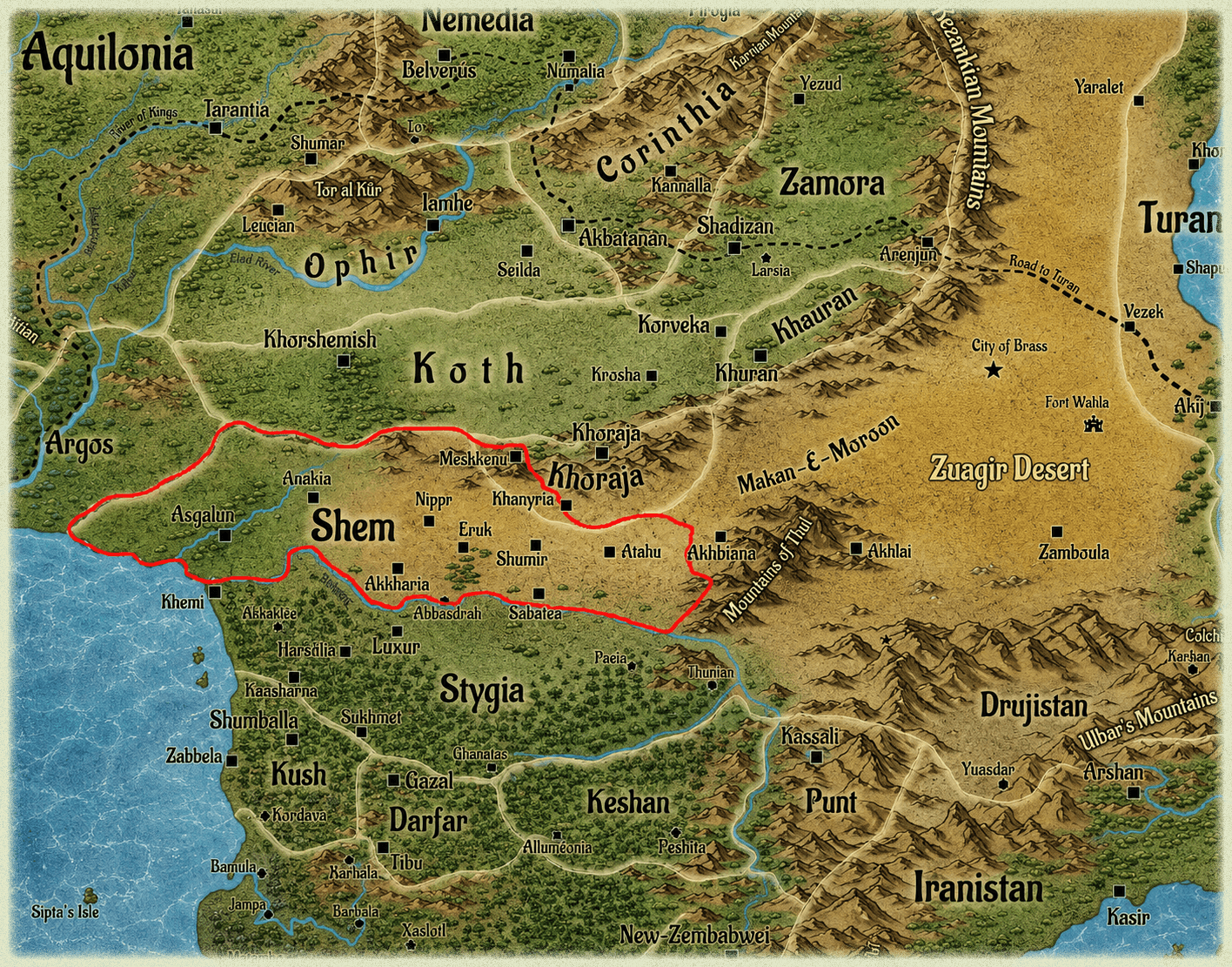

The kingdom's internal border is marked by a chain of hills stretching from the Mountains of Fire (bordering Koth) to the Ford of Bubastes on the river Styx.
- The West: Characterized by lush meadowlands and fertile croplands. This is the heart of Shemite civilization, home to the vast majority of its 34 major city-states, 180 towns, and thousands of villages.
- The East: An expansive desert region composed of shifting dunes, sun-baked mud flats, savannahs, and salt plains. It is a land of ancient ruins, ghost-haunted tombs, and severe isolation.
Notable Landmarks and Ranges
| Feature | Description |
|---|---|
| Mountains of Fire | A volcanic range splintering off the Kezankian mountains; runs south-westerly near Shumir. |
| Pyrrhenian Mountains | Forms the northwestern barrier between the fertile Shemite croplands and the Kothian uplands. |
| Mountains of Desperation | Near-vertical peaks located south of Koth and north of Qjara; a treacherous corridor for caravans. |
| Asgalun River | A critical waterway that splits at Anakia, flowing through the cities of Ghaza and Kyros. |
| Libnum Hills | Strategic heights overlooking Asgalun, traditionally used for sheep herding. |
| Shan-e-Sorkh | "The Red Waste." An extremely arid, waterless eastern desert. |
| Makan-e-Mordan | "Place of Ghosts." A haunted sub-region within the Red Waste; contains the oasis city of Akhlat. |
City-State Dynamics
Shemite society is organized into independent, competitive city-states, each ruled by its own king.
- Political Fragmentation: There is no national law in Shem. Legal systems are entirely determined by local monarchs, meaning a criminal in one city may be a law-abiding citizen in the next.
- Economic Interdependence: Despite constant inter-city warfare, these states are fragile. They rely entirely on the trade routes that snake between them. Each city specializes in a specific output, such as fine wines, advanced weaponry, or nomadic livestock herding, necessitating a precarious peace or uneasy alliance to maintain their economies.
- Urban Aesthetics: The cities are marked by high, gleaming architecture, characterized by white zikkurats and towers that rise starkly against the desert or meadow horizon.
The Historical Echo
The eastern deserts of Shem are dotted with ancient, crumbling tombs and ruins—grim reminders of the era when the dark empire of Stygia exerted its influence over these lands. These silent monuments are frequently half-buried in shifting sands or exposed on the cracked, baking savannahs, serving as a reminder of the shifting power dynamics that have defined the region for millennia.

Shem lacks a centralized government, functioning instead as a collection of independent city-states and autonomous nomadic tribes. This decentralized structure fosters intense competition, ensuring that no single entity holds total sway over the region.
City-State Government: The Theocracy
Shemite city-states are fundamentally theocratic. Secular and religious powers are unified, as the king functions as both a political leader and a priest.
The Role of the Monarch
- Divine Right: Kings trace their lineage to the Great Cataclysm, claiming both historical and religious authority.
- Warrior-Priest: Kings are typically drawn from the warrior class. They are responsible for leading armies, enforcing law, and presiding over religious ceremonies. Many kings are deified within their cities.
- The Queen: The queen often serves as the high priestess or a living personification of the city's patron goddess.
- Methods of Control: While kings are not absolute dictators, some maintain order through the asshuri, a security force used to suppress dissent. Ruthless tactics, including the deportation of rebellious populations into the desert, are occasionally employed.
Administration and Social Structure
The aristocracy manages the city under the king's direction. Their duties are strictly defined:
| Administrative Role | Responsibility |
|---|---|
| Scribes & Functionaries | General governance and record-keeping. |
| Labor Overseers | Drafting commoners for public works and irrigation maintenance. |
| Tax Collectors | Collecting a percentage of crops to feed soldiers and dependents. |
| Council of Elders | Advising the king alongside the priesthood. |
"The priests are charged with maintaining the social status-quo. They tell the commoners their hard labours are necessary because they were created to serve the gods."
Nomad Tribal Government: The Republic
Nomadic tribes reject the concept of sovereign law, operating as republics guided by tradition, consensus, and personal honor.
Laws of Honor and Vengeance
Social order among the nomads is maintained through a rigid adherence to honor. Because there is no central authority to enforce laws, individual behavior is moderated by the collective fear of:
- Dishonor: Bringing shame upon one's family or clan.
- Vengeance: The right of individuals and clans to pursue blood feuds, which can escalate into tribal-wide conflicts.
The Sheiks (Shaykhs)
Leadership among the nomads is elective and merit-based rather than hereditary.
- Selection Process: A council of elders elects a sheik from the family of the previous leader. This process favors reputation and charisma, often sparking violent competition among familial rivals.
- Leadership Style: Sheiks rule by consensus and arbitration. They do not hold dictatorial power and interact with their tribesmen on relatively even terms.
- Democratic Tendencies: The nomads are noted for being among the most democratic people of the Hyborian Age. They are pragmatic, often following charismatic foreign leaders if it results in the acquisition of loot.
"A sheik’s expression of opinion, more often than not, becomes the tribe’s de facto opinion. Such is the esteem in which the sheiks are held."

The culture of Shem is starkly divided between the urban, mercantile lifestyle of the Meadow Shemites and the rigid, survivalist code of the eastern nomadic tribes.
The Meadow Shemites and Pelishtim
Urban Shemites are defined by a pursuit of wealth and beauty. They surround themselves with jewelry, luxury, and slaves, often traveling great distances to acquire these goods through trade or mercenary work.
- Reputation for Deceit: Shemites are widely renowned as unrepentant liars and masters of the tall tale.
- Ethics: There is no universal moral standard. While some follow civilized codes of honor, many do not. The asshuri generally adhere to a mercenary code of honor, but for many urban Shemites, there is no inherent moral compass governing their social interactions.
The Nomadic Code of Honor
In contrast to the urban centers, the nomadic tribes live by a strict, barbaric code where the fear of shame is the primary deterrent against antisocial behavior.
| Value | Definition |
|---|---|
| Shame | The most dreaded outcome. To shame one's family, clan, tribe, or nation is a social death sentence. |
| Honor | The positive counterpart to shame; it must be actively defended. |
| Revenge | The necessary response to an unatoned insult or act of dishonor. |
Social Structures of the Nomads
- The Clan: The fundamental unit of society, consisting of multiple families living in their own tents. Multiple clans form a tribe. Those within a clan are considered blood-kin and automatic allies.
- Allegiance: A nomadic Shemite’s first loyalty is to their immediate family, followed by their clan.
- Patronage: Because the system of revenge can be dangerous for the weak, they seek the guardianship of powerful warriors or sheiks. A patron is honor-bound to protect their ward; any slight against the ward is treated as a slight against the patron himself.
Traditions of Conduct
Hospitality: Shemite nomads are famously generous, often willing to sacrifice their last meal for a guest. Once a stranger is accepted as a guest, they are under the host's protection and treated as an ally.
Note: Asking for hospitality is considered insulting. It must be offered voluntarily.
Water: Water is the most sacred resource. Sharing water is a definitive gesture of trust and friendship.
Revenge and Blood Feuds: Vengeance is a social check against rudeness and violence. Insults can trigger blood feuds that escalate into full-scale tribal wars, often requiring a third party to negotiate a blood price to restore peace.
"The nomads are polite and honourable toward the weak, lest their patrons enact revenge."
Allegiances and Social Expectations
For those Shemite nomads adhering to the code of honor, three allegiances are considered mandatory:
- Family: First and foremost.
- Clan: The primary social and protective unit.
- Guests: Once hospitality is extended, the guest is a protected ally.
Failure to observe these values can result in being stripped of tribal status or outright exile—a sentence that is usually fatal in the harsh desert environment.

The appearance of the Shemites is distinct, characterized by sharp features and a style of dress adapted for both the heat of the desert and the prestige of the urban city-state.
Shemites are generally of medium height, though distinct regional variations exist. Those of the borderlands who have interbred with Stygian bloodlines often possess a noticeably taller stature.
- Facial Features: They are known for their sharp, hooked noses and dark, piercing eyes.
- Hair: Their hair is characteristically raven-black, often possessing a deep, blue-toned sheen.

Shemite attire is designed for the arid environment, balancing protection against the sun with the display of status. Wealth and social position are visually communicated through the quality and craftsmanship of one's garments.
Nomadic Male Attire
The traditional dress of the desert tribes is both practical and symbolic:
- Khilat: A white, girdled robe featuring full, open sleeves. It is typically crafted from linen, cotton, or silk.
- Breeches: Worn beneath the robe, providing comfort and mobility.
- Head-dress: A flowing cloth that falls to the shoulders, secured at the temples with a kafieh—a triple circlet of braided camel-hair.
- Cloaks: Heavy outer layers made of woven camel hair, essential for survival against desert temperature shifts.
- War-Gear: Many nomads favor turbans wrapped tightly around spired helmets for protection in combat.
Female Attire
- Chadors: Women typically wear these full-body robes, which include integrated hoods and veils. These garments provide protection from the harsh sun and sand while maintaining the modesty expected in Shemite society.
Indicators of Status
In Shemite culture, clothing acts as a ledger of a person's standing within their tribe or city-state:
- Embroidery: The density and intricacy of embroidery on the khilat or kafieh serve as a primary indicator of wealth and social rank. A more heavily decorated garment identifies the wearer as a person of greater consequence.
- Fabric Choice: The use of finer materials like silk versus common linen denotes the distinction between the wealthy aristocracy and the common peasantry or nomadic clansmen.
For a detailed breakdown of regional variations and specific tribal patterns, see Shem – Gateway to the South.

Gender roles in Shem are sharply divided between the sedentary, urban Meadow Shemites and the mobile, communal lifestyle of the nomadic tribes.
Meadow Shemites
In the city-states, society is patriarchal, with women occupying a subordinate position. While they possess specific legal and economic rights, their safety is perpetually tethered to the military strength of their city.
- Legal and Economic Standing: Women may own property, conduct business, and engage in trade. They hold the specific right to designate which son receives their personal inheritance.
- Domestic Expectations: A woman's primary duty is to manage the household, bear children, and defer to her husband. Marital conduct is strictly scrutinized; a woman must avoid public displays of independence or mocking her husband, as such behavior provides grounds for divorce.
- Vulnerability: Women are viewed as potential spoils of war, serving as sexual rewards for soldiers. This cultural perspective renders them perpetually vulnerable; they can be sold by male relatives to satisfy debts or seized as concubines during conflict. Consequently, women remain heavily dependent on the protection of the city-state's armed forces.
Nomadic Shemites
The tribal environment fosters a more egalitarian structure, where women function as essential partners in the survival of the clan.
- Domestic Partnership: Women are central to the nomadic economy. They are responsible for the construction and maintenance of tents, the tending of livestock, weaving, clothing repair, and food preparation.
- Social Freedom: Nomadic women are not secluded. They enjoy the freedom to move about and interact with men without social stigma. They are influential figures whose advice is regularly sought during clan councils, and many are recognized as poets and keepers of tribal lore.
- Marital Norms: Women are permitted to marry multiple times. Their independence is bolstered by the strict nomadic code of honor; men are bound by this code to protect the women of their clan.
- Martial Participation: While rare, women who demonstrate the necessary aptitude may train as raiders and warriors.
- Vulnerability: Despite their higher status, nomadic women remain susceptible to the perils of desert warfare. Any woman captured during a raid is legally transformed into the property of the victor, effectively becoming a slave.
Comparison of Status
| Feature | Meadow Shemites | Nomadic Shemites |
|---|---|---|
| Social Status | Subordinate; dependent on state protection | Full partners in tribal survival |
| Mobility | Limited/Home-focused | High; move freely without shame |
| Influence | Limited to domestic/business spheres | Influence in councils and tribal policy |
| Marital Rights | Subject to divorce for perceived slights | Can marry more than once |
| Warfare | Excluded; viewed as spoils of war | Rare women may serve as raiders/warriors |

Slavery is a foundational pillar of Shemite society and economy. The Shemites are notorious across the Hyborian Age for their active participation in the slave trade, both as captors and merchants.
The Slave Economy
In most western Shemite city-states, slaves constitute the majority of the population and perform virtually all manual labor. The city-states rely on this forced labor to maintain the complex infrastructure required for their survival.
- Public Works: Slaves are tasked with the grueling labor of maintaining the shadufs, canals, reservoirs, and dykes essential for meadowland agriculture. They are also the primary workforce for constructing temples, palaces, and urban fortifications.
- Domestic and Specialized Roles: Private citizens own slaves for domestic chores. Beyond labor, slaves function as artisans, weavers, millers, and porters.
- The Pleasure Trade: Many slaves are kept as concubines, dancing girls, or "pleasure girls" to satisfy the decadent desires of the Shemite populace.
- Legal Standing: Despite their status, slaves have surprising legal capacities; they may hold property, borrow money, marry free citizens, conduct business transactions, and eventually purchase their own freedom.
Sources of Enslavement
Slaves are acquired through a variety of methods, both foreign and domestic:
- Raid and Trade: Shemite slavers actively prowl the Black Coast in specialized ships, raiding for captives to sell on the auction blocks found in nearly every Shemite city.
- Debt and Family: A Shemite in debt may settle his obligations by selling his wife or children into temporary slavery. A man may even sell himself into slavery to clear his debts.
- Disobedience: Children who disobey their parents face the risk of being sold into servitude.
- Warfare: Captives taken in war or dispossessed farmers form a large portion of the enslaved population.
Treatment and Legal Status
The treatment of a slave is dictated largely by their origin.
- Foreign vs. Domestic: If a slave is a fellow Shemite, their servitude is legally classified as temporary. If the slave is a foreigner, their condition is often permanent, and they may be treated as little more than domesticated animals.
- The Pelishtim Custom: Among the Pelishtim, there is a specific legal tradition where most slaves can earn their manumission through service, typically within a three-year term.
- Punishment: Masters exercise absolute authority over their slaves. Punishments for defiance or escape attempts are brutal; for instance, the amputation of an ear is a standard penalty for those who attempt to flee.
- The "Inferiority" Justification: Shemites justify the institution by claiming their victory over the enslaved is divine proof of the captives' inherent inferiority.
"Hyborian women dread slavery in Shem, where the depraved desires of the decadent Shemites shame and humiliate them."
Vulnerability
No one is entirely safe from the slave block. While the Shemites are prolific slavers, they are also targets themselves. The Black Corsairs frequently raid the Shemite coast, and historical accounts note that even founders of cities in the Black Kingdoms utilized Shemite slaves.

Trade is the lifeblood of Shemite society. The nation functions as a commercial engine, utilizing extensive caravan routes to bridge the gap between disparate regions. Because Shem’s coastline offers few natural harbors, overland routes are the primary arteries of commerce.
Urban Commerce: The Meadow Shemites
The city-states of western Shem specialize in manufacturing goods, sustaining their economy through the constant movement of camel trains.
The Dam-gar
The merchants of the cities are known as dam-gar. Their role is multifaceted and high-stakes:
- Temple Agents: Some work as specialists hired by the temples to negotiate trade on behalf of the priesthood.
- Independent Entrepreneurs: Others operate privately, buying and selling surplus goods for personal gain.
- Financial Role: They manage loans and credit, often operating out of the karum, the designated trade district of a city-state.
- The Risk of Recession: Trade in Shem is inherently volatile. Temples retain the legal authority to cancel all debts during economic downturns, a practice that frequently leads to the ruin of creditor merchants.
Accounting and Documentation
To verify transactions, Shemite merchants utilize clay tokens. These tokens are shaped to represent specific goods (e.g., a cone represents a goat).
- Sealed Balls: Tokens are placed inside hollow clay balls to ensure that the inventory received matches the shipment sent.
- External Verification: In cities like Asgalun, merchants sometimes press the tokens onto the exterior of the clay ball, allowing for quick visual verification without breaking the seal.
The Nomadic Economy: Redistributive and Barter
Nomadic tribes operate under a redistributive economy managed by sheiks and councils, ensuring the needs of the tribe are met.
- Wealth Assets: Land ownership is non-existent among the nomads. Wealth is instead measured in jewelry, wives, and livestock.
- The Standard of Trade: The camel is the most valuable property a nomad can own.
- Seasonal Exchange: During the peak heat of summer, nomads converge on the cities to trade:
- Selling: Livestock, slaves, woven textiles, curd cheese, and wool.
- Purchasing: Rice, wheat, fruit, weaponry, and finery.
Financial Infrastructure
Silver serves as the standard of exchange for large-scale commerce, particularly for the backing of long-distance caravans.
- Caravan Backing: Organizing a caravan is an expensive venture, requiring significant investment in guards, animals, and supplies.
- Temple Financing: The temples act as the primary financial institutions, providing the loans necessary to sustain these massive trade operations. Wealthy merchants also provide credit, though they lack the institutional protections enjoyed by the temples.
- The Elite's Role: The ruling elite control the societal surplus. While they have little direct need for these excess goods, they redistribute them to sustain the labor of specialists and maintain their own social standing and reputation.

Shemite religion is a cycle of life, death, and fertility, mirrored in the seasonal transitions of the desert and meadowlands. It is a faith defined by intensity, physicality, and a deep-seated belief that the divine is physically present within the idols that populate their temples.
The Cycle of Fecundity
The core of Shemite belief is the annual cycle of their gods and goddesses. Their religion is inextricably tied to the agricultural calendar:
- The Dying God: When the heat of summer turns the landscape brown, the Shemites believe their male consort gods are dying.
- Resurrection: With the return of the bloom in autumn, the gods are reborn.
Rituals are designed to reflect this cycle, often involving symbolic enactments of sacrifice and rebirth. These ceremonies can be elaborate, curious, and, to the eyes of outsiders, frequently involve human sacrifice and intense sexual rites.
Idols and Patronage
The Shemites are polytheistic, with each city-state typically identifying a specific deity as its primary patron.
- The Physical Divine: Shemites believe that their squat, pot-bellied brass or copper idols—crafted by artisans to feature exaggerated sexual characteristics—do not merely represent their gods; they are the gods.
- Political Power: Religion and statecraft are one. A king’s right to rule is tied to the favor of the patron deity. A leader with the support of the patron is considered strong and legitimate, while one lacking that favor is viewed as weak.
- Patron Examples: Specific deities often claim jurisdiction over entire cities, such as Bel in Shumir or Pteor in Pelishtia.
Rituals of Humility
Shemite worship demands profound humility, reflecting the awe and fear these deities inspire.
- The Approach: Worshippers often approach the divine on their hands and knees, and frequently while in the nude.
- Prayer: When praying, the faithful clasp their hands across their chests as a sign of submissive devotion.
Prominent Deities
The Shemite pantheon is vast and varied. Key figures include:
| Anu | Adonis | Bel |
| Derketo | The Golden Peacock | Ishtar |
| Nergal | Pteor | Ashtoreth |
| Ereskigal | Lahar | Ashnan |
| El-Lil | Ninkasi |
Note: For comprehensive details on the history, mythology, and specific worship practices of the gods of Shem, please refer to the dedicated Religion wiki page.

To play a Shemite is to embody the cunning, mercantile ambition, and fervent religious intensity of a land that bridges the northern kingdoms and the ancient mysteries of the south. You are a product of a world defined by shimmering zikkurats, dust-swept caravan routes, and the constant, high-stakes negotiation of power and wealth. Whether you are a city-dwelling merchant navigating the political labyrinth of a trade-hub or a desert nomad guided by the strict, primal code of the tribe, you know that influence, reputation, and the favor of the gods are the only currencies that truly matter.
Core Identity
- Race: Shemite. Often of medium height, with sharp, angular features, hooked noses, and dark, piercing eyes. Hair is characteristically raven-black, often possessing a distinct, blue-toned sheen. Those with Stygian ancestry may be noticeably taller.
- Language: Shemite (A fluid, rhythmic tongue capable of both persuasive, honeyed negotiation and guttural, tribal commands).
- Names: Evocative and ancient, often carrying a Semitic cadence.
- Male: Abiram, Bel-Hassan, Gadir, Hadrach, Ithamar, Kael, Nabon, Zakar.
- Female: Amara, Dalia, Hagar, Ishara, Miral, Naama, Qadira, Zarina.
Personality and Archetypes
- The Mercantile Mind: You view the world as a series of transactions. Whether trading grain, weapons, or influence, you are constantly assessing value and risk.
- The Religious Absolute: Your life is governed by your city's patron god. Whether you approach your brass idol in the nude out of humble submission or sacrifice to ensure the rains, your faith is a visible, public, and central fact of your existence.
- The Art of the Tale: You are a master of the tall tale. A mix of truth, exaggeration, and outright falsehood is your preferred tool for navigating social friction and securing favorable terms.
- Divided Loyalties: You are intensely loyal to your kin, clan, or city, but possess a profound, calculating ruthlessness toward those outside your circle—especially those who lack the protection of a powerful patron.
Combat Roles and Equipment
- The Asshuri Enforcer: A cold, disciplined warrior serving the king and temple. Clad in scale armor or reinforced leathers, you wield a curved scimitar and a composite bow, specializing in the brutal suppression of dissent.
- The Caravan Guard: A mercenary veteran of the desert routes. You wear practical, loose-fitting desert garb and carry a spear and dagger, expert in repelling bandit raids in the shifting sands.
- The Tribal Raider: A nomadic warrior of the eastern wastes. You strike swiftly and retreat, favoring mobility, light leather armor, and a recurve bow to harass sedentary targets and seize livestock or plunder.
- The Temple Acolyte: A warrior-priest who defends the zikkurat. You are trained to use ritual weapons and often carry amulets of your patron deity, serving as both a political administrator and a militant defender of the faith.
Social Rank and Background
- Temple Aristocrat / Dam-gar: You represent the intersection of faith and finance. As a state-sanctioned merchant or functionary, you manage loans, oversee trade contracts, and enforce temple policy within the karum.
- Nomadic Sheik / Elder: A leader of the desert tribes, chosen for your charisma and reputation. You arbitrate disputes, oversee the distribution of water, and maintain the fragile, honor-based balance of your clan.
- Dispossessed Farmer: A victim of drought, debt, or warfare. Forced into the shadow-economies of the city-states, you have survived through wit, labor, and a deep-seated desire to reclaim your status or exact vengeance upon those who ruined your house.
- City Exile: A former citizen or merchant who broke a local law or fell out of favor with the king. You now survive in the desert fringe, using your knowledge of urban corruption to navigate the nomadic tribes.
- Captive-Born Survivor: You were taken in a border skirmish or sold into debt slavery. You have learned to endure the harsh life of the laborer or the concubine, and you possess an intimate knowledge of the city's dark, decadent underbelly.
Starting Package
Every Shemite character begins their journey with gear suited to the arid heat and the demands of desert commerce:
- A set of traditional Shemite garb: a linen or cotton khilat (robe) with open sleeves, loose-fitting breeches, and a flowing head-dress secured by a braided camel-hair kafieh.
- A pair of sturdy, comfortable sandals or soft leather boots.
- A primary weapon of choice: a curved steel scimitar, a long, stabbing spear, or a composite recurve bow with twenty arrows.
- A small clay token—a personal seal of your house, clan, or temple—and a purse containing a small amount of silver or copper.
- A water-skin, a personal amulet of your city's patron god, and a pouch of dried dates or grain for the road.

- Shem – Gateway to the South (Modiphius/Mongoose Publishing): The foundational sourcebook for Shemite geography, government, trade, and social stratification.
- Conan: Faith & Fervour (Mongoose Publishing): Essential reading for the complex, fertility-focused religious practices and the pantheon of Shem.
- The Hyborian Age (Robert E. Howard): Provides the historical context for the rise of the Shemite city-states between the empires of Koth and Stygia.
- Black Colossus and The Hour of the Dragon (Robert E. Howard): Feature prominent Shemite characters and settings that illustrate their mercantile and martial culture.