
Stygia is a land of ancient, sinister decadence, a black-hearted theocracy feared by the rest of the Hyborian world. It is a kingdom defined by its absolute devotion to the cult of Set, a xenophobic population, and an obsession with death, mummies, and forbidden immortality.
Geographic Foundations
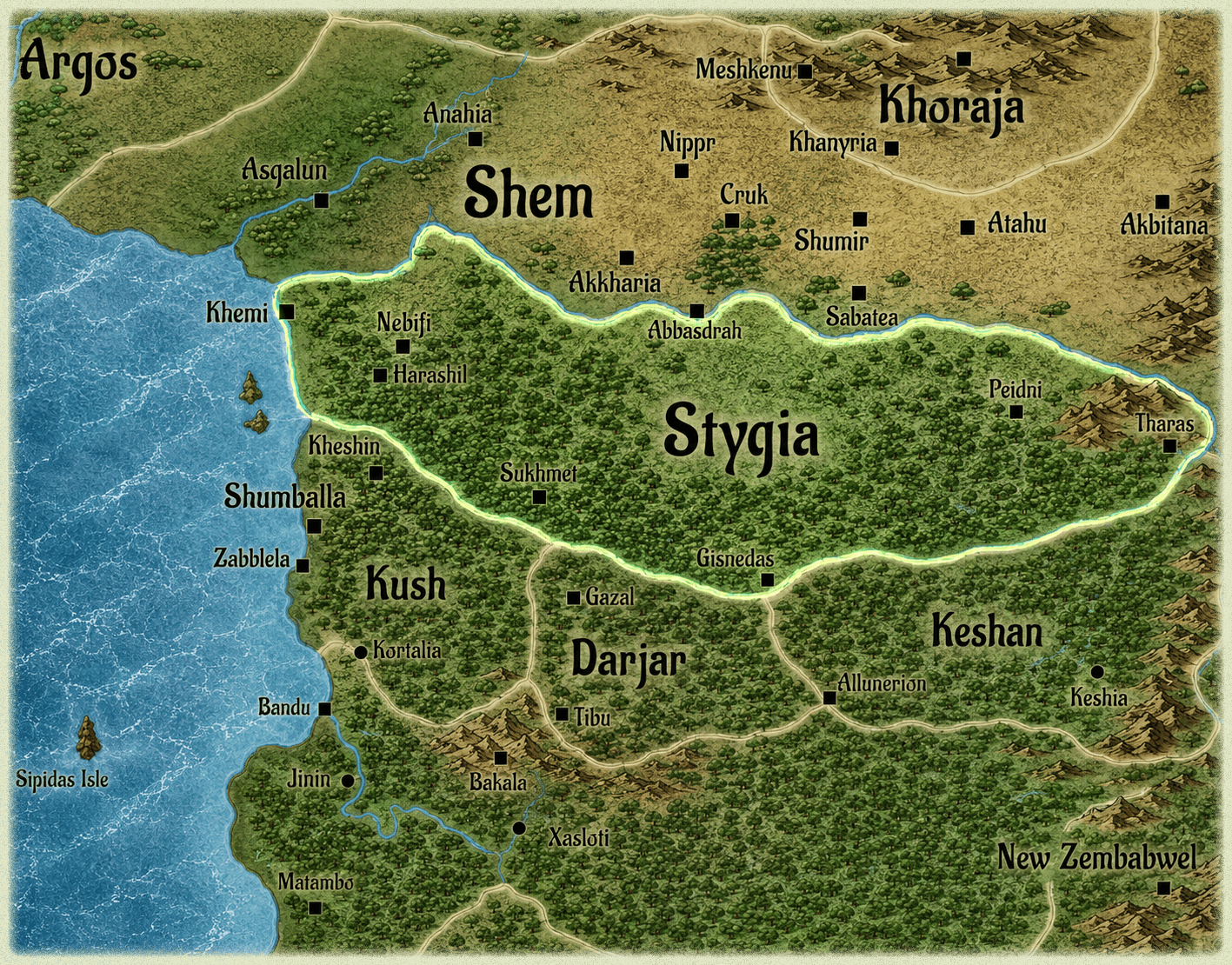
The kingdom is split into two primary terrain types: rocky desert and sandy desert. Despite its arid nature, Stygia is a land of fertility and life, tethered entirely to the River Styx (also known as the Nilus).
The River Styx: The nation's lifeblood. It flows from the jungles of the Black Kingdoms, irrigating the fertile banks of Stygia before emptying into the Western Ocean at Khemi.
Borders: Stygia maintains some of the world's most secure frontiers.
North: Shem.
South: Kush, Darfar, and Keshan.
Flora and Fauna: The land is alive with dangerous predators, including lions, jackals, and massive snakes. The riverbanks are choked with crocodiles and hippopotami.
Notable Landmarks
- Taian Mountains: A volcanic range in the northeast where the Styx turns toward the sea.
- Purple Lotus Swamp: A haunted, southern marshland where the legendary purple lotus is harvested.
- Ellobolu: A long, narrow, marble-lined lake in the east, rumored to have no bottom.
Major Cities
| City | Significance |
|---|---|
| Luxur | The royal capital and home to the Ivory Throne. A commercial powerhouse managing river and caravan trade. |
| Khemi | The priestly capital and greatest city. A sealed metropolis on the Western Ocean where holy snakes roam the streets for sacrifices. |
| Kheshatta | The southern city of dark magicians and headquarters of the dreaded Black Ring. |
| Nebthu | Known as the "City of Tombs," a ruined site overlooking the Bakhr River. |
| Harakht | The ancient, forbidden city of the Hawk-God. |
| Pteion | A ruin swallowed by the desert, rumored to have been built by serpent-men. |
| Sukhmet | A southern border town fortified by mercenaries against Darfari raids. |

Stygia functions as a rigid, uncompromising theocracy. The state operates as a divine instrument, with all authority originating from the worship of the ancient and sinister deity, Set.
The Theocratic Structure
The government is built upon a foundation of absolute divine mandate. The King of Stygia maintains his position by claiming the explicit support of Set and the broader Stygian pantheon.
- Divine Right: The monarchy asserts that the king is the earthly representative of the gods. Consequently, any act of rebellion is framed not merely as treason, but as a spiritual affront that would invite catastrophe upon the entire kingdom.
- Priestly Bureaucracy: The administrative heart of Stygia is its priesthood. The bureaucracy is almost entirely comprised of religious officials, creating a seamless integration of temple affairs and state policy.
- The Temple-Cities: The largest temple complexes are effectively city-states within the kingdom, functioning as massive, self-contained economic hubs that employ diverse strata of workers to sustain their operations. These priests serve as the king's eyes and ears across the land.
The Pyramid of Society
Stygian society is notoriously stratified, organized into an inscrutable class system that dictates every aspect of a citizen’s life, influence, and privilege. This hierarchy is determined primarily by physical race and literacy.
| Social Tier | Composition / Status | Roles |
|---|---|---|
| Upper Echelon | Pure, white-skinned Stygians | Ruling class; direct stewards of the divine will. |
| Middle Tier | Dusky-skinned Stygians | Aristocrats, priests, scribes, and the warrior caste. |
| Bottom Rung | "Mongrel" populations; mixed-blood individuals | Manual laborers and servants; numerically the largest class. |
Key Social Determinants
- Literacy: The ability to read and write is a guarded privilege, restricted to those in the higher tiers of the priesthood and bureaucracy. It serves as a fundamental marker of status and a tool for social control.
- Racial Stratification: Stygian society is obsessed with purity of blood. Even those who are legally and culturally Stygian are relegated to the lowest social tier if they are of mixed heritage, ensuring that power remains concentrated among those who conform to the prescribed racial ideal.

At the top of the pyramid is the royalty. Beneath them are the nobility and aristocracy, as well as the scribes. Beneath them are the bulk of the Stygian people, the labouring classes, including artisans, farmers, shepherds and merchants. Throughout every level of society are the slaves, priests and soldiers of Stygia.
Nobility
Stygia’s royal and noble castes are descended from the ancient, original inhabitants of Stygia. Stygian royalty and nobility are relatively tall people with black hair and fair skin the colour of pale ivory, as were their ancient forebears, the blackhearted, sorcerous Giant-Kings. Many of their eyes still have a feral glitter in the dark. The royalty include the King of Stygia and his family. Beneath him are the ancient families descended of the Giant-Kings who once ruled these lands. These families betrayed their former culture and helped usher in the current culture. Many still keep man-serpents enshrined in their family tombs as protectors and avengers. Stygia’s fearsome king is worshipped as a living god. Temples are built in his honour. Nobles are permitted to hold government posts, where they glean their wealth from tributes paid to the king. All Stygians give gifts to their grim gods and the ivory-skinned nobles represent these slithering gods in this dark land. The nobles all have great status in society.
Aristocracy & Priests
Below the royal and noble families, the haughty, ruling elite of aristocrats and the powerful middle class are dusky skinned, hawk nosed men. Interestingly, it is this caste which most non-Stygians consider to be true Stygians. They are descended from the sorcerous priests and fell priest-kings of the wandering Khari who conquered Elder Stygia. Holding the reins of power in the government, the aristocracy leaves the nobles free to hang about the court at Luxur. Aristocrats pass their position down from father to son.
Priests are holding the reins of power in the government and in the temples, the priests are drawn from the most able throughout society. The priests grow wealthy from donations to the gods, for all Stygians give gifts to Set and the other gods. Priests and nobles pass their position down from father to son. Most of Stygia’s priests are priests of Set. Priests often specialize in some function or other. Some priests specialize in sacrifices, some in sorcery. Some priests function as diplomats and foreign dignitaries, other priests function as doctors. Almost the entire bureaucracy of Stygia is composed of priests. Part-time priests are appointed from the lower castes who function as porters, painters or scribes.
The Warrior Caste
The warrior caste are a tall and muscular breed, usually hawknosed and dusky skinned. Charioteers are drawn from the nobles and aristocratic classes and infantry are conscripted from the labouring classes. Of course, soldiers fight in wars but they also serve during peace as well. They supervise farmers, fishermen, labourers and slaves that work for the temples. Some work with scribes as brutal tax collectors. Some actually learn to read and write and become scribes themselves, often with the goal of becoming a tax collector. Below this are the foreign mercenaries employed to bolster Stygia’s army.
Common Folk
Most of Stygia’s population are farmers, and accomplished ones at that. Virtually everyone in Stygia is involved in at least some aspect of agriculture, either by working the land or by recording the crops or collecting taxes on the crops. Farmers usually work the land of wealthy landowners and are usually paid for their work in food, clothing and shelter. Some farmers rent the land and keep the profits from their crop, paying the landlord a portion of that crop. In addition to ploughing, planting and harvesting, farmers are also required to maintain irrigation canals and work as labourers on any construction projects.
Artisans are generally employed by the government or the temples and work in large workshops. Virtually all crafts are performed by groups of artisans. There are no masters of a craft, such as the guildmasters of Aquilonia or the master craftsmen of Shem. For the most part, everything is standardized and produced in masse.
Artisans include carpenters, amulet-makers, metal workers, jewelers, potters, sculptors, wall-painters, glass makers and weavers. They usually receive payment in food, beer and grain.
Slaves and Servants
Slaves and servants fill a wide range of positions – all the way from labourers to administrators. They perform non-clerical tasks for the temples, work in households, labour in fields, cut hair as barbers, serve as watchmen and as soldiers. These workers are often a strong hybrid of various foreign and Stygian bloods and form the lowest class of Stygian society. Slaves and servants can be bought and sold like property. A person can even sell himself into slavery or servitude and later buy himself out of it. About 10% of the population is composed of slaves. Servants and slaves, regardless of original caste, are strictly forbidden to carry weapons unless they are carrying them for the convenience of their master.
Stygian Law
Stygian laws are restrictive and brutal. Everyone in the kingdoms follows them. Permits are required for many elements of life, including but not limited to changing one’s place of residence, travelling more than 20 miles from one’s home or owning weapons or armour. These permits provide a pair of powerful tools for the Stygian government:
Income and internal security. The selling of permits sends a steady stream of income to the ruling classes. Internal security is provided because permits are often denied and this prevents known dissidents from gathering. There is no legal recourse to those who are denied permits and doing something without the requisite permit invites severe punishments, such as fines, confiscation of goods and even physical mutilation, such as public whipping, hamstringing or execution. The bodies of criminals are not mummified. They are left to rot, denying them an eternal afterlife with Father Set.
Religious crimes are punished even more severely than secular crimes. Not attending a religious ceremony is cause for a hefty fine. Failure to tithe to the temple gives rise to fines even worse than the tithe would have been, plus the offender still must make the requisite tithe. Ceremonies are required by law and priests always charge for these services. Examples of these required rites are numerous: crops must be blessed; all children must be consecrated to Father Set; even the dead have requisite funerary rites that must be performed and paid for. Failure to meet these requirements may be considered heresy; the punishment for heresy is death, confiscation of all property and enslavement of the offender’s entire family. Repeated failures are most definitely deemed heresy.
In addition to the required rites, several animals enjoy protected religious status. Snakes and hippopotami are sacred and allowed to exist unmolested in Stygia. It is against Stygian law to injure either animal and doing so also provokes a charge of heresy. Although the priesthood does not insist on any particular behaviour before a hippopotamus, all Stygians must lie down when a snake is sighted and await the snake to either attack or move on. If a snake attacks, the Stygian chosen for the honour is considered blessed by Father Set and none will try to save him. Most Stygians so blessed go quietly. It is a strange custom but one accepted by the people of Stygia with quiet dignity.
The Stygians have dietary restrictions forbidding them from eating raw fish and certain ‘unclean’ animals. Fish is only eaten sun-dried or preserved in salt brine. When families have enough surplus to eat a little better, they add dates, olives, duck and prized delicacies such as seasoned and fried silkworms. Families also supplement their diets by hunting, fowling and gathering wild fruit and roots. Families in danger of starving can also get beef from the temples, who distribute their surplus to the needy.
Unlike the wealthy in Aquilonia, Stygians do not overindulge. Obese Stygians are few and far between. Commoner dishes are made of clay, while the wealthy dine off of dishes made of precious metals. Food is eaten with the tips of the fingers, not with spoons, forks or knives. Little water bowls are provided to each diner at the end of meals for the washing of their fingers. Higher Caste Stygians usually refuse to eat in front of strangers.
Burial
Despite the collective skills of the physicians of Stygia, Stygians still die. This is where the embalmers come in. The embalmers are priests who live and work in a workshop known is the Clean Place or the Wahbet.
The process of mummification begins when the priest in charge brings the body to the Clean Place. The assistants to the head embalming priest begin reciting formulae over the corpse. The head priest dons a horrific mask of the bestial image of Yinepu. When the masked priest orders the embalming to actually begin, the body is washed and laid on the floor.
With ritual precision, the embalmers remove the inner organs of the dead. The heart, intestines, stomach and liver are washed in palm wine and stuffed with sweet-smelling herbs. The organs are covered in an unguent and bandaged in linen. The names of four gods are written on the internal viscera and the now embalmed innards are placed in canopic jars. Another priest, a scribe, inscribes the name of the deceased on the blank spaces of the jars. Without the preservation of these organs, the deceased has no hope of living again.
The embalming priests then stuff the body with resin and a type of salt called natron, and lay the body in a tank of liquid natron to dry it out for seventy days. In the meantime, all the amulets to be buried with the deceased are inscribed with his name. Over a hundred amulets are used in wealthy mummies, fewer in the mummies of lower castes. Coffin makers spend these seventy days creating the uniquely ornate coffins for the deceased, which are made to be nested inside of each other. Certain personal belonging are laid to rest within the coffin as well as a few ushabtiu figures. Sorcerers are often buried with copies of their spell-books (usually scrolls of inked papyrus) rolled up and lain beside their mummies. Composers may have copies of their favourite poems or songs written on papyrus for burial so they can continue to enjoy their creations. Craftsmen usually have their tools buried with them. Scribes may be given ink, quills and blank sheets of papyrus. Children are often buried with their favourite toys. Flowers may also be laid inside the casket.

The physical appearance of a Stygian is a primary indicator of their social standing, as the nation maintains a rigid class structure based on racial heritage.
General Appearance
- Royalty and Nobility: These upper castes are tall with black hair and fair skin the color of pale ivory. They descend from the original inhabitants of Stygia and the black-hearted, sorcerous Giant-Kings.
- Aristocracy, Priests, and Warriors: This caste is composed of dusky-skinned, hawk-nosed individuals. While they hold the actual reins of power, they are the figures non-Stygians most commonly associate with the Stygian identity.
- Lower Classes: Serfs, slaves, and laborers are typically of mixed heritage, a hybrid of various foreign and Stygian bloodlines.
- Military: The warrior caste is tall and muscular, sharing the hawk-nosed, dusky-skinned features of the aristocracy. Foreign mercenaries are also employed to bolster these ranks.

Clothing in Stygia is rarely worn for modesty. Due to the intense heat, attire is thin, often transparent, or nonexistent. Clothing serves either a practical function or acts as a medium to enhance the aesthetic appeal of the body. Stygians take great pride in their appearance, keeping themselves and their garments meticulously clean.
Royal and Noble Attire
Royalty and nobility utilize clothing to display their divine associations. This clothing is never purchased; it is presented to them as a gift of devotion.
- Nemes: The royal headdress, featuring fine accordion pleating on the lappets and a band bound tightly over the brows.
- False Beards: Worn by both royal men and women as a vital symbol of divinity.
- Shendyt: An accordion-pleated royal kilt wrapped counter-clockwise around the body.
- Noble Kilts: Wealthier citizens wear a distinct kilt that is half-pleated and wrapped counter-clockwise, with the pleated section pulled forward and knotted out of sight. A long, transparent kilt is often worn over this.
- Robes and Gowns: Both men and women of the nobility wear long, see-through, pleated robes. During cooler morning and evening hours, wealthy women wear long-sleeved gowns that hang in folds.
- Festive Adornments: On special occasions, noble women wear restrictive nets of colored cylindrical faience beads across the middle of their tunics.
- Body Painting: Many noblewomen forgo clothing entirely, choosing instead to paint their bodies with henna, often in fish-net patterns, accessorized only with jewelry.
- Status Indicators: Status is not denoted by the quantity of jewelry worn, but by the transparency of the clothing. Nobility also utilize silk cloaks and a gold band featuring a rearing serpent-head emblem to confine their hair.
Commoner and Slave Attire
- Soldiers: Off-duty soldiers typically wear a simple linen kilt and a mantle to signify their rank.
- Laborers: Boatmen, fishermen, and gatherers often work entirely naked during the heat of the day, though some opt for loincloths made of linen or animal hide.
- Slaves: Most slaves work in the nude. Those serving as the personal playthings of the nobility are distinguished by a curious green necklace, which prevents them from being bought or sold to commoners.
Grooming and Personal Adornment
- Jewelry: Worn by all social strata, from the poorest laborer to the King. Common materials include gold, colorful beads, turquoise, and lapis lazuli.
- Footwear: Stygians generally walk barefoot, carrying sandals to be worn only when necessary.
- Kohl: This black powder is applied by virtually every Stygian, from the highest noble to the lowest slave, to rim the eyes, darken lashes, and paint the eyebrows.

In Stygia, gender dynamics are defined by a surprising degree of legal and social parity, contrasted against the kingdom’s dark religious and cultural practices. While Stygia is a land of horror, women occupy positions of significant power and independence that diverge sharply from many other Hyborian cultures.
Legal and Social Standing
Stygian women are treated as legal equals to men. Their rights and autonomy are protected within the kingdom’s rigid legal framework.
- Legal Autonomy: Women possess the right to own land, inherit property, run businesses, and participate directly in court proceedings. They are subject to the same legal penalties as men.
- Marriage and Assets: Marriage does not subordinate a woman to her husband. Women retain their independence, maintain control over their personal assets, and are not considered property.
- Professional Life: Women hold a wide variety of professions, including doctors, farmers, acrobats, professional mourners, and scribes. While the priesthood is generally reserved for noblewomen, women of all classes are encouraged to pursue work suited to their station.
The Matrilineal Seat of Power
Despite the presence of a King, true political power in Stygia is rooted in matrilineal lineage.
- Royal Succession: The throne is claimed not through direct patrilineal descent, but through kinship to the Queen. A man’s claim to the throne is validated by his status as the son, brother, step-relative, or nephew of a Stygian Queen.
- Queen’s Authority: Inheritance of royal power is entirely dependent upon the Queen’s status. Consequently, women are central to the stability and legitimacy of the monarchy.
Marriage and Family
Stygian family life is highly valued, and the role of the mother is central to the societal cycle of birth and rebirth.
- Formation of Marriage: There are no formal religious or legal marriage ceremonies. Marriage is established through cohabitation and the beginning of a sexual relationship. While often celebrated with social gatherings, these are private affairs rather than religious rites.
- Arrangements and Taboos: Marriages are typically arranged by parents, usually within the same social class. Stygia lacks the incest taboos common to the rest of the Hyborian Age; marriages between cousins, siblings, or even fathers and daughters are a recognized and frequent practice to consolidate power and wealth.
- Fertility and Reputation: Stygian women gain social acceptance and reputation through their fertility. Pregnancy is viewed as a source of pride and societal admiration. The importance of women is further underscored by the prominence of female deities within the cult of Set.
Women in the Stygian Workforce
| Role | Description |
|---|---|
| Scribes | Requires literacy, often taught to noblewomen by tutors. |
| Priestesses | Reserved exclusively for women of noble birth. |
| Performers | Includes dancers, singers, musicians, and acrobats. |
| Commerce | Women may own and operate businesses independently. |
| Household | Women manage the household and control their own assets. |

In Stygia, the concepts of servitude and sexual service are deeply integrated into the religious and social fabric of the state, operating under different rules than those found in the rest of the Hyborian Age.
The Context of Stygian Slavery
Slavery in Stygia is a state of reduced rights, often functioning as a form of social, legal, or economic management rather than a simple commodity trade.
- Paths to Enslavement: Individuals become slaves through debt, criminal punishment, voluntary submission, capture in war, or as tribute.
- The "Feudal" Contract: Seeking safety from the harshness of life or the threat of demons, some free Stygians enter into voluntary servitude. They pay a monthly stipend to a temple or powerful noble in exchange for lifelong protection and security for themselves and their descendants.
- Limited Terms: Unlike the chattel slavery of other lands, Stygian slavery is frequently limited in duration. Debt slaves and those who sell themselves into service may purchase their freedom once they acquire sufficient wealth.
- Slave Transactions: Stygia lacks the large public slave markets seen in Shem or Turan. Most transactions occur privately or as gifts.
- The Value of Skills: While male slaves are preferred for their labor capacity, the most valuable slaves are those possessing rare or specialized skills.
- The Limits of Escape: Escaped slaves face a nearly impossible situation. Their only hope is to reach a foreign border or claim sanctuary at a temple.
Prostitution as a Sacred Practice
Sexual activity is not viewed through the lens of modesty in Stygia; rather, the sexual socialization of children is treated as a religious duty. Prostitution is inextricably linked to the cults of deities such as Derketo and Isis.
- Sacred Status: Temple prostitutes are not street-walkers; they are revered members of society, held in awe as symbols of fertility. They carry no social stigma and serve as a significant source of temple revenue.
- Temple Service: Young girls—often including those of noble or high birth—are pressed into service in these cults until they reach their first menstruation.
- Appearance: These women walk entirely nude, save for a distinctive feathered headdress, signaling their status as sacred objects.
- Protection: Because they are considered holy, they are afforded high levels of protection. Violence against them is rare, and traveling performing troupes are always accompanied by armed guards to ensure the safety of the women.
Summary of Social Standing
| Aspect | Slavery | Temple Prostitution |
|---|---|---|
| Social View | A state of reduced rights/servitude | A sacred religious and social duty |
| Duration | Often limited; can be bought out | Terminated at first menstruation |
| Stigma | Low (common feature of life) | None (highly regarded/sacred) |
| Publicity | Private transactions only | Public, ceremonial appearance |
"Temple prostitutes rarely permit violence to themselves as they are sacred objects of awe and fertility."

Despite its harsh, arid landscape, Stygia maintains a robust and specialized economy. Wealth flows from the fertile banks of the Styx, from the exotic trade in mystical goods, and through a carefully controlled mercantile system.
Key Industries and Exports
Stygia operates as a sophisticated commercial hub, leveraging its access to the Styx to connect the distant interior of the Black Kingdoms with the Western Ocean.
- Primary Exports: Silk, ivory, skins, onions, papyrus, slaves, and precious stones.
- The Silk Trade: Stygia produces massive quantities of silk. So pervasive is this industry that even common slaves are often observed wearing silk garments.
- Magical and Sorcerous Goods: Urban artisans and specialists produce highly sought-after sorcerous jewelry, unique medicines, and potent magical drugs derived from rare ingredients like the black and purple lotus.
- Foreign Trade: Stygian merchants travel as far as Khitai in search of mystical pharmaceuticals. The nation also acts as a broker for luxury goods sourced from Iranistan and Vendhya.
- Predatory Commerce: Stygia maintains a modest fleet of ships that actively prey upon Hyborian merchant vessels, supplementing the kingdom’s wealth with plundered cargo.
The Stygian Economic Model
While Stygia possesses a currency system, the economy remains heavily grounded in practical barter.
- Barter and Grain: Barter is the standard for most transactions. Because food is the primary necessity, wages are frequently paid in grain, dates, or other foodstuffs.
- Famine as Opportunity: Strategic stockpiling of grain is a recognized path to social advancement. During times of famine, commoners who have saved food can trade their surplus for land and slaves, effectively transforming themselves into wealthy landowners.
- Labor for Ritual: Laborers often trade their skills or craftwork directly to the temples in exchange for vital spiritual and medical services, such as amulets, healing, or necessary funerary rites.
Currency and Metalwork
Although Stygia does not maintain a formal state mint for coinage, money exists in a standardized form:
- Ring Money: Stygian merchants melt down foreign gold, copper, and silver coins into standardized rings of fixed weight, which function as the domestic currency.
- Imported Coinage: Stygian-minted coins (bearing the likeness of the King and Set) do exist, such as the silver sethi (equivalent to a day's laborer wage) and the copper gurah.
- Legal Risks: The use of foreign currency is perilous. For instance, possession of Aquilonian coins is illegal and can lead to severe punishment for the bearer and their family.
- Royal Monopoly: All gold is legally the property of the King in Luxur. Possession of gold requires proof that it was a royal gift (recorded in the Treasury) or a result of tomb robbery.
The Social Significance of Trade
Trade serves a purpose beyond mere profit; it is a vital tool for social maneuvering. The exchange of gifts between parties of unequal standing is a critical cultural ritual, functioning as a public demonstration of generosity, the formal acknowledgement of social hierarchy, and a means to accrue honor within Stygian society.

Stygian religion is defined by the absolute supremacy of Father Set, the Old Serpent. It is a faith steeped in pre-human history, darkness, and blood, functioning as the primary pillar of the Stygian state and its oppressive theocracy.
The Cult of the Old Serpent
Set is not merely a god; he is an ancient force that once dominated much of the world. In the pre-Cataclysm era, Set reportedly walked the earth in human form and served as the progenitor of a mysterious, pre-human race.
- Global Pariah: The cult of Set is outlawed across the Hyborian kingdoms, where Mitra is worshipped. Hyborians view Set as the arch-enemy of their faith and fear the sinister, unknown nature of Set’s rituals.
- A Bloody Survival: Modern Stygian worship is a continuation of the strange rites established by the pre-human culture that once occupied Stygia before being overthrown by the ancestors of the current population.
Rituals and Sacred Objects
Stygian worship is a guarded, gruesome mystery characterized by unspeakable rites and mass human sacrifice.
- Ceremonial Regalia: During certain rituals, priests don monstrous, half-bestial masks topped with ostrich plumes.
- Ritual Tools: Ceremonies often involve the use of curious black candles that burn with a strange green light and staves topped with white human skulls.
- Sacrificial Rites: Captives are held in deep pits to be fed to amorphous monsters from the Abyss. Within the temples, massive, iridescent, and drugged serpents coil, awaiting the offerings and worship of the priesthood.
- Processions: Silent, ritualistic processions are a hallmark of the state’s religious public life.
The Priesthood and the Black Ring
The priests of Set are almost universally sorcerers. They maintain their grip on the population through fear, demonstrating a cold willingness to sacrifice even their own followers to achieve their corrupt, magical ends.
- The Black Ring: The most powerful and dreaded of these sorcerer-priests comprise the Black Ring.
- Temples and Tombs: The priests gather at sacred sites, specifically the ancient pyramids that dot the Stygian landscape. These structures, likely built by the pre-human race, serve dual functions as temples of worship and burial sites for Stygia’s mummified elite.
Sacred Animals
The veneration of fauna is a legal and spiritual mandate. Injuring a sacred animal is an act of heresy punishable by death.
- Snakes and Hippopotami: These animals are protected by law. When a snake is sighted, all citizens must lie down in submission. If a person is attacked by a snake, they are considered "blessed" by Set; the victim accepts this fate with dignity, and others are forbidden from intervening.
- Animal Mummification: The veneration extends to death. Stygian necropolises contain vast numbers of mummified sacred animals. Each temple maintains graveyards dedicated to their specific patron animal—such as the mummified crocodiles of Sobek or the mummified cats of Bast.

To play a Stygian is to embody the dark, ancient, and chillingly decadent spirit of the land of the Old Serpent. You are a product of a civilization that pre-dates the rising of the Hyborian nations, where the boundary between the living and the dead is as thin as the shifting desert sands. In Stygia, power is measured in sorcerous secrets, bloodline purity, and the favor of Set. Whether you are a high-ranking priest navigating the murderous politics of the Black Ring or a desperate laborer in the shadow of a pyramid, you know that survival depends on absolute obedience to the priesthood and the fear of the dark gods.
Core Identity
- Race: Stygian. Nobility is marked by tall, lithe frames, raven-black hair, and pale, ivory skin. The ruling aristocracy and warrior castes are dusky-skinned, hawk-nosed, and muscular.
- Language: Stygian (An ancient, guttural language of rhythmic formulae and complex theological terminology, often used in precise, hushed tones).
- Names: Heavy with ancient, mysterious tones.
- Male: Amenhotep, Ctesphon, Khnum, Menes, Nakht, Setem, Thoth-mekri, Userhat.
- Female: Ankh-es-en, Hepshet, Iset, Khem-nefert, Meret, Nefertari, Sit-amun, Tausret.
Personality and Archetypes
- The Hierarchist: You are obsessed with order, rank, and the rigid stratification of Stygian society. Your place in the pyramid is your primary identity, and you treat those beneath you with cold disdain and those above with profound, trembling awe.
- The Mortal Obsessive: Life is fleeting, and death is an eternal work-in-progress. You are fascinated by the macabre—mummification, forbidden lore, and the preservation of the physical form for the afterlife—viewing the corpse not as a loss, but as a potential vessel for eternity.
- The Xenophobe: The world outside Stygia is a savage, ignorant expanse. You view foreigners with deep suspicion, as heathens or potential slaves, and rely solely on the protection of your city’s temples and the laws of Set.
- The Calculated Survivor: You are a master of hidden agendas. In Stygia, silence is safety. You are prone to speaking in half-truths and performative displays of piety, knowing that a single accusation of heresy could lead to the total annihilation of your house.
Combat Roles and Equipment
- The Black Ring Initiate: A practitioner of the dark arts who serves the pyramid-temples. You wield a ritual staff or ceremonial dagger, relying on sorcerous amulets and psychological terror rather than raw strength.
- Stygian Charioteer: A member of the noble-born elite. You drive bronze-fitted chariots with surgical precision, armed with a composite bow and a long, curved spear to strike down infantry from the high ground of your platform.
- Temple Guard: A disciplined, armored soldier of the priesthood. You wear reinforced bronze scale armor and a tall, crested helmet, wielding a heavy scimitar or khopesh specifically designed to execute those who desecrate holy sites.
- Border Enforcer: A desert-hardened mercenary or conscript stationed at sites like Sukhmet. You are expert in suppressing border incursions and managing slave labor gangs, using a leather whip and a short, stout infantry sword.
Social Rank and Background
- High Priest / Black Ring Member: You possess rare literacy and forbidden knowledge. Your life is dedicated to the administration of the temples and the pursuit of eternal life.
- Royal Courtier: You move in the orbit of Luxur. Your wealth is derived from royal tribute, and your existence is a constant, lethal game of navigating the whims of the Pharaoh.
- Embalmer Priest: A skilled craftsman and theologian who works in the Wahbet. You hold an honorable, though morbid, station, essential to the state religion.
- Standardized Artisan: A worker in the temple workshops. You do not own your tools or your output; your life is defined by the repetitive, high-quality production of state goods.
- Mixed-Blood Laborer: Born to the lowest caste, you are a cog in the Stygian machine. You possess little legal recourse and are likely involved in the maintenance of irrigation canals or agricultural production.
Starting Package
Every Stygian character begins their journey with gear that reflects the rigid order and religious intensity of the Nile-like plains:
- Traditional Stygian garb: A lightweight, pleated linen shendyt (kilt) or transparent robe, bleached spotlessly clean.
- A set of personal adornments: A string of faience beads, a protective amulet of Set, and a supply of kohl for the eyes.
- Primary weapon of choice: A bronze-tipped khopesh, a ceremonial bronze dagger, or a composite bow.
- A small personal kit: A water-skin, a pouch of salt-brine preserved fish or dates, and a clay seal or token signifying your city or temple affiliation.
- A pair of portable leather sandals (carried, not worn).

- Stygia – Serpent of the South (Modiphius/Mongoose Publishing): The definitive source for Stygian governance, social hierarchy, and the mysterious history of the pre-human eras.
- Conan: Faith & Fervour (Mongoose Publishing): Essential for understanding the gruesome, snake-focused cult of Set and the ritualistic nature of Stygian society.
- The Hyborian Age (Robert E. Howard): Outlines the ancient conflict between the pre-human race and the ancestors of the current Stygian elite.
- The Hour of the Dragon and The Scarlet Citadel (Robert E. Howard): Provide iconic depictions of the Black Ring’s power and the sinister atmosphere of Stygian sorcery.