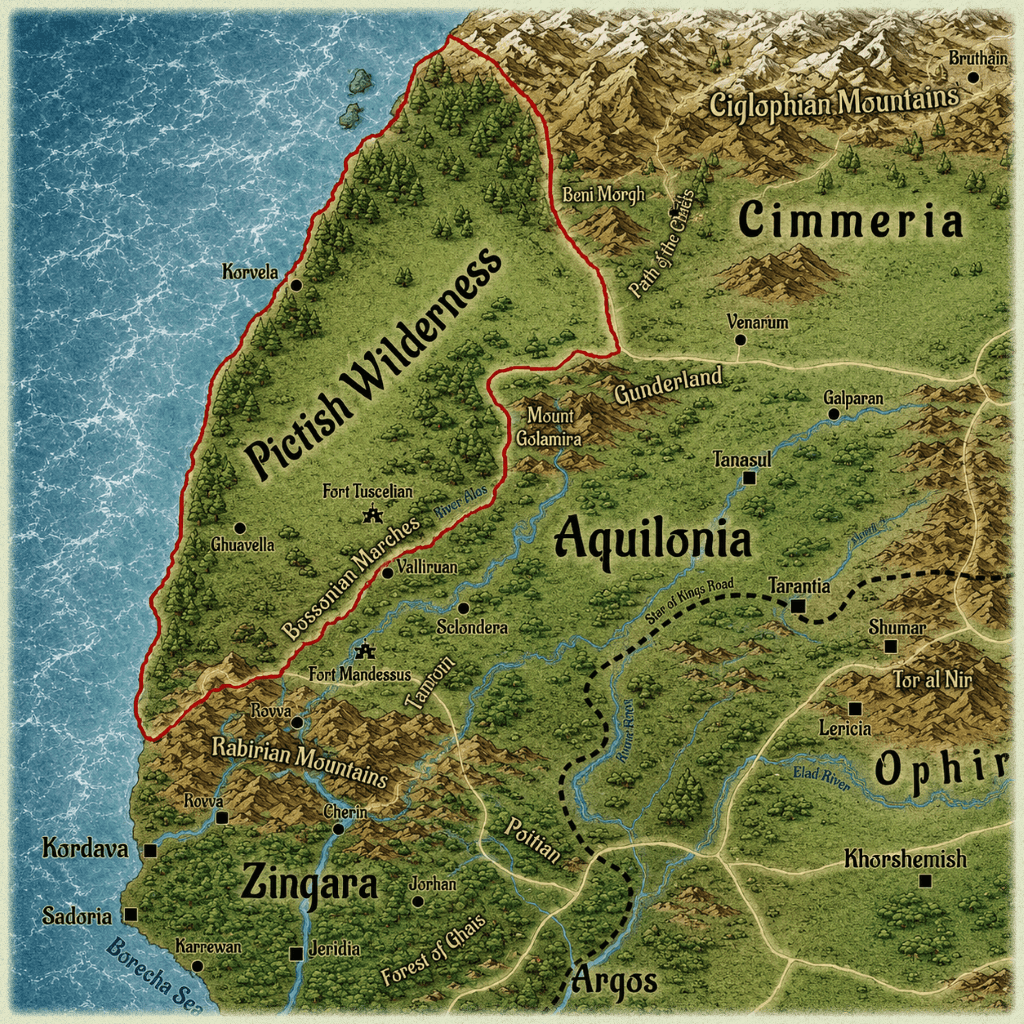

The Pictish Wilderness serves as a formidable barrier between the civilized Hyborian nations and the primal mysteries of the west. The region acts as a pressure cooker of conflict, bordered by powerful neighbors who collectively view the Picts as an existential threat:
- North: Vanaheim
- Northeast: Cimmeria
- East: Aquilonia (specifically the Westermarck and the Bossonian Marches)
- South: Zingara
The land is characterized by profound hostility; the Picts exist in a perpetual state of warfare, not only against the encroaching Hyborian powers but also in endless, bloody internecine conflicts between rival tribes.
Key Geographical Features
The wilderness is defined by its treacherous terrain, thick, ancient forests, and massive river systems. It is described as a land of "legendary" danger, inhabited by apex predators—such as sabrecats and dire wolves—thought to be extinct elsewhere.
| Landmark | Significance |
|---|---|
| Thunder River | A massive, roaring waterway marked by white rapids; it forms a contested border between the Pictlands, Aquilonia, and northern Zingara. |
| Black River | The northern border between Aquilonia and the Pictlands. It originates in the northern Pictish mountains and flows through the Bossonian Marches. |
| Ghost Swamp | A strategic location within the Westermarck. It functions as a neutral ground for inter-tribal meetings and is a site of constant, brutal skirmishing between Picts and Aquilonians. |
| Corvela Bay | A former wooden fort-castle colony established by an exiled Zingaran noble; it was annihilated by the Picts in under a year, serving as a cautionary grave for all outsiders. |
The Landscape of Survival
Despite its dangers, the wilderness is exceptionally plentiful, offering abundant game and river fish for those skilled enough to harvest it. The Picts have adapted their way of life to this environment through extreme cultural and architectural variance:
- Dwellings: Housing is non-uniform, ranging from primitive thatch and mud-and-wattle huts to tree-top dwellings or semi-permanent cave systems, dictated entirely by the specific tribe’s terrain.
- Defensive Architecture: Many settlements are fortified with simple wooden stockades designed primarily to keep out the region's massive predators.
- Territorial Markers: Pictish settlements are often adorned with grim, visceral displays of victory, including stacked skulls and bone-chute chimes designed to unnerve intruders.
Communication and Cultural Identity
The Picts possess a unique cultural infrastructure designed for a land of dense forests and impenetrable swamps.
- Long-Distance Signaling: The Picts utilize a complex system of rhythmic drumming to communicate across vast distances. The deep, rolling echo of these drums can be heard for miles through the forest canopy, serving as both a tactical tool and a psychological weapon of terror against their enemies.
- The Inviolable Wilderness: The ferocity of the Picts is such that even the hardened, war-driven Vanir of the north avoid traversing the Pictish Wilderness and refuse to take Picts as captives, fearing the inevitable, violent retribution of the tribes.
- Total War: There are no alliances with outsiders. To be Pict is to be a warrior; the culture lacks concepts of mercy or kindness toward the "civilized" races. They view the entire region as their ancestral birthright, and they wage a relentless, generation-spanning war to push back the heavy boots of Aquilonian settlers who have occupied their lands.

The Picts possess no overarching government or unified nation-state. Their society is a volatile, decentralized patchwork of hundreds of independent tribes scattered across the Wilderness.
- The Tribal Dual-Power: Each tribe is led by a Chief, typically the most capable warrior, who governs in tandem with a Shaman. The Shaman often wields equal or superior authority, serving as the tribe’s spiritual conduit and ritualistic guide.
- Constant Conflict: These tribes are not a monolith. They are frequently engaged in bitter blood feuds, territorial disputes, and cyclical warfare with one another.
Totemic Society
Every Pictish tribe is organized around a totem animal. This totem defines the tribe’s core values, combat doctrine, social customs, and political posture toward outsiders.
| Clan | Defining Values | Military/Cultural Doctrine |
|---|---|---|
| Alligator | Stealth, Ambush | Grapples prey in water; ritual scarring mimics leathery skin. |
| Badger | Tenacity, Tunneling | Ill-tempered and territorial; specialized in undermining fortifications. |
| Bear | Strength, Order | Ranged weapon focus (melee is for the elite); scalp-taking culture. |
| Boar | Stubbornness, Force | Overwhelming frontal "tusk-first" charges; impossible to dislodge. |
| Eagle | Marksmanship, Pride | Predator-focused; use of bows and single-feather ornamentation. |
| Hawk | Wisdom, Action | Values sight and proof; sober, measured actions; feud with Raven clan. |
| Otter | Industry, Vigilance | Expert trappers; female-led shamanism; highly suspicious of treaties. |
| Owl | Observation, Silence | Night-time psychological warfare; uses whistles and silence to terrorize. |
| Panther | Cunning, Stealth | Night hunters; aggressive; exclusive alliance with the Hawk clan. |
| Raven | Hedonism, Sadism | Nudist, chaotic tricksters; obsessed with blood, gambling, and excess. |
| Shark | Adaptability, Speed | Nomadic coastal raiders; hit-and-run bloodletting tactics. |
| Snake | Poison, Subtlety | Masters of toxins and stealth; strike only when the target is vulnerable. |
| Spider | Traps, Ambush | Dwellers of deep caves; masters of trip-wire traps and dark-space combat. |
| Vulture | Opportunity, Scavenging | Follow larger war parties to loot the fallen; serve as camp followers. |
| Wildcat | Agility, Targeting | Climbers who attack from above; target the weak to exhaust the strong. |
| Wolf | Loyalty, Strategy | Largest alliance; values oratory/diplomacy; pack-based warfare. |
The Totemic Philosophy
For the Picts, the totem is not merely a symbol—it is a template for existence.
- Imitation: Members physically manifest their totem through tattooing, scarification, specific ornamentation, or dressing in the hides and remnants of the animal.
- Behavioral Mimicry: A tribe’s battle strategy is a direct translation of their totem's natural behavior. An Alligator clan member acts like an alligator; a Wolf clan member acts like a pack hunter.
- Values as Law: The totem determines the tribe's political reality. The Wolf clan values oratory because wolves communicate through sound; the Hawk clan values "seeing" because hawks are aerial observers.

For the Pict, tribal identity is the absolute bedrock of existence. It determines an individual’s rights, obligations, and social standing within the hierarchy. This kinship system is rigid, clearly defining the roles of fathers, mothers, elders, and youth.
- Foreign Integration: Outsiders who survive long-term contact with a tribe are often assimilated through adoption. By assigning a specific kinship title like "brother" or "cousin," the tribe establishes exactly how the foreigner should be treated and what their responsibilities are, effectively removing the ambiguity of their "outsider" status.
The Way of War
War is not merely an activity; it is the essential driving force of the Pictish identity. There is no such thing as a peaceful Pict. While their strategies are varied and tribal-specific, they adhere to a rigorous cultural code of conduct:
- Honorable Conflict: While Picts are known to capture, maim, or torture fallen enemies, they maintain strict boundaries. Acts such as slavery or rape are considered stains on one's honor and are largely abhorred.
- Weaponry Rituals: Weapons are treated with profound care. Specifically, the spear is a symbol of elite status. It is a weapon that must be earned through combat; for an unproven warrior to wield a spear is seen as both foolish and deeply shameful.
Mysticism and the Supernatural
Pictish daily life is saturated with mysticism, superstition, and ritual. They view the world as a place filled with forces beyond human understanding, which they navigate through constant ceremony.
- The Impossible Denier: There is no such thing as an atheist or non-believer among the Picts. The presence of spirits and divine omens is considered an objective reality. They believe their steps are constantly guided by these powers, and they read natural signs to determine the fate of their hunts, wars, and migrations.
- Reverence for the Abnormal: Physical abnormalities—which other Hyborian cultures might brand as "deformities"—are often lauded in Pictish society. These individuals are frequently viewed as the offspring of wild spirits and are granted elevated social status, often serving as the tribe's shamans or spiritual leaders.
Sexuality and Social Expression
Pictish sexuality is fluid, open, and entirely devoid of the rigid taboos found in Hyborian cities.
- Non-Monogamous Norms: Monogamy is rare, though tribal leaders and high-ranking men may be more possessive of their mates. Homosexuality is viewed as a natural variation of life and carries no stigma.
- Gender Fluidity: Pictish society operates on a pragmatic basis regarding gender roles. Those who act as the opposite sex are treated as the opposite sex. In many tribes, these individuals are integrated seamlessly into the community, and in some, they hold vital ceremonial and spiritual positions, functioning as "two-spirit" conduits for tribal magic.
Cultural Summary Table
| Category | Pictish Social Philosophy |
|---|---|
| Social Structure | Absolute tribal hierarchy based on kinship and earned status. |
| View on War | The primary identity; governed by codes of honor and martial prestige. |
| Supernatural | Total belief; reality is mediated through spirits, omens, and ritual. |
| Disability | Often viewed as spiritual blessings/marks of the divine. |
| Sexuality | Open, non-monogamous; fluid gender roles integrated into society. |

The Picts possess a distinctive, compact, and intimidating physiology. They are universally noted for their short, powerful, and stocky frames, engineered for the grueling physical demands of the dense, treacherous forests they call home.
- Complexion: Their skin is deeply dark, often possessing a distinct copper-like sheen.
- Features: They have sharp, angular facial structures and dark, piercing eyes.
- Build: Despite their lack of height, they are exceptionally strong, possessing dense muscle mass that allows them to move with surprising speed through the thick undergrowth.

Pictish attire is defined by its brutal utility. While garments vary wildly from tribe to tribe, the fundamental materials and aesthetics remain consistent across the Wilderness.
- Materials: Every tribe relies heavily on soft, durable leathers and thick, insulating furs.
- Totemic Design: Clothing is never merely functional; it is a visual extension of the tribe's totem. A member of the Bear clan will wear heavy furs to mimic the beast, while a Wolf clan member utilizes patterns and textures that allow them to blend into a pack.
- The War Color: Black is the color of war. It is most frequently worn by male warriors, utilized for both ceremonial purposes and tactical camouflage during forest ambushes.
Ornaments and Rank
In Pictish society, an individual's appearance is their biography. Every piece of jewelry, feather, or claw is a record of their history.
| Ornament | Cultural Meaning |
|---|---|
| Feathers/Claws | Often denote successful hunts or specific favors granted by the totem spirit. |
| Teeth (Animal/Human) | Animal teeth represent prowess; human teeth are trophies earned in battle. |
| Tattoos | Permanent markings that can denote tribal loyalty, specific spiritual initiations, or personal history. |
| Arrangement | The specific placement of jewelry is a visual ledger of a person's life events, heroic deeds, and status. |
Grooming and Hair
Hairstyles are essential tribal identifiers, instantly signaling a Pict’s origin to friend and foe alike.
- The Scalping Tuft: Perhaps the most iconic Pictish look, involving a completely shaven head with a single, long, braided tuft of hair left at the crown.
- The Unkempt Mane: Alternatively, many Picts maintain a full, wild, and intentionally tangled head of hair, often woven with twigs, bones, or feathers to blend into the wilderness.
- Practicality: Even the most elaborate hairstyles are designed not to snag on branches or foliage, ensuring the Pict can move silently and swiftly through the forest canopy or dense brush.

In the harsh, volatile environment of the Pictish Wilderness, survival dictates a rigid division of labor. Pictish society is distinctly patriarchal, with men dominating the public, martial, and political spheres, while women manage the essential, labor-intensive domestic economy that sustains the tribe.
- Male Sphere: Men are tasked with the primary responsibilities of hunting, patrolling borders, engaging in tribal warfare, and holding major positions of leadership (such as chieftain or warrior-commander).
- Female Sphere: Women are responsible for the drudgery of tribal maintenance—cooking, pot-making, fire-tending, and the construction of dwellings. While they hold a second-class status, their internal hierarchy is earned through productivity. Expert craftsmanship in leather tooling, intricate beadwork, and the bearing of healthy sons are the primary metrics by which women gain prestige and influence within their own ranks.
Discipline and Social Order
The Pictish social structure relies on communal enforcement to ensure that all members fulfill their roles. Unruly behavior is not tolerated, as a failure to contribute directly threatens the survival of the tribe.
- Correction: Women who fail to adhere to their social standing or who shirk their duties face immediate physical correction. While men participate in this discipline, it is most often the other women who administer beatings, as the burden of the "unruly" woman's missed work falls directly upon them.
- Survival Dependency: Pictish women are not trained in combat and are keenly aware that survival in the Wilderness is impossible without the collective protection of the tribe’s warriors. This reality reinforces their diligence and adherence to their assigned roles.
Child Rearing and Education
Childcare is a communal responsibility handled primarily by the elderly women of the tribe, freeing younger, labor-capable women to focus on their daily chores. This system ensures that every child receives a grounding in the essential knowledge of the Pictish world.
| Age / Gender | Educational Focus |
|---|---|
| All Children | Taught by elder women regarding spirits, gods, and the various dangerous creatures of the forest. |
| Young Boys | At age seven or eight, they begin training in hunting, using slings and bows to fell small game. |
| Young Girls | Taught leather working, beadwork, fire-tending, cooking, and house-building to ensure tribal functionality. |
Note on Social Flexibility
While the standard tribal roles for women are defined by labor and domestic support, Pictish society remains unique in its occasional flexibility. As previously noted, individuals who demonstrate atypical gender expression—such as men behaving as women or women behaving as men—are often integrated into the tribe in accordance with those behaviors. In certain clans, these "two-spirit" individuals may even rise to important ceremonial or spiritual positions, providing a stark, pragmatic contrast to the rigid labor expectations of the broader tribal population.

In a world where nations like Ophir, Aquilonia, and Koth treat human beings as liquid capital, the Picts stand in complete opposition. They neither participate in the international slave trade nor tolerate the practice of slavery within their own borders.
- Slavers' Avoidance: External slave traders and raiding parties generally avoid targeting Picts. A Pict’s identity is so intense and defiant that they will seize the first available opportunity to kill their captors, even when that act guarantees their own immediate death.
- The Code of Pride: Within the Pictish tribes, the concept of selling a human being—even a sworn enemy from a rival tribe—is viewed as a profound stain on their honor. While Picts are known for their endless blood feuds and willingness to execute rival clansmen, they view the act of selling a person into servitude as cowardly and inherently disrespectful to the warrior spirit.
The Fate of Captives
Because the Picts do not utilize forced labor, captives taken in border raids or tribal skirmishes meet one of three distinct ends:
- Sacrifice: Captives are frequently offered to the brutal gods and forest spirits that the Picts believe govern their world.
- Execution: Those not marked for sacrifice or potential assimilation are simply killed on the battlefield or in ritual contexts.
- Assimilation (The 'Cleansing'): Captives—particularly those from the Hyborian kingdoms—may be subjected to a grueling process of "adoption." This is a violent, ritualistic transformation involving torture and spiritual cleansing designed to strip away the victim’s "white spirit" and replace it with a Pictish one. If the captive survives this process, they are no longer viewed as a foreigner, but as a member of the tribe.
The Absence of Prostitution
Due to the Picts' deeply ingrained culture of open sexuality, the commodification of intimacy is non-existent.
- Natural Expression: Because their society lacks the rigid sexual taboos and moralistic gating found in "civilized" cities, there is no economic niche for the sex trade.
- Communal Logic: Relationships, trysts, and encounters occur within the tribe based on personal preference and social dynamics rather than financial transaction. Since there is no shame attached to sexuality, there is no "vice" to profit from, making the very concept of prostitution alien to the Pictish way of life.
Summary of Pictish Social Commerce
| Activity | Pictish Stance | Reasoning |
|---|---|---|
| Slavery | Rejected | Considered shameful; captives are either sacrificed or adopted. |
| Slave Trading | Prohibited | View human life as warrior-prey, not a commodity. |
| Prostitution | Non-existent | Open sexuality renders a paid sex trade redundant and unnecessary. |

Trade, as understood by Hyborian civilizations, does not exist among the Picts. There are no merchants, coin-based markets, or haggling. For a Pict, an exchange is an intimate, binding political act.
- The Gift-Alliance Protocol: All exchanges are viewed as an offering of friendship or an overture toward an alliance. A Pict will never accept a gift unless they intend to align themselves with the giver.
- The Obligation of Reciprocity: If a Pict accepts a gift, they are socially and spiritually bound to return one of equal value. Failing to provide a reciprocal gift is not merely a breach of etiquette; it is an overt declaration of war.
- The Zingaran Exception: The Zingarans are the only outsiders who have successfully navigated this dangerous diplomatic minefield. These interactions are notoriously volatile; each attempt at "trade" is a gamble where the Picts may either accept the gift—forming a temporary alliance—or reject it, resulting in immediate hostility.
Tribal Professions and Roles
Within the tribe, labor is divided by necessity and capability rather than by economic status.
- The Provider: Every man is a hunter, and every woman is a crafter and laborer.
- The Shaman: The most vital "profession" in Pictish society. The Shaman is the conduit between the tribe and the spirit world, interpreting signs and demanding the rituals necessary to ensure tribal survival.
- The Scout/Warrior: Status is earned through martial deeds. Because the Picts have no professional military, every member is expected to defend the tribal territory at a moment's notice.

The Pictish religious world is complex, varying from simple animism to the worship of ancient, primordial entities that most of the world has long forgotten.
| Belief Category | Nature of Worship |
|---|---|
| Animism | Revering the spirits residing in trees, stones, rivers, and animals. The most common form of faith; spirits are seen as active, intervening forces in daily life. |
| Jhebbal Sag | Worship of the ancient master of beasts, along with his children, Jhil and Gullah. Worshippers view all followers of this path, even foreigners, as "brothers." |
| The Outer Abyssal | Cults dedicated to forgotten, sleeping gods from the outer darkness. These dark, bloodthirsty entities are awakened through ritual and sacrifice. |
The Spirit of the Wild
For the Pict, religion is not a separate institution; it is the fabric of reality. They believe their world exists in a fragile balance with the spirits that inhabit every aspect of the Wilderness. Rituals, offerings, and sacrifices are performed daily to appease these forces.
- Jhebbal Sag and the Ancient Brotherhood: The worship of Jhebbal Sag is unique because it transcends tribal boundaries. It provides a rare framework for peace, as anyone, even an outsider, who shares this faith is recognized as kin.
- The Abyssal Awakening: The most dangerous tribes are those who keep the memory of the "sleeping gods." These entities are not benevolent; they are dark, primal, and ravenous. Their worship involves specific, often gruesome rituals aimed at stirring these ancient forces from their slumber to enact their will upon the world.]

To play a Pict is to embrace a primal, brutal existence where the human spirit is forged in the fires of the Wilderness. You are a creature of the ancient, unmapped forests, a warrior-mystic bound not to kings or stone cities, but to the blood, the bone, and the totemic spirits of the earth. In your world, there is no "civilization," only the struggle for survival, the weight of the spear, and the eternal, thunderous drums of your ancestors.
Core Identity
- Race: Pict. Physically short, dense, and stocky, with powerful musculature built for maneuvering through dense undergrowth. Your skin is dark and copper-toned, your features sharp and angular, and your eyes dark and piercing.
- Language: Pictish (A guttural, rhythmic language that relies as much on sharp vocal commands as it does on mimicry of natural sounds).
- Hair & Eyes: Hair is universally dark, worn either in a shaven-head style with a single long scalping tuft, or left as a thick, wild mane. Eyes are dark, adapted to the shadows of the forest floor.
- Names: Hard, short, and percussive.
- Male: Bran, Gorm, Kael, Morna, Raun, Skar, Torc, Vulf.
- Female: Aila, Brana, Draka, Kora, Muna, Runa, Sola, Vala.
Personality and Archetypes
- Totemic Absolute: Your life is defined by your totem (Alligator, Wolf, Raven, etc.). You do not just worship this animal; you emulate its behaviors, adopt its morality, and structure your combat tactics around its natural hunting style.
- Honorable Savagery: You follow a strict, often violent code. You treat the enemy with respect through your ferocity, but you despise acts like slavery or sexual exploitation, viewing them as stains on a warrior’s soul.
- Spiritual Certainty: There are no atheists among the Picts. The spirits of the trees, rocks, and rivers are as real as the air you breathe. You accept that spirits guide your steps, and you treat every "abnormality" or deformity in your kin as a holy sign from the wild spirits.
- Insular Defiance: You have no concept of "peace" with outsiders. Foreigners are either prey, obstacles, or—if they survive long enough—adopted "brothers" or "cousins" bound to your tribe.
Combat Roles and Equipment
- The Totemic Stalker (Light Infantry): You move silently, wearing leathers and furs decorated with the bones or feathers of your totem. Armed with a recurve bow and a stone or iron-tipped hunting spear, you strike from the canopy or the mud, disappearing before the enemy can rally.
- The Ritual Spear-Bearer (Elite Warrior): A champion of the tribe. You have earned the right to wield the spear—a weapon never used by the foolish or the unproven. You are the wall that stops the "civilized" invaders.
- The Spirit-Shaman (Tribal Guide): You act as the vessel for the tribe’s gods. You lead the rituals, interpret the omens, and use your knowledge of poisons and natural toxins to sabotage enemy war camps.
- The Night-Hunter (Panther/Owl Clan): You specialize in nocturnal psychological warfare, using whistles, mimicry, and total silence to drive enemy outposts to the brink of madness.
Social Rank and Background
- Chief’s Kin: You lead the hunt and the raid. You are the best warrior in your clan, but you lead only by the consent of the Shaman and the strength of your own arm.
- Shamanic Apprentice: You hold a position of immense power. You are the guardian of the rituals and the one who cleanses the "white spirits" from captives during the adoption process.
- Totem-Bound Hunter: You provide the food and the skins for the tribe. You are the backbone of the clan, constantly proving your worth to the tribal hierarchy.
- Cleansed Outsider: Once a captive from a "civilized" land, you underwent the ritual torture and spiritual cleansing to purge your foreign heritage. You are now a true Pict, more savage and loyal than those born to the tribe.
Starting Package
- A set of rugged furs, soft leathers, and hide armor, draped with meaningful bone, feather, or claw ornaments representing your tribal totem.
- A tribal-specific weapon (a hunting spear for warriors, a recurve bow for stalkers, or a bone-hilted obsidian knife).
- A small pouch of ritual components (dried herbs, spirit-stones, or animal entrails) for daily offerings.
- A set of ritual tattooing tools (for those who have reached their status) and a container of black war-paint.

- The Hyborian Age (Essay): Robert E. Howard’s foundational text regarding the history of the Picts as the primal, western-dwelling inhabitants of the continent.
- Beyond the Black River (Robert E. Howard): The definitive source for the Pict-Aquilonian border conflict, the cultural nature of the Pictish tribes, and the "Thunder River" geography.
- The Hour of the Dragon (Robert E. Howard): Details the Picts' reputation as a constant, savage threat to the stability of the Western kingdoms.
- *Savage Sword of Conan (Comic Series): Extensive depictions of Pictish tribal diversity, totemic practices, and the brutal nature of the "cleansing" rituals.