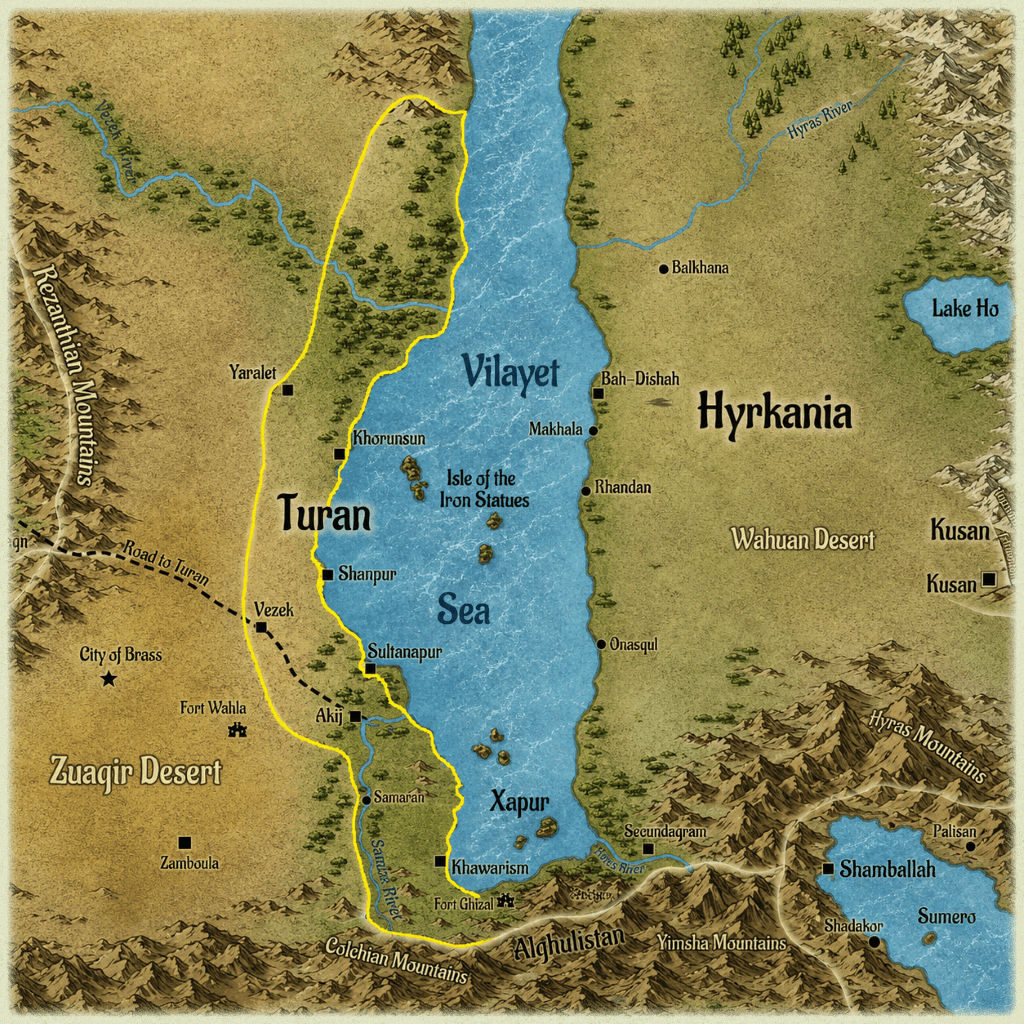

Turan is the dominant, sprawling empire of the East, a land of gilded domes, militaristic ambition, and vast horizons. Often referred to as the "Empire of the Vilayet," its power is centered around the vast inland Vilayet Sea, which serves as the lifeblood for its military logistics and trade.
Geographic Foundations
Turan’s geography is as varied as its imperial reach, stretching from the temperate grasslands of the west to the unforgiving, arid wastes of the east.
- The Vilayet Sea: The defining feature of Turan. This vast, inland sea allows the Turanian fleet to exert power rapidly across the empire. It is a vital artery for trade, military transport, and control.
- The Kezankian Mountains: A rugged, treacherous range serving as the primary natural barrier between Turan and the kingdom of Zamora. These peaks are infested with primitive hill-folk and dangerous, bestial creatures.
- The Misty Mountains: Stretching along the western coast of the Vilayet Sea, this range is the home of the bellicose Khozagri hillmen. The southern reaches of these mountains contain the ancient, sacred necropolises of Turan's long-dead kings.
- The Eastern Desert: A vast, harsh region that transitions westward into the highlands of Koth and the pastoral lands of Shem. It is a contested frontier, frequently skirmished over by Turanian patrols and the nomad tribes (Zuagirs) of Shem.
- Shan-e-Sorkh: A desolate portion of the Eastern Desert defined by its crimson sands and total lack of water. Within this lethal environment sits Akhlat, a city built upon a fertile oasis that is whispered to be haunted by spirits of the past.
- The Nightmare Swamp: A dark, foreboding marshland hiding the ruins of Puhru-Shatammu. Once a thriving commercial hub, the city was abandoned a century ago after being cursed by a demon. It is now reportedly guarded by hellish "devil lizards."
- Islands of the Vilayet: The Vilayet Sea is dotted with numerous islands. Most are desolate, avoided by sailors and pirates alike due to persistent rumors of hauntings and the ruins of long-forgotten, demon-worshipping cults.
Notable Imperial Cities
Turan is a land of hundreds of cities, ranging from the opulent seats of imperial power to grim border fortresses.
- Aghrapur: The capital city and the glittering heart of the empire. It is a city of immense wealth and the center of the Turanian imperial administration.
- Zamboula: A notorious city-state situated on the edge of the desert. It is known for its dark, subterranean mysteries, human-eating cannibals, and its significance as a trading crossroad.
- Akif: A powerful city near the northern frontiers, often acting as a bastion against incursions and a base for operations toward the northern reaches of the Vilayet.
- Al Azair, Ashraf, and Dimmorz: Major commercial and strategic hubs that maintain the empire's internal security and tax flow.
Imperial Scope and Borders
Turan is a true superpower, holding borders that challenge the strength of several other nations:
- West: Zamora and Koth.
- South: Shem (contested borders).
- North: Borders parts of Hyperborea and wilder territories.
- South-West: Proximity to Stygia.
The Turanian military is strictly organized and highly mobile, utilizing the sea and the rivers that crisscross the territory to strike at enemies before they can organize a defense. Its culture is a blend of the nomadic, horse-riding traditions of its eastern ancestors and the refined, decadent urbanism of the wealthy imperial centers.

Turan is a militaristic, expansionist empire built upon a foundation of ancient Hyrkanian conquest. It currently stands as one of the wealthiest nations in the world, rivaled only by Vendhya. The state is governed with absolute, iron-fisted authority from the throne, prioritizing imperial stability and constant outward growth above all else.
The Imperial Hierarchy
The government functions as an absolute autocracy, where all power flows downward from the monarch.
King Yezdigerd: The supreme ruler of Turan. He directs the empire’s expansionist policies and holds ultimate authority over the life and death of his subjects.
The Ruling Class: Immediately beneath the King are the nobility, the clergy, and the military leadership. Despite their high status, they are effectively servants to the throne. Their existence is justified only by their ability to protect the empire, expand its borders, and maximize the extraction of resources for the King.
The Productive Classes:
Farmers: Comprising the majority of the Turanian citizenry.
Craftsmen: Concentrated in the urban centers and cities.
Merchants: The engine of Turanian wealth and imperial trade.
The Enslaved: Occupying the lowest echelon, slaves are viewed as property rather than citizens and are formally excluded from the social hierarchy.
Stability and Succession
Turan employs brutal but effective measures to ensure the integrity of the state and prevent internal collapse.
- Succession Purge: To eliminate the threat of civil war or dynastic conflict, the ascension of a new king is marked by the immediate execution of all his brothers and his brothers' children.
- Provincial Oversight: To prevent local governors from seizing too much autonomy, the leadership of every province is divided among a triumvirate of three officials. These individuals are tasked with overseeing one another and reporting directly to the King, ensuring no single official can consolidate enough power to challenge the throne.
Meritocracy and Mobility
Despite the empire's authoritarian nature, Turanian society is a functional meritocracy.
- Social Mobility: Wealth and personal achievement are the primary drivers of status. Individuals are not strictly bound by their birth.
- Military Advancement: Military service serves as the most prominent vehicle for social climbing. Through bravery, tactical success, or loyal service, a citizen can rise through the ranks.
- Slave Potential: Remarkably, even those at the lowest level—slaves—can technically utilize military service to climb the social ladder, creating a unique incentive for loyalty even among the unfree.
Law and Order
Turan is governed by an "iron fist." The state maintains a zero-tolerance policy regarding political instability.
- Anti-Dissidence: Uprisings, rebellions, or even the smallest signs of dissent are met with immediate and overwhelming violence.
- Public Contentment: Paradoxically, despite the state's ruthlessness, the populace is generally content. This satisfaction is largely driven by the empire's immense wealth, economic opportunity, and the stability provided by King Yezdigerd’s firm rule.

Turan is a civilization built on the conviction that order, organization, and strict adherence to protocol are the true measures of humanity. Their culture is defined by a rigid sense of national superiority and a deep, foundational commitment to an honor code that governs every facet of life, from the palace to the marketplace.
National Identity and Pride
Turanians possess an unwavering belief in their own cultural supremacy. This nationalism renders them remarkably resistant to foreign influence; they do not adapt their customs, dress, or traditions to suit outside tastes. While they are frequent travelers and diplomats who interact constantly with other nations, they do so with the unshakable certainty that the Turanian way is the only "right" path. To a Turanian, true civilization is synonymous with the strict organization and preservation of their specific cultural honor.
Protocol and Order
Life in Turan is a series of choreographed interactions. The empire is a nation of protocols, with prescribed behaviors for nearly every scenario:
- Courtship and Daily Life: There are established expectations for conduct in the royal courts, public baths, city streets, and personal relationships.
- Regional Variation: While codes of behavior may shift depending on the province, the underlying insistence on order remains consistent across the empire.
The Legal Framework
Turanian law is a cornerstone of their society, functioning as a stabilizing force for the empire’s vast population.
- Oral Tradition: The law is not written in statute books but is maintained through a rigorous oral tradition.
- Specialized Jurists: Dedicated judges are responsible for upholding and interpreting these laws.
- Justice and Equity: Law applies to all citizens. While commoners are protected, the nobility and the elite face a harsher standard; they are expected to serve the King and the law without the slightest error, as their failures are viewed as a greater affront to imperial order.
- Retributive Justice: Turanian jurisprudence is rooted in the principle of lex talionis—an eye for an eye—ensuring that punishments mirror the severity of the offense.
- Gender and the Law: Turanian law holds the protection of women in high regard. Except in the case of one's own slave, the killing of a woman is strictly illegal.
The Code of Honor
Honor is the essential currency of the Turanian citizen. To maintain one's honor is to adhere strictly to the social expectations of the empire. Conversely, honor can be easily tarnished by improper behavior. Three specific transgressions are viewed with extreme societal and legal severity:
- Violation of a Woman: Sexual assault is considered a grave dishonor (excluding slaves).
- Unfair Combat: The Turanians prize martial excellence and personal skill. Disarming an opponent or engaging in "dirty" fighting is considered cowardly and disgraceful.
- Betrayal of Hospitality: Failing to protect a guest who has been welcomed under one’s roof is seen as a heinous breach of social trust, reflecting poorly on the individual’s character and family.
These offenses are not merely social slights; they are frequently treated as legal crimes punishable by the state, depending on the context and the status of those involved.

Turanian physical appearance reflects their Hyrkanian ancestry, characterized by an aesthetic of lean, desert-hardened grace. Their dress is a deliberate blend of practical adaptation to the climate and a deeply held system of religious symbolism meant to invite fortune and ward off misfortune.
Turanians are typically tall and slender. Their complexion ranges from tan to dark, echoing their Hyrkanian forebears. Both eyes and hair are predominantly dark, though, in rare instances, individuals may possess light brown hair.

Attire in Turan is highly standardized, serving as both a functional garment and a vessel for religious protection. They strictly avoid black and purple dyes, viewing these colors as omens of bad luck.
Standard Garments
- The Talismanic Shirt: Both men and women wear these tunics, which are intricately decorated with holy images and symbols. These garments are believed to be vessels for good fortune, and they are rarely seen without them.
- Male Attire: Men typically wear turbans, tunics, and loose-fitting trousers, providing comfort in the heat and mobility for their active, militaristic lifestyle.
- Female Attire: Public modesty is strictly enforced. Women are expected to be veiled at all times. In the most conservative societal circles, women favor the khalat, a long dress that conceals the entire body from neck to ankle.
Performers and Dancers
Performers serve as the notable exception to the rules of modest dress, though the cultural requirement for veiling remains:
- Dress: Dancers and performers generally wear nothing more than slim belts and minimal, strategic silks to allow for maximum movement.
- Veiling: Despite the skimpy nature of their costumes, female dancers are still required to keep their faces veiled.
Summary of Appearance
| Category | Standard |
|---|---|
| Build | Tall and slender |
| Complexion | Tan to dark |
| Hair/Eyes | Dark (rarely light brown hair) |
| Modesty | Veiling required for women |
| Unlucky Colors | Black and purple |
| Spiritual Protection | Talismanic shirts worn by all |

Turanian society presents a complex dichotomy: women enjoy significant legal and financial autonomy, yet they are systematically barred from the highest echelons of political power. The social structure is defined by arranged childhood unions, strict moral codes influenced by religious doctrine, and a surprising concentration of family wealth in the hands of women.
Legal and Financial Independence
While many women focus on the domestic sphere, this is often a matter of personal choice rather than legal requirement. Turanian women possess a high degree of independence.
- Autonomy: Women may pursue any profession, including military service. Notably, the field of medicine is dominated by women.
- Property Rights: Women can own land and resources on the same terms as men. Their property is legally protected; male relatives cannot sell a woman’s assets without her express, documented consent.
- Financial Control: Because men lack the same legal protections regarding property, family wealth in the wealthier classes is frequently held and managed by the women.
- Marital Independence: Women retain financial independence after marriage and possess the legal right to renounce or exit a marriage.
Political Constraints
Despite their economic and social freedoms, a "glass ceiling" exists in Turan. Positions of actual political power—governing, high imperial administration, and supreme leadership—are exclusively reserved for men.
Sexuality and Marriage
Marriage in Turan is a formal, legal contract, usually brokered well before the participants reach adulthood.
- Arranged Unions: Brides are typically chosen by the groom’s mother while the future spouses are children. Weddings usually occur between the ages of 10 and 15.
- Monogamy and Exceptions: The standard practice is monogamy. While polygamy is permitted in specific regions like Aghrapur, it is rare and typically utilized only to consolidate diplomatic or business alliances.
- Divorce: Divorce is accessible to both genders for any reason, though the legal risks and societal consequences are often heavier for men.
- Purity: Female virginity is highly prized for first-time brides. Because of the young age at which marriages are contracted, this standard is strictly upheld.
Social Values and Morality
Turanian society is conservative regarding public and private conduct, heavily influenced by the tenets of their primary deity, Erlik.
- Chastity and Moderation: Erlik promotes a lifestyle of moderation and chastity, which discourages promiscuity. Consequently, open sexual behavior is frowned upon.
- Social Taboos: Homosexuality is not accepted within Turanian society. The culture emphasizes traditional, stable family units and adheres to a moral framework that prioritizes order over individual sexual expression.
Summary of Gender Dynamics
| Feature | Status |
|---|---|
| Political Power | Reserved for men |
| Financial/Property Rights | Women possess full legal protection and autonomy |
| Professional Life | Open to women (Medicine is female-dominated) |
| Marriage Age | 10 to 15 years old |
| Moral Code | Based on Erlik’s teachings (chastity/moderation) |

In Turan, the slave population is a visible component of the imperial economy, serving as the backbone for both labor and private intrigue. Slavery is treated with the cold pragmatism of an empire that views humanity as a resource to be managed, utilized, and discarded.
The Reality of Slavery
Slavery in Turan is widespread and accessible, driven by the empire's vast wealth and its constant reach into neighboring territories.
- Origins: The slave population is highly cosmopolitan. The most common nationalities found in chains within Turan include Brythunians, Nemedians, Stygians, Zamorians, Shemites, Darfari, and Kushites.
- Cost and Accessibility: Slaves are generally inexpensive, making them accessible to a wide cross-section of Turanian society, not just the ultra-wealthy.
- Legal Status: Slaves possess no citizenship and are categorized strictly as property. Because they exist outside the protection of Turanian law, they have no legal recourse against the whims of their masters.
- Usage: Slaves are tasked with any labor their owner demands. Beyond manual labor, they are frequently utilized as disposable tools in the complex political and social schemes of the nobility, serving as spies, messengers, or pawns.
- Social Mobility: Despite their status as property, the Turanian meritocratic system technically allows for upward mobility. Exceptional individuals may, through significant achievement or military service, ascend the social ladder.
The Conditions of Servitude
Life for a slave in Turan is uniformly harsh, though the degree of suffering varies by labor.
- The Ship Slaves: These individuals endure the most brutal existence in the empire. Forced to row the massive vessels that fuel Turan’s naval power and trade, ship slaves are kept in horrific conditions. The physical toll is extreme, and mortality rates are high; few ship slaves survive their labor for long.
- The Kozaki Alternative: The brutality of slave life drives many to flee. A common path for those who manage to escape their masters is to strike out for the steppes, where they join the Kozaki—bands of outlaws and rebels—to seek vengeance against the imperial masters they left behind.
Prostitution
While the provided texts focus heavily on the institutionalization of slavery, Turanian culture maintains a strict moral and religious framework that influences the nature of sex work.
- Social Taboos: Due to the influence of Erlik, who champions chastity and moderation, promiscuity and open vice are generally not accepted in Turan.
- Performers vs. Vice: Unlike the sacred temple prostitution found in other regions, sexual labor in Turan is often obscured by the rigid societal adherence to "order and tradition." Dancers are the primary exception to the empire’s strict modesty codes, but they exist as performers who are culturally distinct from the vice-oriented prostitution seen in more decadent or permissive civilizations.
Summary of Slavery
| Feature | Status |
|---|---|
| Legal Standing | Property; no legal protection |
| Availability | Affordable and widespread |
| Common Origins | Brythunia, Nemedia, Stygia, Zamora, Shem, Darfar, Kush |
| The Ship Slaves | High-mortality, brutal rowing labor |
| Path to Freedom | Military service or extreme merit; escape to Kozaki |

Turan functions as the central commercial hub of the East, leveraging its massive size and military might to dominate the trade routes of the Hyborian Age. The empire’s economy is a sophisticated engine of agricultural production, tribute-gathering, and mercenary-like trade enforcement.
Imperial Commerce and Trade Routes
Turan’s influence extends far beyond its own borders, creating a mercantile sphere that encompasses the known world.
- Global Reach: The empire maintains established, high-value trade routes stretching to the distant lands of Iranistan, Stygia, Vendhya, and Khitai.
- The Tribute System: Turan enforces its economic hegemony by demanding tribute from smaller or weaker nations—including Koth, Shem, Brythunia, and Zamora. In exchange for these payments, these nations are granted the "privilege" of moving their goods along Turanian-controlled routes.
- The Marketplace: Turanian cities are defined by their vibrant markets. Since urban citizens do not engage in agriculture, the city-dwellers are entirely dependent on these vendors for survival, making the market the true heart of every Turanian urban center.
The Agricultural Backbone
Despite the empire's reputation for war and gold, its economic foundation is surprisingly humble and agrarian.
- Export Dominance: A staggering 90% of Turanian exports are agricultural products. These goods flow primarily into the markets of Stygia and Shem, which rely heavily on Turanian surpluses.
- Occupations: While the empire boasts a diverse range of professions, the overwhelming majority of the population is engaged in agricultural labor, which remains the most essential sector for the stability of the state.
Slavery and the Human Trade
Human beings are a standard commodity in the Turanian economy.
- High Supply, Low Cost: Slave commerce is a ubiquitous feature of all Turanian cities. Because the empire is constantly expanding and conducting raids, the supply of slaves is so plentiful that even high-quality slaves remain relatively inexpensive.
Crime and Piracy
Not all Turanians can (or wish to) adhere to the rigid, lawful standards demanded by the empire's strict social protocols.
- The Vilayet Sea: Piracy is a rampant issue on the Vilayet Sea. For those who find the laws of the empire too suffocating or who fall out of favor with the authorities, piracy and organized crime represent a viable, albeit dangerous, career alternative. These renegades frequently prey upon the very trade routes that the imperial fleet is meant to protect.
Economic Summary
| Category | Description |
|---|---|
| Agricultural Exports | 90% of total exports; vital to Stygia and Shem |
| Tribute Partners | Koth, Shem, Brythunia, Zamora |
| Slave Trade | Ubiquitous, high supply, low cost |
| Common Jobs | Primarily agricultural laborers |
| Illicit Activity | Piracy on the Vilayet Sea |

The religious landscape of Turan is dominated by the worship of Erlik, the "Yellow God of Death." A legacy of their Hyrkanian ancestors, the faith is deeply tied to the empire’s martial culture, viewing life as a testing ground for warriors and death as a divine transition overseen by their patron.
The Cult of Erlik
Erlik is venerated as the First Man, a god of both death and war. His influence is absolute, and his favor is the primary concern of the Turanian state and its vast military.
- Sacred Sacrament: The Lotus is considered a holy sacrament, strictly reserved for those destined to reach Paradise. Consequently, the cult of Erlik is intensely hostile toward any non-believer who consumes, grows, or utilizes lotus in their own rituals.
- The "Thutala": Turanians possess a dismissive, exclusionary view of foreign faiths. All gods worshiped outside of the Turanian tradition are collectively dismissed as "Thutala"—a singular, trickster entity that assumes various guises to deceive non-believers.
- Martial Veneration: Erlik respects those who live and die by the sword, making him the ideal deity for the vast, expansionist armies of Turan.
Priesthood and Sorcery
The priesthood of Erlik serves as the empire's gatekeepers of the divine and the arcane.
- Structure: The priesthood is exclusively male. The most devoted followers, including the priests themselves, practice strict chastity and abstinence from alcohol.
- Sorcerous Blessing: Priests of Erlik are the primary practitioners of sorcery in Turan. While necromancy is permitted, it is governed by a rigid code of behavior. It is believed that Erlik grants these powers, and priests who deviate from his path find themselves instantly stripped of their magical abilities.
Rituals and Burial Practices
Religion in Turan is public and grandiose, with massive temples in every city open for the offerings of the common folk.
- Sacrifices: Monthly sacrifices are mandatory. These can take the form of blood or life offerings, with slaves frequently utilized as the victims.
- Funerary Rites: Burials are deeply symbolic, often involving the placement of green branches in the hands of the deceased. If the deceased owned a horse, the animal is draped in black and follows the funeral procession.
- The Cypress Test: A cypress tree is planted at the grave. A tree that thrives indicates the deceased has entered Paradise; a tree that withers or dies is interpreted as the soul descending into the torment of Erlik’s demons.
The Prophet Tarim
The state religion centers on Tarim, a mystic and founding figure of Turan, portrayed by the high priests as a living avatar of Erlik.
- The Living Tarim: The title is traditionally held by the direct descendants of Tarim.
- The Imperial Secret: While the public still reveres the "Living Tarim" as a prophet and avatar, the ruling class is aware that the last known descendant died after being captured by Hyrkanians. To preserve order, the government maintains the facade that the avatar still lives, explaining his recent lack of public appearances as a divine mystery.
Religious Influences
| Deity / Entity | Role / Description |
|---|---|
| Erlik | The "Yellow God of Death"; patron of warriors. |
| Thutala | A collective term for all foreign "false" gods. |
| Tarim | The Prophet/Avatar of Erlik; revered by the masses. |
| Yenagra | The Turanian name for Ishtar, worshiped by populations near Koth. |

To play a Turanian is to embody the discipline, martial ambition, and rigid cultural superiority of the greatest empire of the East. You are a product of a vast, golden-domed civilization that commands the Vilayet Sea and demands tribute from the surrounding kingdoms. Whether you are a disciplined officer of King Yezdigerd’s army, an ambitious merchant navigating the imperial protocols, or a survivor of the harsh frontier, you know that order, honor, and service to the state are the bedrock of civilization.
Core Identity
- Race: Turanian. Typically tall and slender with tan to dark skin. Hair and eyes are dark, though light brown hair occurs in rare instances.
- Language: Turanian (A precise, formal tongue used for complex protocols, military commands, and religious rites).
- Names: Strong, resonant, and often reflecting Hyrkanian heritage or imperial prestige.
- Male: Al-Hafiz, Azim, Boru, Jamil, Keshvan, Malik, Rostam, Yezd.
- Female: Azura, Farah, Gulnar, Jihan, Leyla, Mina, Parisa, Yasmin.
Personality and Archetypes
- The Imperial Nationalist: You possess an unwavering belief that Turan is the pinnacle of civilization. You are slow to adapt to foreign ways and view external customs as inferior or "Thutala" deception.
- The Protocol-Bound: You view life as a series of formal interactions. Whether in the bath, the court, or the market, you adhere strictly to the protocols required by your station, believing that organization equals honor.
- The Meritocratic Warrior: You believe status is earned through action. You are ambitious and career-minded, viewing every service to the King as a step toward higher rank, wealth, and influence.
- The Martial Stoic: Shaped by the worship of Erlik, you value courage, moderation, and martial prowess. You are disciplined, often abstaining from excesses to prove your worthiness to the "Yellow God of Death."
Combat Roles and Equipment
- Imperial Lancer: A member of the elite cavalry that enforces Turan's borders. You are armored in lacquered scale and trained to strike with a long lance and curved scimitar from horseback.
- Vilayet Marine: A disciplined sailor and soldier who maintains control over the Vilayet Sea. You are trained for boarding actions, wielding a short spear and a boarding axe.
- Erlik’s Acolyte: A warrior-priest who serves in the temples of the Yellow God. You use ritualistic weapons and are trained in the harsh, sacrificial rites of the state religion.
- Border Scout: A veteran of the Eastern Desert or the Misty Mountains. You prioritize mobility and survival, favoring the composite bow and a talent for ambushing those who threaten imperial trade routes.
Social Rank and Background
- Triumvirate Official: You are one of the three administrators overseeing a province. You are skilled in bureaucracy, surveillance, and reporting to the throne, constantly watching your peers for signs of dissent.
- Imperial Merchant: You operate under the King's protection, managing trade routes and ensuring the collection of tribute from neighboring vassal states.
- Military Veteran: You have climbed the social ladder through years of service. You are hardened, respected, and deeply loyal to the military structure that lifted you from your origins.
- Temple Guardian: You serve in the grandiose temples of Erlik. Your life is marked by religious duty, chastity, and the maintenance of the empire’s moral and sacrificial protocols.
- Urban Artisan: A resident of a great city like Aghrapur. You work in the markets, contributing to the agricultural and manufacturing heart of the empire.
Starting Package
Every Turanian character begins with gear reflecting the discipline and prosperity of the empire:
- Traditional Attire: A set of loose-fitting trousers and a tunic, covered by a Talismanic Shirt (decorated with sacred symbols for luck) and a sturdy turban.
- Footwear: Sturdy, well-crafted leather sandals or boots.
- Primary Weapon: A curved steel scimitar or a high-quality composite bow with a quiver of arrows.
- Personal Seal: A small bronze signet ring or clay token indicating your administrative or temple affiliation.
- Provisions: A water-skin, a pouch of dried grain or dates, and a small, blessed amulet of Erlik.
- Status Indicator: A pair of green branches (carried in honor of burial rites and divine transition).

- Return to the Road of Kings (Mongoose Publishing): Essential for mapping the vast cities, the Vilayet Sea, and the geopolitical scope of the Turanian Empire.
- Faith & Fervour (Mongoose Publishing): The primary source for the worship of Erlik, the death rites, and the role of the priesthood in Turanian society.
- The People of the Black Circle (Robert E. Howard): Features Turan’s interaction with the East and its complex military and sorcerous hierarchy.
- Conan the Conqueror (Robert E. Howard): Provides context on Turan’s position as a world power and its rivalry with the West.