
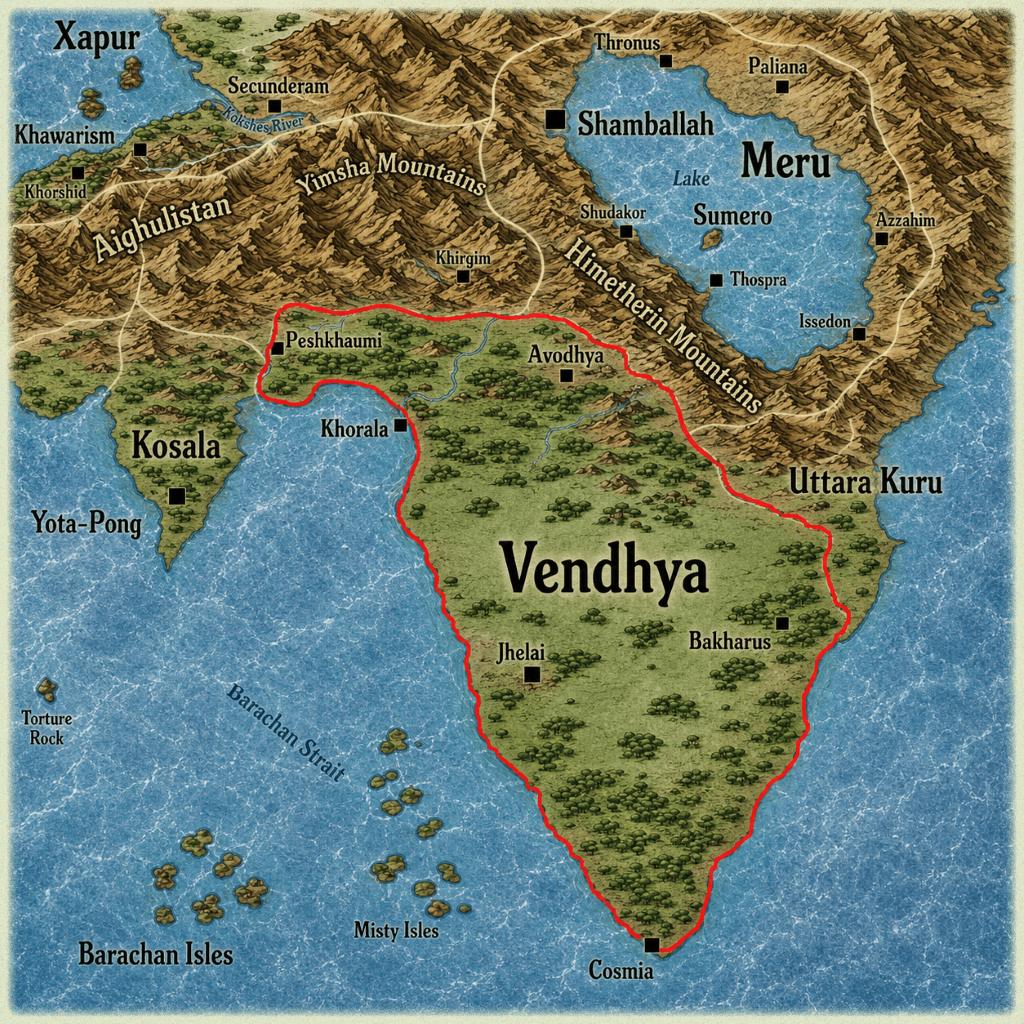

Vendhya as a whole is extremely fertile, although the stony regions of the Himelian foothills are considerably less so. This fertility brings about a well-developed agricultural environment. In addition, Vendhya’s northern mountains are a thriving source of copper, silver, gold, and iron. Unfortunately, the southern coasts are ill-suited for seafarers and seaports, limiting much of Vendhya’s trade to overland routes, which the Himelian tribesmen make dangerous. Vendhya has wide expanses of untamed forests and jungles where man should not tread lightly, for most do not return from such places where nature runs wild and rules the fate of those who enter.
Femesh Valley – Femesh Valley lies along a tributary of the Jhumda River.
Forests of Ghendai – These dire forests lie but a few leagues to the west of Gwandiakan in eastern Vendhya. The people of the area avoid cutting down the tall trees or going anywhere near the forest, so no road cuts through this dense wood. The forests are filled with huge swarms of tiny, stinging flies and dangerous fevers that bring intense pain that lingers until death brings an end. Most Vendhyans would rather die than risk the insanity and infections of this fearsome forest. Because of its reputation, the forest continues to expand and grow, swallowing entire cities over time. One such city was Maharashtra, which now lies inside the confines of this killer wood. The forest has a thick canopy overhead that effectively hides the hot sun but creates a greenhouse heat. Birds scream and monkeys play in the high canopies of the forest, creating a noise that can be almost overwhelming.
Himelian Mountains – This is an impressive mountain range north of Vendhya. The mountains are cold and high. An important pass through the mountains is the Zhaibar Pass, which is the road from Peshkhauri into Hyrkania beneath the watchful mountain Yimsha and through the valley of Gurasha. This range is inhabited by fierce tribesmen. Trails criss-cross the mountains except in the virtually impassable centre, but mostly these paths are thin and dangerous; few civilised men would even dare to cross them without an army, largely because of the tribesmen. Most of the passes are suitable for horse-travel. Only the hillmen know all the paths and features of these twisting, hulking mountains and vast, engulfing escarpments. The Zhaibar Pass is the most famous route through the mountains, although others such as the Shamla Pass and the Amir Jehun Pass exist. Snow makes most of these passes impossible to travel in the winter months, although the summer brings caravan travel from Hyrkania to Vendhya. The southern reach of this dangerous range is called Ghulistan. The south-western portion of Ghulistan is referred to as Afghulistan. Several tribes of hillmen reside in these dark mountains, including the Zhaibari, the Wazuli, the Dagozai, the Khurakzai, the Wamadzi, and the Uzbak.
Jhumda River – This river flows south-west through Vendhya from the Himelian Mountains. The river lies between Ayodhya and the Ghulistan border. It also runs along the border of Kosala, a kingdom to the west of Vendhya.
Misty Isles – The Misty Isles are islands off the western coast of Vendhya. Secret herbs and plants are grown here and sold to sorcerers and connoisseurs around the world.
Cities and Settlements
Cities, towns, and villages are noisy places in Vendhya. The gongs and chanting from the temples reverberate through the air, but the villages and towns are lively places of great secular activity. Not only are the people vivid and loud, the animals are too. Vendhyan cities are characterised by the number of free-roaming animals that inhabit them. Monkeys hang out in the bazaars and shops, hoping to steal fruit from a stall or a passer-by. Elephants trumpet as they tromp around, led by Kshatriya squads. Birds of all sorts squawk incessantly.
Ayodhya – Ayodhya is the capital of Vendhya and has been the seat of powerful monarchs for centuries. The city was built and maintained as a symbol of Kshatriyan authority in this huge realm. This is where the Devi Yasmina rules. The city is laid out with a sacred centre, a royal zone, and an urban core, all separated by irrigated valleys. It is home to more than 460,000 residents, making it a massive Hyborian Age metropolis.
Bhagobah (Ruin) – The ruin of Bhagobah is located a half-day’s journey from Gopur, deep in the jungles of the south. It was built by slobbering homunculi, who summoned the people of Gopur, who were never heard from again. It is haunted by the undead form of an ancient hero and great worms worshipped as gods.
Gopur – Gopur is a city of golden minarets. It lies near the southern jungles. It is ruled by Princess Khajura. The people of the city must hide at night or be lured to Bhagobah by the ghost of a prince, the brother of Princess Khajura. Those who are lured are never seen again.
Gwandiakan – Gwandiakan is the first city some caravans crossing the Himelias stop at; it is located in eastern Vendhya. It also served as a favoured summer resort for Kshatriyan nobles until the Great Forest of Ghendai started growing too close, bringing with it deadly plagues and swarms of biting insects. Here the women dress from head to toe but in such sheer silk that the clothing actually conceals nothing. Dancers dress in veils that are discarded until they are dancing nude with but a single veil over their faces. The city is becoming more and more deserted as the forest creeps closer. It currently has a population of some 26,000 people, although it could easily hold and support 150,000. Great walls surround the city, which is characterised by alabaster towers, minarets, and domes.
Jhelai – This is a cave-pocked mountain where ascetics live. This sect requires a separation of past, so the monks and hermits no longer use names nor do they abide by the caste system used by the rest of Vendhya. Most of these hermits are scholars, although they do not use books or tomes for their philosophies and theurgies. They are consulted as oracles by those who know of them.
Kanghra – Kanghra is a northern Vendhyan city. The King’s Summer Court can be found in a beautiful vale in this city.
Maharashtra (Ruin) – This is an ancient city of Vendhya. The streets are covered in dirt and humus, and the trees of the tall forest that surrounds the ruin have grown everywhere. Two thousand years ago, this was the city of the first Vendhyan King, Orissa. When he died, he was worshipped as a god in a temple built over his tomb. Five hundred years later, the city was sacked and abandoned. In time it was absorbed by the Forest of Ghendai and its location lost.
Najapur – Najapur is a city-province of western Vendhya. The province is mostly verdant forests.
Peshkhauri – This is a powerful city and province in north-western Vendhya, an hour’s ride westward or northward of the Himelians. Like all Vendhyan cities, Peshkhauri is relatively noisy, replete with song, instruments, and the noises of animals. This is a dangerous city, charged with keeping the hillmen in the hills. The prison quarters are separated from the rest of the city by a massive wall inset with an iron-bound door under an arch. The door is always guarded. Peshkhauri has a population of more than 28,000 people.
Shirakma – Shirakma is a region of Vendhya where wine is produced.

The government of Vendhya is defined by its remarkable efficiency and organized structure. It operates as a sophisticated administrative state that prioritizes the stability of its populace, ensuring that the wheels of society turn through a system of state-sponsored support and communal welfare.
Administrative Philosophy
Vendhyan governance is characterized by its proactive approach to social management. Unlike the feudal or slave-driven labor models found in many Western kingdoms like Aquilonia or Nemedia, the Vendhyan state maintains its infrastructure and public works through a system of paid labor, avoiding the reliance on forced servitude for its monumental projects.
State-Sponsored Social Support
The empire utilizes its wealth to ensure the well-being of its citizens through several key mechanisms:
- Public Health: The state provides free medical care to the populace, recognizing the value of a healthy citizenry to the empire’s continued strength.
- Stipends for the Arts: A unique aspect of Vendhyan policy is the financial support provided to those of creative pursuits. Artisans, craftsmen, and poets receive government stipends, liberating them from the burden of manual labor and allowing them to devote their lives entirely to the development of their art.
- Consistent Compensation: All levels of the state apparatus, from the highest-ranking government officials to the common soldier and the domestic servant, are paid regularly. This regularity ensures loyalty and reduces the temptation of corruption or local instability.
Communal Economy
Vendhyan society is built on a foundation of collective responsibility, particularly regarding the most critical resource: food.
- Communal Grain Storage: Towns and cities feature large, central granaries where the community's grain is stored.
- The Anti-Hoarding Ethos: There is a strong cultural and legal imperative against private hoarding. Food is viewed as a communal asset to be enjoyed by all; consequently, the poor are actively fed through these communal reserves, ensuring that the empire rarely suffers from the famines that plague less organized nations.
The Social Divide
While the state provides high levels of care for the general citizenry, this system has a stark limitation:
- The "Untouchables": The social welfare and organizational benefits of the Vendhyan state do not extend to the aboriginal "untouchable" caste. They remain outside the protection of the state's social initiatives and the caste-integrated structures that define the lives of other Vendhyans.

Vendhya is a civilization defined by a profound appreciation for existence. While deeply rooted in complex philosophical and religious traditions, its culture is remarkably hedonistic and aesthetic, focusing on the beauty of life. This culture is heavily stratified by its caste system, yet even within those bounds, there is a pervasive, almost magical reverence for artistic expression.
The Aesthetic of Life
Vendhyan life, particularly for the elite Kshatriya caste, is vibrant and indulgent.
- Art and Literature: Vendhyan artistic expression is largely defined by its celebration of life, often manifesting in highly erotic literature and visual arts.
- The Power of Dance: Dance is the preeminent art form in Vendhya. It is both a performative and spiritual endeavor, used to recount the deeds of gods and heroes or to impart moral instruction.
- Gestural Language: The dance is noted for its intricate code of hand gestures. A single hand position can convey complex emotions, represent deities, mimic animals, or signify natural forces. These movements are considered so precise and evocative that they are believed to border on the magical, capable of influencing the spirits of both men and nature.
- Visual Motifs: Vendhyan art, including painting and sculpture, is characterized by its exoticism to Western eyes. It features depictions of multi-armed deities and mortal heroes, embellished with painstaking detail, including spirals, tendrils, vines, and sweeping architectural curves.
Social Infrastructure and Travel
Vendhyan society is organized differently from the Western Hyborian kingdoms, reflecting its unique reliance on pilgrimage and state-managed transit.
- Accommodation: Unlike the ubiquitous inns of Western cities like Shadizar, Vendhya utilizes guest houses specifically for the massive influx of pilgrims traveling between its holy cities.
- Taverns: While present and functioning as hubs for information, they operate differently than their Western counterparts.
- Xenophobia and Surveillance: Foreigners are viewed with deep suspicion and are frequently treated as potential spies. The society is a crucible of intelligence gathering; the art of spying is long-established and highly developed. For an outsider, navigating social circles or gathering information is exceptionally difficult, and the penalty for being identified as a spy is severe, often resulting in execution or forced servitude.
Slavery and Punishment
While Vendhya is a prosperous and highly organized state, it is not without its darker aspects.
- Universal Slavery: Slavery is an entrenched fact of life. It is not limited by caste; indeed, slavery is frequently employed as a legal punishment for crimes, meaning individuals from any caste, including those once high-born, can find themselves stripped of their status and reduced to property.

The aesthetic of the Vendhyan people is characterized by a refined elegance and a vibrant, color-conscious approach to dress. Their style is heavily influenced by the tropical climate, religious modesty codes, and a profound cultural love for precious metals and ornate jewelry.
Vendhyans typically possess a distinct, graceful physical profile.
- Physique: They generally have a slim body style and olive-toned skin.
- Features: They are noted for having straight black hair and large, dark eyes.
- Enhancements: Women commonly use make-up to accentuate their eyes, further emphasizing their natural size and darkness.

Clothing in Vendhya is deeply intertwined with religious and secular regulations. While the climate dictates much of the functional style, the use of color and ornamentation serves as a primary expression of status and piety.
Female Attire
Vendhyan women favor lightweight, gauzy fabrics that allow for breathability in the heat.
- Basic Garments: The dhoti serves as the foundational garment, an unstitched length of filmy cloth wrapped around the lower body. Women may pair this with a choli, a loose-fitting blouse.
- Regional Variations: Women in warmer regions dress minimally, while those in mountainous areas dress more conservatively.
- Saris: While urban women rarely wear saris, these lengths of fabric, wrapped around the entire body with one end draped over the shoulder, remain common among tribal populations.
- Adornments: Women decorate themselves extensively with jewelry, including nose rings, anklets, tiaras, crowns, armbands, and waist belts. In some contexts, they drape filmy robes or gauzy veils over their attire. Dancing girls frequently perform in minimal dress, consisting only of a veil, ankle bells, and finger cymbals.
Male Attire
Men’s clothing is typically more uniform in color but allows for versatility in how the fabric is worn.
- Dhoti: Men primarily wear the dhoti, though usually in white or black rather than the vibrant colors favored by women. It can be wrapped as a skirt or tucked between the legs to function as trousers.
- Upper Body: Men may wear fitted shirts or vests, though many choose to remain bare-chested.
- Headgear and Jewelry: Nearly all men wear large turbans, which are often decorated with feathers. Male jewelry is also common, including rings, bracelets, and anklets.


In Vendhya, slavery and prostitution are deeply institutionalized systems integrated into the caste-based hierarchy and legal frameworks of the nation. While the empire boasts a sophisticated administrative welfare state for its free citizens, these darker industries operate under rigid state surveillance, cultural rules, and judicial practices.
Slavery and Judicial Punishment
Slavery in Vendhya serves as both a primary economic force and a severe instrument of the legal system. Unlike the purely racially driven or foreign-sourced slave trades of some Western Hyborian nations, the Vendhyan slave population is drawn from internal and external sources alike.
- Universal Caste Vulnerability: Slavery is a recognized legal punishment that spans across the societal spectrum. An individual from any caste, including the high-born Kshatriya or even members of the priesthood who commit grave offenses against the state or cosmic order, can be stripped of their status and reduced to property.
- The Untouchables: The indigenous aboriginal populations, who exist outside the traditional four-tier caste system as untouchables, are highly vulnerable to institutional exploitation and forced labor, providing a permanent underclass for the most grueling domestic and state tasks.
- Royal and Domestic Servitude: Slaves are common fixtures within royal palaces, such as the grand court of Ayodhya. Slave-girls perform menial tasks, act as attendants to the royal family, or serve as food and wine tasters to protect monarchs from assassination.
Courtesans and Dancing Girls
Prostitution in Vendhya is deeply intertwined with the nation's aesthetic celebration of pleasure, dance, and eroticism. Sex work and erotic performance are highly visible parts of urban secular life, heavily concentrated around the bustling city bazaars, taverns, and luxurious nobility resorts.
- The Cult of the Dance: The highest art form in Vendhya is dance, which often carries spiritual connotations or tells epic historical stories. Many courtesans are highly trained dancing girls who utilize the sophisticated codes of hand-gesturing to captivate audiences before transitioning to physical intimacy.
- The Aesthetic of the Veil: In pleasure hubs like the alabaster-towered city of Gwandiakan, performance attire is tightly regulated yet highly provocative. Dancing girls often perform wearing only ankle-bells, finger-cymbals, and sheer, gauzy veils. These veils are systematically discarded during the performance until the dancer is nude, save for a single veil obscuring the face.
- State Revenue and Surveillance: Taverns and pleasure houses serve as prime locations for the exchange of coin and information. Because foreigners are viewed with intense suspicion as potential spies, these establishments are heavily monitored by the state's internal espionage network, where courtesans often double as informants for Kshatriya authorities.

Vendhya maintains a position of relative economic independence, bolstered by vast natural resources and a highly organized agrarian foundation. While the empire is largely self-sufficient, it selectively engages in trade with neighboring powers, carefully regulating its exports to ensure that the finest products of its culture remain within its borders.
Economic Foundation
The Vendhyan economy is anchored by three primary pillars: mineral wealth, intensive agriculture, and specialized textile production.
- Mineral Wealth: The northern reaches of the realm provide abundant access to gold, silver, copper, and iron, fueling the empire’s immense capacity for luxury ornamentation and high-quality metallurgical work.
- Agriculture and Livestock: The fertile landscape supports a diverse agricultural output, including wheat, barley, rice, and peas. Fruit cultivation, particularly dates and melons, is widespread. The animal husbandry sector is equally robust, with farmers managing herds of sheep, pigs, water buffalo, and zebus, while fishing remains a staple of the diet in both rural villages and urban centers.
- Textiles: Vendhya is renowned for its production of fine cotton and silk, which form a major part of the domestic economy.
Trade and Export Philosophy
Vendhyan trade is defined by a policy of "national preference." The state prioritizes the needs and luxuries of its own citizens above foreign markets.
- Selective Trade: Vendhya maintains active trade relationships with Iranistan and Turan. However, they never trade their highest-quality items. The best work of their artists, farmers, and craftsmen is reserved strictly for Vendhyans; only the surplus or secondary-quality goods are offered to foreign merchants.
- Renowned Exports:
- Vendhyan Steel: Their steel is prized for being exceptionally light and virtually unbreakable, making Vendhyan swords a highly sought-after commodity among the military elites of the eastern nations.
- Shirakman Wine: This aromatic, scented wine is a famous export. While its exact origin remains debated, whether it is a specific geographic region, a vineyard, or merely a distinct style of wine, it is celebrated both locally and abroad.
Professions and Artisanal Life
The societal emphasis on art and specialization ensures a steady output of high-quality craftsmanship, supported by the state-stipends mentioned in previous administrative records.
- Craftsmanship: Beyond the agrarian majority, Vendhya hosts a thriving class of specialized artisans. Because craftsmen, poets, and artists receive government stipends, they can dedicate their lives to mastering their trades without the distraction of manual labor.
- Economic Structure: Because the government provides for the basic needs of its people, such as food from communal granaries, the professional class is free to focus on refining their specific skills, leading to the sophisticated goods that define Vendhyan commerce.

Vendhya reveres the mystical religion of Asura, a faith born of enormously complex rituals derived from four great books. These texts are the compilations of centuries of religious thought and practice. The people believe in a cosmic order and in cause and effect that extends beyond the physical realm.
The Priestly Class
The priestly class prizes their intellectual acumen, and they use that intelligence to further their own aims.
- Preservation of Order: Even as the Vendhyan civilisation was taking shape, the priests taught that if these mysterious and shadowed rituals were performed incorrectly, the cosmic order would be disturbed and catastrophe would follow.
- Divine Oversight: Asura keeps a keen eye on how smoothly the world runs, requiring constant maintenance through ritual.
- Spiritual Hierarchy: The priests were the only ones who could perform these clamorous rituals properly, allowing them to rise as a class above even the Kshatriyan rulers, at least in spiritual matters.
Beliefs and Afterlife
Vendhyan religious thought is anchored in a structured understanding of divine justice and moral consequence.
- Judgment and Fate: As a result of this sense of cosmic order and justice, Vendhyans believe in a heaven, a hell, and the judgment of souls.

To play a Vendhyan is to embody the ancient wisdom, vibrant aesthetic, and absolute belief in the cosmic order that defines the greatest empire of the South. You are a product of an incredibly fertile, gold-rich civilization where nature runs wild, yet human society is governed by centuries of strict religious and secular rules. Whether you are a high-born Kshatriya warrior executing the will of the Devi Yasmina, a Brahmin priest interpreting the sacred books of Asura, or a state-supported artisan perfecting your craft, you know that cause and effect extend far beyond the physical realm and that every action shapes the judgment of your soul.
Core Identity
- Race: Vendhyan. Typically possessing a slim, graceful body style and olive-toned skin. Hair is straight and black, framing large, remarkably dark and expressive eyes.
- Language: Vendhyan (A melodic, highly structured language rich in philosophical nuance and formal court etiquette).
- Names: Elegant, resonant, and deeply tied to ancient southern heritage or spiritual lineages.
- Male: Chunder, Firoz, Gokal, Jehun, Khemsa, Orissa, Ram, Shamla.
- Female: Gitanjali, Khajura, Lalita, Padmini, Priyam, Sanjula, Veda, Yasmina.
Personality and Archetypes
- The Aesthetic Hedonist: You possess a profound, almost spiritual love for life, beauty, and pleasure. You view art, erotic literature, and intricate performance not as distractions, but as the ultimate expressions of a divine, harmonious existence.
- The Cosmic Traditionalist: You view the universe through the absolute lens of cause and effect. You are meticulously careful to follow the countless religious and secular rules governing daily life, believing that stepping out of line invites immediate cosmic catastrophe or a terrifying judgment in the afterlife.
- The State Loyalist: Raised in a highly organized, efficient welfare state that feeds the poor and pays its public laborers, you harbor a fierce pride in Vendhya's superiority. You look upon the forced labor models of Western nations like Aquilonia and Nemedia with deep moral disgust.
- The Watchful Xenophobe: Shaped by an ancient tradition of internal espionage and a constant threat of foreign infiltration, you are deeply suspicious of outsiders. You treat all foreigners as potential spies and are fiercely guarded with information.
Combat Roles and Equipment
- Kshatriya Elephant Master: A disciplined noble warrior trained to ride and command the massive war elephants that tromp through the metropolis, executing squads with tactical precision. You wear beautifully embellished armor and wield a heavy lance.
- Peshkhauri Border Guard: A hardened veteran stationed at the dangerous northwestern frontier. You are charged with keeping the fierce Himelian hillmen in their peaks, relying on unyielding discipline, light armor, and a razor-sharp sword of unbreakable Vendhyan steel.
- Asuran Inquisitor: A martial agent of the priesthood who ensures that religious heresies do not disrupt the cosmic balance. You are trained to spot spiritual deviation and carry specialized ritualistic weapons to enforce the laws of Asura.
- Gwandiakan Scout: A tracker familiar with the dense, terrifying frontiers bordering the creeping Forests of Ghendai. You excel at surviving greenhouse heats, resisting deadly fevers, and navigating wild jungles where most men tread once and never return.
Social Rank and Background
- Brahmin Scholar: A member of the highest priestly class who prizes intellectual acumen above all else. You spend your life studying the complex rituals of the four great books, holding immense spiritual authority over even the Kshatriyan rulers.
- Kshatriya Noble: A member of the warrior and ruling elite. You are accustomed to a life of vibrant luxury, regular state compensation, and summer retreats to beautiful vales like Kanghra or the alabaster towers of Gwandiakan.
- Stipended Artisan: A master craftsman, poet, or painter. Supported entirely by a regular government stipend, you have never known the burden of manual labor and have dedicated your life strictly to refining Vendhya's exotic, curvaceous art forms.
- Temple Dancer: A highly trained performer skilled in the complicated, borderline-magical codes of hand-gesturing. Your poses can alter the atmosphere, shift human emotion, or recount the epic moral lessons of the gods.
- Aboriginal Untouchable: Born outside the four traditional castes, you are excluded from the state's medical care and communal grain storage. You are a survivor of institutional exploitation, utilizing a lifetime of grit and street-smart survival to navigate the noisy urban cores.
Starting Package
Every Vendhyan character begins with gear reflecting the wealth, spiritual devotion, and distinct styles of the empire:
- Traditional Attire: A lightweight, finely woven dhoti (unstitched cloth wrapped around the waist) and either a fitted choli blouse or a bare upper torso, topped by a large, protective turban for men or a filmy robe for women.
- Footwear: Light, flexible leather sandals suitable for navigating hot urban stone or muddy jungle trails.
- Primary Weapon: An exceptionally light, nearly unbreakable sword forged from prized Vendhyan steel, or a curved ceremonial dagger.
- Cosmetic Accoutrements: A small case of dark eye makeup used by both women and men to enhance and enlarge the appearance of the eyes.
- Provisions: A water-skin, a pouch of warm wheat bread, and a sealed container of barley or dried dates gathered from a communal town granary.
- Personal Adornment: A striking piece of silver or gold jewelry—such as an armband, anklet, or nose ring—painstakingly detailed with spirals and tendrils.

- The People of the Black Circle (Robert E. Howard): The foundational source for Vendhyan lore, introducing the capital Ayodhya, Devi Yasmina, the outpost of Peshkhauri, and the fierce Himelian border conflicts.
- The Hour of the Dragon (Robert E. Howard): Establishes the Cult of Asura and the core Vendhyan theological beliefs in a heaven, a hell, and the cosmic judgment of souls.
- Kingdoms of the East (Mongoose Publishing): The definitive sourcebook detailing the rigid caste system, the complex rituals of the four great books, the unique properties of Vendhyan steel, and the state-run communal granaries.
- Return to the Road of Kings (Mongoose Publishing): Vital for mapping Vendhya's physical landscape, including the Jhumda River, the fertile agricultural plains, and its mineral-rich northern mountain borders.